
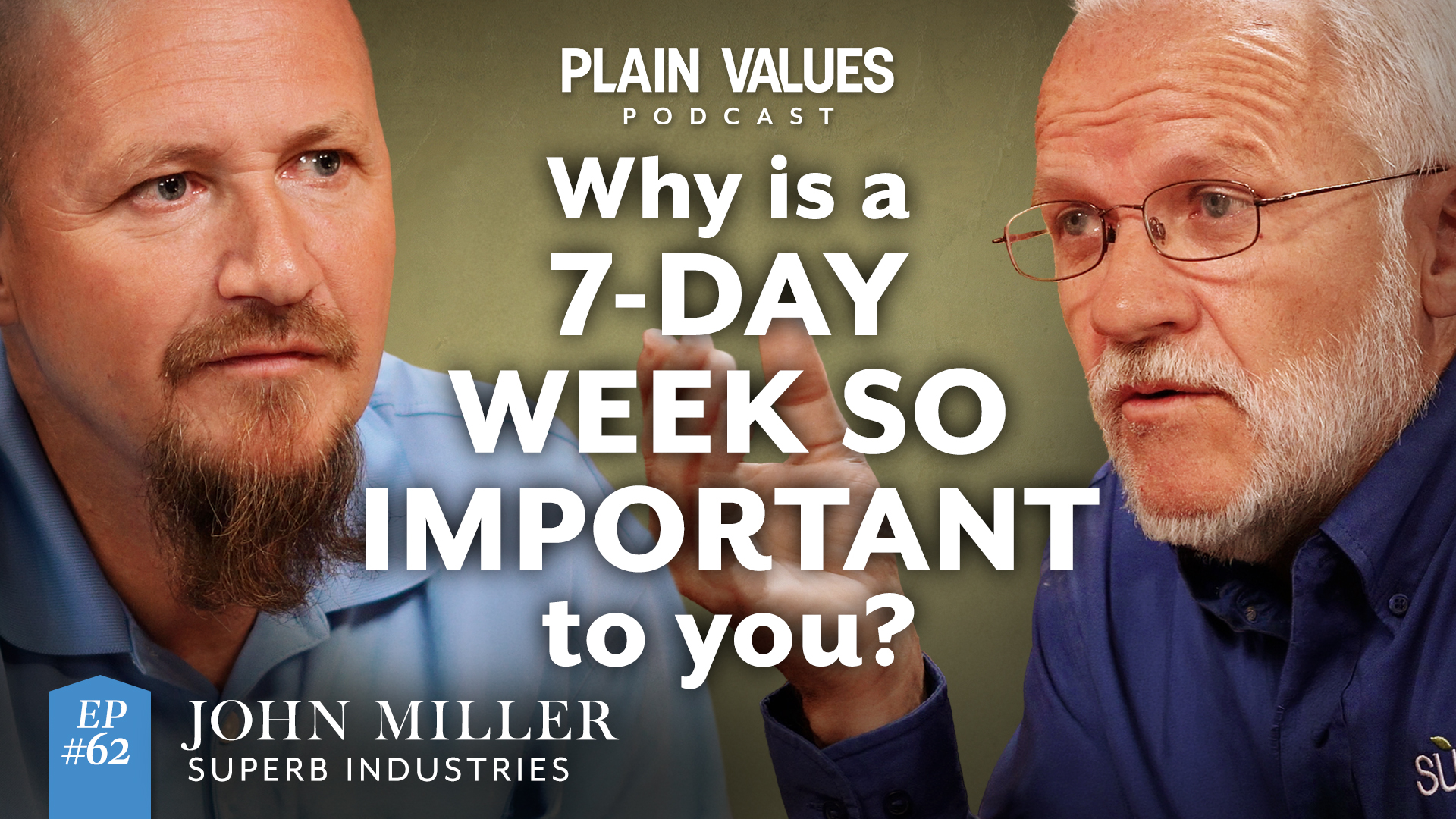
In this episode of the Plain Values podcast, Marlin sits down for a conversation spanning hundreds of years. John Miller has a few things to say about his anabaptist forefathers and the influence they’ve had on our lives today.
John and Marlin cover many topics including John’s personal life and his unique reason for why he left the Amish, how he was accused by the bishop of murdering his own son, his Anabaptist great-great grandfather’s journey to America, and a few current cultural hot topics. John also makes an intriguing connection between AI and the beginnings of the Anabaptist movement in the 16th century.
In 1837 John Miller’s great, great grandfather, Jacob Raber traded a castle in Germany for a cabin in Charm, Ohio. John himself has been to the land of his ancestors and looked upon the castle they left behind. In a real way, they gave up convenience for conviction. Their choice lives on in John today.
John grew up in New Bedford under a father who is characterised by John’s son as a strong believer in child-labor. John laughs and quips that he honors his father by passing this belief down to his own son. There’s even a picture of John’s grandson, not 4 hours old, holding a wrench ready to get to work. John goes on to say how no one could have told him at the age of fourteen, that he was not a man. Compare that to today’s masculinity.
In 1966, John watched his father successfully press his first spring for his manufacturing plant. At just five years old, John vividly remembers watching the processes and having a conversation with him about it later. John says, “the things that form us the most, are the things that are so normal we don’t even think about it.” What was just work for his father, was life changing for John and his worldview. He watched his dad innovate to make a better machine for his factory, and John himself became an innovator that day.
Today John Miller’s Superb Industries manufactures over 5 million engineered components a day and over 25 million canning lids a year.
🔵 Guest Bio and Links …
Get John’s book on Amazon: https://www.amazon.com/Good-Samaritans-Worship-Spirit-Truth/dp/B0H6HN8FYK/
Timestamps & Transcript
You and your- Mm-hmm … you and your wife got married- Mm-hmm … Amish. You were not looking to leave. I wanna hear the story again. It’s another barnyard story. And, and this is what- Mm … is wrong with part of our culture. We send our kids off and have professionals teach them, and I’m not against education, I’m against woke education that we have today because of the damage it does. But nobody, nobody professional could have ever taught- Mm … me what my dad taught me in those formative experiences, and there’s a whole- Yeah … list of them. How many kids do you guys have? Two that live and one that died in an auto accident that I caused. All of a sudden, just kind of out of the blue, he says, “John, when are you going to stop driving down the road with a horse farting in your face?” And he put his finger right into my face and said, “John, let me tell you something. Them there clothes that you are wearing and the traditions you follow are to God as filthy rags.” The question of a seven-day week, why is it such a big deal to you? I’ll tell you why. I think the best characterization of me, uh, from a theological belief standpoint is here you’ve got this guy that’s a Sabbatarian Anabaptist. Because my, my, my belief system, other than that issue, uh, I, I would have never left the Amish. Mm-hmm. I was never bothered, I was never bothered by the restrictions. So, so you’re saying that the Sabbatarian issue is the issue that m- made you leave? Yes. It is. That is- Okay … at the heart of, of why my wife and I, we, we c- so, so in a nutshell, we, rightly or wrongly, we came to the conviction that God at creation, when He said, you know, um, and, and God said, “I rested on the seventh day and, and sanctified it,” and if you look at what that means is He set it apart for holy use. And we can, man cannot make anything holy, even though God says, “You shall be holy as I am holy.” So it, by, by not observing what God made holy, um, you profane or desecrate it. And we just came to this deep conviction that now that we understand that, if you know to do good and do it n- Mm-hmm … he who knows to do good- That’s sin … and does it not, to him it is sin. And that’s what drove the decision that, you know, got us estranged from the community. Now, I, uh, I, I’m happy to share that, um, and, and this is, I mean, I’m, I’m hoping that this book will explain my heart. Mm-hmm. The book explains the rationale behind it, and it’s an invitation. I’m not… I’m just a man of many flaws, and I’m not your judge. Yeah. So I think, I think the thing that I, that I was, was questioning about the book and about the whole, about the whole concept, about everything- Mm-hmm … is this, is the, is the Sabbatarian-ness a primary issue to reorder my life? Mm-hmm. Is it actually something important enough that, that I need to think and pray through how I’m living right now? Mm-hmm, mm-hmm. Um, I, I, I think that’s where, that’s where my questioning, you know, c- uh, comes into play with the whole concept. Well, that, that, that is the question that I think every individual has to answer. Mm-hmm. Mm-hmm. Because there are those who, in the Anabaptist community, I come to find out this last year, I didn’t know this, I, I always thought it was a handful, you know. It wasn’t. At the high-water mark, it was either 20,000 or 40,000 Anabaptists, s- uh, the high- Mm-hmm … the high number is 40, the really solid number is 20. So if you look at the overall Anabaptist population at the time, uh, it’s one in five. That, that was actually living out a Sabbatarian- Lifestyle … lifestyle. Yeah. Okay. Um, let’s come back to that in a bit. Okay. But let’s go back to your, to your roots. Mm-hmm. Um, where were you born? Well, are we recording now? Yeah. Oh, I didn’t realize. Oh yeah, we’re going. Okay. So- We’re, we’re good. So you were born in Holmes County. I was actually born in Holmes County but lived in Coshocton County, but I could throw a rock from my house to Holmes County. You were right on the line. I was right on the line in New Bedford, Ohio. Okay. And huge family? A, you know, a tiny family. How many siblings do you have? So my, my… I have two sisters and one brother, so we’re a family of four, so I guess mid-size. We, um, we- my, my mom had a stillborn, so there were five of us. Um, but, um, yeah. And I think one of the things that, that in my early life really impacted me was the fact that there were only three Amish families living in New Bedford, Ohio, which m- most people today would, would, um… And New Bedford is like charm. So I had considerable influence from German-speaking, um, non-Amish neighbors. Um, and I think that has also shaped my, my ability to go back and forth, and having lived in Germany, um, so the German culture was not, uh, new to me. Mm-hmm. I, I, I put it this way, Marlin. By the time I was six, and you’ll learn this in this I’m a, I’m a very flawed individual. By the time I was six, I think I knew all the German swear words. So bring some context. What year were you born? 1961. 1961. So I had the big 65 birthday last week. You’re younger than I thought, and I don’t mean that in a bad way. I, I was expecting you to say you were born in ’55 or something like that. Oh. Uh- I hope that’s because you think I’m wise- … um, and not just old. That’s exactly. Yeah. That’s exactly right. I, and I say that tongue in cheek- … because I, I will tell you, Marlin, the, the, the last several years I know less and less. I just know a lot less than I did 10 years ago. Yeah. Um, I, I’m not trying to equate myself in any sense because I’m, I’m a young idiot half of the time. Um, but the older I get, the more I realize that I really don’t know jack- Yeah … jack squat. Yeah. And I think- Maybe that’s a good thing. I, I, I don’t know I, I think it’s a good thing, as hard as it is, but- Yeah. Um, o- one of the things, just to peel back that onion a little bit- Mm-hmm … that layer, something that, that, that I have noticed as we have gone through, you know, the last six, eight, 10 years when COVID hit, when all, all of these things, Black Lives Matter and the transgender movement and, and all of those things, everybody is so sure about everything. Mm-hmm. And everybody is an expert in something, and I, I don’t know if that’s good or bad. My, my gut, it just seems to… It just makes me uneasy that everybody is so sure about everything. Well, social media has given non-experts the platform to pontificate. And boy, they do. They do, and, and the voices that are the loudest are not necessarily true. And to just loop back, I’m, I w- I guess I want to redeem myself of the comment- … I knew all the German swear words by the time I was six, and what I wanted to add to that is these were the Lautenschlagers, the Dohmers, the Scheetzs, the Lorenzes. I knew all of those families, and, and by today’s standards, they were ordinary individuals, um, who, uh, used words that I have removed from my vocabulary. Um, they were cigar-smoking, pipe-smoking, um, blacksmith farmers, um, in the community. But here’s the point I want to make. All that may have been the case, but here’s, here’s the takeaway that the six-year-old John took away. You could count on what they told you they would do. They may have been simple-minded by today’s standards, but if they said they were gonna do something- Mm-hmm … they would either do it or die trying, and boy, would that make a difference today if we could just get back to the place where people did what they said they would do or at least try. Yeah. When you look, when you look at our culture today, you know, we’re, we’re in the middle of this Lindsey Clancy trial. Mm-hmm. All, all of the things that, you know, that I just mentioned a couple, you know, couple minutes ago, when you look at all the things that are going on, what, what, what do you think of or pray about the most? We are living in a culture today, Marlin, that has simply lost its way, and the reason we have, uh, they have lost their way is we’ve moved away from the fundamental values that were part and parcel of why my great-grandfathers came here. They came here for religious freedom, religious conviction, a broad… There was a broad spectrum of beliefs, and I, as I mentioned beforehand, I just spent, um, a week, 50 stops, 2,400 miles doing Anabaptist research, and maybe that’s a, another topic. Um, that, that, uh, we could, we could get into. But today, we are pu- we pursue, um, the here and now and try to make our convictions line up with the here and now instead of our convictions guiding us. Um, I was just with my Uncle Abe last night and went over to the Raber farm, um, where my great-great-grandfather Andreas, who came here from Germany, is buried, and there’s this castle on the banks of Lake Constant- uh, Lake Constance in Hagnau where the Rabers lived before they came here. From 1821 to 1837, they lived in this castle, had a winery and a distillery and a horse trading business. The history’s very well documented, but, but I’ve gone there I think six times now, and it always impacts me. There’s a, a bench on top of the hill behind the castle where they lived, and I’ve sat at that– on that bench at least six times, and it, it never ceases to impact me. This is a three-story 180-foot-long… Well, it’s more than that. It, it’s just… I, I can’t… It’s hard to describe it. Right on the banks. They sold all of that. They had two wash baskets full of silver coin when the auction was done, and I have the auction bill. The silver that they had approximates $2 million in today, in today’s dollars. There were 20 of them that immigrated and came to the US, and it cost $50,000 per person for the one-way ticket. Hmm. Here’s the question in my mind, and I think this is the… I, I sat there on that bench and I thought, “Would I sell everything that I own today and move to Argentina,” for example, just to pick a country, “if I would no longer be able to exercise my convictions here?” That’s what they did. Jacob Raber moved to the backside of Charm into a little cabin, and came from a castle. Yeah. And that’s… Uh, but when, when people live conviction, the convictions may contradict, and I think we need to give a lot of grace when convicted- Mm … people have contradicting views. That’s not necessarily a bad thing. It sharpens. That is way better than to have the situation we have today where conviction is convenience, where c- where you have convenience, not conviction. Well, um… Okay, before I forget, did, did your, your great-grandpa moved– did all that, was that in 1837? In 1837, Jacob Raber, his son Andreas, and his uncle Christian moved away from there, and they were accused of being thieves. Um, in 1834, um, uh, s- several of the Rabers were imprisoned for having robbed the, uh, the village winery. It’s, it’s unclear, at least with my research right now, on whether that had any basis in fact. I, I tend to think it probably wasn’t. Um, and, and here was, here was what they faced. They were the only Anabaptist family in Hagnau at the time in an otherwise Catholic community, and they leased, they, as you say in German, they, they “”verpachted”” the castle. So it was, it was a lease that was e- almost equivalent to ownership from 1821, and so th- they, they were really, really prosperous. Mm-hmm. So the, the otherwise Catholic community didn’t really like that so much, and the reason I know so much about this story is the Catholic priest, who was a prolific writer, documented, um, romantic engagements and whatever else about the Raber family. But they, they, they, they left there to come here because they could practice their convictions. So… Okay. The thing th- the, uh, f- the thing that comes to mind as you were saying that, John, was today when you look at the church, when you look at people in general- Mm-hmm … there, uh, th- there’s this tension between, between comparing… Everybody seems to be comparing themself to everybody else- Mm-hmm … because of social media and because of all that stuff. But, but rare are they that, that stand on what they actually believe. Mm-hmm. Because it, it seems like, it seems like… The verse that came to mind was the whole thing in, in the Book of Revelation where he’s talking about i- Either be hot or cold because y- you’re, you’re, y- you’re just gonna be lukewarm. Mm-hmm. I mean, if you’re not hot or cold, you’re just gonna be lukewarm, and you don’t mean anything. That characterizes our current culture. I think so. I think it does. I mean, it’s Laod- I mean, it, depending on, on who you read on the, the, the churches, the messages to the churches, that was first and foremost- Mm-hmm … a, a letter that was written to literal churches. But there’s also the idea that it also represents since epochs of time coming down to the end, and that the, the, the characteristic of the church and the culture, and, and the church unfortunately is to some extent or to a great extent, um, a reflection of the culture we find ourselves in. In Laodicea, n- you know, it, Christ says to John, “I would that you would be hot or cold.” You know, just tell me what it is. Right? I can deal with it. Yep, your yes be yes and your no be no. That’s not- Yeah. So, so you have this, you have this complex, you have this complex situation where nobody stands for anything and, and yet we’re pontificating on social media about everything and, and pointing out the faults in the others. It’s, it’s something that I really think, I mean, it’s not new- Mm-hmm … but social media has given, um, individuals who otherwise would never have been heard the ability to be really, really loud. Yep. Um, oh, man. I just lost my train of thought. Uh, ah, there it is. So when I was a kid, I worked at a, um, at, at the local IGA. Mm-hmm. You know, German Village over in- Oh, yeah … right? And there, so me and my buddies were, were the stock boys, and I worked in the deli and, y- you know, we just all hung out. And a new girl started w- working at the cashier, you know, on the front or in the front there, and she was a cute little thing, and there was a bet that basically went around who, who could, who could take her out first. And I happened to have won the bet. I don’t know why, but, but I- I can imagine … but I did. And I very, very quickly realized that I was in the middle of what my buddies were calling missionary dating because I took it, I… She, she was not, I don’t think she was a believer at the time. Mm-hmm. Okay? And I justified trying to win the bet by, “Well, maybe I can make an impact for the Lord.” Right? That never works. That never works. The whole thing of, you know, justifying things for that purpose, I sh- I, I shouldn’t say never, I’m sorry, but rarely does that work. I found my own character going south rather quickly, and here’s the point. When, when nobody takes a stand for what is right and just and true, you as a group, as a, as a, you know, a group of buddies or as a culture are gonna go which direction? You’re all gonna go south. You’re all gonna go south. The idea that, that you can rub off in a, in, in a holy direction rarely happens. Um, man, that, oh, that’s interesting. Okay, so let’s go back to your childhood. Mm-hmm. Tell me about your mom and dad. So, um, my mom and dad, my dad was born, um, just a mile south of New Bedford. Um, actually, my grandfather, um, your local people would know him as Menu Dan. Um, he in 1938 moved to the southernmost part of th- the Amish community. All the neighbors were German-speaking, non-Amish, um, people. So, so that was my dad. And then, um, my mom, uh, grew up, um, just, um, a mile away from Guggisberg Cheese in Charm. In fact, my, uh, grandfather, Ben Yoder, um, built the initial structure that became Guggisberg Cheese for the Guggisberg family. So we’ve been connected to the Guggisbergs, you know, going back, um, remember them really well. Yeah. So, um, Bedford Charm, uh, was the, um, place where both of my parents grew up. Okay. Um, what was your dad like as far as, as, as far as how he raised you guys? Was he, was he, like, super strict? Was he… Did, did he let you explore things and, and, and think, you know, about big topics? Or, like, what do you remember about your dad? So my, um, my son would characterize it this way, that my family believes in child labor. Okay. My dad worked and, uh, he expected us to work. And, and he, the, we I mean, my cousins would get to go fishing, and I had to go work. Um, I’m sorry, I have to… So your son would basically say, “Daddy was a child labor guy.” Like, he just- Yeah … you worked- And, and, and my son says that I- … that I, um, have been honoring my dad by continuing to- … the tradition. And the funny thing is my son believes in it too, because he, his firstborn, uh, was an emergency, um, C-section, and it wasn’t but… I mean, everybody’s concerned because, you know, uh, uh, the life of mom and child were at risk. And it wasn’t, I don’t know if it was an hour or two hours, certainly not more than three after this traumatic birth, he called me and said, “Dad, go back to the shop and get a wrench. I want to see if this kid can hold a wrench-” “… in his hand.” So I have this picture- … of my, my grandson with an open-end box and 3/8ths inch wrench in his clenched hand, and he was no more than three hours old. I don’t know why that’s so funny. Uh- But that is hilarious. But, but, but we- I mean, it never hurt me, okay? And, and, um, so the biggest thing my dad taught me was principle and, and work in the context of manufacturing. My dad had Crawford Manufacturing in New Bedford. Mm-hmm. So some of my earliest memories, I remember as a five-year-old walking to my grandfather’s farm just one mile away, and we, my dad had just bought a stamping press, and I remember the night we successfully made the first stamped part. I was five. H- how did he power that stamping- Oh … press? On, it was the, the, um, machine was put into my grandfather’s renovated chicken house that had a line shaft in it. Under the floor? No. Uh, the line shaft in this case ran, uh, uh, across the ceiling. So we had a flat belt that dre- drove the, um, the press. Now, the very first part my dad made was the rewind spring for a Briggs and Stratton engine. So I mean, it’s about a six-foot long, uh, blue tempered, uh, spring, and it’s, it’s interesting what drove this. You asked about my dad. My dad was an innovator. He had at that time JD Miller Engine Repair in New Bedford fixed engines, and he realized that the rewind springs in this engine was made out of a non-tempered steel and they would wear out. And they would break. And they would break. Yeah. So he was gonna make a better spring. Had no background in, in manufacturing, but he was gonna make a better spring. So he bought an old, um, press. First thing he had to do is weld the frame because it was cracked, and, um, it took two tries to get a die that was correct. And, and then we had… So how do you, how do you, h- how do you sta- run a stamping press on a flat belt? Well, what he did is we ran the press, and then we, he, he rigged a battery on a switch, and the, th- there was a roller feed that ran this out to the end, and then there was a little lever that the material would trip against, which levered, and there, there was a mercury switch. He, he had, he had a switch that when it tilted, the mercury would run a current through, which then tripped a air s- uh, solenoid valve that engaged the press to go, to, to clunk. Mm-hmm. So we would run it out to clunk, cut it off, run it out to clunk, cut it off. And that one evening, um, we made the first press, um, um, the first spring successfully. I remember how proud my dad was. But here, here’s the thing, Marlon. I remember the conversation that we had walking home that night, and the conversation went like this. We were stamping out little, uh, p- bits of steel, and I asked my dad if I could have those because I was gonna build something from it. And- Like the cutoffs? Uh, the cutoffs. And he told me no, because Danny, my three year younger, he was concerned that Danny may want to eat, um, he would get, get these cuttings into his mouth, which later proved to be true because- … Danny, Danny swallowed a hook. Um, I forget, that would’ve been a year or two later. He was playing with a, uh, hook that was, that you put in the wall, and he swallowed it, and we had to take him out to Millersburg Hospital and cut him open to get it out. Are you serious? Yeah. So they couldn’t… Like, when you say a hook, do you mean like a- I’m, I- … like a sharp hook? No, I’m talking about the, the sort of hook that you hang a glove on that was, that had threads on one end. It, as I recall, it was about an inch long, and he was playing with it, had it up above his mouth , dropped it in his mouth, and, and swallowed it, and went and told h- mom- … “I swallowed a hook.” And- And she believed him. Well, uh, she was like, it, she, she, she asked him which hook, and he told her, and then she realized, yeah, okay, there was this hook and it was nowhere to be found. Man. So they did an X-ray, and sure enough, there it was in his stomach. And they couldn’t have pumped it out apparently. They had to open him. No, they, they cut him open, went in, and, and got it. Wow. Uh, let’s go back. Let’s go back. Uh, so this is something that I find really fascinating. You, 1966- Yes … you were five years old. Yes. You remember the conversation with your dad walking home. Oh, yeah. I remember. I remember where, which turn I was on- Get out of here … as, uh, next on the road when I asked that question. It’s… And, and see, see, here, here’s what I came to writing this book. The things that form us the most and have the most impact are the things that are so normal we don’t even think about it. That, that was an extraordinarily formative experience. But, okay, hold on. But to my dad, it was just work. Hold on. What was the formative experience? That shaped my desire to make stuff better, because my dad did it. Got it. You’re saying… Okay, I thought you were talking about walking home and talking and him saying, “No, you can’t have those because-” Your brother might, might shluke it. Mm-hmm. You’re saying watching him innovate- Mm-hmm … that’s the, that’s the thing that you saw that impacted you, weighed. I mean, that- I, I, I only realized that years later. But when, but, but if I go back today and look at it, and, and this is what- Mm … is wrong with part of our culture. We send our kids off and have professionals teach them. And I’m not against education, I’m against woke education that we have today, because of the damage it does. But nobody, nobody professional could have ever taught me what my dad taught me in those formative experiences, and there’s a whole- Yeah … list of them. But that’s, that’s the first one as it relates to manufacturing. Man, there’s, there’s so many things there that I could, that I could pull on. I, even, even the concept of a one-room schoolhouse with multi ages teaching and learning and watching e- everybody, because the younger ones are gonna learn from the older ones, and the, and the older ones learn how to help the younger ones. And, and that whole concept, when we, when we basically said, “Okay, when you are five- Mm-hmm … you’re gonna go to school with- Mm-hmm … a whole bo- a whole boatload of other five-year-olds.” Mm-hmm. Now, uh, now outsiders are doing the influencing that God intended parents to do. If you remember Deuteronomy 6- Yeah … you are to teach these things to your children when you walk by the way, when you sit in your house, and when you lie down and when you get up. That is the educational model that God put forward. Yeah. And we ignore it to our own demise. Does it not point to, I mean, n- not, not to go down a crazy train, but I, but I don’t think it’s that awfully crazy, when you look at The Communist Manifesto, I- Yeah. What, when- I mean- Take the children- That’s exactly- … away from the parents- That’s exactly … and teach them. Exactly. That, that’s exactly where we are. Right. Um, okay, so five years old, you see your dad do that. Crawford Manufacturing grows. Mm-hmm. Did you go through the eighth grade and stop? Mm-hmm. Mm- And I will tell you, nobody could have told me at age 14 that I’m not an adult. Really? Well, I think, I think that’s true to, uh, uh, with, with Amish youths today. By age 14, when you leave eighth grade, um, you’re expected to carry your share of the load. Mm-hmm. And I think that’s a good thing. How, how has the 14 thing changed? How, it… Okay. Let, here, let me start over. How did we go from 14 years old- Mm-hmm … seeing yourself and having your, your peers and your, your family, your mom and dad treat you like an adult, to today we’ve got 20-year-olds- That we still coddle. Yeah. How, how did that happen? I, I think part of it, uh, I mean, affluence, um, I think has the uncanny way of, I mean, what… We, we didn’t have enough to be coddled. We- You had to go work. I, we had to go work. Um, and I mean, my, my dad in, in, in the context, uh, did pretty well, so we, we got to do, we worked really hard, but we also got to do things that maybe some other, uh, some other kids didn’t as far as travel was concerned. We spent a lot of time in West Virginia and Virginia, um, and all that. But comparatively speaking, um, I think, I think to, to a certain extent, it, it’s just driven by the fact that we have a lot more and, and kids don’t have to work as one part of it. And then the other part is, I mean, just in, in general, where, you know, we, we coddle kids. Mm-hmm. And you see, doing hard stuff brings meaning to life. And when you take that opportunity away, especially from young people, they lack meaning. I think, I think, number one, that’s a fantastic way of putting it, John. I think on top of that, I think our culture today equates hard to bad. Yes. Right? To, to where, oh, that’s- And, and hard often is bad. Well- But, but I mean, we need to look no further than our Savior to know that sacrifice, uh, Doc- It’s real … it’s real, and Dr. Jordan Peterson of late did a very good job of articulating from an academic standpoint that, you know, without sacrifice, there is no meaning. So man, I… Okay. Sorry. I mean, I’m, I’m, I’m going off- No … into maybe directions you- No, I love this … didn’t intend to go. I- John, the, uh, no, this is wonderful. Uh, I, I did just realize something. I have an 11:00. I’m, I’m supposed to be with someone at 11:00. Do you guys have a hard stop? No. You, you’re okay before? Okay. Yeah. I’m- Or till 11:00? Okay. I’m okay till 11:00. Um- So, is your dad still alive? No, he died in ’21. He died in ’21? Right. How old was he when he passed? Oh, let me think. ’21, 30… He would’ve been 83, 84. Is your mom still here? No, she died a couple of years prior. We had mom much, uh, thanks to, you know, modern medical technology. When she had the stillborn- Mm-hmm … um, the doctor made a error of judgment, and he thought the baby would naturally… She, she carried the baby not quite to full term, but pretty close. And, um, yeah, it was a bad situation. Basically ruined her, um, major organs. So she, she had 30 years of, um, heart issues and, and those kinds of things. Really? She was on her fifth pacemaker when she died. Um, she would’ve been, she was in her 70s when, when, when she died. But, um, the, the biggest contribution that my mom made was to the grandchildren. Really? The grandchildren adored her. And, and again, eighth grade educated, in public school, though. Um, it just, you know, the value of mom cannot be underestimated. And, you know, we… “Well, she’s just a stay-at-home mom.” If you want to get, if you want to light me up- If you want to light me up, go on that topic. Yeah. Well, I, I am with you 1,000%. No, I understand. Being, I know a little bit about- Yeah … your situation and what you’ve done, which I admire. Yeah. I, I… That whole thing of, uh, it, it’s… And see, here, here I go again, back to every single Tom, Dick, and Harry is a professional. Mm-hmm. Uh, a teacher is now a professional. Mm-hmm. And therefore, they tend to disqualify the mom- Mm-hmm … from teaching. “Well, you’re just, you’re just mom.” Dude, I- Why don’t- But, but, but the Torah or Deuteronomy 6, parents, parents and the priest were the primary educators, and they were to do it naturally when you walk by the way, and I think of, you know, that, that five-year-old experience and, and then there are the barn. I’ve got, uh, a lot of my education is in the barnyard. Yep. Animals and life and death and- Oh, oh, no. No? No, no, that’s not what I’m talking about. Okay. So, so let, let me give you a snippet. I think I would’ve been, I don’t have a exact marker of how old I would have been. Um, six to eight. I’m standing in the barnyard of my grandfather’s farm. I, I was the oldest grandson, so I spent a good bit of time over there. And my, my grandpa, of which I’m the spitting image, was having an animated conversation with one of his neighbors. And the essence of which was this. It had to do with someone that owed my grandpa money. And he said, and I quote, that, “If someone owes me money and I realize, you know, they’re on hard times and they can’t pay it, I’ll just forgive the debt.” And then came the but. “But if I know that someone’s not paying just because they don’t wanna or they make excuses about what, I… And I will spend twice as much to collect it as what I’m owed-” “… out of principle.” And little Johnny was standing there in the barnyard, and I don’t know, that thing stuck in my craw. So just so you know, I have adopted that principle. If you owe Superb Industries money and you just don’t wanna pay, I’ll spend twice as much to collect it. Now, whether that’s a Christian principle or whatever, I mean, I think- But, but my, but my point is- Yeah … he, it was one of these formative things. That conversation was not intended for me, right? So, so I saw that side of my grandpa. I also saw him in, in, i- i- and he was very active in, in, in the community, and we had… Their next-door neighbors, the Yoders, had several kids, uh, that had cerebral palsy. Mm-hmm. And I, I, I would’ve been eight or nine. Um, actually, I went back to the gravesite. I can’t remember now. I, I, there I have a marker that I could find. And for some reason, again, I was at Grandpa’s house when one of the girls died. And I remember my, I remember my grandfather going there and helping them and comforting them, and the practical thing he did was he said, “Look, we need a community cemetery.” And he organized the cemetery where he now is buried, um, in, in that moment. But see, these are the things that, again, I just happened to be there. But it formed me. There’s, there’s something… Man, there’s something- I, I have read, I’ve read many, many leadership books- Mm-hmm … and many- Mm-hmm … time management books- Mm-hmm … and all that crap. Mm-hmm. You know, for, for a long time there was this, this thing that talked about quality over quantity. Mm-hmm. That, that, that, basically it seems to me that they were justifying, you know, trying to, to tell people that, that you can, you can work at the office late five days out of the week if you spend a couple really good hours with your kids later. Minutes. Minutes later. Yeah. Because, because quality is over quantity, which I think is a load of horse crap. However, i- the, the reality is that those moments don’t happen in those five minutes. The moments happen when you walk by the way together. Exactly, and you are in the middle of the quantity. Quality doesn’t just ha- you, you can’t manufacture quality time. Mm-hmm. Like, people think that I … See, here I go jumping on a soapbox again. I, I don’t understand why w- how, how we got there. Like, those are the questions that- Well- … that- But, but, but- … that I wrestle with … but, but maybe we do understand. We, the United States, and I’m, I may have my year, just give me grace on whether it’s ’77 or ’78. The United States was number one when it came to education, and then we established the Federal Department of Education in 1978, I think it was established, and we have spent billions of dollars. Yeah. Billions of bureaucratic dollars. And to be sure, uh, I’m sure a good, a number of good things were done, but they’ve managed to get us down to 26. I was gonna say, we ain’t number one no more. Right. So, so fundamentally, I think, uh, to … You know, if I want … I’m a, you know, why do things work kind of a guy. And so I, I said earlier that I know less and less, and I mean that, because I’m not sure I understand it. But also, but, but, but just because we think we don’t understand everything doesn’t mean we don’t understand something, and I think it’s, it’s, it’s, it’s not that complicated. We- if you look at the family, and, you know, we, we, we went away from what family means. Mm-hmm. Left the farm. Left the farm. Um, split where people go during the day. Mm-hmm. Um, and the state becomes the primary influencer at age five- … if you believe in kindergarten, at age three if you send them to preschool. Right. And there are people who, you know, understandably, they, i- in order … Uh, uh, and, and here, here’s the other thing, Marlin. Children have an uncanny way of knowing whether or not mom has to go to work so that I can have my jelly sandwich, or whether mom is going to work and I am simply not important enough to warrant her attention because she’s got a career. And that in itself has an impact, a formative impact that probably can’t be repaired. Mm-hmm. Mm-hmm. Because the motives, the motives underneath it all- Mm-hmm … shine through- Right … to that little kid. Um, how, how is it that your memory is so sharp at … I mean, you, you, you, you sit here and you are recalling things. I, I don’t, I don’t know that I have many memories of, of when I was five. I don’t know. Um, I have memories when I was three- Do you? … that I can re- recall. But yeah, I mean, yeah, I don’t know. My father-in-law has memories of, of him at two and three years old. Mm-hmm. And that’s always, that’s always impressed me, because I, I don’t know. I’m not … I mean, I’m, I’m guessing they’re still in there. I just gotta, you know, get a path to go b- you know, to go back and find them. Mm-hmm. Uh, we have taken many, many different little, uh, bunny trails here. Uh, let me l- let me go here. Um- You’re now going to go back to the plan? Is that- Well, I’m, that’s what I’m thinking of here, yeah. Uh, what … How, how old were you when, when you began Superb? So Superb started in, um, 1986 in a two-car garage. You were 25. Yeah. Mm-hmm. And what do you actually do? Because I r- so, so let me give you the context for my question. Okay. So my dad grew up in Sugar Creek. Okay. Um, I remember going to Pop’s home place, and we would go down past this building, and I would see it down in there. And I remember thinking, “Superb Industries.” And I was not five years old, I’m sorry, but- Okay … but I remember thinking, “What? I wonder what they make in there.” And I still, I mean, I know a little bit more, but I really don’t know- What you guys built your business around. Mm-hmm. Well, those are two different questions. Um, there’s the what we produce, and then there is the, the deeper thing, the philosophy behind it. So I’ll, I’ll, I’ll answer both questions. So in a nutshell, we make right around five million engineered components out of metal and plastics a day. For what? For the automotive industry, for the electronics industry, and most recently we also make canning lids. Um, we make 25 million canning lids a, a year right now, which a lot of people think that’s a lot. It’s not. Um, we should be doing a lot more, but that’s a different question. So we make, um… But, but the, the… I, I started the company in a two-car garage when I had no money and had the audacity to name it Superb. Um, even though I was in a community that at that time would neither work for me or buy from me. I mean, what could possibly have gone wrong? That’s, that’s a great idea. It, it, it, it just- That’s wonderful timing. It, it, it, it was great strategic planning, you know? It’s beautiful. I mean, it, it, it fits, it checks all those boxes. But the essence goes back, I suppose, I mean, I, I’m just… When, when you think of what, what makes somebody crazy enough to do it, and, but when you think about it, my dad started his company in a chicken coop- Yeah … making things better. So I had this vision of being superb, hence the name Superb, not perfect. But this vision of doing, making things better. And, um, so our mission is to be superb. Or, or, uh, sorry, our vision is to be superb, and our mission is to make the world a better place one engineered component at a time. And I spend a lot of time on that because it’s very easy to get involved in the making of stuff, especially when you make them as fast as we do, and, and it just becomes routine making, um, metal parts. So let me just tell you one story. We make the world a better place one engineered component at a time. That sounds like something a- … consultant wrote, right? Except that he didn’t. I wrote it, and I mean it. And here’s why I mean it. We make, for example, contactors that go inside a thermostat for a hot water heater. Well, when I got up this morning and I stepped into the shower, the water was hot, and my world was a better place. We do that. By, by noon today, we will have made the components for over 3,000 water heaters. That is enough to put a new water heater in just about every home in Tuscarawas County. So I want, I… And every one of them has to work. Mm-hmm. So I want my people to look at the picture of, um, turning on water heaters all around, a- across Tuscarawas County, so that’s what we really do. The metal parts that we make are incidental to that. That’s how you’re doing it. That’s how we’re doing it. Yeah. Um, how did the, uh, the canning lids come to be? I got a phone call, two phone calls actually, um, and I can name the day. It was the week of Thanksgiving in 2020. I got one phone call from Mark Coblentz at, uh, Walnut Creek Foods and another phone call from the Lehmanns at Lehmann Hardware. “Can you make canning lids?” Track right back. Wait. The, they didn’t call you the same day? They called me the same week. In the same week? Mm-hmm. They called me the same week. Boy, that’s out of- Out of, out… Well, I mean, the Lehmanns was completely out of the blue because I didn’t… I mean, I knew Lehmanns, but I didn’t know them. Mark Coblentz and I, um, were skiing buddies, so, I mean, that he would call me as- Yep … you know, I, I guess- All the time … would, uh, could be expected, but they had the same problem. They couldn’t get them. Because that was in the middle of the first canning season after COVID would hit. Correct. Right. So everybody thought that there was a shortage because of COVID. That actually is not true. There was a shortage because the, um, uh, primary, and it’s no secret, Ball is the primary, uh, brand. Mm-hmm. They were moving their manufacturing from Muncie, Indiana, to Columbus, Ohio, and it went sideways on them. So they were, w- what we were dealing with was the, uh, demand was up some because of COVID, um, but it was primarily due to the fact that they had limited capacity because, um, of the move that was going on. Okay. I, I, of course, did not know that. Yeah. Um, so man. Um, let’s talk about AI for a second. Artificial intelligence. Artificial intelligence. Yeah. How, how do you see it? Well, I use it, um, uh, to, to some level. I mean, uh, not to the extent that we probably could. Uh, we are skeptical of it. I know my IT department is very skeptical about, you know, um- Putting our knowledge base of the company up in the cloud. We have s- we, we have hyper-secret projects that we work with, um- Mm-hmm … certain automotive customers, and I kind of- their concern is that it leaks. Okay? Right. Um, the- I found ChatGPT to be a great research tool. Um, it, you know, where I used Google before to find things out, I use ChatGPT because it will not only give me sources, it will, uh, kind of summarize the information. Um, also found out this past year that ChatGPT is a great editor. If you think it can do your writing for you, uh, absent content- … I mean, it, it, it absent ideas or comments, uh, content, then you’ll be, you’ll be disappointed. Mm-hmm. Um, but here’s the other thing it does. It’s a really good lawyer. I- It’s a really good lawyer, and here’s why. It can… And, and, and I say it’s really good because I’ve used it, um, because we’ve had several, uh, complex cases this last year. So you upload the facts of your case and ask it to evaluate it based on, um, case law out there and, you know, uh- It’s gonna find things that you or your attorney would not know of. Well, I hope my ad- my law firm has an even better AI, uh, that’s more specific. Um, and I’m, I, you know, I, I’m not suggesting that AI can replace a lawyer. Right. What I am saying is it can very quickly provide you with a background to have a more intelligent conversation with your legal team and, and look at the, the options. Mm-hmm. So it’s like anything. Um, it, it’s, um… So let me give me- give you the dim view and, and also the optimistic view. We’ll start with the optimistic first. Um, AI is another technological leap that w- that, um, at least at this point, provides the free flow of information and access to information for a greater number of people. And if you go back to… Go back in history, if you think of the dark ages we came out of in, in, you know, one thou- from 1000 to, say, 1400, 1500, the thing that changed it more than anything else was Gutenberg’s invention of the printing press. Yep. And there wa- on, on this Anabaptist research trip that I did, something stood out to me. Luther’s translation of the New Testament was published in 1523, and for the first time, the common man in Germany could read the New Testament, the Old Testament came a little bit later, um, in their own language. 1523. Now, you and I all know the event in 1525, in January, where Felix Manz, Conrad Grebel- Mm-hmm … um, his arguments were rejected by the Zurich council, and they were taught- told to recant, and sap- instead, they doubled down and administered the first documented c- baptism upon confession of faith. So we look at that, and it’s a historical event, and it’s im- important to us because of our Anabaptist, uh, heritage. But, but what we might miss and how this connects back to AI is by having access to the word of God at the level, and we can’t underestimate the power of language and the mother tongue that we- Yeah … you and I know that, I mean, English is secondary. Um, in three years, Marlin, it only took three years for people to read the New Testament and come to convictions that were revolutionary. Mm-hmm. And they were willing to become a bonfire, to be drowned in the river, et cetera, et cetera. And it tracks back to the ability of mass, uh, distribution of information. AI is no different in that sense. So the hopeful part of me is that people use it to access information for the benefit to make the world a better place. So that’s the optimistic view. The dim view, of course, is that the wrong people get ahold of the, the spine of AI and basically are able to tweak truth and change, you know, what it reports back to us. Mm-hmm. So that, that, that could go wrong really badly. Yeah. And then there’s, there’s the other aspect of it. What if it gets out of, outside our control? ‘Cause when you hear Elon Musk and others, I, I don’t pretend to understand the, the technology behind it because I don’t. Um- Mm-hmm … but it, there is this element of self-learning. Yeah. I drive a Cybertruck, and I n- uh, the, it, it, it, uh, it’s a way better driver than I am. And it, and it learns. Well- So what happens when AI gets beyond the point of human control? Um, that’s the really scary part. There are, there are almost… I, I w- I was gonna say, John, there’s almost an infinite way or, or an infinite amount of ways that it could go sideways or downhill really fast. Infinite is a bit much. Yeah. I, I- That’s a bit much … think that, I think that’s overstating it a little bit. It, and, and, and, and if it were infinite, I mean, we’re really in trouble. It only has to go wrong two or three ways to be really bad. To be really r- really bad. To be really bad. Um- But I would, I would just say this. This is why I think we need to be engaged, because all we need for something to really go wrong is for good people to do nothing. Yep. Yep. So let’s… Okay. Who, who was the most impactful person in your life? Oh, boy. I don’t know. I don’t know that I- I could name one person. Um, I’ve had… I mean, obviously, it, it- early on, probably my grandfather. Um, and that’s partially, um, you know, I, I went fishing with him. I… Oh, another about five-year-old memory, you know, I, I remember, I mean, he was a pipe smoker. He, he smoked his pipe from earliest memory, and I remember being allowed to drive the horse to, uh, uh, we went to Baltic to buy groceries and, and he, he had to pa- um, fill his pipe. Okay? Um, n- and I’ll get back to the, the merits of smoking here in a minute. But, but my, my, the important thing to me was that while he was filling his pipe, I got to drive the black horse named Ted that went clip-clop. Um, and w- that story I’ve told to my grandchildren, you know, I, I, I’ve spun… Y- you know how grandchildren are. You come to grandma, grandpa’s house, the, the, the contest becomes how to stay awake, awake the longest. Um, so I, so I made up these stories about Grandpa Daniel, who had a horse named Ted that went clip-clop and lived in a, a red barn, and that, I ended up having to make up dozens of them because this took time. And they loved it. They, they loved it. Um, so my grandfather would’ve been probably the most influential, um, and, and, and my dad in a quieter way, um, you know, taught me how… taught me by showing me how to innovate and to work against all obstacles. You know, he- And ju- just not give up. Just not give up. Yeah. He was very limited in many respects. Well, let me, let me give you tangible examples. So we ran everything on compressed air, um, because electricity back then was not an option. I mean, today, uh, the Amish, um, uh, workshops generate their own power, uh, in most cases. So we, we had a 371 Detroit Diesel on a huge air compressor to compress the air, and my dad figured out that there’s something called air relay logic. So instead of having, um, a program- programmable logic PLC like we do today, he did air relay logic, uh, to automate. So we were an Amish company that supplied all of the… I mean, we started out making brakes and Stratton rewind springs, and then it, it, it went to the Hoover company, the Hoover sweeper, if you remember, the cord would pull out. Yep. Well, we, we made the spring that pulled the cord back in, and later made the bulk of the, um, the, the, the, the actual reel. As a subcontractor to a big company in Cleveland, my dad went up there, and they had a whole bunch of people making these springs in a big room. My dad took that and used 10 feet along a 60-foot building to do what they had in 10 times that room with… Let me think. We had two people on that line. And they had 10, 20, 30, however many- Mm-hmm … paying them… Yeah. Yeah. Yeah. So that, I mean, that, that’s where, I mean, we do that. I mean, the, the, the earlier instance that I mentioned of making parts for water heaters, um, in 2005 our customer came to us and said, “John, we really love what you’re doing, but we’re gonna move everything to China.” That’s an interesting conversation. Yeah. I mean- … it’s like, “Thanks,” but, I mean, at least you were honest. So our family had to make a decision to what are we going to do? So we, we doubled down and said, “We’re gonna invest for the long term.” The contactors that I mentioned were being made in Mansfield, Ohio at, at the plant, and they had 13 people in a semi-automated process to make those contactors. Today, we have one person doing it. You’re saying for the water heater thing? Mm-hmm. So- So we, so we, and, and if you’ll let me finish here, so we did that. It cost $2 million to get there. Um, but one person could do what 13 people did, so those parts never went to China because when you reduce the labor component to o- one person, it, it’s almost inconsequential. So that’s how we, uh, stayed competitive. But I learned that from my dad, and my dad didn’t one day sit me down and said, “Johnny, you know, now we’re gonna talk about the strategy of how to make parts in this way.” You watched it. I watched it. You watched it. So the question I was gonna ask you was how long did your, did your customer stay in China? My customer well, we… That, not one of the parts that they were gonna move to China went to China. Are you serious? Not one of them did. They’re all here. In fact, we shipped to China. And, and that same customer is multiples of what the size of what it was. But it comes back again to- You know efficiencies and stuff that that I watched. Um So, so we, we should probably talk about the book. Oh, the book? But b- but I do have one question for you. Yeah. You, you told me a while ago at, I mean, over the last… How long have we really known each other? Three or four years? Five years at the most? Four. I’m gonna say it’s probably five years. I’m trying to remember. I, I… Well, no, it, I, I, I, I do have a marker. Um, when, when I went to see Marcus Wangard and said I wanted to start a canning festival, he said I’m thinking too small, which that doesn’t happen very often. But I’m thinking too small. We, we, we, we need to have this big thing. So it was Seed to Spoon, and we, we put this thing together in a matter of months. And, and like four weeks before we realized we have no exhibitors, okay? So, so Marcus says, “Let’s call Marlin.” So we called Marlin, Marlin, and you rescued us, right? Ma- you remember that phone call. I think that might’ve been- That was the first time we really met, wasn’t it? It, it, I’m going to say it’s the first time we engaged where- Yeah … I mean, I may have known of you, and certainly knew of Plain Values before then. Well, and, and I have, I mean, th- this happens… I, I actually really love when these kinds of stories happen, where, where people tell me, “Man, Marlin, you gotta meet this guy.” Mm-hmm. There’s usually a good reason that they’re saying that. Mm. And I had heard that about you for years before. Mm-hmm. But I never, like our paths never crossed- Mm-hmm … and it just never happened. Um, but all those years ago, you told me that you were the happiest Amish guy, you and your- Mm-hmm … you and your wife got married- Mm-hmm … Amish. You were not looking to leave. I wanna hear the story again. It’s another barnyard story. W- w- that- Yeah. Yeah. No, I, um, and, and I, and I want to be very clear about this. I don’t have the, you know, everybody has their story, and I, I don’t, y- you know, I, I don’t, um, want to elevate mine above the others. I mean, mine has its own downfalls and difficulties. Um, but I don’t have the typical, I mean, I would say may- maybe you can, maybe you can verify this for me. I think a, a lot of people who, for whatever reason, leave the Amish had felt constricted, felt, um, um, you know, maybe not able to do the things that they wanted to do, and all of that, and I, I never felt that. I was rather, and still am, um, and we’ll get back to that, very appreciative, how can you not be when you sit on the hill and look at the Raber estate, of the, the price that was paid in order to get us here. Um, so, so I, I don’t, and, you know, I mean, well, maybe it was because my dad was so innovative and he, there was, he, he never violated the tradition. He just worked around it. And he was, was innovative enough to, well- Mm-hmm … uh, can’t have electricity, so you have air, air electricity. And, and automated in a way that he was able to compete with educated minds in Cleveland. Mm-hmm. Um. Mm-hmm. So by the way, why am I blanking on your wife’s name right now? Susan. Susan. I was gonna say Sharon, and I knew that wasn’t right. Um, how many kids do you guys have? Three. Three. Two that live and one that died in an auto accident that I caused. Can I ask you about that? Yeah. How, how did that happen? What, what do you mean that, that you caused it? I backed over my one-year-old in our driveway. Really? Okay. Um… I have read, I have heard, I’ve talked to many, many families that have lost, uh, children. Mm-hmm. The percentage of marriages that survive, it’s pretty stinking low. Yeah. How, how did you and Susan, you, y- y- you guys are married f- 45 years … I was gonna say 40 or 50 years, right? Mm-hmm. How did you guys deal with that? I mean, oh, my goodness, John, I’m, I, I’m, I’m imagining the, the finger-pointing could happen at, I mean, all of those things. All, I, I, I can’t even imagine what I’m not thinking of. Yeah, we were accused of murder. Are you serious? By my bishop, former bishop. It was, it was the most horrible thing that could have possibly happened. Um, so, so you asked a question. Um, we got some really good advice from our pastor when that happened, and he was a guy who is kind of a man of few words, and he walked into our house and he said Two things. Don’t blame each other, and don’t blame God. And we could have. My wife had changed the brakes on the car, and the two kids, the other two, two older ones, um, uh, were there, and she brought the little one-year-old out ’cause he wanted to be with the rest of the kids and set him next to the car, and I, and thought I saw him, and I didn’t. And then I backed up and backed over him. Um, so I could have easily blamed her, and she could have easily blamed me. Um, so we, we just never went there. I’m sorry. Yeah. I… What year did that happen? ’86. So he, yeah, he’s… He? He would’ve been- And, yeah … he, he would’ve been 40, uh, 42 this year. Mm-hmm. How has that, how has that grief changed? Um, over the years, uh, the way, uh, um, I guess the advice I would give people who… I mean, I do have, uh, some messages out. I’ve written about this topic, so if, if you… I think the titles are something like Time and Chance. If you Google it, I think it’s still available. But the, the, the advice of not blaming each other and not blaming God, um, I think is fundamental. And then the second thing, um, is to reach out and to help others, um, in similar situations, which my wife and I have done a good bit of that. Um, but I mean, uh, there’s, we, we, we have some work to do as a family on this issue. Um, I’m in the process of, um, starting a cemetery, and my intent is to move his remains. And just in our conversation with family, we realized, eh, there are some things that aren’t settled here that, that we still need to work through. So, um, it’s just something that, that doesn’t go away. Um, and but, but it’s 2 Corinthians 1 is the famous thing about the God of all comfort and, and to go out and comfort people. What I’ve learned, Marlin, is this. If you can, if you can come alongside someone that has experienced a tragedy in those first several days and just kind of get them pointed down a positive path, it, it, it can be very helpful. So that’s what I’ve tried to do. And as, as you know with having special needs children, until you’re in a situation, it, it… My, my story is traumatic, but it’s not unique. I mean, there, it, it happens way more, way more times than, um, you would think. Yeah. Um, I had a good friend sit there and tell me the story of losing his son, Ryan. Mm-hmm. That was in, you know, that was in, it was a motorcycle accident. Mm-hmm. And he said, he said, “Marlin, time heals absolutely nothing.” Yeah. Everybody says, “Oh, time, time heals all wounds.” Or, or, you know- Yeah. Right … people say that. And he said, “That is such a… Time heals nothing.” Right. Um, wow. Um, so let’s, let’s come back to the book for a little bit. Mm-hmm. Um, like I told you before I think we started, I’m not very good at this sort of thing. Uh, but what, what is the overarching point of The Good Samaritans? So, like anything, it has a story. I, um, and, and maybe I need to… And I’ll, I’ll just wrap back to where I think you were going before we got distracted. Uh, which, I mean, it is… You, you- There’s 1,000 squirrels in my head, okay? So Well, well, the… I think you need to title this podcast The Distracted Podcast, you know. Um, so you were asking me, you know, why did I leave the Amish and all that, and it’s another barnyard encounter. Um, I, we were newly married, had two children, um, and I had a little side hustle selling, um, selling, uh, plant food that was organic. And I managed to sell a couple semi loads of it to Bob Schlabach in Sugar Creek, who you may remember. At the time, he was one of the large corn farmers. And so about middle of the summer of 1984, the agronomist came down to visit big customers, see how things were going and, you know, all that. And the regional rep is sitting with Bob in the milk house, um, talking, you know, shop. Susan and I are sitting in the, sitting in the conversion van, uh, with John Siege was his name. He was a Czechoslovakian agronomist. Living and practicing in Leamington, Ontario. So we’re sitting there making small talk, just having a conversation, and, um, all of a sudden, just kind of out of the blue, he says, “John, when are you going to stop driving down the road with a horse farting in your face?” That’s what he said? That’s exactly what he said. That- And, and, and my reaction was exactly like yours. I thought it was the funniest thing that a person could have said. Oh, that is hilarious. Okay. Uh So he, he was a big man. He didn’t think it was funny. You laughed. I laughed just like you did. And he did not laugh back? No. This was a 1980s conversion van, with the bucket seats, remember? Yep. He sat back in his bucket seat and reached down for the handle and spun around. Yep. And he put his finger right into my face and said, “John, let me tell you something. Them there clothes that you are wearing and the traditions you follow are to God as filthy rags.” He got serious real fast. Oh, he got real serious. And he said, “You are going to answer to God one day about what you did on this earth, not what some minister told you to do.” Where did this come from? I have… I, I, phew. You tell me. No idea. No idea. And I was flabbergasted. Never thought about any such thing in my life, but what stuck, what stuck with me was this notion that we have direct individual accountability to God, not… And, and again, community is important, church is necessary, all of those things, because you can take this to the wrong place, too. So that’s what I remember, and I remember well. And it’s funny how you laugh, because that’s exactly my- … it was g- uh, uh, exactly my reaction. What did Susan do? She sat there. He, she was… I don’t remember what she did. Because he pointed to me. He didn’t, didn’t point to her. Um, so the, the, the, the guy wrapped up the conversation and we went home, and we got home, and Susan and I were like, “Did you hear what he said?” “Yeah. We get to answer to God.” “Hmm.” I mean, it, it shook us to our core, this, this concept of accountability to God. Not what, you know, somebody would tell you, “Okay, just do what I said. You know, just do what I said, what I say, and everything will be all right,” type of thing. Right. So we did, we came up with a radical idea. Simple one, but radical. We said, “You know what? We’re going to read our Bible and just do what it says, and then we should be okay with God. And just to be safe, we’re gonna read the German Bible.” Okay. Because, you know, everybody knows they read the English Bible, you know, it, it, uh, can be a problem. That idea turned out to be really radical. Reading the Bible and just doing what it says, you know, however fraught it might be. Yeah. But, you know, the Bible says, “If it is written,” you know, when you think about it, “it is written” are the three most powerful words in the universe because Jesus, in contrast to Eve, when Satan came to him and attacked his identity, he simply, he didn’t take the bait, he just said, “It is written.” Mm-hmm. So we went to what was written, and we got no further than the second chapter of Genesis, and we had a problem. So you’re going through creation- Mm-hmm … and you come to chapter two. And it said, “God rested on the seventh day and sanctified it.” And I mean, I knew, I mean, somehow I knew that story before, but, but the problem was we had made this kind of pact that we would do what it says, and then we realized we weren’t doing what it said. So can I- Yeah … stop you for a second? And this might be a dumb question, okay? But when I look at my calendar, I know that I see Sunday first. Mm-hmm. Mm-hmm. But in my head, I think I’ve always thought that Monday is the first day of the week. Where, where am I off? Am I just simply ignoring the fact that Sunday is the first day of the week? Maybe. Um, the, I mean, the, I, I, funnily enough, I get into the, uh, the, the office conversations. I was at a business meeting, a business dinner, and the owner of a $500 million company asked me that exact same question, and he said, “John, how do you know that the seven-day cycle that we have, this, y- you know- Right … is, is actually the same as back creation?” Right. And it turned it… We, we, we started that conversation, went to midnight. We, we wore it out. And, and I’ll answer you, um, in the same way I answered him, because it… And, and part of this, this is something I just recently thought about. You know- The month is connected to what celestial body? The sun. No, the month. The month of the year. The Earth. Isn’t it the rotation around the sun? The moon. How? Month is so called… Well, the month, uh, a, a lunar month approximates 30 days. Okay? And then you have 31 days and, and all of that. So- New moon. Yeah. I got it. Yeah. I’m sorry. I got it. Yeah. So you have a new moon and, and, and- To full, and then back to new. Correct. Our friend Marcus just made a lunar gardening calendar, and he made a really interesting point. Okay. He made this lunar gardening calendar, and it messes with my mind the same way you mentioned it. If you, if you plot it out by the moon, it creates a wh- entirely different structure. It, it, uh, Sunday, Monday, you know, Su- uh, Saturday and Sunday come down to… He, what he did is he created a, a 12-mo- month lunar- Mm-hmm … calendar just, you know, from new moon to new moon, and then put the Roman numbers in and the Roman, uh, days of the week. And, and instead of this calendar that you and I have been looking at th- this whole time, where it’s neatly, you know, um, whether it’s Sunday or, or Sa- uh, Saturday, first and the last day, you, you have this grid you look at. The lunar month, all of a sudden now Sunday goes diagonally across the page. Mm-hmm. And it’s like, huh. Right. I can- Um, but so, so the, so the month is connected to the moon directly. Mm-hmm. The year is connected to the sun because- Right … you, you take your trip around the sun once a year in 365 days. And then the days are connected to the sun. You know, God said, on the first day, God, uh, said, “Let there be light,” and there was light. Sure. And then evening and morning were the first day. And, and here, here… Have you ever thought about the fact that the biblical day starts at sunset? I think most people, um, think about it that way. Or maybe you don’t. I see you look puzzled by it. The biblical day starts at sunset. The, the ne- So- And, and the reason we know that is Genesis says, “And evening and morning were the first day.” The first day. “And evening and morning were the second day.” But, but m- we, we can get into the, the whole particulars, but, but this, this tells you something about the mind of God. Rest comes before work. Who does that? Nobody. Nobody. Nobody. God gives us… We rest on the first part of the day before we work on the daylight part of the day. And this is what I told… Do you know, do you know what calendric element, I, I don’t know what, what part of the calendar is not connected to a celestial body, moon, sun, Earth? What part of the calendar? So you’ve got… I mean, all the seasons are tied to, to the Earth’s axis, the 23 and a half degrees. Mm-hmm. And where the sun is positioned across the equator. Right. And then you’ve got apogee and perigee and all that. That, those are the- I don’t know what that means, but- Well, those are w- like, the closest point to the sun- Yeah, yeah … and the furthest away. Okay. Those are your, your, uh, your summer or, or your spring and your fall solstices. Right. Or I think they are. Well, it’s the, the, the length of the day, and then there is the closeness of the sun, but now you’re getting into astronomy that’s above my head. But- So is there a part of the calendar that’s- Yeah … not tied? I would say probably not. Mm-hmm. Is there? Yeah. There is? Yes. New Year’s Day. I have no idea. Well, that, that too. But, but, but that too, but you know what’s not connected? The seven-day week. So when he instituted… Okay, and, and just for fun, I’m just gonna throw this out there because this fascinates me to no end. He tied, w- which by the way, I’m a literal creationist. Okay? Mm-hmm. Like, I think, I think a 24-hour day- Mm … was instituted on, on day one. I believe that too. Okay. And that, that’s another discussion. But here’s my question. Yes. Here’s, here’s the thing that I love to, to think about. Mm-hmm. He started creation with the light- Mm-hmm … and the water. Mm-hmm. But there’s no sun until, like, day three. Mm-hmm. Right? Mm-hmm. And then the stars were fourth and all that. Fourth day. No, the stars were in the same day as the sun and the moon. Was it? Okay. And they were kind of an afterthought. Yeah, it was a total afterthought. Ah. It’s not an afterthought that- He created- He created stars also … also. Right. It’s like trillions of stars also. Mm-hmm. Um, how did he time out day one and two before there was the sun for the Earth to go around? I, I find that fascinating. Mm-hmm. Uh, so now back to your question. I’m sorry. The, there’s the squirrels again. What was your question? So what i- so we, we just all agree that the moon is the- The week … the week. The week. I’m sorry. Yes. Why does, why does a week have seven days, Marlin, instead of 10? Wouldn’t that be more convenient to have 10 days in a week? You know, w- wouldn’t, wouldn’t that be… Or say eight days or, you know, pick a number. What, what- But why did he pick seven? I, I don’t know. Or- I, I, I tend to think that all the things that he does point back to his character somehow. Mm-hmm. Uh, is, is it just the fact that seven is his number? Well, I mean, isn’t 10 his number too? I mean, or 12 because there were 12 tribes of Israel. I mean- And 12 disciples and all those. I, I don’t know. Yeah. That’s a great question. And, and I, I was talking about this CEO who I have no idea what his belief system is, and somehow he- And, and I’m, I’m in the presence of eight German engineers around the table. That’s hilarious. And so I’m confronted with, with this question about, you know, the… His specific question was one you… How do we know that the first- First day is the first day and the seventh day is the seventh. Right. Um, so I, I came back to him and said, “Well, why is the seven-day week not connected to some celestial body?” And, and here, here is, here is the interesting point. Do you know… I mean, you have variant calendars. You know, you have the Jewish calendar, you have the Gregorian calendar. Before that, we had the Julian calendar, which got all messed up, and you had to add 10 days. And, and you have the Islamic calendar, and, you know, you make a list. Right. Um, do you know what they all agree on? The seven-day week. Uh-huh. Do you know that the, the Communist Chinese and the Russians, who are atheists, all of them have a seven-day week? Has anybody ever actually questioned it or, or fought to change it? Yes. The, there have been cultures, I think the Aztecs would have been one, and maybe the Egyptians, that came up with a better system, like a 10-day week. Do you know what all the cultures have in common who adopted a non-seven-day week calendar? Mm-mm. No clue. They’re extinct. But the re- but the remarkable thing, the remarkable de- thing about the seven-day week is this. The irony is unbelievable. The most atheistic cultures in this world, by virtue of having a seven-day week, in their practice acknowledge the existence of the Creator because it is only in creation. He created the seven-day week into being- Mm-hmm … by virtue of the example of his creation and his creative act. That he set the example. Right. Mm-hmm. So boy, that is kind of funny. That, yeah, there’s so many ways in which an atheist has way more faith than, than you and I. Oh, it takes a lot of faith to be an atheist. That, it takes an unbelievable amount of faith to do it. Um, so, so let me go back to the question I asked you, I think, at the very start. Yeah. What’s that? How or why is the question of a seven-day week, why is it such a big deal to you? Um, I’ll tell you why. And, and, and this is, this is, this was a… And, and again, if it don’t matter- Right … I’m okay with that. Right. But, but here, if, if you read, if you go to Genesis 2:1, and God, you know, before that he said he looked at everything that he had created and made, and it was all good. Yep. And then on the seventh day, he rested from all that he had done. And, and if you, if you look at the Hebrew, the Hebrew word for rested is, uses the word Shabbat, the verb form of it. Mm-hmm. So that’s, okay, maybe the good Lord was a little tired, if, if that’s possible, after creating all this stuff for six days. I don’t think so. But in any case, he rested. So that’s one component of, of Sabbath or Shabbat. The other component is that he sanctified it and made it holy, okay? Um, so for me, this, to, to violate that period of time that, you know, to be precise, begins on Friday evening sunset to Saturday evening sunset, that’s the way it is. To me, the understanding and conviction I came to was that that is a period of time that God has set apart that is holy. We can’t make anything holy. Mm-hmm. So I can only choose to either keep it holy, as the commandment says, or to desecrate it. And I’ve been tested, Marlin, on that issue as, uh, as recently as two weeks ago, when presidents of companies made mistakes in ordering parts, and when they, when our sales team told them we were not gonna work on Saturday, they didn’t think that was a great idea of customer service. Right. But my son and grandson went in after the, the sunset on Saturday night and made the parts for them. Um, so, so the, God said it was good, and if you know to do good, he who does it not, to him it is sin. Um, so we came to the conviction that we needed to observe this time, and it’s been, it’s been unbelievably enriching. Now, here, here’s the remarkable thing. The, the, the Ten Commandments, you know, you shall- Love the Lord your God … you shall, shall, shall, shall, or shall not. Right. Mostly shall not, right? And then you come to the fourth command. What does it say? Oh, man. The fourth? Uh- I’ll help you out here … okay. Thanks. Remember the Sabbath day to keep it holy. Yeah. Of all, nobody disagrees with all the other ones. We insist on forgetting it. It’s the one commandment we’re told to remember. Do most people not just assume it’s Sunday and just- Yeah … not ever think about it? I, you, you, you, yeah. That’s what I’ve done. Yeah. And, and, you know, if you, if you research that point, the Catholic Church changed it from Saturday to Sunday, and actually, I mean, he, this is, the, there’s some pope or a priest on the record on this to, to say, “You know, the Protestant think, the Protestant think they, they broke away. Mm. They still keep our Sabbath, and we had the authority to change it, so they’re still worshiping on the same day.” They, they actually, they actually, uh, lay claim to that and, and in my recent research, I mean, the re- the… I, I, I want to say this. I, I made my decisions because I had made this inconvenient commitment of reading the Bible and just doing what it said. My advice- … if you’re a principled person, don’t ever do that, because … you know, it’ll be the most inconvenient, transformative thing you’ll ever do because- Yeah … there’s a whole bunch of things in there that are challenging, and, and to be- Yeah … sure, I fall short many times, and that’s why we need a savior. But, um, I have forgotten now what I was going, going to say. What was I going to say? Well- Okay … were, w- were you gonna go to, I mean, just the whole story of, like, how you got there? Well, I mean, it, it was… So we started looking into this, and then I read this thing. If you, if you go to, if… Remember you said the, the stars and the moon were an afterthought? Mm-hmm. Well, they’re not, because in the same context, it says that these were given as signs, uh, days, and seasons, signs, and season, days, and years. Mm-hmm. We, we read that in English, and it’s kind of like, “Okay.” Right. But, but what the Hebrew actually says is they were given for moedim, moed. Well, moed is connected to the moon, but moedim means, a better English translation is appoint- times appointed. So, so the moon and the sun were given to be able to observe them, um, and make an appointment, and, uh, now that was later c- codified or w- w- with Moses, the festivals, the… If you go to Exodus, uh, here, here’s, here was another formative scripture. First one was Genesis chapter two, and then we got to Exodus 31. And it referred to Sabbath in plural. Okay. “These are my Sabbaths,” plural. What does that mean? That was my question. Whatever does that mean, that there is more than one? And, and I’ll just, uh, I’ll leave you, I, I, I will menti- make this point. It says that, “It shall be a sign between you and me that you shall know that I am the Lord your God.” And I thought, “Here we’ve been inventing.” And the Amish, um, lest you think I’m singling them out, we have traditions. We create all kinds of identifying things that are a sign. You know, which team are you for? And you wear a Ohio State jersey or whatever. God identifies this Sabbaths plural thing as a sign between you and me that you shall know that I am the Lord your God. How big is that? Sounds like it would be a big deal. And then, it, there’s a generational impact. There’s a promise in there that those who would observe these appointments, He, there’s a generational commitment and blessing on His part, and I, and, and do you know that the Jewish people, at least in my studies, are the only people that I know of that have maintained their identity, their cultural- Mm-hmm … familial identity for over 3,000 years? I don’t know of any. I don’t think there are any others. And do you know what the… I mean, they, and they, you wanna talk about tradition, extra-biblical tradition- … go to New York and- Yep … and, and look at the black hats there. Um, but the one thing that they, they, they kept was the Sabbath, and it, it, true to form, and this is, I… That, that the Bible is the literal Word of God is something that I, it, it, it, it’s just, it just keeps proving itself over, and over, and over again. Mm-hmm. Um, so yeah, so you, you look at that, and you, it’s like, “Whoa.” So then we, um, had to make a decision. Do we change our, um, customs to align with what I read in the Bible, or keep doing what we were doing? That was a very difficult decision Back to the commitment you made. Yeah. Um. So to the book the book, it was, it’s been on my mind for a number of years, and I was in the hospital in Germany, and, and that kind of creates focus. Um, and then after I was through my procedure, I had couple of weeks, and I’d been thinking about this, this idea that I want- I wr- I, I wrote this for my evangelical friends. A lot of evangelical friends. Love my evangelical friends. Um, and I thought I would, um… So I wrote it. It just, it, it came out. I mean, it just, I had tons of time, and it just, you know, you know, it just came out. Um, and conceptually, it occurred to me that the Sam- the, that modern evangelicals, to a, a large extent, mirror culturally the Samaritans of Jesus’ day. And here’s how. The Samaritans have a storied history going back to when Rehoboam and Jeroboam split the kingdoms. Mm-hmm. And Jeroboam said, “You know what? If I let the 10 tribes go back to Jerusalem to the festival of the seventh month, they’re going to end up going back to that.” So he changed, think of this, he changed the feast of the seventh month to the eighth, just moved it by a month, and then, um, created his own worship routine. And the Bible says that he devised this in his own heart- Mm-hmm … and it was accounted to him as sin. And ultimately, the northern tribes went into captivity. And then we had a problem. The problem was the Assyrians brought non-Israelite people into the land to keep it. They, they, that’s how they conquered people. And these non-Israelites had a problem that the lions would come and tear them apart, so they said, “We do not know the God of this land, so can you send a priest back?” So they send a priest back to teach them about the God Yahweh. So they worshiped the God of Israel, along with all kinds of other gods, and came up with this syncretic religion. And so that’s the background when, when Jesus… And this is instructive, too. No self-respecting Jewish rabbi in Jesus’ day would dare walk through or go, would stoop to the level of going to Samaria. They’d walk all the way around it. Jesus went right to the well and met a woman of ill repute in the middle of the day and, you know, that’s where I draw this story from. But The Good Samaritan, which is the title of the book, the Good Samaritan did what the priest wouldn’t do and what the Levi wouldn’t do. He was very hospitable- Mm-hmm … charitable. Um, and it occurred to me that evangelicals reflect that. They’re the most charitable, loving, um, people. Um, you know, if I’m in Chicago and get mugged, I want a good evangelical to show up because he’s gonna take me to the hospital. So I wr- wrote it for my evangelical friends, and it’s, I mean, the reviews say this. It’s written as an invitation to consider whether, you know, kind- kind of, I guess, go back to what I did. Just read the Bible and do what it says. But an invitation to consider what part of our worship liturgy- Mm-hmm … has no basis in scripture. So it’s both an invitation and a challenge, and it’s doing pretty well. It’s in the top, today it’s in top 2% on Amazon of all titles. I, you know, this goes back to what you and I were talking about early on with everybody is so sure. I- I’m not sure if anything John did. I, I’m not sure if anything John did. Here’s what I’m sure about. It is written. Okay. Where I was going- Yeah … was how many things do, do we grow up thinking, assuming, and not really ever questioning? Why is today S- since we’re on calendar, why is today Su- Tuesday and tomorrow is Wednesday? Everybody knows that it’s Tuesday or Wednesday. Why, why, why is that? It’s just the way it is, right? Mm-hmm. And if there’s one thing I learned in writing this book, I mean, I, the, the author probably learns more than anything else. I didn’t know this going in. If there’s one thing I learned about the book, writing the book, is that the things that form us the most are the things that are so normal we don’t even think about it. It’s exactly my point. Yeah. You made it better than I could’ve. I, those are the things that I actually really enjoy pulling the thread back on or thr- pulling the thread on because it’s, it’s in those normal things that you’ve, like when you dig in and you c- like you actually study it and, and try to figure it out, that you learn something new because you just assumed X, Y, and Z before- Mm-hmm … and you never really, you know, looked at it. Um, man, oh, man. Okay I’m gonna go to a lightning round because it, it is after 11 o’clock What is a lightning round? Uh, I have a handful of questions that I’m just gonna fire at you. And I, I get to- Okay … answer it in one sentence? You, you get, like, a word or two. Oh. Okay? Now. Now that’s hard. Okay. Okay. All right. Uh, actually, not. Okay. I mean, you can expound on this however you want, but I have a handful of questions- Okay … I’m just gonna fire at you. Uh, if you could chat with one biblical character other than Christ, who and why? Joseph. I want to understand how he dealt with the fact that he was in the dungeon and the, and it is written, “And the Lord was with Joseph.” Yeah. No kidding. I mean- Yeah. What’s the best kids’ cereal of all time? The best kid what? The best kids’ cereal of all time. I don’t know. Okay. My, my mom made granola. So. Done. Uh, what advice would you give your 16-year-old self? Oh, boy. I have said so many times recently, if I could go back and be 24 again and know as little as I do now. Why 24? I don’t know. I, I, I, I don’t know. Well, that’s how old I was when we had the barnyard encounter, 24, so I think that’s probably why. Um, I would be, I hope I’d be even more convicted by the Word of God. I hope I would be, um, maybe more careful in how, how, how I articulated it. As I look back, you know, you, you get pushed- Mm-hmm … into a corner. Mm. And we had a parade of people through our home. That adversarial, I’m sure I could have handled that better. Yeah. Um, if you could pass one timeless tradition, a family tradition, down to the next generation, to your grandkids- Mm-hmm … what might that be? Family prayer. Family prayer? Mm-hmm. Here’s an, and so the, the other book I’m working on is, uh, called Structure Shapes Culture. The predominant structure that shapes our culture is time, the rhythm of time. The second thing is language, and, and let me just tell you something. We lived all over the world, including Germany. My, both of my children, and, and I’m leaving out, I’m letting out a family secret. I’ve never talked to my kids about this. Okay. So one thing we did was made sure that we preserved Pennsylvania German. We wanted them to be able to speak to their grandparents in the mother tongue. So, and it wasn’t that hard to do. We sat our children down when I got my job at Chrysler, as we realized that two-year-old Maryanne was defaulting to English, uh, s- part of the time. So we sat them down and said, “Look, when we’re alone by ourselves in the home, we’re gonna speak Pennsylvania German.” And we had to remind them a couple of times, “No, we, we speak German,” but then it just, it just, I mean, to this day, I mean, last night Maryanne called Susan and they were yakking away, she’s in California, yakking away in Pennsylvania German. So then we had the tradition, maybe it’s not a tradition, that in the evening we would all kneel bedside and say our prayers, and, and we’d start with me, Mom, and then the kids. All together- All- … at the same bed. At the same bed. Mm-hmm. Um, and we would, you know, what- whatever, I mean, the whole session might have been 10 minutes. Mm-hmm. Um, but, but here’s the thing. Like I said, I’ve never talked to my children about this. Um, somewhere along the way, Susan and I started praying in English. Really? You had been praying in Dutch. Yeah. And somewhere it changed. Why did it change? I don’t know. It just happened. Okay? Um, but here’s what didn’t change. So Dad prays in English, Mom prays in English. Daniel’s next, and he prays in Pennsylvania German. Hold, hold on. That’s not what I thought you were gonna say. You, you prayed in English. Correct. Susan prayed in English. Mm-hmm. And Daniel still prayed in Dutch? Mm-hmm. What? Now finish your story. So, and it was one of these things that we never talked about it. I guess it was so natural that when you pray to God, in the children’s mind, I might, I have a point to this. The k- ‘Cause I have another question. Yeah. The, well, okay, um, well, ask the question and then I’ll come back. Did you and Susan notice and talk about it the first time it happened? That we s- that we switched? Yeah. No. I mean, it just- You didn’t … it, and, and I, um, maybe it was just because, I mean, church services were in English and, and, and all of that, and, you know, we at some point- Um, spent more time in our English Bible than our German Bible. I, and, and, and maybe it was… I, I don’t know, it just happened. But, so, so I’m trying to remember. I mean, it, it, it, our children would’ve been five, six years old when, maybe four, five, six years old when, whenever we switched to English. And, you know, we continued this until they finally were out of the house. Through their entire teenage years, kneel down to pray, and they do it in Dutch. And the, the epiphany came to me not that long ago, and I thought, “I think this is significant.” And here’s why it’s significant. When my children knelt down bedside to speak to their heavenly Father, they defaulted by nature to the family language. To this day, when Daniel just… One of the reasons I… Daniel called me moments before I walked in here, and default to German or Dutch- Mm-hmm … whatever you wanna call it. Right. But I, uh, but, but I thought, I, I, I really thought that was significant. John, I hope you know how much I enjoyed this and how much I appreciate the time. Um, I have a feeling that we could keep going. It’s now 20 after 11. Well- I have a feeling we could keep talking each other’s ear off. Oh, oh yeah. We, we- … we could. But, uh, the, the, the, I, I’m not going to ask you for the statistics of the people who started watching this and ended up watching the whole thing because I’m sure most people get bored long time before. I’m sure they do. No, I, uh, you know, I, I often, I often wonder what, what is going to happen with our culture. We have, we have lost the ability to maintain focus for more than 30 seconds. I know. Three seconds, I think, is the statistic. But, but, but actually pod- It’s ridiculous. I know, but podcasts, long form podcasts have encountered that because- I know … we’ve gone to an ever shorter segment. Yeah. And yet, you know, people, I guess, driving down the road listen to, uh, uh, conversations, and I think the reason- Yeah … why is this is not what I expected to talk about when I came here. Well, good. I’m glad. But, but it’s, but it’s, um, I’m happy with what we talked about. Um, but I think- Yeah … one of the, one of the reasons podcasts have been successful is they’re raw, unedited, n- un-fake. Yeah. That ties into AI in more ways than- Mm-hmm … we can shake a stick at. Um, John, thank you. You’re welcome. It’s been so good. Thank you. Uh, really quickly, tell people where they can find the book. You can, uh, get it at local bookshops. Your gospel bookstore has it. Gospel Shop has it here in the Sugar Creek area, but the easiest way to get it is go on Amazon and, um- Yeah … just search for The Good Samaritans. Like I mentioned, uh, it’s, today I think it’s in the top 2%. Last week it was in the top 1%, so at least from a ranking standpoint. Uh, of course, there are 40 million books. Yeah. And mo- most books on Amazon never see the light of day. Yeah. So it’s had some traction, and I hope, um- Good … it’ll shed some new light on a few pe- for a few people. Thank you again. You’re welcome.








Leave a Reply