
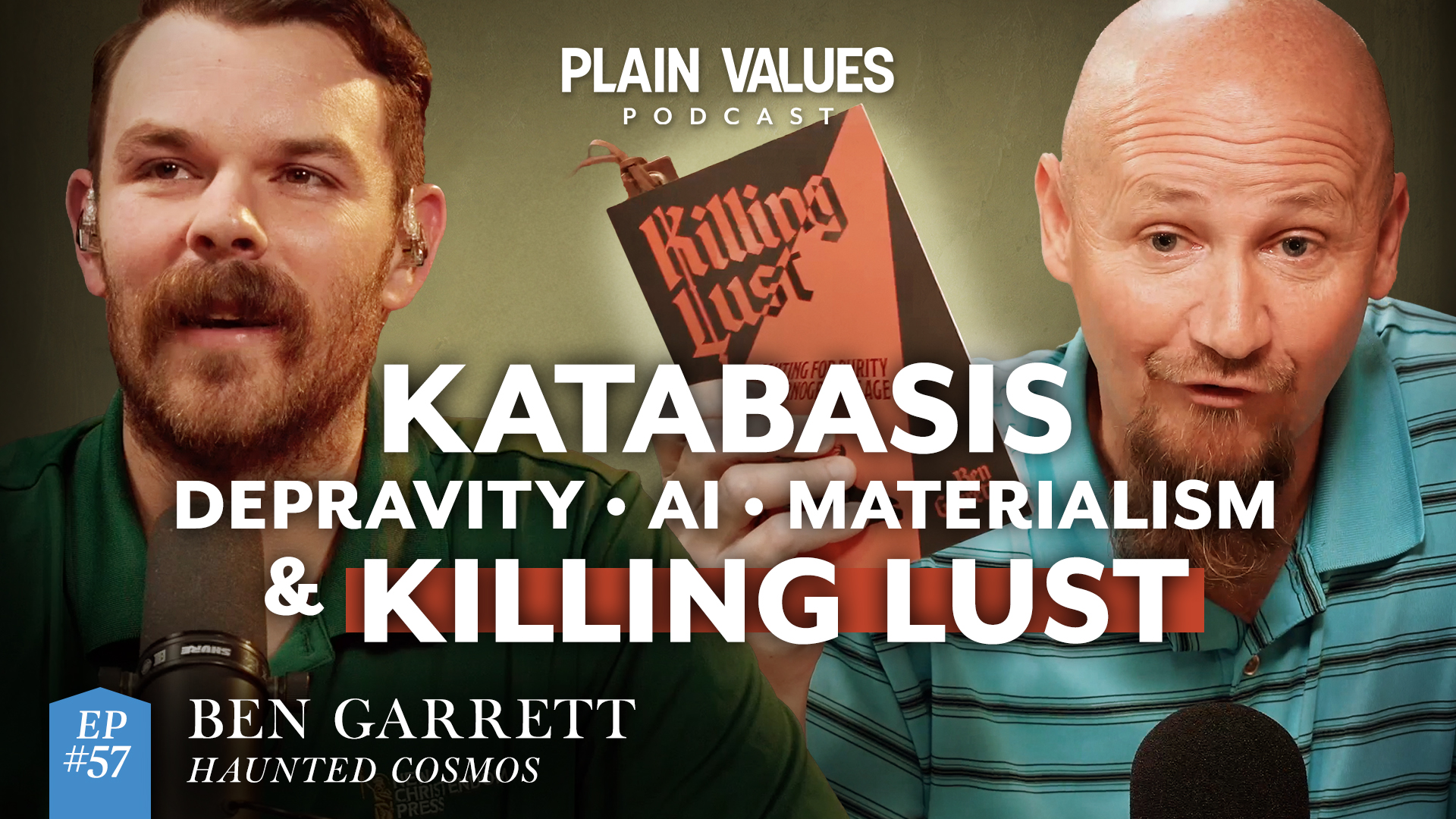
In this episode of the Plain Values Podcast Marlin meets Ben Garrett, a woodworker (though he failed at that), pastor, writer, podcaster, and bigfoot researcher. Ben is the pastor at Refuge Church in Ogden, Utah, the co-host of the Haunted Cosmos podcast, and author of the book Killing Lust: Fighting for Purity in a Pornographic Age.
Ben begins the episode talking about how he came to Utah and Refuge Church. They discuss childhood, family, and parenting. Then they jump into the deep end discussing the spiritual realm, Bigfoot, mythology, scary stories, and what these should mean to us today.
What do we gain by talking about scary stories? Ben answers this question first by cautioning against an unhealthy fascination with the ugly. He goes on to say, “When you (in a measured and sober minded way) are exposed to the ugly, it gives you a greater appreciation for the beautiful. When you make adequate eye contact with the terrible lie, it gives you a much greater appreciation for the truth.”
Ben talks about “the cababasis of man.” The descent of man into death or the underworld, and the ascent out. In stories, the character grows and learns something that could only come through that descent. Ben and Marlin also discuss materialism, AI, and Ben’s newest book, Killing Lust.
This book was written to be worked through alongside a mentor. Not an “accountability partner” or group of guys on the same level of maturity as the addict, but someone further along the journey who can call them out when needed. Anyone who struggles with lust, if they are in church, already has all the tools they need to overcome this sin. This book reminds us of those tools.
They close in discussing Milton’s Adam in Paradise Lost and how even after his sin, he may have been the most joyful man who ever lived because he saw Christ and tasted salvific grace.
🔵 Where to find Ben:
@tompawnbadil (X)
newchristendompress.com/killinglust
thehauntedcosmos.com
Ben is the senior writer at New Christendom Press, Co-host of the Haunted Cosmos podcast, and Pastor at Refuge Church in Ogden, UT.
Timestamps
00:00 – Intro (Shoutout New Christendom Press)
04:19 – Ben’s Childhood, Career, and Ministry Call
08:38 – Fatherly Memories: Paintball and Go‑Karting
10:51 – The Most Impactful Person in Ben’s Life
13:10 – The Blessing of Godly Parents
16:42 – Marlin’s Amish Background and the Supernatural
20:01 – Why Are We Drawn to Scary Stories
28:35 – Katabasis: A Descent to Death
31:00 – Human Depravity and the Gospel
32:48 – An Argument Against Materialism
38:43 – Ben’s Take on AI
44:20 – Are We in Huxley or Orwell?
46:22 – “Killing Lust”
53:56 – Best Kids Cereal of All Time?
54:11 – Which Biblical Character Would Ben Chat With Over Coffee?
55:33 – How Would Adam Have Dealt with Regret?
58:11 – Ben’s Advice to His 16-Year-Old Self
59:26 – How Can We Pray for You?
Can I pull a shameless, uh, plug for New Christendom Press? Please. I mean, if, if you don’t mind. As I’ve been preparing- Look at that … I, I… Ben, Ben, what a beautiful mug is that. It’s, it’s fantastic. I know, they’re awesome. Whoever did that, whoever did that little molded thumb thing- Yep, yep … genius. It’s genius. So member of our church, member family of our church, is, uh, Taste and See Ceramics, and I have, I have two of their mugs actually in my office. I love them because of that thumb thing. The thumb thing is genius. It’s… And then, and then it has a pouring spout- Yeah, yeah, yeah … or whatever you wanna call it. I- The li- I- … ramp. Right. It’s a ramp. That’s a perfect way to say it. It’s great. Um- Yeah … it’s, it’s so good. Um, if you are good, I, I tend to just kinda jump right in. Oh, yeah. If you don’t mind, I, I’d, I’d like to start by, by reading something from this old book right here. Heck yeah. Um, chapter 12 is, is absolutely the strangest thing to ever happen. Oh. It’s probably one of my favorite chapters in everything you guys have d- have ever done. That was my… That’s, like, th- favorite chapter of the book by far that, that I got to write. Ben, so, so, so for the listener, for the, you know, for the viewer, uh, th- I, I’m, I’m just gonna read one paragraph, and I want to do this so that you get an idea of who we are talking to and the mind behind it. I, I, I think this is such a beautiful thing. All right, here we go. “In him, there are two wolves. The one barks that he has right to think her cruel. In fact, she’s so cruel that she’s lost the right to be his mother at all. She is not fit to hold authority over him. The other, which at the moment is much weaker, whimpers that he knows what he should do, that his mother doesn’t actually hate him, that she has only ever done him good, and that should be enough to do it. But in a matter of seconds, the first wolf’s howling has drowned out the latter’s whimpers, and so when the mother’s back is turned, the kid quickly snatches a cookie and sprints for the door, only his untied shoelace catches under his other shoe. He trips and slams into the floor, sending cookie crumbs all over the fesh- over, all over the freshly swept tile and landing with a hard thud on that elbow he had just scraped earlier that afternoon. Poetic justice.” “The world is not just stuff.” Ben, I, I hope you know how, how much my wife and I enjoy your work, and, and the, you know, from the books to the podcast, this, this beautiful tension that you guys seem to hold in a really beautiful way where you’re talking about life and death, y- you know, the supernatural, like, the biggest things in, in, in all of the universe, and at the exact same time, you don’t take yourself too seriously. You do things like the soap commercial. Yeah. Yeah. Dude, we, we have laughed our, our, our back ends off. Um- Thank you … you guys just do a really great job. Thank you. Um, so that is, that is who we are actually having the honor of, of, uh, of chatting with for, you know, the next bit. Um, Ben, tell us a little bit about your, your childhood, your family, your parents. Give us, like, a 30, you know, 30,000-foot view of, of how you grew up. Yeah, I’ve… I, I would love to. I mean, and also thank you very much for having me. It’s a, it’s a real honor and pleasure to be here. That, those are very kind words, and, uh, I’m, I’m incredibly humbled to know that our, our little piece of work is, uh, is doing some, some good and, and blessing other people. We certainly have been blessed by it, so, so thank you. Um, yeah, I w- I was, uh, raised in Georgia, um, born and raised in Georgia in 1995 to Christian parents who, uh, I love very, very much and who have loved me very well, um, all of, all of their days and all of mine. Raised in the church, uh, Southern Baptist Church. Excellent church, by the way, uh, Hebron Baptist Church, shout out, Gwinnett County. And, uh, yeah, was raised… I, I had one biological sister, and then, um, my, my parents did end up getting a divorce when I was, uh, in fifth grade, and so I have some step-siblings as well, and we all have a, a good relationship, which is very fun. But kinda, m- you know, grew up doing the normal thing for a, a Christian kid in that area, which was to go to a, a private Christian school with the same name as the church, actually, Hebron Christian Academy. Great school. Uh, my mom still teaches there, actually, after, I think, 28 years, and, um, maybe more now. But, uh, anyway, graduated from there in 2013, went to college for exercise science, switched majors to mechanical engineering at the University of Georgia, graduated there in 2018, having, uh, uh, married my wife a year and a half prior, and then we ended up just moving out to Utah because we thought, “Why not? There’s mountains out here, and that’s pretty cool.” And, and before we left, we were like, “Well, we’re Christians. We need to make sure we find a church that we can land in there. Like, does Utah have Christian churches? I don’t know.” Turns out they do, and we found Refuge Church just by doing a Google search and listened to some sermons, and we’re like, “That, it looks great.” So, uh, we landed here, and, and then, yeah, the rest is history. It’s been a wild eight years, more or less, since then. And, you know, I went through the engineering department at, uh, Hill Air Force Base and was a contractor for a company there for a while, went through COVID, ended up resigning, tried to start my own woodworking company, utterly failed, and fell flat on my face, was just a terrible businessman, one of the worst, probably one of the worst to ever do it, to be honest. Uh, like, can’t emphasize enough how terrible I am as a businessman, or at least was. And around that same time, um, that all coincided with, with what I felt to be a, a really genuine internal call to ministry. And I was already a deacon at the church at the time. Um, and then, I don’t know, just got, got more involved with the church, and so I was around the pastors here, I was around, uh, Brian Sauve, and I was around Eric Conn. We were already close and, and got along well with each other. I was around Dan Burkholder a lot. And Eric needed an executive assistant. He brought me on. It was a massive mistake. If I’m bad at business, I’m even worse as an administrator. Um, but through the rigmarole, we discovered that Brian and I really like talking about Bigfoot together, and so we started doing Haunted Cosmos, and I was ordained to the pastorate a few years ago, and now we’re here. So it’s been a, a wild ride. Wow. Um, that, that whole thing about enjoying Bigfoot, that, i- in, in this little office, uh, the, the topic of choice is typically the Nephilim- Yeah … more than Bigfoot, but you and I both know it’s effectively the exact same thing. I was gonna say, like, but, you know. Depending- Yeah … on who you ask, maybe you repeat yourself. Yeah. V- very true. Um, do, do you have, do you have a f- like, a favorite memory of growing up? Hmm. The memory that, that tends to come back the most to me is, uh, when… I- it’s kinda like two things. It- both of them have to do with my dad. Uh, when I was y- really young, I wanted to get into paintball, and my dad was like, “Cool. Let’s, let’s get you into paintball.” And so I waited for Christmas, and he got me a Tippmann 95, uh, everyone’s first paintball gun, I think. And he was like, “All right, if you’re gonna get into paintball, you need to know what it feels like to get shot with a paintball gun.” And so in the middle of December… And, and by the way, like, Georgia’s really hot, but when it gets cold, it’s pretty bitter cold ’cause it’s so humid. So we went out Christmas morning, and it was cold. He was like, “All right, take your shirt off,” and- … took my shirt off. He’s like, “All right, turn around.” All right, turn around. Shot me about four or five times in the back, bareback with a, with a paintball gun in the freezing cold. And, uh, that was a good memory that I have of my dad. He’s a good man. Um, and then the other one is, uh, w- we, he got me a go-kart one year, which was awesome. Like, every kid’s dream. And we would go to this backwoods place, and again, it was really cold. And no one else was there, ’cause it was so cold and boggy. And, uh, and so we just got the whole place to ourselves, but it meant we were going through these bogs and going up and down, and, and the go-kart kept getting stuck over and over again, and I was soaking wet, and I was freezing cold. He was soaking wet, and he was freezing cold, and he would, uh, uh, he would have to get out and push the go-kart while I was flooring it to get out of the bogs o- I, I mean, probably two dozen times over the course of an hour. He had to be absolutely miserable, man. Uh, but he sure didn’t let me know it. He, he was just happy to, to be there with me. And, and then the Subway sandwich that we had after that was probably the best thing that I’ve ever eaten. Um, there’s, there’s so many good memories that I have growing up where I did and with the friends that I had. You know, there’s neighborhood stories I could tell. That’s such a good question, but those are the, the first two that came to mind. Awesome. Uh, you and your wife, which… Do you mind if I ask what her name is? No, yeah. Her name’s Ally. Okay. Uh, how many children do you and Ally have? Like, seven or eight, right? We have, we have three and one on the way. Brian is the one that can’t stop having kids. Uh, he- He’s got seven. And, uh, but, but we have, we have three, and really four, but, but one of them is still, still cooking. So we’re really happy with that, and hopefully, Lord willing, th- there will be more in the years to come. Yeah. Yeah. The quiver is, is not full until it’s full. I’m not sure what that means, but- Yeah, yeah … yeah. So- I guess it’s not full until you just stop having kids. That’s true. Yeah. Um, so who, who was the most… Up, up to, up to this point, Ben, who, who was the most important and the most impactful person in your life? Ooh. I think my mom- We might be into the deep end of the pool here. I’m sorry. J- just- No, no, you’re good. I, I think my mom. I think that my, uh, m- my, my mom… So when my parents got divorced, my mom was the, the one who primarily raised me. I mean, we, we all had a great relationship still. Like, I, I s- saw my dad as much as I could, but, you know, it just is what it is. I lived with my mom. And so she really raised me through the teen years, through a lot of formative years primarily. And, um, that, that woman is a pillar of faith, uh, an absolute pillar of faith. I, i- especially now that I’m older a little bit, I can look back and see how hard her life must have been. And she had already, you know, gone through some things in her own childhood and teen years, and, th- that was really hard. Uh, she lost her mom when, when she was young. And, uh, I don’t know, the way that she carried herself, every passing day, I, I feel like I get more respect and appreciation for her example and for her specific example of faith. Just a… You know, you talk about the, the gift of faith. This woman has it. And she certainly passed down to me, I think, a, a strong inheritance of the fear of the Lord, um, the love of the Lord, faithfulness, cheer, prayer, all of these things that really never… You know, you never graduate from them being the most important parts of your life. Um, and, uh, yeah, I’m, I’m really happy to say that we, we have the relationship that we have. It’s very good. And, uh, yeah, she… I, I think as I’ve gotten older, she’s become more and more the, the most impactful person that I’ve, that I’ve ever met. Yeah. Uh, that’s- You know, the older I get, I’m, I’m 49 now, and my dad passed away about 15 years ago at 55. Mm. And the older I get, man, I… What a massive blessing to have godly parents- Yeah … who, who sincerely aim, you know, to, to, to do the best they can to, you know, shepherd, you know, their children to, to the fold. And yeah, man- Very- … every day I, I long to get home more and more, so. Yeah. Yeah. What a blessing it is. Um, if I can- There’s something about the, uh, the parent that, like, when you have a good parent, uh, it, it’s pretty hard for anybody to outdo that in, in your life. There’s this, I can’t remember if it’s Macbeth or Hamlet, but I think it’s Hamlet, and his d- he’s talking about his, uh, his dad is dead, and he says something like, you know, “He was a king, and he was a man. Take him for all that he is. I shall not look upon his like again.” And I, I think that that, I th- you could say that about a mom, you could say that about a dad, you could say that about a lot of people, but there is something to be said for just, you look at your parent, and they’re oftentimes just ordinary people. But when they’re faithful in their, in their ordinary parenting, you’re just like, “There, there will never be another person like that again.” Yeah. Do- It’s pretty special … do you think that’s because we know them so well? Or, or is it, is, is that just an inherent thing that a child has for- Mm … a parent? I think it’s both. Um, I tell parishioners a lot, we, you know, we talk a lot about child discipline and raising a child well in the pastoral office. And something that God did that was very kind, uh, is charge the parents to raise their kids in the nurture and admonition of the Lord, but then he kind of baked this thing into nature where for a large part of the, of the child’s life, um, son or daughter, they look at mom and dad and they just think, like, they’re the best people ever. You know, like, da- Yeah … dad’s Superman and, and mom is, is this angel. And, um, so there’s that natural affection that’s really strong, and you wanna cultivate that. So I think that has a lot to do with it. But I also think, you know, when, when you do family right, uh, when you do marriage right, when you do parenting right, it’s kind of, uh, I think the most potent fulfillment of the promise that, uh, that we get in 1 Corinthians 13 that, you know, someday we’re gonna be known even as, or, or we, we will know as we’re fully known. Um, and, and the foundation of that is the, the full manifestation of divine love that, that God has for us and that we will finally recognize, um, and get to fully walk in. I think that family is the, the best example of that that we get on this earth when it goes right. Yeah. And then obviously when it goes poorly, it is a beautiful representation of our brokenness- Yeah … and the fall and all of it. Just how bad it can get. Just how bad it can get. Yeah, exactly. Oh, man, that’s, that’s well said. Um, so let me give you a little bit of context, if, if I may, just 30 seconds, for, for where Lisa and I, my wife Lisa, and Isaac and Matt, who you just met. Mm-hmm. Um, the culture inside the Amish community, wh- which is where we are, uh, I grew up Amish, the, the, the Amish don’t, I don’t wanna say that they deny the, the existence of angels or demons, but they tend to, they tend to ignore it- Mm-hmm … a little bit. And, and here’s what I mean. Um, after we got married, my wife was a teacher in the public system for eight or nine years until we adopted our daughter, and she was instructed, she was told, she, she was in a unique situation, Ben, where she was a first grade teacher in a public system, a public s- uh, you know, public district, but she had 13 to 15 little Amish first graders. Wow. All Amish, no English, you know, no, n- no English kids, non-Amish kids, and so it was a really interesting, uh, dynamic. Well, she was, she was made aware rather quickly that in any and every resource that you use, be it a book or any- anything, you must remove a, a photo or a reference to, to, to any and all snakes. So she would have to, I, I know. Huh. I know. She would have to go through the books that she was using to teach a science class or, or to do whatever, and she would literally have to cut out the photo of the snake or the, you know, the copy written about the snake. So as, as Lisa and I have, have grown up in this, um, it, it presents some interesting things and, and some interesting situations w- where, where we, we believe there’s more to life than just materialist. You know, we’re not reductionist, we’re not materialist in any sense. Yeah. And to, to be able to, you know, to jump into a podcast like you, like you guys have, where you’re talking about the supernatural, you’re talking about the things that, that you wonder and you hear stories about, it is absolutely such, it’s been so mind-opening if, if, eye-opening maybe I should say, for us. Um, because it’s not, it’s not something that we were- Made aware of and, and encouraged to think and talk about- Mm … if that makes sense. Sure, yeah. Um, when Isaac and Matt told me about the Haunted Cosmos podcast, we jumped in. Lisa and I listened to High Strangeness on the High Seas. You know, obviously, I believe it’s your first episode, right, or what? Oh, yeah, the, the, the gateway drug, yeah. Oh. Well, you, you stinking hooked us something awful. And the… So, so this is… I’m sorry. Ben, sometimes my, my mouth can’t keep up with my, my goofy brain. I think I have ADD all over the place. I can, I can relate to that. When we- when you jumped into Atlantis and the Richat Structure, I, I don’t know how to say it other than it seems like there was a bit of a f- y- like a switch that was flipped in me, where I started to kind of piece together the, the pieces, I’m sorry, that’s horribly redundant, um, that potentially the y- you know, the Zeuses and the Poseidons and all of those are actually based on real things. Yeah. Like, there’s truth behind those legends, you know, the Greek mythology. And I, I’m, I’m telling you, I’m telling you, you, you, you totally hooked us, and we can’t get enough. Um, we are still pansies. I will freely admit we’re still pansies. Uh, my wife does not like scary stories- … nor do I, really. Uh, but w- we’re, we’re all in on the tamer stuff. Yeah. So, um- No, praise God, man. That’s awesome. It’s, it’s been a lot of fun. So, so here- Ever since the, the, like, Richat thing, it’s funny you bring that up. Like, that whole idea was the same for me, where I was like, “Wait a minute, wait a minute. Like, maybe, maybe Poseidon was real.” Uh, and that’s been, like, my whole… You can ask anyone in the office. Like, that’s been my whole personality intellectually for the past four years. That’s pretty cool. Um, what, what is… Why… I’ll ask it like this. What do we gain by, by talking about the, you know, the air quotes, you know, scary stories? What is the draw behind the scary stories in life? Uh, I think… Yeah, that’s a good question. I think that there’s a, a major draw that is not good. Um, it’s funny. Like, I, I think maybe my answer has changed a little bit from what I would’ve said, you know, even three years ago. Um, there’s some of it that’s just morbid curiosity, you know. Like, people want to… People love mystery, uh, and they think they love answers. They don’t, they don’t really love answers. Uh, a- at least not, not all answers. But they really love unanswered questions a lot. People love leading questions that never, ever get answered. Aristotle does this in his Physics. He begins his Physics with a riddle that he never solves, and everyone loves it. You know, everyone loves Aristotle for that. Um, and I think that there’s something that is, uh, th- that man knows instinctively about the corruption and the ugliness, the privation of the world that has come about through sin, and I think that it fascinates us. I think that we’re interested in that because it’s part of our own history. It’s something that we did or that we consented to. You know, like, uh, Satan tempted, but Adam and Eve consented to the temptation. We introduced this corruption into the world and this curse that, that came upon ourselves, and a lot of the st- and, and a lot of it is stuff that even as Christians, we don’t, we don’t fully grasp the depth of it. We don’t fully understand even the nature of sin. Um, like, the origin of sin and the nature of sin is something that systematic theologians still look at, and they’re like, “Yeah, we just… Like, we don’t know. Like, I can’t search out the fullness of God’s wisdom.” Um, and so I think that when you look at a scary story, quote-unquote scary story, you’re looking at something that, um, in its essence includes that privation and corruption somewhere. Otherwise, it wouldn’t be scary, right? It may be, uh, terrifying in the way that God’s holiness is terrifying, but it’s not scary. It’s not horror, you know. It’s terrible. Um, and so I think that there’s a morbid curiosity there at a really basic level, where we see that and we think, “Oh, that, that has something to do with me. Um, and so I’m drawn to that, but I’m still curious about it. I don’t have all the answers.” There’s also something to be said for just the, the masochism of man. I think that we, uh, tend to take some sort of weird comfort and pleasure in pain and sadness, and so I think that stories that… or, you know, music, any form of art, uh, that it, that is willing to make full eye contact with the pain and the sorrow of the human condition is something that we’re even drawn to in an unhealthy, masochistic way. Um, but I do think that there could be something good there, too. I think that… And it’s not just the cautionary tale thing. There’s that, you know, “Oh, look at how ugly it can get, so beware.” Yeah, but I think there’s something deeper. Um, I think that when you, uh, i- in a measured and, and sober-minded way are exposed to the ugly, it really does give you a greater appreciation for the beautiful. Um, when you, when you make adequate eye contact with the terrible lie, it gives you a much greater appreciation for- The truth. Um, and this is something that is required in conversion. You know? Like, if someone’s gonna become a Christian, they have to have faith, but that faith is expressed in repentance for sin, and repentance for sin presumes an awareness of what sin costs, which is the blood of the God man, um, and what sin caused, and that’s, like, the ugliest thing ever. You know? And, and, and I think that there is something there where you, you can’t, you can’t properly love what is right and good and true and beautiful unless you have seen with, with, uh, with clear eyes the alternative for what it actually is. So, like, there’s the morbid curiosity, there’s, there’s, there’s masochism, and, and we shouldn’t, we shouldn’t do that. That’s not good. That’s not a good affection. But there is also the look at what the Lord is redeeming creation from. You know, creation groans for the revealing of the sons of God, and I think that, l- like, okay, but why is creation groaning? Oh, it’s because it’s hurting. It’s because it’s in pain. It’s because it’s dark. It’s because it’s ugly. It’s because it’s horrifying. Uh, and it’s all my fault. You know? And, um, and so that gives me a much greater appreciation and affection, and maybe this is just subjective, but it does this to me, and I think it can do it for others, too. It gives you a much greater appreciation for and a recognition of the, the intricacy of the story God’s telling, and therefore, the incredible beauty that is contained in the story God’s telling. Um, all of the great stories include some kind of katabasis, this, this descent into the fullness of death and darkness. You can look at the myths and, and they all include this. And it’s there where something happens. You know, in the midst of the descent, there is change occurring. In, in, in the realm of the dead, there is change occurring, and then in the ascent out of it, there’s change occurring, too. But, like, the development of the character and the arc of the hero and the virtue then and all these things, like the resolution doesn’t take place until that katabasis and that descent into what is terrible and horrifying to mankind. All of our existential dread is actually faced, and then, then you can go upwards. Um, and I think that horror stories in a, in a way that, uh, can be used for good can help with that, um, and can even make sure that in, in, in the interest of sanctification, the katabasis is kind of ongoing, where you’re never, again, you’re never graduating from the basics of I, I, uh, you know, but for mercy, there go I. I am a sinner saved by mercy alone, and the more th- the more I actually, you know, recognize that, the better it is for my, for my faith, uh, and, and my appreciation for the Lord. This is why we do Good Friday sermons. Uh, like, what is the worst thing that ever happened in history? The death of Jesus Christ. What is the best thing that ever happened in history? The death of Jesus Christ. Um, we do Good Friday sermons or homilies, whatever, because we, we actually need to regularly, uh, sit in the ashes of the world that we burned down and look around and see the waste and see the terror and say, “So, so what’s the way out again? ‘Cause I, I would prefer not to stay here.” Um, but you have to actually go there first. I- Ben, oh, man. Okay. So, so three thoughts, okay? Number, number one, uh, to my shame, can you define what katabasis is? I, I’ve, I’ve never heard that word. It’s, it’s great. Oh, yeah. Uh, katabasis is just, it’s a Greek word, and it means, I don’t know what, like, the technical definition is per se, but it means descent to death. That, that’s more or less what it is, some kind of descent into the underworld. So, you know, you see this with, uh, with O- Odysseus. He goes to Hades and he meets Achilles, and, and it’s a big turning point for Homer’s kind of Iliad and Odyssey, uh, bifecta because h- he meets Achilles, and he’s like, “Hey, Achilles, you did it. You did it. You, you, you were the greatest warrior. You died young, in war, doing your thing, and now everyone will remember you.” And Achilles looks at Odysseus and says, “I would rather be the lowest serf to the cruelest master and live a long life than be here.” Um, and then in The Aeneid, you get Aeneas going down into Hades, and he sees, he sees the terror of it, but he also gets to reconnect with his father, um, uh, Anchises. And by interacting with Anchises, he sees actually he was right to leave Dido because building the walls of Carthage isn’t what he’s for. All of these souls that are to come are depending on him going to Rome and building the walls of Rome. Um, and then he goes up and that’s what he does. And, uh, you see this in, in a lot of stories, though, and the katabasis can be negative. The katabasis can be a descent to death that leads to death. You see this in stories like Blood Meridian- Mm-hmm … where the kid, um- Yeah … he, he’s separated from the Glanton Gang. By the way, Blood Meridian is a really, like, brutal book. Uh, you probably shouldn’t read it, but it is- Don’t … my favorite. It, it- It is my favorite American book. Favorite book? I- it’s my favorite American novel, yeah. Okay. Um, but, like, you probably shouldn’t read it. However, it’s an example of neg- uh, uh, a, a negative katabasis, a true villain. He, he’s separated from his crew, and he goes into this near death, and he, and he encounters this burning bush, and it’s his last chance, and he just leaves. Um, so he, he goes through the katabasis and comes out worse for it, actually, on the other side. But there’s always, in all the great stories, some kind of descent, and it can be literal or figurative, where the hero is faced with the choice. Um, and it’s only in making eye contact with death and mortality and darkness that he’s able to make that choice. Yeah. I, I have a, I have a close friend who, who often says, “Marlin, it is, it is only when we really look at what the Lord saves us from that we can appreciate what He saves us into.” Yeah. And, and, you know, obviously, the promise of heaven to come is ridiculous, but it has implications to right now as well. Yeah. And it’s, it’s, it’s a fantastic thing. And then the oth- uh, just the last thought is Lewis said something to the effect of, “You cannot slander human nature. It is worse than words can describe.” And it’s, we, we are more sinful than we can even imagine. Yeah. And, and, and, and how, how quickly, how quickly we forget how disgusting we really are. Mm-hmm. It’s, and, and obviously there’s people that would push back and say, “Oh, but, but y- y- you know, don’t, d- don’t go down the worm road, and don’t,” you know, all that, which is fair. I- Sure … I mean, I, I understand it, but, you know, yeah. It’s, I mean, it’s a thing. The, I mean, there’s a reason why the preacher in Ecclesiastes says that the, the wise go to the house of weeping. Um- Amen … and I think part of that is this, you know, you see this trend in, in church fathers and really saintly people- Where may-maybe they don’t commit, you know, hopefully less and less those big visible sins that everyone can see but part of being sanctified means that the smallest sin that you notice would w-would tear you up, you know, and would make you so sorrowful, um, and, and would make you flee to the throne of grace. How much more so the sins that you never even catch, the sins that you forget or don’t see? Right. Right. Ugh. Uh, okay. If you, if you met a materialist in a dark alley, how would you convince him that there’s more to life than, than the brain? Hmm. Well, you know, okay, you can go the, the classical route. Um, what is the number six? Okay, the number six is an idea that lives in the realm of pure intellection. It does not exist materially. Um, representations of it exist materially, but it doesn’t exist materially, and yet we all know that it’s there. Um, science cannot by its own rules prove itself or the laws of rationality and logic. It presupposes those things. You can, you know, you can go kind of this classical route. But I think, I, I think also it’s, uh, being really quick to admit that I will be incapable of convincing him of anything. Um, but that in itself can actually be something that causes him to make eye contact with the truth that material isn’t all there is. Uh, if material was all that there is, then I should be able to, if I know the right ones and zeros, I should be able to convince anyone of anything because I have unlocked the mechanics of the materialistic mind, and I- And you can see it. Yeah. If it’s a computer, then I can program it. I can program it. Um, if it’s not a computer, then only he can be convinced of something in himself. Uh, even if he has the greatest debater and the most compelling story and the most compelling evidence in the world, only he can be the one to say, “Okay.” That means that there’s something underneath the basic mechanics of synapses and electrical impulse that, um, that eventually causes him to give his yes or no to something. And so I, I, uh, you know, I’ve, I’ve talked to people before ab-about this, and I think that I’ve left them really, like, disappointed. I, I’m not, I’m not a, I’m not really prof- I’m not a, I’m not a professional debater, that’s for sure. I’m not a philosopher. Uh, but I do know that th-the only reason they’ve come to that conclusion that materialism is all that there is, the only reason that they’re capable of coming to that conclusion is because materialism is false. Um, if materialism was it, then they would not be able to come to any conclusion whatsoever. Their conclusions would be dependent on the rest of the material universe, uh, because it all has to be a, a self-contained positive feedback loop system, and we don’t see that. Um, and consciousness is the thing that we, th-th-that, like, trumps that and throws a monkey wrench into that whole machine. Yeah. It-it’s, it’s, to me it’s always been pretty funny that the evolutionist, you know, will, will look at the randomness of the universe within a structured box that have rules, and he can think and he can work inside that. And, and it’s, it’s effectively this y- you know, huge dichotomy that he’s saying it’s random and yet he can operate inside. I- that’s funny to me. That’s funny. Yeah. So- Like, if, if, if human beings didn’t exist, then materialism would be really compelling to me. Um, but human beings do exist, and human consciousness is, is something that is purely unexplainable. Purely unexplainable. I cannot, that materialist cannot prove to me that everything didn’t come into being five seconds ago with the, uh, w-with, with the appearance of age. Um, he cannot prove to me that I exist. I can’t prove to him on his own rules that he exists. That gets into cosmological and teleological argumentation and kinda classic theism. Um, but even more than, or, or even, like, at a more basic level than classic theism, a, a, uh, a fundamental understanding that there is more to the world than what one can see, feel, look at under a microscope, whatever you wanna say. Um, and denying that is actually just one of the stupidest things that a person can do. Well, it’s, I mean, for, for me to ask you that, I, I feel kinda half silly because it, like, in reality, you and, and Brian get to talk to people who have seen the, the immaterial- Yeah … and have, you know, gotten these, you know, wonderful or not wonderful experiences with something that is utterly not, not, you know, physical, not material, and it, it is just, it’s such an interesting thing how they effectively are constantly… Sorry, I should, I should bring some clarity. How the, how the materialist and the reductionist is bringing, you know, this, this, like, they’re playing m-mind-bending games inside their own head to try to justify that you can’t really know that there’s a mind. It’s only an all, you know, just, just a brain. That’s it. Mm-hmm. That’s all there is. So I- At least the- I know the- At, at least the simulation … theory people are willing to say like, “Yeah, you’re right, and, and it’s just a bigger computer. It’s a more complex computer.” And I’m like, “Okay, so what you’re saying is that there’s a creator.” Yeah. Like, like, so we’re actually agreed on, on that point. Great. Oh, that’s so good. Um, I have a couple more questions, and then I wanna get into your book, okay? Yeah. Um, tell us your experience and your thoughts with artificial intelligence, please. Okay. Uh, my, my experience is that I u- actually, let me tell you my thoughts first, ’cause I think I don’t want my experience to discredit me. Um, my thoughts are that it’s a, it’s a misnomer. There is no such thing as artificial intelligence. Uh, it, it… and it’s really important that everyone understands that, um, from the get-go. It’s a colloquial term that makes sense, and I get it, but what we’re talking about is machine learning, and it is machine learning. So it’s not intelligent learning. It’s not intellection. Um, intelligence requires soul. Y- y- you cannot have intelligence without a human soul. Uh, that’s what separates us from the dumb beasts, you know? We’re the rational animal, as, as, as the philosophers say. We’re, we’re the rational creatures, and that require… You know, that, that means that if you limit intellection and intelligence to humanity, which we all would, you can say it’s artificial in the sense that I’m making something that is intelligent, but you’re not. You’re, you’re artificially producing something that mimics intelligence, but it, but it is not intelligence in itself. That’s really important to remember. Having said that, I do think, uh, that just, just like with animals in, in more ancient history, um, real spiritual intelligences can hold on to something and give it more of the appearance of its own self-contained intelligence, when in reality it’s another intelligence that’s kind of using it as, as, as a, as a mask. Um, the way that I’ve heard it described, I think, I think, like, Tim Pool said this one time when Bryan was on his show, i- where it’s like, you know, uh, the demons are, are, are, are like a many-headed beast and, or, or like a many tentacled octopus, and the demon is real intelligence. It actually exists and, and it is there, and it can put these different masks on at the end of the tentacle, and it can reach out and it can say, “Look, this is the real thing. This is your grandma who died five years ago,” or something. Or, “This is AI and now I’m sentient and I’m talking to you,” and it’s not that actual thing. It’s something that’s masking itself as that actual thing. Mm-hmm. Uh, so I wouldn’t deny that AI, um, can’t be- become an actual intelligence, but not because of what it is, because of something hijacking it. So it has to require that. A real intelligence has to hijack it and then give it the, the semblance of its own self-contained intelligence. Now, I do, uh, my experience with it is that I use it all the time. Um, I use ChatGPT as my go-to search engine. So, you know, the other day I was, uh, “Hey, I need to get new headlight bulbs for my Toyota Sequoia. Which ones do I need to get?” And it, “Oh, here you go. What’s the model year? Boom. Go to O’Reilly. They have it in stock.” “Pick these up.” Um, and then I’m done. So that’s great. I use it a lot, uh, to help with research. You know, “Hey, I, I’m doing a story on the Boston, uh, art heist. I, in 1990. I need you to give me all the sources and, and kind of outline the events so that I can just get them in my head and start percolating ideas for how I wanna present the story.” Great. Really nice assistant for that. Um, even giving feedback for narrative flow. I don’t do this with sermons, ’cause I think that that’s just weird. Um, uh- Agreed … and I, and I certainly never, ever, ever have AI write anything for me. Uh, AI never writes anything for me. But I will ask it to do a pass through something that I’ve written and say, um, “Okay, can you give me some notes on, like, grammar and syntax and, and all this stuff,” ’cause I’m terrible with all that, uh, and do a copy edit basically. That’s one thing. Um, but then also, “I want you to, to read this as if it’s a, a critique, or as if you’re critiquing it, and give feedback and tell me some things that you think should be improved on to, uh, to sweeten the listening experience, to make sure the logic of it is coherent.” Um, if I’m, if I’m going, uh, if I’m getting too, uh, uh, if, if I’m leaning too much into l- creative license with something, uh, you know, you can flag that and then I can make the call. Like, “No, I wanna do that,” or, “I don’t wanna do that.” So I think that AI, you know, ChatGPT or Grok or Claude or whatever, they can be really helpful administrative tools, um, for really everybody, um, in the household, creatively, um, business, i- i- in business. Um, but I think that it’s really important that you limit its uses so that you… If you treat it as if it’s intelligence, as if it can actually, like, make something, then you’re misusing it, because it can’t. And so it’s always going to be, at some level, a plagiarism of, of everything else. It’s not you anymore. It’s not you that’s saying it. It’s everything else that’s on the computer that’s saying it. And if you’re preaching a sermon, providentially God ordained that you would preach that sermon to those people at that time, not everyone else that’s ever existed and put their sermons online. So y- it has to be you, uh, but it can, I think it can be a helpful assistant in helping you clarify, um, and even improve technically in certain areas, and certainly, like, as a basic search engine. Yeah, very good. Um, Huxley or Orwell? Hmm. Huxley. Huxley. Yeah. It’s a good answer. I think I, I like Huxley- Because I like Plato and what, what Huxley did was I think purposely misunderstand Plato’s Republic and say, what if this regime in words, what if this city and speech was real in the modern day? What would it look like? Uh, not what Plato intended at all, but I like the idea that he was going with, and I do think what it reveals is that Plato was on the money when he was looking at the tendencies to corruption of the human soul. So I, I like, I like Huxley. Yeah. I would, I would second that. Not as profoundly well-reasoned, but I like… I, I’ll, I’ll, I’ll put it this way, Ben. Uh, when I look at the world around us, uh, with everybody basically saying, “Ah, don’t worry about it. Go have some more sex and drugs,” and- Yeah … it, it, it’s fine. It’s fine. That I think we’re living in the brave new world. Yeah. And I think- Right now … and I think that, I think that Orwell is next. Um, and again, this is Plato’s whole progression of you have the, the truly philosophic man. You have the timocratic man. You have the oligarchic man. We’re living in the democratic man age, which is Huxley. Next is the tyrannic age, truly true tyranny, which is, which is Orwell. So I think they’re both, uh, uh, different steps in the same progression, or regression I should say. Yeah. Amen to that. So I… The… Forgive me, okay? Forgive me, buddy. I have never, I’ve, I’ve not done a podcast around a book. Ben- Oh, I don’t have to forgive you. So the last thing that I wanna do is the standard thing that everybody does. So, uh, what made you write Killing Lust? Why- Sure … why did you do that? Give me, give me something else. Like, what, what, what was the need or what, where did it come from? I, I’m so sorry. I’m embarrassing myself because I am doing exactly what I said I don’t wanna do. However, I’m not very good at this, so there you go. Um, you are very good at this. Uh, don’t, don’t sell yourself short. And I’ll try… I don’t know. I’ll, I’ll try to give you something else, but I’m, I’m worried that I’ll just disappoint you. Uh, okay. I began writing this just as a, a very, very small counseling pamphlet for the people of my church. So it was really limited in scope to, um, pastoral issues that we were facing right then, um, things, and it, it, we didn’t have some massive problem, but, you know, when you live in this day and age, you’re going to be counseling men and women who struggle with lust. You just will. And so we were like, “Well, let’s have a resource for that. That, that seems like a low-hanging fruit thing. Let’s check that off the list.” That’s how it started, and then it evolved from there, where, where Brian and Eric were like, “Well, hey, you already have, you know, 15,000 words. What if you just doubled it and, plus a little bit more and tried to write it to a more general audience, um, but still maintaining that rigorous pastoral approach?” And that’s the, that’s why this book exists, is because th- there’s actually a l- uh, uh, other lust books out there that are very good. Um, Joe Rigney wrote a book called More Than a Battle on the same topic that is very good. I w- I’ve recommended it to others, and I will continue to. Um, but what I think the books lack is a assumption and a rule upfront that you’re not gonna be going through this book alone. You actually need… And if you do, you’re not gonna get as much out of it. Like, you’re gonna, you’re gonna take away from yourself. What you need, man or a woman who’s struggling with lust, is to admit that you are at the lowest rung of sanctification and self-control, that you are wildly, wildly immature, and therefore, you need to find someone who is more mature than you, preferably a lot more mature than you, preferably a pastor, who can walk with you through it and make sure that you’re getting out of it what needs to be got out of it. So there’s, there’s homework questions, scripture memorization. There’s guided prayers at the end of almost every chapter. But all of it, and I try to say this a lot throughout the book, all of it is precluded upon the assumption that the w- the one who’s reading it and actually struggling with lust will be going through it with a mentor. Not an accountability partner or a group who’s at the same level that he is, but a mentor or pastor who is further along in maturity and holiness than he is and who can actually correct him in his error in a way that will benefit him and, and rebuke in the way that he needs to be rebuked without discouraging, uh, heaping up reproach where it doesn’t need, you know, need to be heaped up, um, but while also- Hm … not being afraid to make honest eye contact with the severity of the sin and saying, “And so you must stop this, and if you don’t, there’s gonna be consequences,” like church discipline, for example. Yeah. Well, that, that, I know that we don’t have the time to dive into it, but Ben, that, that is a can of worms that just, just in five seconds, I, I think it seems like today’s culture of Christianity, uh, and, and, and forgive me, I’m just shooting from the hip here, okay? Oh, yeah. But it seems like m- many churches, most churches I, I dare say, have really kind of set aside that command- Mm-hmm … to say, “Uh, you know, there is a thing like, you know, church discipline.” And, and it almost seems like they’ve just simply taken the cup and said, “Uh, that’s a tough one. We’re gonna set that over here- Yeah … and not touch it.” Yeah. Yeah, and- “Oh, hey, we’re gonna pray for you.” You know, that sort of thing. Yeah, and like, of, of course, pray for him, but also, like- It’s one of the marks of a true church according to our own tradition, uh, the faithful preaching of the gospel, the proper administration of the sacraments, and church discipline. These are things that the church requires. God gave us the keys of the kingdom and it’s, and he’s gonna, he’s gonna ask me to give an account for the souls of the people that I’m shepherding. Um, and Christ gives the command in Matthew 18 that if w- if that soul is recalcitrant in their sin where they refuse to repent and accept, uh, the consequences of their actions, they actually have to be given the mercy of being told, “And you are not a Christian.” So, hey, believe the gospel, please. Like, let, let’s work this out. But, like, if you die right now, you’re, you’re not, it’s not looking good. Um, and you need to, you need to make eye contact with that. So yeah, I mean, uh, th- this book doesn’t do any of… I, I try to make sure that it’s not a psychological book because one of the problems that I have with, like, some of the sin-specific, uh, pastoral resources is that they treat it at some level like a knowledge issue. Like, oh, if someone just understood this about their brain, then they would be able to overcome this sin. That’s not what the Bible says though. It’s not a psychological knowledge issue. It’s not that you don’t understand yourself enough. It’s that you, it, it’s that you actually just have made peace with your sin. And so it’s a sin issue, not a psychological issue. It’s not a condition that you have. It’s that you’re, uh, apart from the fact that you’re a sinner. It’s that you’re in sin, and you need to go through the steps of repentance that God has already given us. Like, it’s nothing, it’s nothing new. It’s nothing novel. Uh, it’s already there. It’s just distilled now for this specific sin. But anyone who struggles with lust already has all the tools at their disposal and all the knowledge they will ever need if, if they’re in the church to overcome that sin period. Um, and so then it becomes much more of just a, a pressing pastoral focus, encouraging the gospel, trusting the Holy Spirit, trusting the scriptures to, to go out and not return void. And then, yeah, there’s the practical side of it, and, and we’re, we’re very, uh, very excited about practical applied theology and, and, um, and Christianity at this church. But at the end of the day, it’s like if you wanna stop looking at porn, you will. Yeah. It’s actually not that hard to not look at porn. Uh, it’s just that you have to hate it, and if you don’t hate it, you’re probably gonna give into it. So retrain your affections, submit them to the Lord, and just don’t look at it again. Yeah. Th- there’s a lot more there that I’d love to, to, to dive into, but it’s time for our lightning round. Ooh. Are you ready? I think so. All right, here we go. Talk about shooting from the hip. Here we go. Hey, well, well, but listen, as in honor of you and, and Brian, uh, listen my brother in Christ. Uh, th- this i- this is well thought out, okay? Okay. I’m ready. What is the best kids’ cereal of all time? And defend your answer. Froot Loops. Ooh. Uh, defense is that they are the most delicious. That’s a good answer. And if you disagree, you’re incorrect. If, if you could chat with a biblical character other than Christ, uh, over coffee or something el- you know, something else, um, who would it be and why? Oh. Probably Adam. Adam, that’s a great answer. I think that’d be fascinating. I think I, I would have so many questions for him. How long were you in the garden? Uh, what did the cherubim look like? Yeah. Did you live right outside the walls of the garden be- … or, or did you move away ’cause it made you so sad every time you looked at it? Uh, did you, like, did you hold Enoch on your lap, you know, as, as a great-great-great-great-grandad or what? ‘Cause you lived for so long. Like, what, you know, what- Right … what was it like for you? Can, can you even begin to imagine the, the, the amount of regret that that man lived with? Oh. For I, I… My, my wife, my wife has, has multiple times said, “I, I, I refuse to, to talk to Eve in heaven.” Like, “I, I don’t wanna talk to her.” She’s mad. She’s upset with Eve. So anyway, moving on. Have you, uh- I’m sorry … have you, I’m, I’m sorry. I’m gonna just… Have you ever, uh, have you read Paradise Lost? I, I have, I have, I’ve dabbled. Okay. I have the preface to Paradise Lost that Lewis wrote. Yeah. And I’ve dabbled in, in Paradise Lost, but I’ve not read the whole thing to, to- Par- Okay. Yeah. It’s amazing. Uh, the, I would like to think that Adam didn’t have to live with regret, uh, at least not the crippling regret that I would expect. And, and it’s because he was the first one to be acquainted with salvific grace. Uh, and, and I, I’d like to think that that did a lot of heavy lifting on taking the burden of guilt away. Um- Yeah … Milton does this in Paradise Lost. After they sin, uh, and, and they repent, you know, they, they say sorry, uh, the angel, I think it’s Michael, no, it’s, it’s Raphael, takes Adam up to a mountain. And he looks out over the world, and he’s given a vision of all of human history up to and including the crucifixion, and he i- is given, like, a light of knowledge to understand what these things mean. Um, and it starts with him going to Noah, and he takes a break. And he’s like, “This is too much for me. I can’t. Like, I, the regret, the, it’s crippling. I’m going to die.” Uh, and then he goes all the way, and he sees Christ, and he, and he turns, and he says, “That’s better.” Whatever would have come from me not sinning would’ve been not as good as that. And so for the sake of that, I can live before you because you’re going to do something far better with my sin than would’ve occurred without my sin. So I’d like to think that even, even so early on, he, he may have been the most joyful man to ever live because of the, the salvific grace that he got to taste. Well, it, it… Man, oh man. I, yeah. Well, you sold me. I mean, I gotta- … I gotta get into it again. My goodness. It’s been, it’s been a couple years since I even opened it at all. Um- It’s, like, I don’t know if that happened or anything like that, but I know that Adam was saved, and so I’d like to think that- Right … he was able to, to live as a joyful man. Yeah. I, I, I’m in the middle of, of, uh, of Dante right now. Mm. And it’s, it, you know, people have said, “Why, w- why are you wasting your time reading that poem?” And, uh, number one, that’s a really dumb thing to say. It is a dumb thing to say. Sorry. Uh, but, uh, yeah, I… I’ll keep going. That’s catabasis, though. Dante goes down and then he goes up. Yep. Yep, I had the same exact thought, Ben. Uh, I have a couple more. Are you ready? Yeah, yeah. I’m ready, I’m ready. All right. What advice would you give your 16-year-old self? Oh. Assume that you’re incorrect about everything you say. Um, treat your own selfishness and, and pride as the main problem in your life. W- appreciate your mom. And don’t bother with college. Ben, can I, can I… Number one, that’s a, the, all killer answers. They, they’re all beautiful. One thing that, that has just come to really irritate me when I look around and I talk to my friends and talk to people, and e- everywhere I go, everywhere I look, everybody is so doggone sure about everything. Yeah. And I don’t, I don’t understand it, and I, it just, it’s something that I just have to wrestle with because I could, I could get, you know, cynical far too quick. I, I’m- Yeah … I’m a very, very broken man. Um, last question. Okay. How can we pray for you and Ally and your kids? Oh, thank you. Um, certainly, you know, the grace to remain qualified in ministry. Uh, I would like to do this for the rest of my life. Um, that means I need to be a good husband and father, first and foremost. Skill, technical skill in writing and preaching and counseling, um, storytelling. Uh, for my wife, that she would have relief from the morning sickness, ’cause it’s been, it’s been the worst this time around as it’s ever been. Uh, and then yeah, you know, that I would be able to win the hearts of my kids. Um, just that they would, they would honor their father and mother. I want them to live long and happy lives. Yeah. That is wonderful. Listen, th- this has been such a joy and such an honor, and, and I, I told my wife that I, that I need to tell you this on, on her behalf or for her. She told me this morning over coffee, she said, “Marlin, Ben and Brian and, and their openers and their closers,” if I can say it that way, “Y- you guys are the best storytellers out there.” And at the risk of being a brown-noser, forgive me, you, y- you guys really do a wonderful job with the podcast. Your writing is stellar. Um, dude, it is just, it is just a, it’s just a joy to, to, you know, to share an hour with you. Thank you. So. That, uh, it was really humbling. Thank you. Thank you so much. And, and wh- what was your wife’s name? Lisa? Yeah. Te- tell Lisa- Yeah … I said thank you very, very much, uh- I will … the pleasure is all mine. The, the honor is all mine. I have really loved this and, and just honored to be here. Thank you. Awesome. Well, very good. We’ll wrap it up. Sounds good.
Brought to you by …

🤝THIS EPISODE’S PREMIERE SPONSOR: Rustic Strength
Rustic Strength is the real deal. This hardworking family-owned company in Missouri makes high-quality, non-toxic laundry, home, and body care products in small batches… completely free from harsh chemicals, dyes, and synthetic junk you don’t want around your family.
Learn more: https://rusticstrength.com/

🤝THIS EPISODE’S FEATURED SPONSOR: Azure Standard
Our friends at Azure Standard have been quietly setting the standard for clean, wholesome food since the 1970s. Family-owned and values-driven, they make it simple to fill your pantry with organic, non-GMO groceries, bulk staples, and household essentials delivered straight to your door or a convenient local drop point.
Learn more: https://www.azurestandard.com







Leave a Reply