
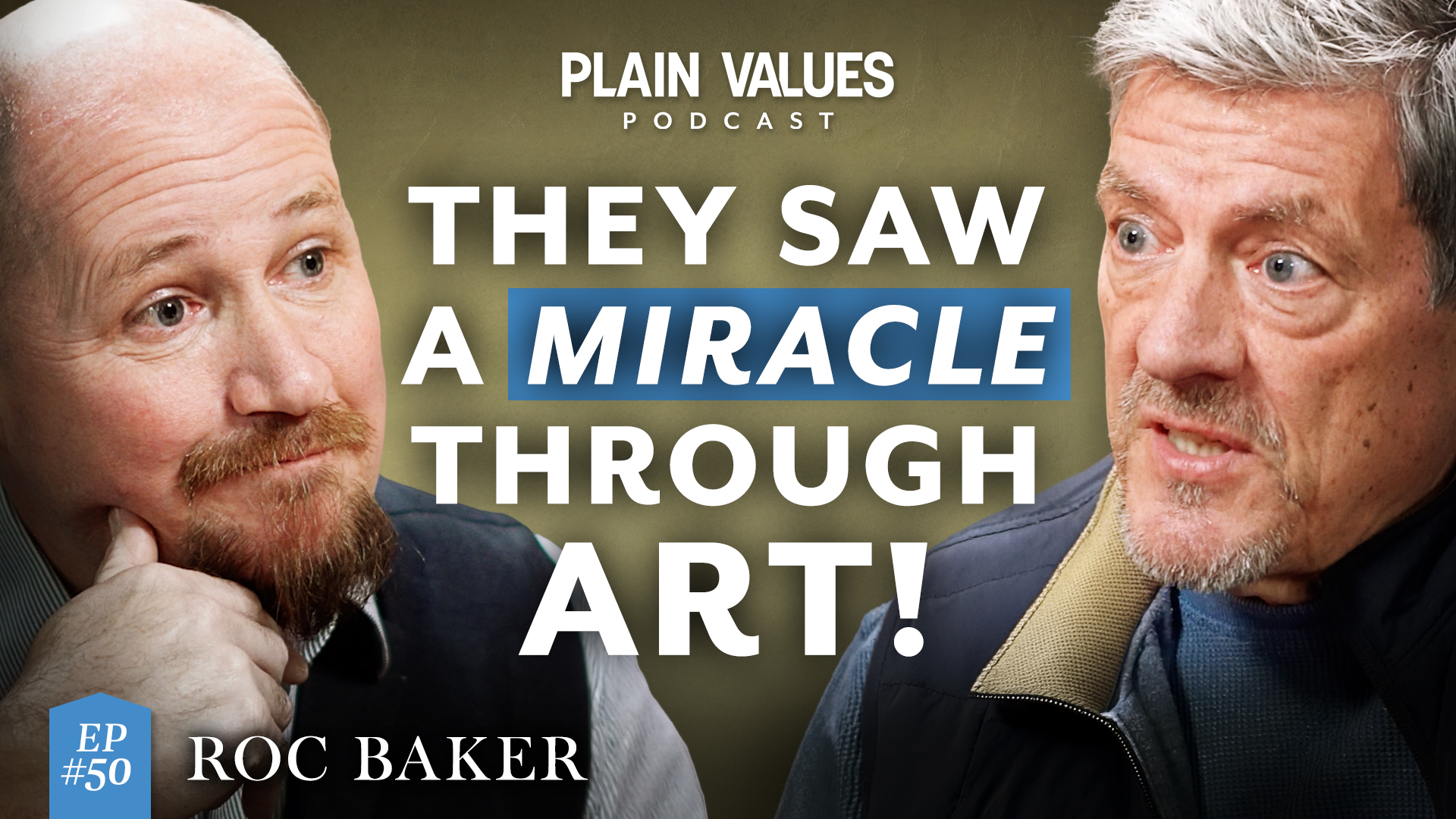
In this episode of the Plain Values Podcast, host Marlin Miller sits down with Roc Baker to trace a life forged in West Virginia hills, Ohio oil fields, and deep family roots.
From his father’s hard-earned lessons in the tool-dressing days to raising six boys, Roc shares the gritty, grounded wisdom that shaped him.
The talk flows naturally into the healing power of art. Roc recounts painting hospital walls and panels with patients, from a stroke survivor who suddenly spoke again to a troubled teen in Greece who softened with every brushstroke. The process, not the product, builds connection and brings peace. “The pain goes away when they paint,” he says.
Music enters too… late-blooming guitars and the joy of learning alongside grandchildren. Roc reflects on grandparenting as the chance to slow down and pass on what matters: birdhouses, whittling, real conversation.
He weighs today’s changes (AI, quantum computing, cultural shifts) with steady realism. Energy demands, common sense, and protecting what’s entrusted to us all surface as quiet concerns. Yet his anchor remains clear: gratitude, generosity, and daily prayer for wisdom.
Warm, candid, and full of lived truth, this episode reminds us that real wealth lives in relationships, creativity, and the steady pursuit of happiness. Perfect for anyone craving perspective from a life well-rooted.
Whether you’re a musician, a creative, or simply someone who appreciates honest conversations about faith and culture, this episode offers encouragement to pursue your gifts while keeping family and integrity first.
Learn more about Plain Values at https://plainvalues.com
Transcripts
0:00 – Introduction
0:45 – West Virginia Roots & The Oil Patch
6:38 – Dad’s Simple Wisdom
11:42 – Knowing When to Step Aside in Leadership
16:10 – Brotherly Dynamics & Active Retirement
20:09 – The Foundation for Hospital Art
31:51 – A Miraculous Transformation in a Greek Asylum
42:22 – Grandparenting & The True Pursuit of Happiness
47:42 – The AI Movement
57:26 – Praying for Wisdom & Outro
Roc Baker:
As we’re leaving, the doctor says, “I don’t know what you people have done, what successes you’ve had, but this is truly amazing. I’ve never seen anything like it.”
Marlin Miller:
In one
Roc Baker:
Day. We’d go there and find a hospital that would allow us in and take sterile walls that patients are looking at and add paint to it to give them something to look at. A lot of the times, over Tom Sawyer things, we would involve the patient.
Marlin Miller:
How do you see the AI movement?
Roc Baker:
Threatening and beyond AI, quantum AI.
Marlin Miller:
Your dad was really, he was just really special.
Roc Baker:
He was.
Marlin Miller:
Lisa and I had a lot of respect.
Roc Baker:
Yeah.
Marlin Miller:
Have a lot of respect for him.
Roc Baker:
Community did too. A lot of fellows come back. I still have a fellow at church that just, he was my dad too type of thing. My dad was never really a dad to me, but your dad was. So I think he’s my dad too.
Marlin Miller:
What year was he born?
Roc Baker:
Dad? Yeah.
Marlin Miller:
1933. Okay. And he was the youngest? No?
Roc Baker:
No. He was next to youngest. Uncle Paul was the youngest.
Marlin Miller:
Okay. And there were nine or 10 in the family? 10. 10. Five
Roc Baker:
Boys, five girls.
Marlin Miller:
Okay. Were they raised in Virginia?
Roc Baker:
No, it was West Virginia down Beetrice, West Virginia. And I think I told you that story, how they got down there, but it was an escape.
And William Thomas Baker and Ms. Codwell eloped and took off to West Virginia. Ended up around Beatrice. I don’t know the whole track, but that’s where they ended up. Had the five children, I believe it was five, and W.R. Baker, the oldest, would be my grandfather, Wesley Rexroad Baker. And then he started a family with Mary Eddie, that’s what it was. I was trying to think of what her last name was. It was Eddie. And she’s got a track record or family track record that goes, I think, to The Plains. And I mean, there’s a Frank James, Jesse James connection somewhere in there, but I’m not sure what that is. Tom Lamp would probably know more about that than others. I think he’s talked
Marlin Miller:
About
Roc Baker:
That sometimes.
Marlin Miller:
Was the Caldwell guy the judge?
Roc Baker:
Yeah. Well, I don’t know if he’s a judge or a magistrate. There’s stories.
Marlin Miller:
And
Roc Baker:
Sometimes it gets embellished and you know what’s true and what’s not. So I’d be afraid to say what’s fact, but I do recall a story about a posse was sent to try to find him, believe it or
Marlin Miller:
Not. I love it.
Roc Baker:
But anyways, I’m not sure where they were all born, but I believe most of them were born in West Virginia. And then they migrated back. You’ve always heard a story about the capital of West Virginia. You ever heard this one?
Marlin Miller:
No. It was
Roc Baker:
Canton, Ohio.
Marlin Miller:
The capital of West Virginia was Canton, Ohio. That’s awesome. The
Roc Baker:
Story goes. It’s a joke. And as the oil patch was growing, this family crewed this direction back toward Ohio. And that’s when WR came back up. Dad was, I think, five years old
Marlin Miller:
When
Roc Baker:
It migrated back. The stories that I’m told, I don’t know for a fact. And then they probably lived a couple places, but up in Baker Ridge is where they sort of migrated to.
Marlin Miller:
Yeah. Settled down there. Settled
Roc Baker:
Down there.
Marlin Miller:
Okay. Your dad was in the oil patch as a kid?
Roc Baker:
Yes. He was underaged as most kids were because they were working early. Ended up working for Uncle Roscoe. His oldest brother needed a tool dresser. And his helper didn’t show up one day, so he grabbed dad, took him with him, and it was no looking back
Marlin Miller:
After that. Oh my goodness. Well, Lisa’s dad, my father-in-law, Larry, of course, is your cousin. And Larry has told me stories of dressing tools and things that I don’t have any. I have the foggiest idea.
Roc Baker:
What that means?
Marlin Miller:
I don’t. I have no clue what that sort of thing means. I just know that it’s hard work.
Roc Baker:
Dressing tools is basically making a bit sharper. So a sledgehammer, forging operation. They bring out something that’s red hot and you take a sledgehammer and beat it back into a point. They called that dressing tools.
Marlin Miller:
Okay. As the Baker family moved into Ohio, did you guys. Were you drilling wells here as well?
Roc Baker:
No. I think the first employer, again, this is information that I’m aware of, was grandpa was working for Oxford at that time.
Marlin Miller:
Oxford Mining?
Roc Baker:
Well, they had an oil division.
Marlin Miller:
Okay.
Roc Baker:
So Oxford Oil and Gas, which was the Straker family. And I know Roscoe, I believe, worked for them too for a time. And then who Roscoe was drilling for, I’ve been told, but I can’t remember the names. But there’s a group of people around there that knew the Baker boys were into oil and gas, so they would hire them to do some of that work. And it was tough work. It was hard work. We can’t find anybody today to do that stuff.
Marlin Miller:
Really?
Roc Baker:
Yeah. We can’t find helpers in our rigs now. Wow. It’s tough.
Marlin Miller:
Are you still actively drilling or has it
Roc Baker:
Come up? No, we haven’t drilled a well for long. I’d say 15 years. Last three wells we drilled were disposal wells down in Coshocton County.
Marlin Miller:
Really?
Roc Baker:
Yeah.
Marlin Miller:
Wow. Something that I’ve always appreciated about you and your family is that you guys have. It seems like you guys have an ability to share of the wisdom that you’ve learned. And I think it’s more you than most. And I think your dad had that ability a good bit. Obviously I didn’t know him as well as I know you, but where did that come from? How did you guys learn that?
Roc Baker:
Dad was a little bit, I don’t want to say iron fist, but he would teach us the hard ways. Encourage us to. He jokes about it or he joked about it before his death that the only problem with us boys, his sons, was he didn’t beat us enough. But no, he always gave good, solid, simple wisdom. And a lot of it just God-based simple things. He really didn’t have a wild side to him, but he had an ornery side, which I’ve heard some of those stories and he’s admit to them. His buddies like in Kilbuck when he was in high school, he had a buddy come up and back then they had street lights that were bulbs. They screwed a bulb in, unlike the ones today. They might paint, put a brush on a long pole and paint those lights all red in town. So the town glowed of red.
Putting Amish buggy up on top of the theater is another one
Marlin Miller:
That
Roc Baker:
He says he didn’t participate with a smile.
Marlin Miller:
He had that little
Roc Baker:
Smirk. And one day somebody stopped by and they were trying to shoot a BB gun. I was there for that one. And he was telling them, “Well, the BB’s a drop and you got to give a little bit windage.” And so they were trying to shoot that light out and they couldn’t hit it. So he popped up, bam, light went out. We’re out of here. But no, he was always a lot of fun. He and his buddies that he drilled with, the Morave brothers, had this deal where they started to sing toot. You ever heard that one?
Marlin Miller:
No. I don’t think so. He
Roc Baker:
Would tell you a story and he would say, “Toot.” There’s still people around. Frank still does it.
Marlin Miller:
Frank
Roc Baker:
Does it a lot. I asked dad one day, “What’s that mean? Toot. Where’d that come from?” He said, “When we’d tell a lie, we’d finish it with toot so that we would know that it was a lie.”
Marlin Miller:
And it just got passed on.
Roc Baker:
Well, yeah. Most people don’t know what it means,
Marlin Miller:
But
Roc Baker:
When they do that, I say,
Marlin Miller:
“Okay,
Roc Baker:
That was a lie.”
Marlin Miller:
Love it. I think
Roc Baker:
Frank’s pretty good with it. He’ll toot.
Marlin Miller:
Yeah. So when you think back, how old was your dad when he passed?
Roc Baker:
85. 85?
Marlin Miller:
Okay. That
Roc Baker:
Was 2019.
Marlin Miller:
Okay.
Roc Baker:
So we’re talking this month. About this time of the month.
Marlin Miller:
Okay.
Roc Baker:
Maybe it’s the 17th of January.
Marlin Miller:
Okay.
Roc Baker:
So we’re talking six years.
Marlin Miller:
Wow. When you think back over all those stories and all the things that he taught you and all that, is there like a one or two lesson thing that just stands out more than anything else?
Roc Baker:
I wouldn’t say anything particular like that, no. When I moved away, I got a job after graduation from Ohio State, three years in Youngstown with a CPA firm, and then ended up ultimately going down to North Carolina. And I was looking for some leadership training. And so I convinced the plant manager to start a. Oh, what would you call it? Anyway, it was a training course that gave us some of the things that I use and that I like sharing. A Dale Carnegie course is what it was. So I learned a lot from that as far as the reason why I share, because you’re encouraged to do it. And once you do it, you have a joy in doing it. Dad’s side of that would be, you could learn so much. At some point you’re full. It’s spilling out. Don’t waste that. Share that so you can drop it back down a little bit and you can learn a bit more, but you need to share what you know.
So that was probably good wisdom there.
Marlin Miller:
When you look at our culture today and the way in which. How do I say this? The older generations seem to be A, dismissed often or B, almost ignored. Have you noticed that? Is that just me maybe? I don’t know.
Roc Baker:
Well, I’m probably in the transition phase of that. I’m still very active in the community. I’m still active on several boards and on the most part engaged. But there are some that I’m checking out of a little bit. By choice. By choice.
Marlin Miller:
Yeah.
Roc Baker:
At some point, you bring a certain energy to a board and your ideas and the amount of effort you give has a limit. And at some point you’ve used it. Now you’re no longer effective for that board anymore. So you need to phase out and allow somebody younger that does have the enthusiasm, the creativity to bring their ideas forward. I was like that on the West Home School Board. And we had some fellows that were on that board for 28, 30, 40 years. They were on the board. And we ended up hiring a consultant. This was when I was a newbie. We hired a consultant to come in and just to give us an overview of why things weren’t going the way we’d like. And ultimately got to the point that the older guys have tried all these things and it didn’t work for them, so they didn’t want to try anymore.
And the recommendation was that you guys need to move out of the way.
Marlin Miller:
Really?
Roc Baker:
Yeah. You need to let this new energy give it a shot. And it could be the same thing and it might work because it’s a new day and
Marlin Miller:
All
Roc Baker:
That. And there’s a time period where you’re on a board for so long, you’ve burnt some bridges. The other side’s not going to move because of your personality, not because it was a bad idea. I don’t want to go TDS or like that, but there’s a lot of people like that that have Trump derangement syndrome that won’t move because it’s Trump, not because it’s a bad idea or a good idea. It’s just they’re against him. So sometimes you got to just get out of the way so things can happen again.
Marlin Miller:
I have a lot of friends who have kids that are 20 to 30 years old. And one of the things that I remember and love very much about my own dad was we would talk about everything if we agreed or not. And that was part of. Honestly, I mean it’s iron sharpens iron, that whole idea. Because it is conflict. Life is just full of conflict all the time. But today I’m seeing that when the younger generation sees something like that whole tedious thing, they simply just hack the relationship off. How do you think. I mean, if you were in that situation, how would you go about trying to restore that whole relationship?
Roc Baker:
Well, first of all, I would avoid that issue. I would talk about, you mean as far as having a conversation or a relationship, you find out what their passion is and you bring that passion to the forefront. I have a grandson like that. He’s just very quiet. He won’t talk, won’t say a word. Won’t offer new information or anything, just stand back. But if you hit the right button, he lights up and just loves a conversation. So that’s where we try to spend our time is in the conversation he likes. But as far as my dad and the relationship we had with him, we could disagree. And when he’d start calling one of us Sonny, we knew, okay, here comes a lesson. Someday Sonny, you’re going to find out or something like that. So he had this one key word that I recognized that a lesson was about to come.
Marlin Miller:
What was it like for you and your brothers?
Roc Baker:
Well, we had, there’s six of us in eight years, so we’re all pretty tight. Jeff and Bill, my oldest two brothers were 14 months apart. So they were pretty close. And then there was a little bit more time for me. Wasn’t two years, but almost two years that I was born. Then Rex was about, I don’t know, 14, 15 months behind me. So we’ve come in like pairs of twos. So Jeff and Bill hung together and Rex and I hung together and fought together and nobody else could fight us, but we fought a lot. And then Tim and Rusty, they were the last two at the house. And so Jeff would be the first one out to try things. So he was the trailblazer. Tim got away with everything under the sun because I don’t know if mom and dad wore out, didn’t care anymore or what, but he seemed to get to do things we never thought of doing.
And I’m a middle child. This not a heartbreaker, but I’m a middle child. So I lived in the shadows.
Marlin Miller:
And you got away with all kinds of no?
Roc Baker:
I wasn’t that ornery. Rex probably got away with most stuff, but he would disagree with that. But he would probably be more ornery than I was and get caught.
Marlin Miller:
Let’s
Roc Baker:
Put it that way. So I didn’t make the negative side of life too much, but I’ve had a great life. The brothers have been great. The four of us still get together occasionally. Jeff doesn’t get together with as much as Rex and Bill and I get together, but I’m going to try to work on a golf outing this year with the four of us. Rex and I, last couple years, have been playing golf as much as we can. And Bonnie’s been playing and Joanie’s been playing. So we’re having a great time. Played pickleball last night, the four of us. Or Martin Creek. We had three courts gone pretty strong over there last night.
Marlin Miller:
That’s so cool.
Roc Baker:
But good relationship with the brothers. We’ve had our times where we disagree. Everyone is very different than each other. I can’t think of us there. I mean, Jeff and I were both CPAs, but still his life’s totally different than mine. And he lives in Columbus and he’s retired. So we just don’t get to talk as much as we used to.
Marlin Miller:
Yeah. Have you officially retired? Yeah. Like half semi-ish?
Roc Baker:
Well, I’m on Social Security, and I don’t get a paycheck for going to work. I still go to work. I still go down to work for two or three hours in the morning, unless I don’t want to. Like this morning I though, nah. Piano tuner’s coming today at 10. I’ll stay home.
Marlin Miller:
One
Roc Baker:
Of those deals. And then we had your appointment. Or the night before a pickleball quote, “Hey, you guys want to play tomorrow morning?” Sure. We’re in like that and I just don’t go into work.
Marlin Miller:
You and Bonnie do a lot of things. You dance and you paint, right?
Roc Baker:
We continue to take dance lessons because if you don’t continue to do it, you sort of forget. So there’s a group in the community that we get together with an instructor who reminds us what we’ve already learned and forgot. Occasionally there’ll be an event where we’ll go to and there’ll be ballroom type dancing and we’re not afraid to do it. That’s been one phobia my brothers have always had. They wouldn’t do that.
Marlin Miller:
I’ve
Roc Baker:
Been dead before. Shouldn’t need to do this. So I do.
Marlin Miller:
Tell us about the painting.
Roc Baker:
The painting, we got some real good artists in our family. I’m not one of them. Bill’s an excellent artist. Rex is an excellent artist. Rusty was a fantastic artist. I’ve dabbled in it, but nothing compared to those guys I’d be afraid to show it. I am involved in a foundation for hospital art, which is based out of Woodstock, Georgia now. Used to be in Atlanta, Georgia. Started and created by my uncle John, be my mother’s brother, John Fight. He was between jobs one day, decided I need to do something. So he gathered up some paint and went into Northside Hospital, a cancer hospital and said, “I’m just going to paint walls.” And started putting murals on walls. And I’m going to tell you his gig a little bit here. One day he was doing a jungle scene and little girl with her ear burnt off and a head wrap on walked up and stared at for awhile.
And she says, “I want to paint.” And John’s first reaction was, and he looked at her, he’s like, “This is mine.” And then the light bulb came on. It was like, “No, she wants to paint.” Wow. The paint goes away when they paint. So he gave her a brush, taught her how to make some grass at the bottom because she could reach it pretty good. And he watched her and she just spent a whole day painting and wanted more and didn’t think about her problem.
Marlin Miller:
Right.
Roc Baker:
Changed her whole. The healing of art.
Marlin Miller:
Oh man.
Roc Baker:
Created this foundation that John started. And it’s been based on that, the healing of art. It’s the theme of it. And it’s got a website out there. And we’ve got paintings I think in every country now, except for one in South Sudan, I believe, because they need other things. They don’t need freebie paint.
Marlin Miller:
Wait, in every country?
Roc Baker:
Yes, of the world.
Marlin Miller:
There’s 190 some countries, right?
Roc Baker:
I think it’s 170, was it 196 or 176?
Marlin Miller:
I’m not sure. It was
Roc Baker:
Down to one.
Marlin Miller:
It’s a lot.
Roc Baker:
Oh
Marlin Miller:
My goodness.
Roc Baker:
Most of that by visitation. We’d go there and find a hospital that would allow us in and take sterile walls that patients are looking at and add paint to it to give them something to look at. A lot of the times, over Tom Sawyer things, we would involve the patient. And it got to be where it evolved from doing paintings on walls where they had to get out of the bed to we created panels that could fit in the bed and they’d paint panels. We went through a phase of ceiling tiles.
Marlin Miller:
Wow.
Roc Baker:
A lot of rooms, you can’t get to the walls. So those ceiling tiles, that’s fair game. When we were in Brazil, we did just hundreds and hundreds of ceiling tiles. And there’s all kinds of neat stories associated with this where you see something, you think, “Oh my gosh, how could I think otherwise?” One quick story, and this was down at Warm Springs, Georgia and President Roosevelt’s therapy center. H had polio and he had this place where there was Warm Springs and they used the Warm Springs for therapy.
So we’re in this therapy center and we’re painting panels with patients that wanted to paint. And a nurse walks in pushing a lady. It looked like she’s totally struck out. I mean, stroked out. Her head was down. And I said, “Oh, would she like to paint?” And the nurse said, “No, she can’t.” And my uncle John’s head comes up because this is his baby. “Oh yes, she can. So he said, Rock Bonnie, get over here. “So we go over and I hold the panel. And John puts the brush in her hand and Bonnie holds the paint. And I moved the panel because her hand was fixed to put some paint on the panel. And when she ran out of paint, Bonnie would come around and dip it again. I thought, well, Bonnie and I are doing the painting. Well, she’d run out of paint and all of a sudden I saw this.
The brush would go out and be reaching for it. Then she’d be dipping it. I mean, it just kept on getting better and better. Wow. Our visual perception wasn’t that. I mean, this is light yet. So all of a sudden she starts painting, her arms moving. And I don’t know that this was newfound therapy. She decided she wanted to paint. And I thought, geez, maybe I should say something. We’re just standing here and I’m talking to Bonnie and not her. So I just asked her, “How’s your day going?” “Oh, it’s just such a wonderful day. “She talks too.
Marlin Miller:
You had no idea
Roc Baker:
That she was – No. I thought we wouldn’t be able to do anything. And she started reaching out and we had a conversation. Okay. The healing of art that comes back around where they just use the process of painting. Paint itself is not healing,
Marlin Miller:
But
Roc Baker:
The interactions you get between people. So okay, that’s a great idea. Let’s start trying to line up families where they’re painting with their sick child or parent or whatever. I have a set of panels at home right now that I’m waiting to. And there’s a couple candidates I’m looking at where you can take four panels and basically spread them out. Did this with Rick DeMarco’s daughter. She was dying of cancer and she has four kids and each one of them painted with mom.
Marlin Miller:
Wow. Those are memories that will never.
Roc Baker:
Well, and the four panels, these panels can go to each house or each room and come together again. John would always have like six panels where we’d paint. All of them could stand alone. When you bring them together, it’s like looking at a French window at a scenery. Now, not fantastic art.This is simple art, bright colors, happy colors. But yeah, I did that. And a lot of these cases where we go in and paint with people, they paint. They put the paint on the campus. We would take them back to a room and clean them up. And they’d come back out and look really nice and crisp, but they painted. Yeah. So they own it. They got ownership into the painting. So again, the healing of art.
Marlin Miller:
What is it about that attribute of art and music? And I mean, all the creative things that God has put in us, how does that work? This episode is brought to you by our friends at Azure Standard. Lisa and I just recently signed up finally. And we are loving it. Non – GMO, organic. It is all that you can ask for. Go to azurestandard.com and tell them plain values sent you. You can use the code HL15 for a healthy little discount. Thanks guys.
Roc Baker:
Well, I couldn’t explain it, but Bob Winters, one of our directors that came on, our trustees that came on after it was all started. I’ve been in there since like 95. I was a very young director and now I’m the oldest and I’m next one out. He came with that intention to answer that question. I mean, he was studying geriatric effects, how art, music affects that. And of course the dementia side of it come into play. And he was talking about how they kept active with the artistic side, the creative side of their minds, that it pushed that whole thing away of being an issue with Alzheimer’s.
Marlin Miller:
Can I ask about that? Sure. When you say it pushes it away, is it for that moment only? Or is it a longer term actual. They’re seeing a change in the brain and they’re getting better.
Roc Baker:
Well, I haven’t looked back at the results of any of the studies. That was just advice he was giving me at the time. So I really don’t know. It seems to me that a lot of dementia and Alzheimer’s is brought on by inactivity. Maybe what we eat has a lot to do with that. What we medicate with has to do with that. I’m not sure the medications that they’re giving those people are nothing but sales being made because I really don’t see the results. I don’t know. I’m an accountant. I’m not a medical person. But that played into the healing of art too. It’s like, let’s let him be creative with it. We even. Van Gogh. We’re in relationship with Van Gogh Society.
Marlin Miller:
And
Roc Baker:
We had a contract with him for three years where we could Take some of his images and use those in our paintings. They said you can do this, but all we require is that the paintings end up in say asylums or places where people have mental issues. And we did that. And they changed the people that we were dealing with and the new person wanted to throw us out because they weren’t making any money off of us. Well, that’s not the point.
We don’t want to use your, unless we’re. Well, you can use any of our stuff. We don’t care. Okay. Wow. Cool. Disney has invited us back to do more of their images. We have thousands and thousands of volunteers and lots of cities. So anytime we get a deal where a company wants to get their employees back closer to the community, they’ll create an event where their employees paint for a local hospital or something like that. I think it sort of brings them down a little bit. Wow. So it’s just a neat deal. Scott Fight, my cousin now runs the, he’s the director now of the Mijon son. Did a great job. That’s a long time on that subject. Wow.
Marlin Miller:
No, that’s why I brought it up because I knew that there was a lot more to that that I had never really known.
Roc Baker:
If you ever do it and they lay the panels out and there’s lots of noise and people are painting and then all of a sudden after about two hours, the noise level comes way down. And you see two people sitting next to each other, they’re sharing. Okay, it’s working again. You start building a relationship through the art that wouldn’t have built otherwise. You’ll talk about personal things and you share problems. But it’s just magic the way that works. We were in Thessaloniki.
Marlin Miller:
In Greece?
Roc Baker:
Yes. And it went to an insane asylum, top of the hill in Thessaliniki, and walked in. And there was a girl in there that was arrested and they took her to that place. Loud music. When we walked in, she’s playing loud music with boombox and all dressed in goth and black, fingernails, everything, just black and just making all kinds of noise. Doctor comes in and says, “That’s okay. The situation we’re dealing with.” He introduced us to us. She turned around and stormed away. So we went down to the area where we’re working and the director come back and said, “Could a couple of you come out here? She would like to see more.” So John and I went out and she come in and she totally changed. She didn’t have the black on. She had softer colors, but still rough. She was a teenager. She was a Russian in Greece.
Teenager that was pregnant. Okay. Not a good situation. So they introduced me as rock and I was showing her what we were doing with painting and not a tough thing, just adding color. She was done with that, got up, stormed out. Okay. The doctor says, well that’s.
I guess that’s over. It’s better than what it was.
Right. So we go back to the cafeteria area where we’re painting again and doctor comes back in and says, “Well, she wants to paint with Mr. Rock again.” And so we asked her to come back to the cafeteria. So she come back and now she’s wearing another change of clothes. It was brown, softer colors. And she painted for a little bit until she got tired and out again. Then I went and worked on a mural on a door that had a glass and I was working on that one. And then she showed up the fourth time wearing pink pajamas. And you just see the step down of this thing. And she wanted to paint. And ultimately we left paint there and we’d left a lot of murals on the walls unfinished for her to work on. And as we’re leaving, the doctor says, “I don’t know what you people have done, what successes you’ve had, but this is truly amazing.
I’ve never seen anything like it.”
Marlin Miller:
In one day?
Roc Baker:
One day it worked her down from being where she was. And it was the process of just doing the art. It wasn’t us or anything. It was.
Marlin Miller:
Did you notice a change in the actual art she was painting herself?
Roc Baker:
Yeah. She didn’t stay inside the lines. That’s okay.
Marlin Miller:
Right.
Roc Baker:
She started freelancing a little bit. I mean, we try to always leave paint to let them just keep going. Keep doing what you do. We don’t have to carry it home. So that’s always a good thing. We clean up and then leave all the supplies we can with them so they can continue to do whatever. I have not heard about anything on the backside of that, but just as we’re leaving, the guy says, “If nothing else is successful, what you did here today just blows my mind.” Wow. Lots of stories like that that were really cool.
Marlin Miller:
How do you feel or where have we as, dare I say the church, almost dropped the ball in areas of art? It feels to me, Rock, like the secular world years and years ago took a hold of the art scene and turned it upside down, I think in a way where they call this whole concept of beauty is in the eye of the beholder. And they call things that are not very beautiful. They’re calling it art and they’re calling it beautiful. And at times it has felt to me as if the church has chosen to simply not engage that conversation anymore.
Roc Baker:
I don’t have a good answer for you, but as we were talking earlier, it really wasn’t the end product of art that was amazing. It was the process we went through to get there.
Marlin Miller:
In the creative act or the relationship? The relationship. The relationship with you, whoever is in front of them, it changes.
Roc Baker:
These barriers melt that people create for themselves.
Marlin Miller:
We’ve
Roc Baker:
Done a couple art projects at our church where we don’t have the big windows or anything like that. So we painted some up and hung them up. Worked for a while and then we got tired of them. We took them down. But I don’t have an answer for you other than probably art’s probably associated with more of a liberal train of thought, which probably wasn’t strong in the church. But I think it’s necessary and important that we all touch it. We all like things that are beautiful. And again, in our eyes, what’s beautiful to me may not be quite as beautiful for you, but the people that take it and run with it someplace which is crazy. I think they’re just pirating.
Marlin Miller:
Yeah. I think I used to never, as a kid, I’ve never seen myself as a creative person because I don’t paint and I’m not, look what you’re doing here. This is artistic. But that’s kind of my point is I’ve kind of changed to see from the magazine to just even this. I’m much more creative underneath than what I would have ever noticed before. And I think people who never get a chance to actually kind of spread that set of wings are really missing out on a huge part of what God has given them. And it’s, I mean, he tells us to create. That’s what he told us to do.
Roc Baker:
We’re actually talking about paint art and this kind of art. And you mentioned Rusty. Rusty had a kind of art too that
Marlin Miller:
That
Roc Baker:
Was just music. He just loved music. When COVID hit and we were going to all stay home, I’m not just staying home doing anything. So I got something for you. So he brought over two guitars and an amp and he says, “Okay, we’re going to learn how to play the guitar.” And I said, “Okay, great.”
Marlin Miller:
Okay.
Roc Baker:
This is four years ago, five years ago. And you mentioned his barn earlier. He had – Oh my
Marlin Miller:
Goodness.
Roc Baker:
130, 140, 50 guitars. And Rusty would tell me that Claudia’s dad would say to him, “How many guitars can you play at one time?” And Rusty said, “Well, just one.” “Well, why do you need so many? “He would say to Rusty and Rusty got a big kick out of that. So he told me that story. But he was pretty creative with it. I regret shying away from that end of art, the music side.
Marlin Miller:
Really?
Roc Baker:
Early on to do other things, sports and stuff like that. And now in my later years here, it’s almost too late, but it isn’t. I’m trying to learn. So my son, Charlie, has taken up guitar too and has played for several years. He’s got a nice band gone that he takes part in playing lead guitar. And I probably have eight or nine guitars now.
Marlin Miller:
Do you really? Yeah.
Roc Baker:
And how many can you play at one time? Yeah. And I love learning that. I love the theory side. Understanding why those frequencies make these noise and how the one frequency is related to another frequency. And that makes sense. Things make sense to me. I can learn. The ear thing, I’m not so sure.
Marlin Miller:
Yeah. Well, I mean, we all know guys or folks who can literally hear a song that one time and just pick it up and just play it. And it blows my mind how that works.
Roc Baker:
Well, on the theory side, you find out that there’s, gosh, if you memorize a couple patterns and understand what a couple chords are, you can go over the place.
Marlin Miller:
Can you play bar chords?
Roc Baker:
Oh yeah. Really? Yeah. Yeah. Charlie’s got me working on lead stuff now. We’re talking cage and pentatonics. That’s
Marlin Miller:
Cool.
Roc Baker:
I’m no good at it, but I understand it.
Marlin Miller:
Yeah. And it’s fun. You’re enjoying it.
Roc Baker:
Yeah. And I can’t play for anybody. I’ll go downstairs and play on my own. Bonnie will sneak down sometimes and listen. And I just picked up a 12 string guitar. Oh my. And
Marlin Miller:
I
Roc Baker:
Swapped out a fender for that. And this is something Rusty had told me why he had so many guitars because Charlie’s probably got, that we know about a dozen. Because if he gets a new one now, he has to get rid of one. That’s a rule in his household. Yeah. Dad, it’s not about what you own. It’s about the hunt for the next one.
Marlin Miller:
That is great.
Roc Baker:
I was telling a lady church Sunday about that deal. And she says, “Oh, that’s why I have over 400 horse models. Because I don’t care about the ones I’ve got. It’s about the hunt for the next
Marlin Miller:
One.” Oh man.
Roc Baker:
So people collect. It’s not about they have, it’s about what they’re looking for. And once they get it, they’re off to the next
Marlin Miller:
One. How is it different for you and Bonnie to grandparent than it was for you to parent your two boys?
Roc Baker:
So much more fun. It gives me the opportunity because I have the time now to teach my grandchildren the things I should have taught my children, but never had time to do it.
Marlin Miller:
Wow. Do you have to do that intentionally or does it just kind of overflow? It’s the
Roc Baker:
Overflow.
Marlin Miller:
Yeah.
Roc Baker:
But you have to recognize the opportunity too. We’re sitting here doing nothing playing electronics. Let’s go build a bird house. Get to major dick. It has some wood. I’m going to teach you how to whittle. Well, I’m not going to play with a knife. Well, this is between me and you. What goes on in grandpa’s house, you don’t talk about. Man. Anthills. Let’s watch this for a while. Take the time. It’s a time issue.
Marlin Miller:
Okay.
Roc Baker:
Take the time and do simple things and then explain them. Kids aren’t really stupid. Kids haven’t been taught yet. And they don’t know what they don’t know. Okay. We’ve heard that one before. Yeah. I had a young lady says, “I’m going off to college. Well, what are you majoring in? Well, I’m going to start with psychology, but who knows? I may change.” And I said, “That’s right. When you get there, you’re going to learn so much. You’re going to find out there’s a world there you don’t know. And you may have a passion for something else, so you’ll change your mind. That’s okay. That’s the way it ought to be. So go with intention, but it’s okay to change your mind.”
Marlin Miller:
What are you focused on right now?
Roc Baker:
Happiness. Just been blessed with a life that has provided well. And being an accountant, I saved well and I’m in good shape. I share when I can. I loved buying Christmas gifts, but there was a point where the Christmas gifts really weren’t giving me the feeling of gifting because we’re the last day of gifting of all the surrounding for the grandkids and my kids. And you just didn’t see whether they really liked what you got them or not. So I did give them cash last couple years. And dad, why do you do this? You bailed out again. Now why do you do this? Well, to me, I need to give because that’s the gift is my gifting. The fact that you received it and like it is wonderful, but everybody needs to give because that’s where the real gift is, is in the gifting. And anybody that can be there should give somehow.
I mean, we support the church a lot and other things we participate in. We help out when we can. It’s been a good life. So happiness is the answer. It’s not property. It’s the pursuit of happiness. There was a reason he put that in there.
Marlin Miller:
Yeah. And you sure is – They
Roc Baker:
Didn’t say pursuit of wealth. They said pursuit of happiness.
Marlin Miller:
Yeah. You sure can’t take it with you. My goodness. When you look around at our country and at the culture at large, what are the things that are the most concerning for you and Bonnie? What do you guys talk about? Well, guys, I am super excited to tell you about a brand new sponsor of the podcast. Rustic Strength makes clean, chemical-free cleaning products. My wife ordered product before we had a relationship with Rustic Strength, and then they generously shipped us a few more items to test. This very morning when we’re shooting this, she told me, she said, “Marlon, I just cleaned the basement windows with the glass cleaner, the window cleaner.” And she loves it. Couple swipes, super sparkly clean. She adores it. Go to rusticstrength.com and use PV15 for a nice 15% discount off your first order. Thanks guys.
Roc Baker:
Well, you’re into politics. And I don’t know if you want to share this or you’re going to get into politics. Well – So I listen to political news a lot across the board. I mean, I listen to the liberal stuff and just I can’t take it any longer. But I got to know what they’re saying.
Marlin Miller:
Yeah.
Roc Baker:
And it doesn’t make sense. To me, what Trump has done is said, “I’m going to do common sense.” With TDS there. And if he does common sense, that means the other people have to be against common sense. Genius. Yeah. Just
Marlin Miller:
Genius. They have nowhere to go. Yeah.
Roc Baker:
You’re always on the bad guy’s side because it’s not common sense.
Marlin Miller:
How do you see the AI movement?
Roc Baker:
Threatening and beyond AI, quantum AI.
Marlin Miller:
I’ve been looking into quantum. I don’t understand any of it. Rock, I don’t understand how it works. All
Roc Baker:
This crypto stuff and everything. AI world and passwords and stuff like that. Quantum, they won’t exist.
Marlin Miller:
All
Roc Baker:
Security is over. It’s done. It’s gone. So
On the one board that I’m on, we are very interested in understanding and trying to be on task with that because people trust us to take care of their money. So we need to make sure that. So we’re working on it now. We’re working on understanding what AI is. I mean, we got simple AI. I’m having fun at the house with Alexa. Alexa, turn the lights off. Okay. Which one? Rock? Alexa, what’s the weather? Well, good morning, Rock. Well, today’s weather’s going to be. Yeah. That’s pretty cool. I haven’t gotten to the ChatGPT because I don’t need it. I’d probably play with it if I had it, but I’m full.
Marlin Miller:
Yeah.
Roc Baker:
But AI in general is going to be bigger than the printing press, how it changed culture, the iPhone. Can you imagine? Most people can’t imagine because they’re not that old what it
Marlin Miller:
Was
Roc Baker:
Like without it.
Marlin Miller:
Yep. I remember the day when my father-in-law looked at me and said, “Marlon, the day’s going to come when you’re going to carry your computer in your pocket.” And I remember going, “What? No, you’re crazy.” That computer. We’ve been there ever since the iPhone came out. I mean, it’s literally more computing power than NASA had to put a man on the moon in our pocket and we take it for granted.
Roc Baker:
And you go to a stadium or a concert and people hold up, instead of holding their match, they hold up their phones and everybody has one.
Marlin Miller:
Yep.
Roc Baker:
What a change in culture.
Marlin Miller:
Yeah.
Roc Baker:
Okay. It took our culture a long time because we went the line route with the poles and everything. And now the antiquated cultures or the old ones don’t have to go through that. Then you go right to this one, just one tower. And all of a sudden they got all these communications. And Starlink, it’s incredible. So back to the AI thing, AI is going to be greater than all of that. In my mind, it’s going to be multiple times greater than what the iPhone did for us. We almost can’t comprehend how much change is coming for us soon.
Marlin Miller:
I’ve been digging into that a lot. And I wonder how many jobs will have to be lost and how many industries will have to be effectively taken out.
Roc Baker:
You’re looking at your own side of it though. Okay. There’s going to be new jobs. You got to dive in and understand it. True. But it’s going to create new possibilities. I mean, you look in the medicine world right now. In my mind, doctors are at risk
Marlin Miller:
Because
Roc Baker:
AI can take care of a lot of that stuff.
Marlin Miller:
Better than they can. As
Roc Baker:
Far as like a surgeon. As far as data goes, as far as. I’ve never seen that before. Yeah, but somebody has. And here it is.
Marlin Miller:
Yeah.
Roc Baker:
Okay.
Marlin Miller:
Because they’re pulling on the cloud’s data around the world from the world. Exactly.
Roc Baker:
Right. So I think that’s going to be huge. I mean, that’s going to be wonderful. It’s like the printing press or anything else. There’s always a wonderful side and there’s the ugly side. We’re dwelling too much on the ugly side, but we need to be prepared to deal with it. There will be wonderful things that happen we can’t think of yet because of AI. The quantum scares me because I don’t understand it when that comes. I don’t know if you ever saw the Space Odyssey 2001.
Marlin Miller:
No. I’ve heard of it, but I’ve never watched it. No.
Roc Baker:
There was a computer there that could think. They called him HAL,
Marlin Miller:
H-A-L. Okay.
Roc Baker:
That’s only one letter off of IBM. But that scared people. Gosh, computer’s going to think. A computer’s going to figure out that they don’t need humans anymore. Okay. That’s where we are again with AI. Is AI
Marlin Miller:
Going
Roc Baker:
To get to the point where Quantum AI is there where it doesn’t need us, so it does away with us. So all the movies that you saw. Yeah.
Marlin Miller:
Terminator and The Matrix. Yeah.
Roc Baker:
We just need to understand it better and be prepared for it. But I think wonderful things are going to happen too. It’s not just a dead end. It just scares us.
Marlin Miller:
Yeah. The thing that I’m really curious about is there’s a whole bunch of the initial, those godfathers of AI, the guys that helped create it, who are, I mean, effectively raising a flag and saying, “We have to be really careful or we’re going to get ourself into hot water here.”
Roc Baker:
Okay. Now this is rock’s theories. So it’s meaningless.
Marlin Miller:
Yeah, that’s why I brought it up.
Roc Baker:
Okay. To make AI happen. I’m thinking about quantum yet. We need lots and lots of energy. More energy and infrastructure than what we have right now. Okay.
Marlin Miller:
Yeah. The data centers are pulling so much. If
Roc Baker:
We start experiencing
Marlin Miller:
Brownouts
Roc Baker:
Because they’re giving them priority over us, now
Marlin Miller:
That’s
Roc Baker:
Scary. So we need lots of energy. Now it’s nice to stop the drug dealing in Venezuela. That’s wonderful there. But that oil has been gone someplace else and needs not to. Whoever wins the AI war is going to be on top. And right now China’s got to lead and that’s where oil goes. So was it about the drug thing or is it about beating them to the punch, to the power issue and making sure that the energy in this hemisphere doesn’t supply the enemy that’s going to beat us in AI theory?
Marlin Miller:
That’s interesting. I’ve also looked at, there’s new companies trying to develop the technology to put panels into space, beam the energy down with a microwave and basically have it just effectively almost free just for everybody, which of course the big companies wouldn’t let it be free. But they are working on some really creative ways to power all of it. And it’s a whole new frontier that I. Yeah, I agree. There’s no way we can – You
Roc Baker:
Ever been to Iceland?
Marlin Miller:
I’ve never been there. Me
Roc Baker:
Neither.
Marlin Miller:
Nope.
Roc Baker:
But my son’s family went over this summer. They don’t pay for any heat. What do you mean they don’t pay for heat? It’s nationalized. Volcanic and it’s free.
Marlin Miller:
Oh my goodness.
Roc Baker:
Okay. So –
Marlin Miller:
Iceland is full of volcanoes. So it’s geothermal.
Roc Baker:
Yeah.
Marlin Miller:
So they’re cranking pipes. Oh my goodness.
Roc Baker:
So again, it’s a different culture, different way of thinking about it. They’ve taken what’s been given to them. I’m sure they have isolated situations, but in general, your heating’s free.
Marlin Miller:
And it’s Iceland. It’s in the Northern Hemisphere. It’s cold.
Roc Baker:
Well, yeah. Iceland was named Iceland to keep the Vikings from landing there. Greenland’s the cold one.
Marlin Miller:
Okay.
Roc Baker:
It’s covered with ice.
Marlin Miller:
Yeah. I knew that Iceland was green and Greenland was not.
Roc Baker:
I mean, it’s cold there. And I just love watching volcanoes. So I’ve been following that Rekovic area where, was it Glendalock or something like that? Volcano. But the whole AI thing, getting back to that, it’s going to be really interesting. It’s just that where people trust us, we got to be on top of the game to protect them. And here in little old Holmes County, where do we. This is why you see the huge, in my mind, the huge, not collapse, but aggregation of banks. When I first got on the bank board, it was like 1,500 banks
Marlin Miller:
In the
Roc Baker:
Nation. We’re down to around 4,000 now. You got to have lots of resources to do this. And it’s
Marlin Miller:
Really tough for
Roc Baker:
Banks.
Marlin Miller:
Did you say 1,500
Roc Baker:
Or – I’m sorry, 15,000.
Marlin Miller:
15,000. Okay. Got
Roc Baker:
It. I apologize. 15,000 down to about 4,000.
Marlin Miller:
Boy, that’s a massive change.
Roc Baker:
It is. And we’re probably going to get to 1,500, imagine.
Marlin Miller:
Wow.
Roc Baker:
So if you don’t have a particular
Marlin Miller:
Size,
Roc Baker:
You can’t survive because it just costs so much with infrastructure to protect.
Marlin Miller:
Last question. If you enjoy the conversations that we have on the Plain Values podcast, you are going to adore Plain Values in print for a couple reasons. One, you don’t have to look at my mug. And B, you don’t have to listen to me talk. Head over to plainvalues.com and subscribe today. How can we pray for you and Bonnie and your family?
Roc Baker:
Well, we do it every day. We start the day out with asking forgiveness of our sins and being thankful for what we’ve been blessed with. At the end of my prayer, after I go through a list of items, I pray for wisdom to make good decisions. Not just for us, but for our children, because they’d have a gauntlet of decision making to go through. And it’s real easy to make bad decisions and get on the wrong path. And you get on the wrong path, it’s hard to get out of. So that’s what we do is we just pray for wisdom to make good decisions.
Marlin Miller:
Rock, thank you. Thanks for coming. Sure. Thanks for being here. Thanks for just sharing.
Roc Baker:
Well, if you can get this edited right, you should be down about five minutes.
Marlin Miller:
I highly doubt that.
Roc Baker:
Yeah, thanks for inviting me. It’s always scary coming into something like this. How do I prepare? Well, I remember us talking. You don’t. It’s the worst thing to do is prepare.
Marlin Miller:
Yeah.
Roc Baker:
So thanks for being candid with me and
Marlin Miller:
Being a good
Roc Baker:
Friend.
Marlin Miller:
Hey. Thanks, Rock. Thank
Brought to you by …
🤝THIS EPISODE’S FEATURED SPONSOR: Azure Standard
Talk about a mission-oriented company; our friends at Azure Standard set the standard of excellence when it comes to sourcing nutritious food for your family.
They have a new program called “Around the Table” that nourishes by walking shoulder-to-shoulder with churches and church communities. It’s wonderful!
Learn more: https://www.azurearoundthetable.com/ from Plain Values’ mission to share the gospel amid infertility, adoption journeys, and special needs advocacy, this 194-page volume renews hope and affirms the beauty of simple, purposeful lives.
🤝THIS EPISODE’S PREMIER SPONSOR: Rustic Strength
Our friends at Rustic Strength are the real deal.
This hardworking, family-owned company in Missouri makes high-quality, non-toxic laundry, home, and body care products in small batches—completely free from harsh chemicals, dyes, and synthetic junk you don’t want around your family.
From their powerful laundry detergent and dish soap to gentle hand soap, cleaners, and more, everything is thoughtfully formulated to actually work while being safe for your kids, your home, and the planet.
If you’re looking to simplify your cleaning routine with products you can truly trust, Rustic Strength is the place to go. We love supporting a family business that puts real care and integrity into every formula.
Learn more: https://rusticstrength.com/
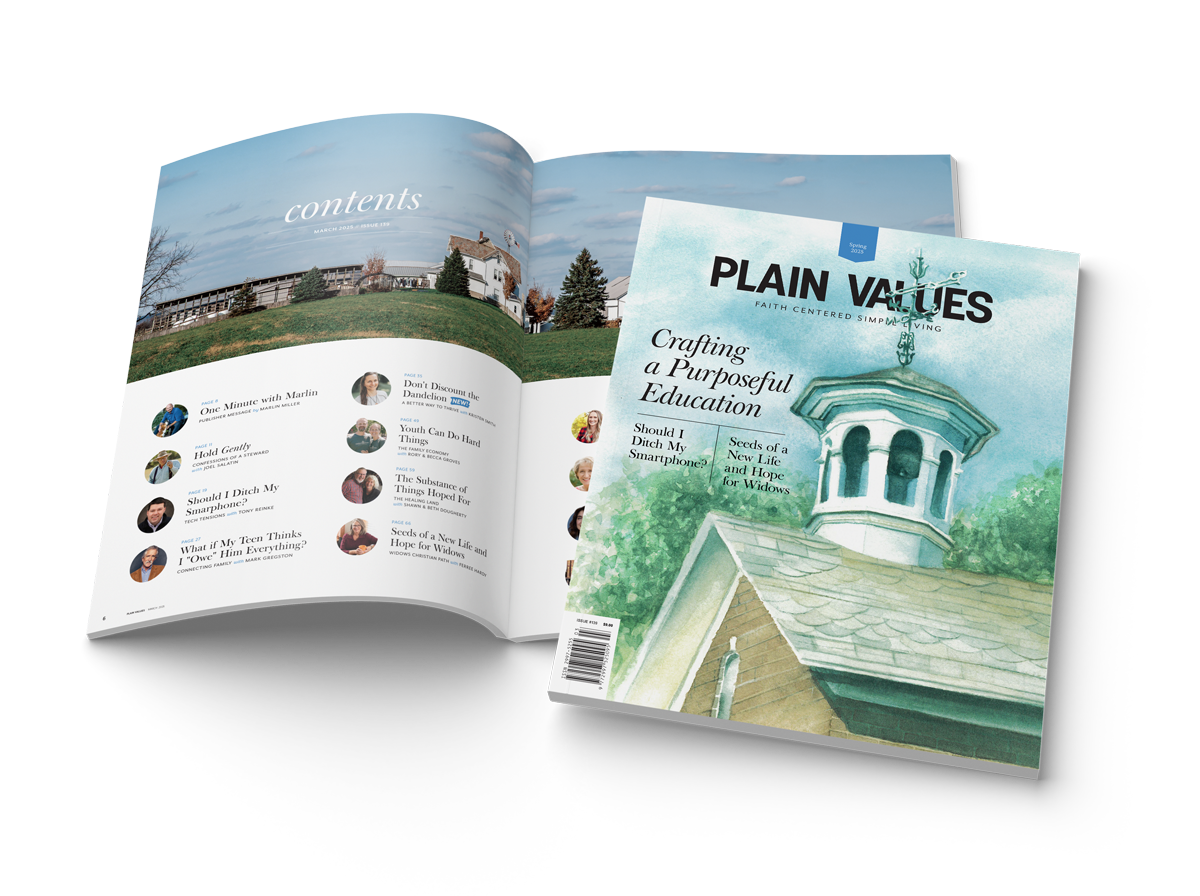
🤝 THIS EPISODE’S FEATURED SPONSOR: Plain Values Magazine
Our friends at Plain Values have been quietly reminding us what matters since day one. Faith-centered, family-rooted, and beautifully crafted, this quarterly print + digital magazine delivers heartfelt stories, timeless wisdom, and practical encouragement from voices like Marlin Miller, Joel Salatin, and Shawn & Beth Dougherty, right to your mailbox.
Learn more: https://plainvalues.com/plain-values-magazine//





Leave a Reply