
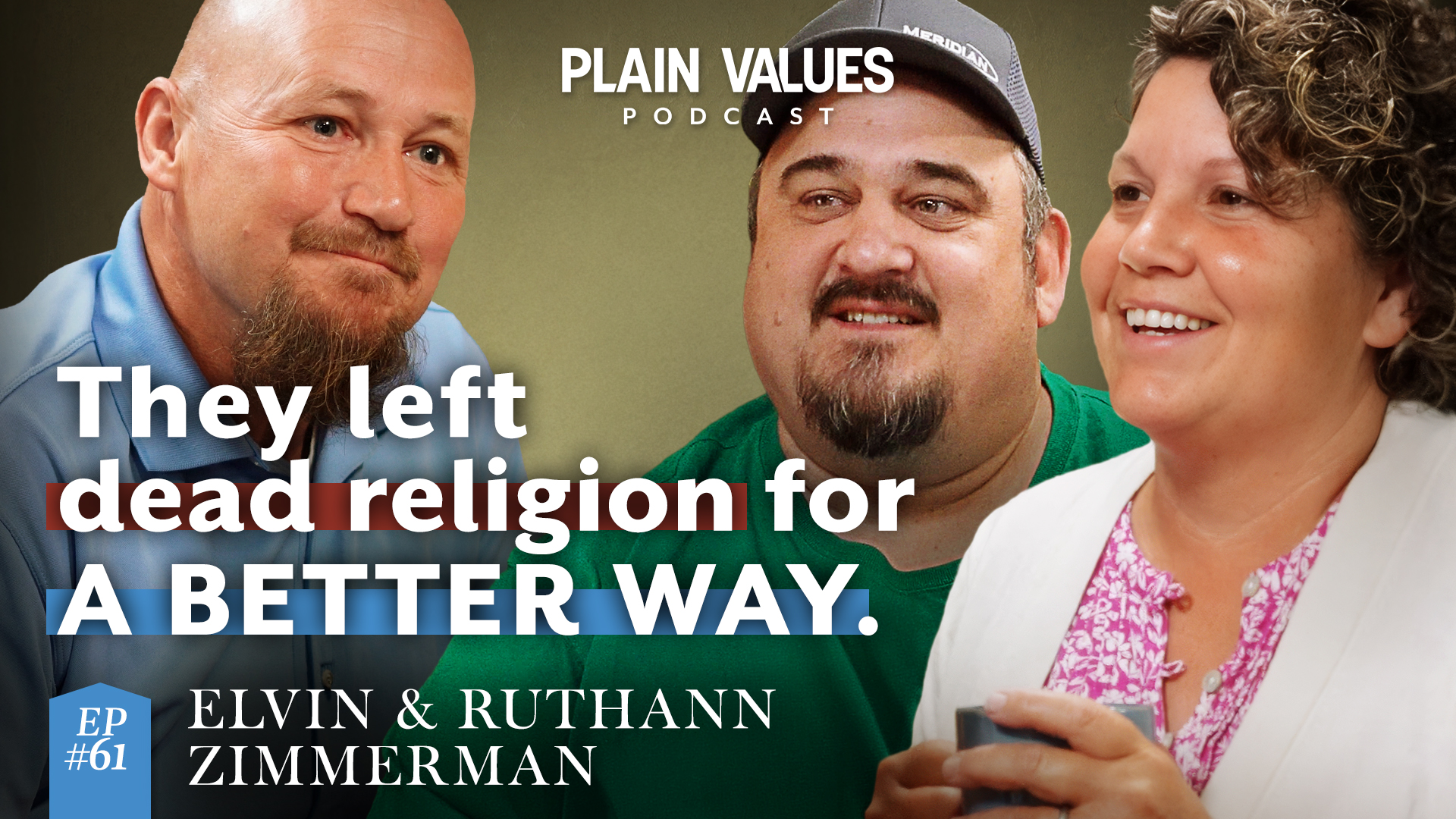
When you hear the name RuthAnn Zimmerman you think of homesteading. In today’s episode of the Plain Values Podcast, we hear the full story behind RuthAnn and Elvin’s journey to becoming one of the leading voices of influence in the modern homesteading movement.
Long before social media and RuthAnn’s millions of followers knew of her, both Elvin and RuthAnn grew up in Pennsylvania in the Old Order Mennonite church, though they did not meet there. As teenagers, both Elvin and RuthAnn seemed to have rebellious spirits and their parents decided it best to send them away for a time. The two rebel hearts connected in Iowa and were soon baptized and married in the church there.
RuthAnn was a school teacher for a few years there, so once they had their own children, she had the know-how to homeschool. She soon became friends with some non-Mennonite women in her homeschool group and she started to see things a bit differently. The Holy Spirit was calling Elvin and RuthAnn into a real relationship with Him.
One particular weekend, they both had a revelation that if Jesus was here today, He would not be allowed into their own church. Jesus was calling them to follow Him, but they were scared to lose their community.
Already feeling on the fringes of their church because of their liberal thinking and uncommitted rule following, the decision came to a head when RuthAnn was denied communion in front of the church because of an incident with her frizzy hair.
Though they left the Mennonite church and embraced the modern conveniences of the world for a time, they quickly saw consequences. They all felt worse than ever from the grocery store food and their daughter especially became quite sick. So they turned back to the skills they learned from their upbringing and grew their own food again. They knew, though they had the freedom to choose any convenience they wanted, they could choose the simple lifestyle without the religious oppression.
Today, Elvin and RuthAnn are intentional about teaching their children to follow Jesus even if it goes against the world, their community, or even their parents. The freedom to choose our lifestyle and to choose a relationship with Jesus is the gift of the Gospel for everyone on earth.
🔵 Guest Bio and Links …
Timestamps & Transcript
00:00 – Intro
01:30 – Mennonite Roots
03:30 – How Did You Guys Meet?
07:50 – How They Became Church Members
10:14 – When RuthAnn Met the Holy Spirit
12:31 – Being Denied Communion
17:02 – Leaving their Church to Follow Jesus
20:00 – A New Battle Against Modern Convenience
28:02 – Healing, Parenting, and Adoption
32:56 – A Miracle!
37:04 – Raising Kids Counter-Culturally
40:36 – Playing God in Your Child’s Life
44:30 – How Can We Pray For You?
45:17 – Cows! 🙂
She talked about God as if she knew him personally, and this started me thinking, “Wait, God speaks to her? She knows him? She’s not dressed appropriately. How can God love her? And here I am trying to do everything just right, and I never hear from him.” How did you guys meet? I don’t talk about this very often. Oh, boy. How deep do we want to go? That’s a long one. The Mennonite church was all you ever knew. Yes. Your entire family- It had become our god I’m listening to these rules, you cannot have this or do this, whatever. I’m sitting there and a m- thought comes to my mind, you know, if Jesus walked in here right now, this is only for members, he wouldn’t be allowed here. We can raise our family to be counterculture. We can keep the old ways that we value without the religious oppression. We can keep the work ethic and the skills. Harrison and I both almost died during that delivery. Yeah. Really? Like, we’re, we are, we are miracles, Harrison and I are. You’re not gonna say that and then not share more about that story. After that experience where I almost did die and go to heaven, we set out with, like, you have each other and, and this is important, and we will build relationship and skills. We cannot play God and make our children’s lives easy because what if we deny them something that God needs in their life? In the end, I think you just have to open your Bible and get your peace from that. Elvin and Ruthanne, I’m so glad that you guys are here. Thank you for coming. Um, can we jump into the deep end of the pool? Absolutely. And- Make a splash. All right. It’s like sink or swim. Let’s do it. That’s perfect. You guys grew up in Indiana. Mm-mm. No. Pennsylvania. I- in Pennsylvania. Mm-hmm. Okay, I’m sorry. Um, you were Mennonite, not Amish. Mm-hmm. Uh, were your grandparents Amish? No. No. Um, are you familiar with the Old Order Mennonites that, that drive horse and buggy? This much. Okay. That would explain why. Okay. Um, they go way back as far as the Amish, actually further. Really? With Menno Simons. Mm-hmm. Okay. Way back, I forget the exact timeline that they split, the Amish and the Mennonites split. It goes back that far, several hundred years. But it goes, it goes back to the Anabaptist movement- Yeah … where they, um, left because they didn’t want to baptize their infants. So it was- Mm … Menno Simons and- Jacob Amman Jacob Amman … Jacob Amman Where that- Right … that split came sometime later. Mm-hmm. Right. S- I’m not sure on the exact history of that. Right. So horse and buggy Mennonite. Yes. Yes. Most of the people from the outside world, or the modern world, would have seen us and called us Amish- Yes … ’cause- Okay … to the, the untrained eye, there was very little differences. Mm-hmm. However, we did have telephones and electricity, um, when I was growing up. The older generations did not have telephones and electricity- Mm … but the church eventually allowed them then. So we grew up with telephones and electricity, but no TV, no radio, no car, no media. Right. Um- Newspapers Newspapers. Al- some of the more progressive families- Mm. Mm-hmm … got newspapers delivered. We got newspapers delivered. The Budget. Excuse me. Mm-hmm. The Buttschaft- Yep … but also the daily newspaper. Okay. In your town? In my h- Mm-hmm … in my house. It came to our house. Okay. Uh, how did you guys meet? How deep do we want to go? Oh, boy. That’s a long, that’s a, so- This is a long story. Well, I’ll start with my end of the story. Okay. Okay? Yeah, yeah. Um, and I don’t talk about this very often, so this is kind of exclusive information, right? Um, I was dating a boy that drove a car. Which is a big no-no, right? And it’s a big no-no. Um, so this was in the, in the ’90s, the late ’90s. So to back up a little bit to give context, in the early ’90s, the Old Order Mennonites started buying land in Iowa. Farmland was cheaper or more affordable and more available, um, in Northern Iowa, and my brother, my older brother, bought a farm. And so, um, to get me away from this boy that drove a car, my parents sent me to Iowa to help my brother with harvest. Are you the firstborn in your family? I’m middle child. Okay. So I moved, um, to Iowa to help my brother with harvest. And now it’s your turn to tell your part of the story. Ah. Did you grow up in Iowa? No. I actually grew up in, uh, central Pennsylvania, um, about, what, two hours north of where she grew up. She grew up in Lancaster, but I grew up in a- By Penn State, little more … a small town, um, yeah, up in very rural- Okay … central PA in the mountains. Um, there’s a small, um, community up there. And kinda like her, I was hanging around with a bad crowd, not a good crowd, and my parents were like, um, “We’re going on a trip, and you’re going with us.” My uncle lived in Iowa, the same community- You- … that she did … you gotta be joking. No. No. It’s true, two rebels. Yes. So you’re both- Yes … making poor decisions- Yes … and your parents said, “We’re gonna…” Yeah. “Let’s, let’s separate you from the- I, I, I was- … from the bad influences” … 17 at the time, I think. I was 17, yeah. Yeah. Yeah. So you both go to- I was a rule springer. Right, right. I totally get it. Yeah. Yeah. So you both go to Iowa. Yes. I’m guessing you meet in Iowa. Well, yeah, because so the community’s very, very new and small. Very small. So they don’t have a youth group. Is this- There’s, like, m- maybe six people in their youth group … is this- Total … in Kalona? No, it’s, like, two and a half hours north of Kalona. Okay. Yeah. Um, so I don’t know, how long were you in Iowa before I came? Um, I think almost a year. Yeah, so he was there first. Did, did your family move? No, but I Went there, and I kinda liked this. So you stayed. I’m 1,000 miles from Mom and Dad, and I can do- Oh, yeah … I can make my own choices. The good thing was he only had a bicycle to get around, so he couldn’t get very- Yeah, that helped a lot … he couldn’t get into a whole lot of trouble. You know when things are far and few between. So you’re in Iowa for a year, and here comes Ruthann. Yes. Where did you meet her? At a volleyball game. At a volleyball game. Mm-hmm. Okay. I just- He just marched right up and started playing right next to me. Yeah. I was like, “What a jerk.” “Who’s this guy?” I’m like- Not impressed. Just, I was not impressed. He was very bold. I love it. Yeah. And the rest is history. Yeah, it wasn’t more than, like, two weeks later we were choosing to sit next to each other and visit and yeah. Yeah. Yeah. Um, it was, like she said, a very small youth group, like maybe six kids total. Wow. So, you know, everybody knew everybody, including, um… You know, we went to church, you didn’t just know the youth group- Your youth group … you knew every person there, including the women and children- Yeah, there was probably- … because it was that small … less than 40 families at that time. Oh, there was, like, 15 families. Yeah. Really? Yeah, it was real tiny. Yeah. Yeah. So how long did you guys date before you got married? Like- Uh- … two and a half years … two- Two years … yeah, two or two and a half years. But so the thing is, to get married, you have to be a member of the church. You know, so our families have been members of the Old Order Mennonite Church for generations. We don’t know any other way to get married except with the support of our families and the church. Mm-hmm. Um, so we had to get baptized. We wanted to get married- In order to get married- … but we need to get baptized and become members of the church You, you know how, you know how this works, right? Yeah. I do. Yeah. So, so we got baptized. Now, that was not without its own troubles. They didn’t really want it, and- We, we were kind of you might say on the fringes a bit. Yeah. Okay. So they didn’t really like that. Okay. So they tried really hard to- So they kind of tried kind of to rick us back a little. Yeah, and to get you in line. Yeah. Yes, yes. So, so you did. Yes, we got baptized. Got baptized in the church. Mm-hmm. Had a wedding. Got married into the church. Are you now members of the church? Yes, yes- At that point … we’re members of the church At that point. Yes. That’s what I thought. Yes. And, like, looking back, like, even though we were on the fringes as teenagers, right, we weren’t any, we weren’t a good influence for anybody’s kids. Um- Mm-hmm … but after we got married, I don’t… I mean, I, we were content. I was, anyway. Yeah. I don’t ever remember entertaining any kinds of thoughts of not, you know, staying- No, yeah, we had- Right … we were committed. Yeah, we were committed. Right. Right. Staying in the church. Yeah. Raising our family. Yes. Yeah. And, and here we go. The only way we knew how. Right. Right. Mm-hmm. Right. So w- what changed? How, how long, how long after you got married and were members of the church until you actually decided to leave the church? It was seven years. Seven years. Mm-hmm. Can I ask- So- … what changed? Yeah, so somewhere in there, personally, um, so number one, I was a, a school teacher in the Iowa community, right? So then when our children became four, five years old, I’m like, “I’m not spending $2,500 to send my children to a school when I’m qualified. I know the curriculum inside out. I’m gonna homeschool.” You know, it, it’s kind of like when you get married, and then you have kids, and then finally when your kids are starting to grow up a little, couple years old, you kinda look to the future, you know. What’s here for my kids? Yeah. You know, what do we leave behind for our kids? You know, how do we, um, raise our kids? You know, things take a different- Yeah, you start thinking a little deeper. Yeah. It changes your whole perspective. Mm-hmm. It does on life in, in general. So s- Homeschooling was not real popular because you know what our forefathers went through to get their, um- Private schools established … got their private schools established. Right. So it’s not, it’s not real, it wasn’t popular at that time. I think it’s more acceptable now. Um- Yoder, Yoder, Wisconsin- Yeah … right? Is that where it was? Mm-hmm. Yeah. Okay. That, that’s the case then. Yeah. Yeah, that decided it. Yeah. Mm-hmm. Yeah. So I, I had to look outside of the Old Order Mennonite community for support in homeschooling. Um, so I, um, made friends with other homeschool moms in- In the area … in the area, and the one mom, whom I loved, she’d, you know, show up at my house with books. She wore tank tops and jeans, and she talked about God as if she knew Him personally, and this started me thinking, “Wait, God speaks to her? She knows Him? She’s not dressed appropriately. How can God love her? And here I am trying to do everything just right, and I never hear from Him.” And so that kinda started the wheels turning, and, and she didn’t know, of course. Um, that started the wheels turning, and then it was another homeschool mom that invited me to, um, their church’s ladies’ tea party, and I met the Holy Spirit. Really? Yeah. At that, at the first one? At that tea- at the very first one. Really? And I just knew I, I could never live without that. I knew that whatever it was, at the time I didn’t know what it was, whatever it was, it was missing in my life, and I was determined to take it home to my family and that I would go wherever I needed to go to find that and to keep that. So she worked on me for, for a while. It was probably- It took a while, you know. We had a lot of questions and a lot of things to work through. Um- Yeah, it was probably 18 months … we spent a lot of time searching the Bible for answers. Yeah. Well, first we had to find somebody that could tell us what, what happened because literally it felt like scales fell off my eyes. Really? Like, I was seeing people in a whole new light. Like, everybody I met, I was like, “They don’t know. They have to know. They have to know what I know,” but I didn’t know what I knew. That- ‘Cause I had never been e- I’d never known what the Holy Spirit was, so we had to find… So we, um, I expli- you know, told the girl that I went with, and so then she set up a meeting for me with the pastor’s wife. And so they kind of walked me through, through like the- Over the next year we asked a lot of questions Yeah, we started secretly attending their Wednesday night Bible studies, and that’s kinda where we got some good solid Bible teaching. Mm-hmm. And- I think going back to somewhere in the beginning, what was really defining for me was, um, you know, twice a year the, the, the Mennonites have, uh, communion, right? Mm-hmm. Yeah, it was communion. And that’s… Yeah. Yeah. Uh, we would’ve called it, um- Nachtmahl … Nachtmahl. Um, where Saturdays you have a day of fasting, and then Sundays you… Is it Sundays you have communion? Um, yeah. Yeah. It’s been a while . Where they, they read all the rules- Yeah … and if you’re in line with all the rules, then you get to take communion. Yeah. That’s the same, right. Yeah. Yeah. And- So can we back up and tell the part of the story where, where I get denied communion? Yes, that was actually just before what I was about to say. It was the communion before. It was, like, half a year before. Mm-hmm. Um, so it was a communion service, right? This rainy… It must’ve been fall. I wanna say it was the fall communion service. And I have toddlers, right, and they have outhouses. There’s no indoor bathrooms at church. It’s outhouses. Okay. Is this a church building? Yes. Yes, yes. It’s a church building. It’s all, it’s all church. All Mennonites have church buildings. Got it. So it’s not in- In, not in somebody’s home … in somebody else’s house. No, it’s not. Beautiful. Okay. So we’re at church, it’s communion service, and we had already been visited by the bishop. They knew that you were questioning things? No. The, nobody knew that we were questioning or that we were secretly attending, uh, Bible study. We wouldn’t show up for church- Yeah, we- … like, those- We weren’t very committed members. So they… And they, like, Elvin wore the wrong shoes. They saw me with- To church … a light-colored sweater. You know, things like that. So they had been at our door. Anyway, this certain communion service, my probably two-year-old, being potty trained, needed to go to the bathroom, and I took her out. It’s windy and it’s raining, and you know this hair will not be contained. And I come back in and it’s time for communion, and he gets to me. So communion isn’t where everybody goes up and gets their little… Like, it’s a, it’s a stainless steel tumbler- No … filled with wine, and they pass it around, and you all drink from the same cup, right? Mm-hmm. Yeah. But each person hands it back to the bishop, and then the bishop has to hand it to each person. Mm-hmm. Okay. Well, he handed it to me, but then took it back because my hair wasn’t appropriate. He, he started to hand it to you and then- So, yeah, so he reached it out, noticed my hair, and then wouldn’t allow me to take communion. Were you wearing a covering? Oh, yeah. That’s what I thought. It was just that my curly hair got out in the humidity and the wind when I ran out to the outhouse with my two-year-old or three-year-old. And that was enough to- Yeah … to change that- Yeah … whole process. So I didn’t… In front of the whole church, I got denied communion. So- Which is actually really unheard of. That’s a big deal. Yeah. Yeah. Oh, that was a big deal. That was a huge deal. That’s a huge deal. Yeah. Yeah. Even people in the church, um- Would, would, they would’ve backed us and said that wasn’t right. Yeah. But nobody stood up to the bishop and said, “You need to go make that right.” Mm-hmm, because we were already- So that was the very, that was- … kind of on- Yeah … the front. That, um, brought it to a head really fast. So- What did you do? I just sat back down. But in, in, in my heart, that was the end. These were not my people. Mm-hmm. Did he ever- No … talk about it? No. No. Nothing was ever done, nothing was ever said? My uncle, who’s also a bishop in the church- The senior bishop, actually … um, but not, yeah, but not in our community. Like, he was in a different community. He called and apologized. Yeah. Wow. Uh, just to back up a second, um, that’s one way the Mennonites differ from the Amish, is they have a hierarchy of, um, leadership. There is, um- Like, it’s one large denomination … your local bishop- Okay … but that all falls underneath the network of churches in America. And there’s one senior bishop, and he happens to be the oldest guy in service. Well, the one that’s been, yeah, inser- in, ordained the longest. So, yeah. And that, that was my uncle at the time. That’s how he becomes the senior lead of the whole church. So, okay. That’s- So he has a lot of power. He has a lot of… Uh, that’s where I was going. Yeah. That’s exactly where I was going. Yeah. So- And that would be her uncle. That was your uncle at the time. That’s my dad’s brother. That was your uncle. Mm-hmm. So that happened. Had you already been talking to Elvin about- Yes, we were … about the Lord? We were more or less on the same page. Um- I’m not exactly sure on the timeline, but- I think it was exactly the next communion then. Yeah. ‘Cause we went back for communion the next spring. Mm-hmm. It’s what was expected of us. And that, you know, you have a two-day church. So Saturday I’m sitting in church, I’m listening to these rules being, you know, said. You cannot have this or do this, whatever. I’m sitting there and a m- thought comes to my mind. I, l- later on figure out this is a real revelation from God, that, you know, if Jesus walked in here right now, this is only for members. He wouldn’t be allowed here. They wouldn’t, they wouldn’t want Him. They wouldn’t accept Him because He m- He probably would wear sandals and a long robe. We, we don’t know, but He wouldn’t be wearing Mennonite clothes, for sure. Right. You know, with the correct shoes and the correct suit and tie and, or, you know- And it hit you. No tie. So he had this revelation on Saturday. On Sunday at the, at the big service, I actually saw it. Like, I had a vision of, of Jesus coming in- And them, and him telling me, “Follow me,” and me being like, “Well, I can’t. They won’t. Like, they’ll cast me out. If I follow so- him, I won’t belong.” And so then that day, and I could take you to the exact spot about two miles from the church house in our horse and buggy- Where we talked, this- Where we shared what each of us had experienced, and that was the, that was the last time we went back. The last time we went for that trip. I think that same week we listed our horse and buggy for sale. Mm-hmm. Yeah. That was it. You knew- I knew … that that was Well, and, and it’s, you know, most often people, like, they see that we left, and they think, “Oh, they wanted a car. They wanted to wear jeans. They wanted to cut their hair.” It wasn’t that way. We wanted to stay. Yeah. We wanted to belong- Yeah … but we also knew that the community had become so important to us that we couldn’t see Jesus. That we would have chose- That we would have denied him. We would have chosen to deny him in order to belong- To our family and our church … to our family and our community. That’s where I was gonna go is you’re not… And, and I- I’m not trying to make light of that- Right … you know, whole decision, but the reality is the, the Mennonite church was all you ever knew. Yes. Your entire family- It had become our god … it had become everything. Mm-hmm, everything. And so when Jesus shows up and says- Mm … “Hey, follow me,” he’s asking you- To leave everything we’ve ever known … to turn your back on everything you’ve ever known. Mm-hmm. Yeah. So, so this i- this is what is so fascinating to me. My mom and dad had effectively the exact same experience in, in reverse. Mm-hmm. It was my dad who saw grace first, and then it took my mom a couple years- Mm-hmm … to get there as well and, and to understand it. Mm-hmm. Uh, so y- yeah, I’m, I’m just, I’m seeing all these unbelievable- Yeah … you know, correlations. Yes. Um, okay, so you leave the church. How many kids do you guys have at this point? Two girls. Two girls. What are they, three and four? Well, it was 2007, so they would’ve been four and five. Okay. Mm. And you stayed in Iowa. You didn’t move. No, we didn’t move. We didn’t move. You didn’t move. We still live in the same pla- in the same house. Had you bought that place already? Yes, yes. Mm-hmm, mm. We, we bought that place within the year of us getting married. Mm-hmm. Yeah. Okay. So where did all… Uh, the this feels a little trite to- … I mean, to go here. Yeah. But, but when, when people think of the Zimmermans, they think of the homesteading- Yes … stuff. Right, right. Mm, mm, mm. Have you always been doing all this? Well, so we, we grew up self-sufficient, more or less. Right. Um- With outhouses. Well, the churches- … had outhouses. We had indoor plumbing. I’m sorry. It’s okay. It’s okay. The churches and schools had outhouses. Um, in our homes we had indoor plumbing. You guys do too, right? Yeah. Mm-hmm. Yeah. So we definitely took a little journey away from the self-sufficient lifestyle, um- The first couple years … the first couple years because suddenly I didn’t have to garden to fit in. We could get in the car and go anywhere, anytime. Yeah, we could go to the grocery store. That, that feels incredible. It’s a whole new freedom. Yeah. Yes, it is. So I was like, “Okay, I can just go to the grocery store and buy what I wanna buy. Like, I don’t have to grow it,” right? Convenience started, like, like taking over, but I would say it was probably three years where- Not, not even … not even three years where I’m like, “Okay, we’re feeling worse than we’ve ever felt before. Like, we’re not-” You noticed it? Yes, and our, our daughter started having real inflammation in her tonsils, and- That’s kinda when it all changed … that’s kind of what… And they were like, “Well, we gotta take her tonsils out.” And I was like, “Uh, no we don’t. There’s gotta be a reason.” So then that’s where we learned that there’s food additives in food. Food dye. Food dye and preservatives that are building up in her, um, lymphatic system and her, you know, liver and her kidneys, and the tonsils are actually the last place to filter the blood before it goes to the brain, and if her tonsils are that inflamed, the rest of her body is, too. And so that kind of threw us headfirst into growing our own food, making things from scratch, eliminating ingredients we don’t have to have, and, but it wasn’t until probably 10 years ago that I found the homesteading community on social media. Mm. We didn’t even know it existed. Yeah. Okay. You know? Okay. We’d never really given it any thought, you know? We were just the strange people that had to go home and milk their cow, you know? Yeah. Right. Nobody, like, I didn’t know there was other people out there in the modern world that were living that way. Or, or even wanted to. Yeah. Right. You know, this is way before 2020. Right. Was there… So in this community, in this Amish community, you know, I… Okay, I’m gonna make an assumption- Okay … and tell me if I’m wrong. Okay. Are the Mennonites, have, have the Mennonites walked away from a lot of the traditions of farming like the Amish have? I would say in similar fashion, yes. Okay. In, in some- Yeah, I would say in- In, in some ways … yeah, in Pennsylvania- In many ways … I think it’s a little more so than in Iowa because the community, the Mennonite community in Iowa is so very rural, right? So- They have no, not much choice … so- Yeah … yeah. So to go to the grocery store, you need to either take a whole day with your horse and buggy, or you’re gonna hire a driver, and it’s gonna cost you an extra $50. So I think that keeps them a- Right … little more, um, traditional in their ways, like as far as growing their own food or, or shopping within the community, because it costs more to run to the grocery store. Right. It is, it is really fascinating. You know, back in the f- you know, ’30s, ’40s, ’50s, you know, you had 80, 90%, and I’m, I’m sure that I’m wrong on my numbers here. Mm-hmm. But the lion’s share of the Amish communities were farmers. Farmers. Yeah. They were farming. Grew, grew their own food. They did. They had a dairy herd. They had- Yeah … pigs. They sold extra of whatever they chose to- Exactly. Mm-hmm … was it milk or… Yeah. It, it blows my mind that here today, and, and- Here, I’m, I’m sorry. I’ll finish that thought. Back then, you had 90% farmers. Mm-hmm. 80, 90%. Today, it’s five or 10%- Yeah. Yeah … of the Amish- Mm-hmm … that are farming. And they’re very, they’re really embracing convenience, like the modern world did 50 years ago. Like, I see it as they’re a whole generation behind the modern world. Whatever the modern world is going through, it’s gonna take a, maybe even more than one generation, and then the Amish and Mennonites are right there. And right now they are embracing convenience. And I- And, and, and it’ll, I think it’ll circle back around. So I got a question. Okay. W- why are they- Embracing convenience? Why are they embracing it? Mm-hmm. I think it’s the influence of the modern world. Because even though the Amish and Mennonites, you know, were protected from social media and the influence of- Yeah … the big dogs and big corporations- Mm-hmm … it trickles in. Daily TV and things like that. It trickles in, just the same way as, you know, we didn’t have any media or anything. How did I know about Care Bears? I didn’t watch TV. It was still part of my life. Because it just trickles in, but a whole- Right … lot slower, and I think that’s why they’re a generation behind, is because what we get now, being on social media, you know, all of that, we get bombarded with it. So we already- Right … have our guard up, right? And we’re like, “Wait, hang on.” But the Amish and Mennonites, because they don’t have, they’re not bombarded with it, it comes in the back door, and it trickles in, and it becomes part of their life. And- And they don’t notice … and they don’t notice. They don’t even notice They don’t notice it. Mm-hmm. And I think I would add one thing to the, to the causation of it. There’s a lot of wealth. Yes. That, that- There’s a lot of wealth. Yes. Which I’m a capitalist. There’s nothing wrong- Yeah … with that. That’s not the point. No. Yes. The point you’re making is that it changes their life. It changes- Well, and if- … everything. It does … if you stop and think about, you know, think about our grandparents in the Depression, right? Think if that were us, the last thing I would want my ch- for my children is to struggle the way I struggled. Right. So if I had the means, I would absolutely make sure that my children don’t have to struggle the way I did, and that they can- Mm-hmm … buy bread and not have to worry where the wheat comes from- Right … and make it, and feed their, and not worry where the next meal comes for, from, for their family. And I think that’s where the Amish and Mennonites are now. They’re, they’re progressive, and they’ve got wealth. There’s no need for us- Mm-hmm … to keep the old ways for our children ’cause, ’cause they can buy what they need. They can buy everything they want. They can buy whatever they want. They can buy, they can buy convenience. Now, now we are slowly seeing there’s a return happening. Yeah. Yes. You guys know exactly- Yeah … what I’m talking about. Yeah. There’s, there’s a massive return where w- where they are saying j- I think just like you said- Yeah, we- … in your, in your mind, wait a second, this isn’t all it’s cracked up to be. Exactly. Mm-hmm. It took us about two years to look at the modern world, look at the, the… If I can be as blunt and say, look at the way they were raising their children. Yeah. And be like, “Wait, that’s not what we want for our children.” And, and to take a step back and be like, okay, we can raise our family to be counterculture. We can keep, we can keep the old ways that we value without the religious oppression. We can keep the work ethic and the skills and, and raise our family. We don’t have to embrace the modern world just because we now drive a car and have TV. We don’t have to embrace any of that. Hm. How, what have you guys seen h- s- I’m sorry. How old are your kids now? So the oldest will be 25 this year, and the youngest just turned 10. So there’s seven. And we have two grandchildren, and the third one on the way. You’re grandparents? Yes, we are. Yes. Dog gone. Um, how have you seen th- those choices impacting your kids and soon, you know, as, as- Oh … your grandkids are, are growing up. I mean, I, I am, I’m assuming again here, and I shouldn’t. But I’m assuming that, that your children know these stories, and that you’ve talked about this, that they understand what grace is and what legalism is and- It’s, it’s only been recently that God has convicted us to make sure that we’re telling the hard parts- Mm-hmm … of the story because, you know, that’s their grandparents and their cousins- That is- … and their aunts and uncles. It- Right … it’s a very personal story. So- Right … yeah, so for a long time we didn’t share, and we still don’t share everything with the younger children. But- The older ones are out of the house now, and they do need to know … and so they- Yeah … you know, they, they can see the differences. And we love our Mennonite family, right? And we love, we want them to love and respect their grandparents. But it’s only been recently that God has convicted us that our older children have the capacity to understand grace, um, but to hold part of our story as their own identity. Like, this is what my parents walked through- Mm-hmm. Right … when they left. Um, so we’ve just recently started sharing some of the harder parts, knowing that our children are old enough to l- love and respect their grandparents even though they know the, the full story. Right. Yeah, and we don’t ha- have any animosity towards our parents, our grandparents- Yeah … the church. We, we- We have completely forgiven the bishop that showed up at our house door. Uh, uh- I would still accept an apology. Well, I, I think as humans, we would all say that- Yes. Right … for anything, really. Right. But yeah. Right. Well, yeah, we- We have, we, we have passed that … we’ve, we’ve asked God, when He first started giving us a platform like this, um, we’ve been very diligent in asking God to never let us speak from a place of bitterness. Yeah. But that our- Right … ’cause we’ve seen that … our testimony would be from the side of healing. Mm-hmm. Yeah. How many kids did you guys adopt? We have seven. Oh, so we have, um, seven takeaway four. Three. Five. So we have Can I ask that again? Yeah. Le- let’s start over. I’m so- Let’s do, let’s do another takeaway. We’re leaving that in. Okay. Okay? We’re leaving it- So we have five biological children, two adopted children. Okay. Uh, can you… Now, now I know because of our own adoptions, there are s- y- you know, there’s, there’s issues of privacy- Yes … and all that stuff. Yes. And I’m not- Yeah … I’m not asking for any of that. Yeah. But can you share a little bit about their adoption stories? Sure. Mm-hmm. So, um, so Elvin’s from a family of 13. I’m from a family of nine. We’re both middle children, right? Okay. So we absorbed the whole family dynamic. And so we had four children, and our fourth born ended up with some complications in the pregnancy. And so that was the end, like no more biological children, right? And we’re like, “Four? We barely got started, right?” That’s nothing. You know, at first we- Let’s go for it … at first we kind of embraced it, but then after a while we’re like, y- you know- Yeah, this doesn’t- … we’re still young … it doesn’t feel like we, like- And at the time, there were several families in the church that were adopting kids through the foster care system. Mm-hmm. And we kind of felt like maybe this is something we should do. So we- Yeah … we did. So we became foster parents, and we had four placements total. Two ended up being adoptions. And so the last one, um, I was sick on the couch. I had morning sickness. Surprise pregnancy, right? Against all odds, I became pregnant. What- With, by my- Time that out. What- Okay. So we were foster parents. Um, this is probably- maybe four years, let me think. Let me do the math. Five years after we were told no more children. Um, we already had one adoption under our belt, but we’re still licensed, you know? Mm-hmm. And I’m pregnant, and I’m sick on the couch with a s- a miracle baby. And our older daughters were 14 and 15. It’s summer vacation and, you know, mom’s sick on the couch, and nobody’s doing nothing. The house is going to pot. And we get a call from, um, the agency, and they’re like, “Well, we have a five-month-old baby boy that needs a home just for a couple weeks, maybe a month.” Just to get mom straightened out. Yeah. Yep. And we’re like, “Sure.” It’ll give our daughters, you know- Something to do. Yeah … some- it’ll get me up off the couch. It’ll give the girls something to nurture and… Anyway, he ended up being a permanent part of our family, and so that’s why we have two that are 13 months apart. Yeah. Because- An upstairs plant. Yeah. Mm-hmm. Um, so Kendrick… Harrison was… Kendrick turned one in February, and Harrison was born in March, and Harrison and I both almost died during that delivery. Yeah. Really? We’re, we are, we are miracles, Harrison and I are. You’re not gonna say that and then not share more about that story. So, yeah. Can I ask what happened? So he was a scheduled C-section because of my previous complications. And so I went into labor, so we went in, and my uterus had already ruptured, and there was on- only scar tissue that was holding him away from my stomach acid. Oh, my goodness. So everything was, went well. The C-section went well. Yeah. They, the doctor came back in and said, “Well, we got… You sewed up the best we could. There was lots of scarring.” Scar tissue and- Scar tissue. Yeah. And, and so they sewed your uterus back together the best they could. ‘Cause it had ruptured. So, so this was Harrison? This was Harrison. Mm-hmm. Yeah. So he’s, he’s born. Yeah. Mm-hmm. He’s born. Okay. We’re back in recovery, and I look at him, and I’m like, “Something’s not right. He’s not okay.” And that’s the last thing I remember. Then I passed out. I was, um, hemorrhaging internally. They didn’t know it? They didn’t know it. At first. At first. And I turned arou- Wow … I turned my head around one time, and pretty s- suddenly there’s, like, 20 people in the room all around the bed. I’m like, “This is not good.” Did you code or anything or- Yeah. Okay. So they rushed me back in for, to open me up to see what’s going on. And so I woke up as they’re rushing down towards the OR, and I remember saying, “I have seven kids. You better not let me die.” Because I was very aware of, like, I just birthed our seventh baby. My other baby’s just a year old, and in h- um, Kendrick’s adoption hadn’t been final at this point yet. So I was kinda like, “Wait, what, what happens to me? If I die, he goes- Yeah … to a different family,” you know? And so, yeah, they opened me back up and found me hemorrhaging internally. Um, they ended up giving me eight units of blood, four of plasma and platelets. Um, my, my, yeah, I went into, I don’t know what they call it, my heart stopped multiple times. They had to restart my- Mm … I ended up in the ICU. Um, collapsed lungs, blocked bowels, all, everything. Mm. And Harrison’s- Wow … in the NICU with… Well, he had, like, wet lungs ’cause, you know, so when they, um, when they do a C-section on a baby, they open it up real tiny, and they kinda squeeze ’em out because they need that- The- … compression to, to clean out their lungs, kinda. Mimic, mimic the, the natural birth. They, yeah. Right. But because of everything, they just cut me open and lifted him out, and so he ended up with lung complications. Okay. Which w- turned out to be short-lived. It wa- it was fairly short-lived, yeah. Yeah. But, um, I was in the hospital for another week after that. My goodness. Yeah. Yeah. What… We have never gone through any of that. We’ve never done any of that. What is it like for you to see your wife? Oh, my. It was rough. I can’t imagine. Yeah. Because you have no idea what’s gonna happen. No. I’m down into the NICU with my brand-new newborn son. I keep hearing them calling over the intercom for code blue or whatever it was. And- And you know it’s your wife. Mm-hmm. Yeah. Wow. That was, that was rough. And it’s, like, 2:00 AM, so it’s not like- Yeah, it’s not … he’s gonna call the pastor and have the pastor come sit with him. I, I, yeah, I wasn’t in a place for- No … an- anybody. I, I don’t know. I, I, it was hard. Wow. Yeah. Well, praise the Lord it- Yeah … came together and you- Hallelujah. It worked out … I probably demanded it on my way out. I sh- I’m just that kind of woman. Oh. Oh, my. But yeah, um, in the- So God’s been good to us. Yeah. He really has. In the days following that, um, nurses would come in with tears in their eyes and say, “You are a miracle. We’ve, like, we’d lost you. Like, we didn’t think…” Yeah. They, they were expecting- You to die … yeah … you not to make it. Yeah. Yeah. Wow. Goodness gracious. Yeah. So that was kind of the, um… Like, looking back, that was… It was almost like a, a fresh start, a little bit, um, f- like, personally for me, where I’m like, “Okay, I’m not always gonna be here for my children. I need to make sure that I get done what- Mm … needs to be done.” And number one, the number one goal, and I don’t know why, and I think it’s God inspired, is my little boys, the three of them, don’t share any DNA, but they’re gonna have each other a lot longer than they have me, and when I’m gone, they’re gonna have each other. ‘Cause the four older kids have each other. Yeah. And these three little boys have run as a pack. So I set out to make sure that they have relationship skills, that I don’t have to settle all their fights, ’cause I’m not always gonna be here. Mm. So from a young age, I started making sure that they know how to settle their fights, and I started sharing bits and pieces on Instagram. And that’s part of what gave my account, um, momentum is sharing the, the parenting and the vision I had for relationships among the family. Because after that, I became very aware that Elvin and I aren’t gonna be here to be mediators. Our children have each other. And, and I think part, because we were excommunicated from a community, we felt very much on an island. We have raised our children to be counter-culture. The world doesn’t accept them, and neither do we want the world to accept them, right? Right. Right. Um, so, but because we grew up in a community where you have family and cousins and grandparents that are very close because it’s such a tight community, we felt very much that our children don’t have that. They have each other. And, and after that experience where I almost did die and go to heaven, we set out with, like, this is, you have each other, and, and this is important, and we will build relationship and skills. When you… Boy, I’m just thinking about all the- … all the stuff that- It’s a lot to- Oh, my. I mean, that, that, that goes deep right there because you lived it. Yeah. You lived it. Mm-hmm. When you guys look at your kids and your grandkids, and then you look at the culture around us, all the craziness that’s going on, what, what concerns you the most? As far as the education, you know, the craziness that is the, you know, the, the, you know, transgender movement and, and all of those agendas and, and the, you know, the wackiness with big pharma and big fertility even- Mm-hmm … which, you know, we could talk about- Mm-hmm … the whole IVF movement- Oh, all day … and all, all the things that- We could be here for days. All the gray areas there. That’s, there are so many gray areas. Mm-hmm. Yeah. I- in, in, in the end, I think you just have to open your Bible and get your peace from that. Yeah, I think- I mean- I think that’s our biggest- … the world is full of sin and hard things … heart’s desire is that our children know Jesus. Because once you know, once you walk personally, everything else falls into place. I don’t, I don’t have this huge burden to make sure that my children know that this is right or this is wrong and, and we don’t believe in this, but we believe in this. Because if they know God, God will lead them. Yeah. And, and if they stay close to him, that’s where there are peace is. And, and one of the things that we’ve set out to do with our children, because when we left the Mennonite Church, we were forced to either follow God or please our parents. Mm-hmm. Because we knew God was, where God was calling us, but to follow him, we had to displease our parents. I feel like there’s a verse in the Bible that says something like that. Sorry. Yes, there is. So, so we, we set out to make sure, and we’ll say this to our children, we don’t ever want you to have to be disobedient to God because it wasn’t our idea for you, right? Even if it means, you know, moving to Nepal. Yeah. If you and your, if you’re feeling that that’s where God’s leading you, yes, we’re gonna be heartbroken because we won’t see you, but it’s not about pleasing us anymore. No, it’s not. You’re an adult. Go. Go where God- If that’s where God wants you- Yes … go. We don’t- That’s what we’re trying to- We d- … to … that’s my biggest concern, I think, as a parent, is that my ideas, because I’m very opinionated, right? That my ideas and opinions would keep my children from following God’s calling for their life. If God’s calling doesn’t line up with mom or dad’s opinion- Right … that they would feel what we felt and be like, “Man, I really love my parents, but I don’t have peace- This is what I have to do … unless I obey God.” Isn’t it interesting that, that today it seems like so many times if, if mom or dad have an idea about something, they, they… I’m gonna scratch that. I’m not sure exact- I had it in my head. Mm-hmm. Mm-hmm. But I kinda lost it. Like, it becomes the whole family’s identity or calling. And, and mom and dad almost, almost, it’s their job to protect their children from hard things. Oh, yes. Mm-hmm. Yes. I know what you’re saying. Wait a second. No, it’s not. No. No. That is not our job. It’s, it’s the hard things that God uses to shape our children- To make men … into the people- Yep That he needs … and I call it we play God in our children’s lives. Yeah. ‘Cause we’re like, “No, this is not good for you.” Like, I’m talking about mature children, right? Right. I’m not talking about 10-year-olds. Right. I’m talking about, say, an 18-year-old that is mature and wanting to make his own decisions. We cannot play God in his life and say, “This is not the girl for you,” or, “This is not the job for you.” Because what if that girl has exactly the type of baggage, ’cause we all have baggage. There is no, nobody without baggage, right? ‘Cause of the fallen world. Yeah. What if her baggage that she brings to the relationship is the exact thing that God needs to turn my son into the man that he can use for his will- Glory down the road … and his glory down the road? Yeah. Yeah. We cannot play God and make our children’s lives easy. Because what if we deny them something that God needs in their life? That, I think that’s one of the hardest things about raising adult children, is we wanna play God in their lives, and we can’t. And you have to- We wanna protect them. They, they have to walk through things. Mm-hmm. And we have to allow it. You have to let them go. Mm-hmm. Because they aren’t gonna learn it any other way. No. No. And if we sit on them and not let them experience it, we’re just keeping them from growing. Yeah. We see that in the home school. Uh, area a lot where there’s suddenly all these- Under control … 18 and 20-year-old kids. They don’t have any prospects for marriage or anything because mom and dad kept them at home and- And, and it’s mostly because of fear. It’s a lack of- Mm-hmm … on, on my part. If I was- Yeah … to do that, I would want you, you guys to say, “You’re holding your child back out of your own fear- Mm-hmm … and not trusting God- Yeah … to d- to grow them.” I know that we’re running short on time here. Uh, last question: How can we pray for you guys? Oh, thank you. Well, just pray that we would continue to use the platform that God has given us for His glory and not- Yeah … for our own. Amen. And that all the people, the millions of people that my platform reaches, would recognize that they are drawn to our platforms, not because of anything I’m doing, not because of my tomato plants- … or my beautiful Jersey cows- … and the creamy milk they give me- Yeah … but because- … the Spirit lives within us. And if they’re drawn to anything, it’s because of the Holy Spirit, and that’s it. Yeah. And that’s what we want people to- Yeah, we want people to see God whenever they come to our platform. Yeah. I, I have to just tack one thing on. Okay. So Lisa and I have five cows now. Okay? I cannot be held accountable. You have an addiction. We… Now, now Lisa has wanted cows forever, right? I always thought, eh, eh. Yeah. And that’s what I said. I grew up on a dairy farm. Elvin, Elvin, I love ’em. Yeah. I love our cows. We’re not, we, I mean, we have young ones. You know, they’re not even y- Yeah … you know, we don’t have any milk or anything like that. Yeah. But I love our cows. Yeah. I- And I think I get it now. Yeah. There’s something primal about watching cattle on a hill eating grass. Yeah. I, you, that, I couldn’t have said it any better than- Yeah … you did … there’s something, it’s, it’s biblical. It is- Yeah … so utterly biblical. He talks about the cattle on 1,000 hills. Oh. And, and it’s just like a symbol of- Love it … just how God takes care of us. It’s, so when you guys come to our place, you’ll see on the back farm, there’s 120, 130 acre head of Herefords, I believe. Mm-hmm. And beautiful big hills back there. Yeah. Yeah. And every single time that I see Kevin’s cows, and the little calves- Oh, my goodness … romping and- Yes … just jumping and p- it is, it’s just heartwarming. Yeah. I just love it. Yeah. Yeah. I love it. And they, yeah, we could talk a while about cows- Yeah … but we w- Yeah, we, we better exit on the cows, but yeah. Guys, thank you so much for being here. Well, it was a pleasure being here. Thanks for having us. I enjoyed it.







Leave a Reply