
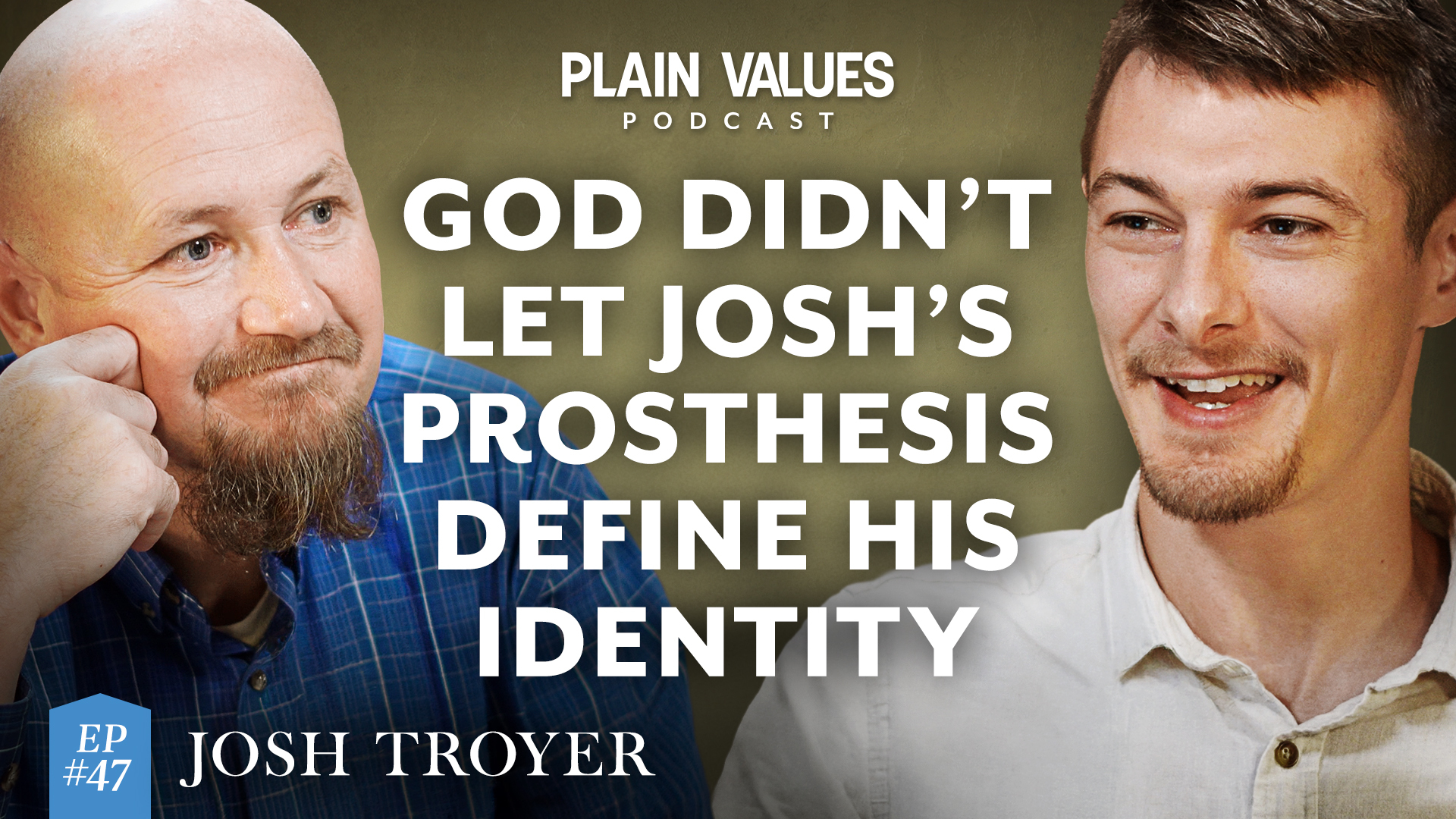
In this moving episode of the Plain Values Podcast, Marlin sits down with Josh Troyer to share his remarkable journey of faith, resilience, and finding true identity in Christ.
Born with proximal femoral focal deficiency, Josh was missing his right femur bone. At just two years old, he underwent rotationplasty, a radical surgery in which doctors amputated his leg at the hip, rotated it 180 degrees, and reattached it so his foot could function as a knee joint. At four, he endured another painful surgery with an Ilizarov device to lengthen his bones, a process that involved metal pins through his bones and months of discomfort.
As a child and teen, Josh wrestled deeply with his identity. He hated being known as “the cripple boy,” struggled with self-pity, and tried to hide his prosthesis. Through it all, his parents sought wisdom and trusted God’s plan. Josh shares how God spoke to him, reminding him that his true identity is not in his leg or his abilities, but in Christ. He began renewing his mind with Scripture, especially Psalm 139 and Ephesians 1, replacing lies like “I am unlovable” and “I am a victim” with God’s truth.
Today, Josh is a pilot, a pastor, and a father of three energetic boys. He credits his challenges with shaping his compassion and gratitude. He reminds listeners that God is the author of our stories, using every hardship to make them beautiful if we respond with trust.
This episode is honest, inspiring, and full of hope for anyone wrestling with their own limitations or identity. Josh’s story beautifully illustrates that our greatest challenges often become the very things God uses for His glory.
Learn more about Josh Troyer at https://www.youtube.com/@gospelhavenchurch
Learn more about Plain Values at https://plainvalues.com
Transcripts
0:00 – Introduction
01:23 – Family Roots & Becoming a Pastor
11:32 – Born Missing a Femur Bone (PFFD)
21:52 – Rotationplasty Surgery
25:27 – The Ilizarov Apparatus & A Father’s Wisdom
32:24 – An Active Childhood
42:34 – Wrestling with Identity
54:16 – Renewing the Mind & Embracing God’s Story
Josh Troyer:
They would cut off my leg, my right leg around the hip area and they would leave just the wiring, so to speak, like the nerves, the blood vessels, and they would rotate my leg 180 degrees so my foot now faces backwards.
Marlin Miller:
What do you think life would be like for you had you never gone through those things?
Josh Troyer:
I would not be the man I am today. And we have to remember that God is writing a story for each and every one of our lives and he’s using those challenges to make our story beautiful.
Marlin Miller:
I knew that this was going to be a great conversation. I didn’t know that it was going to be this great. I told you earlier that you and I have kind of been circling each other I think in a way peripherally, but we never really got to know each other and hang out until the last couple years. I used to work with your uncle.
Josh Troyer:
I see.
Marlin Miller:
I worked with Joel. I worked with
Josh Troyer:
Your uncle
Marlin Miller:
Joel. And then I remember hearing about Josh Troyer probably 10 or 15 years ago. I mean, it’s been a long time. How long ago did you move back into town?
Josh Troyer:
That would have been about 12 years ago that we moved up from Georgia. I grew up in Georgia. Mom and dad, they met down in Georgia. Dad moved down there looking for work probably 35 years ago or more. And then mom and dad met down in Georgia, got together, had all of us children down in Georgia. And then we moved up when I was 19 years old here to Ohio. So it was a huge culture shock. Going from redneck country we had mud bogging and truck poles and a lot of redneck stuff down there to Amish country. So people talk Dutch and I don’t know Dutch. People think I should know Dutch because my dad knows Dutch, but I can’t talk it to save my life.
Marlin Miller:
Can you understand some or not?
Josh Troyer:
A little bit.
Marlin Miller:
Little bit.
Josh Troyer:
So be careful around me when you’re talking.
Marlin Miller:
I
Josh Troyer:
Love it.
Marlin Miller:
So how many siblings do you have?
Josh Troyer:
There’s four of us, two brothers, two sisters, and I would be the oldest of all of them.
Marlin Miller:
Yeah. Your dad moved down for work. How old was he when he moved?
Josh Troyer:
Probably 23. If I was to guess, he was a brick mason up here. He helped his brother Furman and Vernon Troyer. Did a lot of brick mason work here in the area. And winter times they would get slow obviously. Winters are hard and it’s hard to lay brick when it’s snowing outside. So he was on his way down to Florida to get more work down there during the winter months and stopped off in Georgia. He had a friend named Stan Overholt that was like, “Hey, come hang out. ” And Stan introduced dad to my mom,
Marlin Miller:
Charity. That quickly?
Josh Troyer:
Yeah. And dad just decided to… Well, he made some trips down to Florida and back, but he hovered pretty close to Georgia after meeting mom and actually moved in to the house just next to mom where my mom lived with her mom and dad, which would be Walter and Mary Overhaul from Hartville, Ohio. And dad lived next to mom there right in the neighborhood. And so mom didn’t really have a choice but to date dad and to marry her. They even broke, I shouldn’t say this, sorry mom and dad, but they broke up for a portion in there and they ended up still bumping into each other because dad was living right next door. And so they had to get together again. That’s
Marlin Miller:
Funny.
Josh Troyer:
Well, thankfully for all of us children, they got married eventually and here I am.
Marlin Miller:
Is your mom from Georgia? Is she from down there?
Josh Troyer:
She was born in Belize. So my grandma and grandpa Walter and Mary Overholt were missionaries down in Belize. And that’s where mom was born. All kinds of crazy stories from their missionary experience down there. In fact, grandpa was held up for the first out of two times in his life by gunpoint the night mom was born because he was trying to cross the street from the hospital to go over and get some food at a gas station or a restaurant and they stuck the gun into his face and said, “Give me your wallet.”
Marlin Miller:
Oh man. And his little girl was being born across the road.
Josh Troyer:
Yep, that’s right.
Marlin Miller:
How long were they in Belize for?
Josh Troyer:
Oh goodness. I would guess maybe five years, but I don’t know.
Marlin Miller:
So I was in Hartville just last night and there are unbelievable amounts of connections between Holmes County, Ohio and Hartville, Ohio. Oh
Josh Troyer:
Yeah.
Marlin Miller:
And I think there’s Anabaptist, Mennonite, Amish connections. I don’t know much about Hartville family histories and things. I’ve got a few friends up there, but that’s about it. I don’t know much about Hartville, but it seems like a really great place to be and to know
Josh Troyer:
People. I still have family up there. Overholts. And there’s the Graber side as well that would also be related to me. Romy Graber would be my mom’s uncle. And yeah, he did a lot of excavating up there in Hartville area.
Marlin Miller:
That’s cool. Now did your grandpa, your daughter, did he fly? Did he do anything like that?
Josh Troyer:
No. I don’t even think he was thinking about flying. Actually, I remember one time going flying with my grandpa Overholt. We were flying commercially from Ohio back down to Georgia. And I looked over at Grandpa and he had his eyes closed and he was talking to himself. I was like, “Grandpa, what are you doing?” And he’s, “I’m praying.” So that was Grandpa Overhault. He got in a plane as little as possible.
Marlin Miller:
Yeah. Wow, that’s interesting. So you’re the oldest of your four siblings. What is your wife’s name?
Josh Troyer:
Brittany.
Marlin Miller:
Brittany.
Josh Troyer:
Used to be Miller.
Marlin Miller:
I don’t think I’ve ever met your wife.
Josh Troyer:
You should. She is a lovely woman.
Marlin Miller:
I’m sorry, you have to say that. Anyway, I’m sure she is. I’m kidding. Is she from here?
Josh Troyer:
She is. She grew up in the Southtilla area close to Yoder Lumber. Her parents would be Steven Almina Miller.
Marlin Miller:
Did you guys meet obviously after you were up here?
Josh Troyer:
Yes.
Marlin Miller:
Or had you known each other before?
Josh Troyer:
Oh no. This was probably four months after I moved up. We ended up going to the same church and actually the same kids club. There was a kid’s club in Clark that this church had a ministry to. And at the time when we moved up, she was over in Thailand with Igo. And I went to Kids Club when we moved up. And then she came back and came to Kids Club. And my first words to her were like, “You’re new.” And she was thinking, “Oh no, you’re new.” And we just started doing stuff together. Church, youth group, kids club. And I fell deeply in love with her.
Marlin Miller:
And you guys have three kids now?
Josh Troyer:
Three little wonderful and ornery little boys. Rhett, Kai and Barrett. They’re four, two and one years old. So they keep us very busy.
Marlin Miller:
Man, that’s cool. I love it. Well, let’s get into your… Now I’m going to jump ahead. Today, you were ordained not that long ago, right? As a pastor in your church. How long ago did that happen?
Josh Troyer:
That was in April of 23.
Marlin Miller:
Of 23.
Josh Troyer:
So about two and a half years ago is when I was ordained. Big life change. Brittany was pregnant with our second Kylin and he was born about a month, a little over a month after I was ordained. So a lot of life happening all in a very short amount of time.
Marlin Miller:
Yeah. Wow. Well, part of the coolest parts of your story in my mind are the things that you went through as a little guy, as a baby and as a toddler and all that with your leg. I mean, is it fair to say that it has really made you who you have become? That the Lord has used that to turn you into who you are today?
Josh Troyer:
Absolutely.
Marlin Miller:
This episode is being brought to you by our friends at Azure Standard. My buddy Spencer told me a while back about their new program called Around the Table. It is a chance for local churches to partner with Azure Standard. You can learn more at azurearoundthetable.com. But the cool thing about this is that the church gets to become a drop point and it causes these wonderful opportunities to reach out into the community. The people in the church and the communities get to order their food from Azure. The truck brings it by every month and it actually helps raise funds for the church and any ministry that they want. It is a beautiful program. Like I said, azurearoundthetable.com. And tell them Marlon and plain values sent you.
Josh Troyer:
God has used that in so many ways to teach me lessons, to teach me things about identity and who I am. It’s not what I look like. It’s not the way I perform. It is simply who I am in Christ. And that’s what God has taught me through this whole journey.
Marlin Miller:
Yeah. Well, let’s jump into the details. You were born with an issue with your one leg, right? Can you tell us about that?
Josh Troyer:
So when I was born, they handed me, wrapped me up in a blanket, handed me to mom and dad. And typical new baby greeting me, the excitement and joy. And then they took me away to clean me up after the delivery. And it was when I was in another room, there was a nurse cleaning me up and she had unwrapped the blanket and she noticed that my right leg was shorter than my left leg. And the more she looked at it, the more she realized something was definitely wrong. So she called in the doctor and the doctor had never seen anything like this before. So she called in her colleagues, other doctors and had just this meeting, powwow with the doctors there. And this is all in probably a two hour period and mom and dad had no idea. And then the doctor finally comes back into the room and brings me and the little bassinet wheels me into the room and just gently starts to tell mom and dad, pull back the blanket and show them what was going on.
My leg was malformed, I guess if you want to say that. They didn’t even know what condition this was called because they didn’t have Google or Google wasn’t readily available back then. This is 1995. And most of those doctors had never, none of the doctors had ever seen anything like this. And of course that was very emotional for mom and dad going from the excitement of welcoming their first child to how is Josh going to live a normal life? How is Josh going to be able to walk? And that began the journey of going from basically one doctor to the next looking for answers. How can Josh walk? How can Josh live a normal life?
Marlin Miller:
Can you put this into context for us a little bit? I mean, I’m imagining a little baby. Are you talking that it was an inch shorter or are you talking it was like three or four inches shorter?
Josh Troyer:
As a baby, the diference wasn’t very noticeable, but the anatomy of what happened basically was I was missing my femur bone. And as you know, the femur is the largest bon in the body. And essentially my hip and my knee were fused together right where your hip would normally be. And I had the lower part of my leg. So the tibia and the fibula below the knee, I had that. And I also had my foot, my ankle, my five toes. Everything was normal other than I was basically missing my femur bone. So the biggest hurdle was walking obviously. So if you imagine my foot as I would be fully grown would come out about where my knee is on my left leg. So I had about half the leg as a normal person. So it’d be hard to walk like that. The first thing that they did was get somebody to build a prosthesis for me, a fake leg, that was basically a platform where my foot could stand on top of and I could learn to walk.
They gave me that prosthesis at around 10 months old and I learned to walk around 13 months. But it was very stiff walking. I had no joint. I couldn’t move my foot. It was just very, very straight.
Marlin Miller:
So you were like it was a very –
Josh Troyer:
It was hard going and definitely not a good long term solution. And mom and dad knew that. So the first doctor they met with said we should just cut off Josh’s foot because that’s getting in the way of him walking. And then what he would do is just swing his prosthesis naturally when he walks. They didn’t like that idea because it felt too permanent. Once they amputate, there’s no going back. So they went from doctor to doctor to doctor. And this is not easy for mom and dad back then. I mean, they had very little money. The community down there in Jessup, Georgia where I was born really came together. It was amazing. They did fundraisers for me as a baby and mom and dad. And they gave them money to be able to travel around and visit doctors. And they ended up talking with a doctor in Atlanta, Georgia.
And he referred them to a radical doctor. He said, “There’s a radical doctor in Baltimore, Maryland.”
Marlin Miller:
Those are not entirely the words that your mom and dad were hoping to hear.
Josh Troyer:
At this point, they were kind of desperate. And so radical to them sounded kind of good.
Marlin Miller:
So they were looking for someone that would have the guts to try something outside the box?
Josh Troyer:
Yes. Basically. Yes, that’s right.
Marlin Miller:
Wow.
Josh Troyer:
This is Dr. Jor Paley. He’s a Jewish doctor that studied in Russia and came over to the States and he was practicing limb lengthening. And this is incredible, Marlon, how they do this, but he can take like a midget and literally stretch their limbs, their arms, their fingers, their legs, toes, everything. Stretch it all out to make them a full size person.
Marlin Miller:
From a few feet tall – To a full
Josh Troyer:
Size adult. To
Marlin Miller:
A full size five or six foot person.
Josh Troyer:
Yeah. And the way he would do this is with a device called an Alizaroff. And I think it’s a medical device, but I think it’s a device of torture. I’ll explain that more later. An Alizaroff has rings, metal rings that go out around like your arm or your leg. And then the rings have pins that are connected on each side and go through your bones, like your skin and bones. And it’s at different increments through your limb that they’re trying to lengthen. And then the rings are connected by bolts. And so if you tighten those bolts, it pulls and stretches the bones. So it would act a lot like braces for your teeth where you get different braces and it kind of pulls and stretches on your teeth. It would do that for your bones. And it’s as painful as you can imagine because little bits at a time they would keep cranking those bolts to get the length that they want.
Marlin Miller:
Are they doing that as early as they can in someone’s life so that the bones are not… I mean, you do that to me. I’m half old. You’d break something, right? They do it all
Josh Troyer:
Ages. Really? Yeah. They’re doing it. They can do
Marlin Miller:
That
Josh Troyer:
Without children, adults, all ages. They have formulas and calculations. If they’re doing it for like a child, they know about where their limb is going to end up when they’re fully grown. And so they do all those calculations and then they stretch it accordingly.
Marlin Miller:
That sounds incredibly… I don’t really have the words to even imagine how much that would hurt.
Josh Troyer:
So they show up at Dr. Deror Paley’s hospital there in Baltimore and they come in with a lot of hope that he can do that for me. And Dr. Paley, he was very kind and took a look at my situation and he said Josh will basically curse me over my grave one day if I do this for him because there’s so much stretching that would have to happen to his leg to make it full size that the muscles would eventually seize up later in my life.
Marlin Miller:
Was he going to stretch what bone was he going to stretch?
Josh Troyer:
I don’t know.
Marlin Miller:
I mean,
Josh Troyer:
Josh,
Marlin Miller:
You didn’t have a femur to stretch.
Josh Troyer:
I had a little bit. They did an x-ray after I was born and they found just a little sliver of a femur. So I really don’t know what they would have stretched.
Marlin Miller:
Oh man. Oh my.
Josh Troyer:
But thankfully Dr. Paley was just very honest. But obviously that was heartbreaking for mom and dad because they travel all the way from Georgia to Baltimore with hopes that this doctor, this radical doctor could do something for them and their little baby. And dad, in his desperation, he looked at Dr. Paley and he said, “If Josh was your son, what would you do? ” And Dr. Paley, I think with some hesitation said, “There is a procedure that we can try.” And he had studied some of the parts of this procedure in Russia and he thought it would be worth a shot. It’s called rotation plasty surgery. And it basically means they would cut off my leg, my right leg around the hip area and they would leave just the wiring, so to speak, like the nerves, the blood vessels. And they would rotate my leg 180 degrees so my foot now faces backwards instead of forwards.
And then that would allow my foot through therapy to become my knee joint. And mom and dad went away just thinking, praying it through. They took some time to consider it. And through prayer and talking with other people decided that this was the best course of action. And so at two years old, I went up back to Baltimore for this. It was a pretty major surgery. It’s about 10 hours where they did that, they cut off my leg, turned it around backwards, put it back on. And when I woke up, I was in a body cast. The body cast covered my entire right leg up around my hip and then partially down my left leg as well and just to hold everything in place. That was for several months. And then eventually I got the body cast off and then it was therapy and learning.
So the way I walk now, when I stand up straight, my foot is pointing straight down into my prosthesis. But when I’m sitting down or I bend my right knee back, I’m basically bending my foot to like a standing position, a 90 degree angle from my leg. That’s how my knee joint works. And some people ask, is that hard? Was that hard for your brain to learn to walk that way? And my answer is that this is totally normal for me because I was just a baby when they did this. So the way I walk today is how I’ve always walked.
Marlin Miller:
So I have a question. You’re two years old and you’re doing this therapy. You said you had learned to walk a little bit at 13 months,
Josh Troyer:
Right.
Marlin Miller:
Did they give you the prosthesis right away?
Josh Troyer:
After the surgery, there was a new prosthesis that I had to get because it was made differently than where it had a joint actually.
Marlin Miller:
And your foot, your ankle had to get used to turning the other way.
Josh Troyer:
That’s right. That’s right.
Marlin Miller:
Wow.
Josh Troyer:
So I learned to walk again, but that’s the way I’ve been walking ever since that surgery after two. But then at about three to four years old, they discovered that my bones were not growing correctly. And so now enters the Elizarof that I was talking about earlier.
Marlin Miller:
Wait a second. I was assuming you never did anything with the Elizaroth.
Josh Troyer:
Yeah. Unfortunately, I had to have an Elizarof. Really? So I don’t know what exactly the problem was, but they discovered when I would be fully grown, my bones would not be grown correctly. And so that meant another surgery where they went in and I think they broke my bones in about three different places in my right leg that had already had surgery. And they put this Elizareth on, woke up with the braces, the wires going through bones, the bolts. And you’re how old? It was so painful. I was four.
Marlin Miller:
Four years old.m.
Josh Troyer:
That was probably the most physically painful time of my life. Wow. I mean, mom had to clean those pinholes three times a day just to keep me from getting an infection where the pins would go through my bones and into my skin and through my bones. And that was a painful process. She’d have to take a tip and just circle around the pins. And it was always that dreaded time of the day, but it had to happen three times a day. And I still ended up getting sick. And by the time I got home from the hospital even from Baltimore, I already had an infection and they had to have the family doctor come make a house call. This was back when the country doctor would actually make a house call and they came and she checked me out. And yeah, it was a hard time, but they had a lot of community helping them through.
We had people staying with us constantly just helping them because by that point, mom and dad had my brother Austin and he was a few months old. I was in a wheelchair with this Elizrof. And so it was a real entourage whenever they would go somewhere. I was in my wheelchair and had to be pushed and Austin was in his baby carrier and had to be carried. So mom and dad went through a lot.
Marlin Miller:
Have you ever talked to your dad about, and I’m assuming you have, but what was that like for him watching you go through the pain of the Elizaroff at four years old knowing that this is on me in a way? Did he ever struggle with, did we make the right call?
Josh Troyer:
I know for sure mama and dad both struggled with that. They told me that later they basically, the way they made the decision was Josh, if you ever want to, you can always just get your foot amputated later. But looking back, I’m so thankful that God gave me not only godly parents, but parents that sought wisdom. The way dad made that decision, mom and dad made that decision was seeking wisdom from God. Dad talks about wisdom all the time. And growing up, he would tell us children, seek wisdom. And like it says in James, if you ask, we have a generous God that will give us wisdom. And mom and dad were seeking wisdom through that entire process over and over. And so I have so much to be thankful for that God gave me parents that valued wise decisions.
Marlin Miller:
I can imagine that the temptation would be to second guess things
Because of the current pain. And I am Yeah. I’m impressed with your dad and obviously your mom too, that’s not what I meant. But those are hard things. Those are really, really hard things. And then to have to deal with the repercussions of those decisions and the fears of, is this going to turn out the way that we think? Is this going to turn out to be the best thing? 2020 backwards is easy. That’s easy. Looking at history, we were talking about history books. Some of the most incredible things happen in the hardest of times and people with character and wisdom will rise or not rise to that occasion. Well, it’s one thing for you and I to be reading through a Winston Churchill book and looking back and saying, “Well, yeah, of course England was safe and it did not fall to Hitler.” They didn’t know that at the time.
And being in the middle of those situations is a whole other ball of wax. And so that’s incredible.
Josh Troyer:
It’s why Proverbs says it’s better to seek wisdom than silver and gold. And so dad, even today, I work with him. We have a marketing company in Berlin. And over and over, whenever we experience a problem at work, he’ll tell me, he’ll tell our other team members, “Seek wisdom. Ask God what to do first. Don’t make it your B or C plan. Make it your A plan. If you don’t know what to do, ask God for wisdom.” And so that’s one of the greatest lessons dad has taught me and one of the greatest gifts he has given me. And I think a lot of that was born out of that experience with me making decisions for me early in life. But then also dad had, he was a business owner too. Had a lot of business decisions. So I consider that a gift, that lesson about valuing wisdom in our lives.
Marlin Miller:
So now let’s go back. Yo were four or five years old. How long did you have to live in that pain? Did it hurt all the time or did it come and go?
Josh Troyer:
There would be moments where it was worse than others. I mean, I was four. So I have spotty memory, but the memory that I do have was pain. One of my memories, I can’t remember if this was the first surgery or the second surgery, was basically waking up screaming with mom holding me. And all I could do was scream. And I think about that a lot now that I have three little boys and they kind of each hit those stages where I was at less than 30 years ago. I’m 30, so that would be a little bit less than 30 years ago. But when my sons turn two, that brings back memories of my first surgery. And then my oldest son right now is four and it breaks my heart when he gets sick, like a little flu bug. So I can’t imagine how mom and dad worked through that pain.
I know it was God just watching over them and walking with them. Mom has this cool story.
One of the verses that she was reading one morning for devotions was Joshua one: nine be strong and have a good courage. And there was a rainbow that came through the window of the living room and it just came down and it landed on her Bible right on that verse. And there was just so many of those moments that mom and dad experienced where it felt like God’s presence was there and very real. And I take that personally too because where it says in Psalms 139, before how precious are your thoughts, oh God. I’m fearfully and wonderfully made. My substance was not hid from thee when I was made in secret and curiously rotten the lowest parts of the earth. Before I ever knew God, he knew me and he was there.
Marlin Miller:
And he knew exactly what was going to happen. And he did it on purpose in a way allowed it to happen. So go back to how long you were there. How long was that thing on your leg?
Josh Troyer:
Oh goodness. I don’t know. I’m just looking at my notes. I don’t know how long it was there. It was probably about six months.
Marlin Miller:
Okay. So that comes off. You go back into surgery to take it off, right? Did they pull the pins out or did they leave them in there?
Josh Troyer:
They are still in my leg. Really? I didn’t have to do another surgery. I think they clipped them. I don’t know how they did it.
Marlin Miller:
Wait, I got a question. This thing was on your tibia or your fibula?
Josh Troyer:
I don’t know. They’re turned around so that makes it really complicated for me. I really don’t know which it might have been both.
Marlin Miller:
Okay. Because in a way you’d think they’d almost have to do both so that they would be able to stretch together and not mess each other up. Boy, oh boy. So if that’s the case, Josh, you had a double dose. Oh man. So this thing comes off. Did you have to go into more therapy to relearn things?
Josh Troyer:
I think that was about the end. As far as surgeries, therapy, after the Elizro came off, mom and dad and myself started to experience normal life. Whatever normal looks like after you go through all of that, the first four years of your life, I would say life became normal. The challenge became more mental and less physical after that because I could as far as getting around, I was a very active child. And mom and dad remind me all the time how active I was, especially when my boys are active. They said, “Yeah, that’s exactly what you did, Josh.” And I loved riding a bike. I loved playing football with my friends, my buddies. There were so many circumstances that became a little bit unusual having a prosthesis. I would play football and often I was the quarterback and the 200 pound linebacker would come across the line and he’d sit on me and my leg and it would snap.
Marlin Miller:
Did it freak him out?
Josh Troyer:
No. Everybody knew what was going on. Yeah. And so I would just have to take my leg and overnight it to Florida. Literally break. This was normal. So I hobble around the house for a few days on crutches. We overnight the leg to Florida. They fix it, send it right back. Not many people can do that when they break their leg. But I think mom and dad got a little bit tired of doing it because it would happen so often that I would break my leg and we have to ship it to Florida. I’ve had to slow down since. But yeah, swimming, riding a bike, I got to do it all. And thankfully because of those decisions that were made early in life and the wonderful job that Dr. Paley did, I got to live a normal life. And interesting fact, Dr. Paley now, I was kind of his prototype for that surgery, that rotation plasty surgery.
Marlin Miller:
You were the first one.
Josh Troyer:
Yes. Wow. And now he teaches doctors around the world. He has an institute in Florida called Paley Institute. And he specializes in limb lengthening and that rotation plasty surgery. And he’s had me there. He’s taken me to his conferences a few times to show off his work, so to speak. And yeah, it’s pretty incredible to have doctors from around the world there learning this technique. And he likes to touch base and see how I’m doing because I’m like his longest existing patient with that surgery.
Marlin Miller:
Does this sort of thing happen more than I would guess?
Josh Troyer:
It does a lot more now. Now I forget what the percentages of my condition. It’s pretty rare. The official term for it is proximal femoral focal deficiency. PFFD for short. So you can look it up, you can Google it and get more pictures and illustrations about what this is. But more recently they are doing it for children and even adults with cancer. So if the femur bone or femur develops cancer, they can remove that and do exactly what they did for me with the rotation plasty surgery, turning the leg around 180 degrees so that they can live a normal life after removing their femur or their thigh.
Marlin Miller:
Wow. I mean, that’s just simply taking what they figured out with you and applying it to another need. That’s incredible.
It is. Wow. Okay. Let’s jump into the hard stuff. We’ve been publishing Plain Values for almost 13 years now. And about a year ago, the team and I decided to put together a compendium, a best of, if you will, of our favorite stories, the most impactful stories of all those years. And Invited is what we built out of those conversations. It is 194 and four pages and it is absolutely a thing of beauty. We do a monthly gathering here where we just simply open our doors. It’s called PorchTime. And the story of how PorchTime came to be and how our family was invited into that and how we are inviting you and every Tom, Dick and Harry, anybody who wants to come can come and hang out at PorchTime here at the office in Weinsburg. So it was such a natural fit to use the home of the founder of PorchTime and to call it Invited.
You can find it on plainvalues.com on the shop page and you can now consider yourself invited. All of these things have just probably played a huge havoc in your own self-esteem and your own image of yourself and all those things. Talk about that. I mean, what did it do to you?
Josh Troyer:
I really struggled with who I was after that. And it happened progressively or slowly over time, but I would say it really came int full swing about seven, eight, nine years old where I really struggled with who God made me to be. I didn’t like it. I wanted to be normal. And the more I would go out into public and I’d wear shorts where other people could see my prosthesis. I would catch glimpses of children looking and pointing because they were curious. It’s a normal thing to be curious. And the more attention I got from that, the more self-conscious it made me feel. And sometimes kids would say some things that were kind of hurtful. I remember one time I was wrestling with my buddies and just like normal kids do. And I was losing. This was a case where I was losing, which was not totally abnormal.
And one of my friends called out and said, “Don’t hurt the cripple boy.” And those comments, I would try to laugh them off, but they would play in my mind over and over again. And I would say to myself, “I don’t want to be known as a cripple boy.” And those years too, I was learning about God, this God that was a healer, a miracle worker. And I learned from mom and dad and Sunday school that if you have enough faith, God will answer your prayers. And so I began to pray at night in my bed that God would give me a normal leg. And boy, I prayed with faith.
I would pray with tears coming down my cheeks. And in the morning I would wake up and I would feel down from my leg to see like, yeah, God’s going to do this. God’s going to give me a real leg in the morning. And it wasn’t there. And I had to wrestle with that over and over. What is the purpose of this pain? Why did God make me this way? Does he care about what I’m going through? And that was where I began the journey of my identity and understanding what a healthy identity is and what a unhealthy identity is. And the verses that I would read over and over, it became my favorite chapter, Psalm 139, where it talks about my substance. Thin eyes did see my substance yet being unperfect.
And in that book, all my members were written, which in continuance were fashioned when yet there was none of them. And I began to think and process those verses and realize that God does not make mistakes. God has a purpose for every detail of our lives. If he’s written it all down before we were ever made, then obviously God had a plan for leaving something out, which to me, that was my leg. And then I began processing that even more so regarding circumstances and events of our lives and realizing that God not only has a plan and a purpose for the way our physical bodies are created, but he has a purpose and a plan for the circumstances and events of our life. There’s a reason that we were born in the country that we were born in, in the family that we were born in, the community that we were born in.
God has a plan and a purpose for all of our lives. The sooner we wake up to that plan and purpose, the sooner we can start to understand what our true identity is in Christ Jesus.
Marlin Miller:
Did you ever get angry and like as a teenager go drinking or rebel? No?
Josh Troyer:
No. I struggled. Instead of anger, I struggled with self-pity and I struggled with labels. So anytime somebody struggles with our identity, they’ll lash out in one way or another. And my way was to kind of cover up my shame. I wanted to cover up who I was physically and emotionally. As
Marlin Miller:
You got older, did you keep on wearing shorts? No,
Josh Troyer:
I stopped. You stopped.
Because I was ashamed. I didn’t want people to see that I had a prosthesis. I wanted to be normal. And I also, this is funny, this is leading into one of my hobbies now, which is flying. But when I was 11 years old, I started flying. I got ahold of a flight simulator that dad had a flight simulator in 98 and installed it on an old computer and started learning how airplanes worked and flying a lot on the flight simulator. And one day I was like, “Hey, mom and dad, can I go take flying lessons?” For
Marlin Miller:
Real. Yeah. I was
Josh Troyer:
Like, “This would be fun.” And they had to take some time to think about it. But for my 11th birthday, I’ll never forget, dad surprised me by getting one of his buddies to take me on an airplane ride with a small airplane. I’d always been on airlines, big jets, but never a little airplane. And I was so nervous I felt like I was going to puke. But that 15 minute ride kind of changed the course of my life in a way. And man, he was a redneck too. He took me up and his Southern accent, he’s like, “Y’all want to do a wing over?” I was like, “Okay.” And a wing over is basically you pull back on the nose of the airplane and then you get it close to stall speed and you turn it upside down. And I was freaking out. I closed my eyes somewhere in the process.
And when I opened them up and looked out the window, all I could see was trees because we were facing straight down.
Thankfully I didn’t puke. This is like a little Cessna. Yeah. 152. Cessna 152, just two seats. And then after that, he’s like, “Y’all want to do a neck tie?” Okay. And so the necktie is where he pulled back really fast on the controls and it puts a lot of pressure and G-forces on your neck, makes it feel all swelling and heavy. But when I got down, I was like, “I want to do that again.” Not all the aerobatics, but I wanted to start flying lessons. And so dad scheduled flying lessons with a local instructor, Mitch Sutton, good mentor of my life.
Yeah, that was quite the ride, but it became an unhealthy part of my identity for a little while because whenever I had a conversation with people, I wanted to talk about airplanes because I wanted people to start knowing me as the guy who flies and not the cripple boy anymore. I did not want to be the cripple boy. And that label making followed me through my teen years. It was flying. Flying was one of them. Work was another one. I ended up working for dad. He had a fence company and I became a gate technician. He installed a lot of fence, but he also did a lot of automated gates for communities. It involved programming phone systems and keypads and stuff. So this was 17 years old. I was going out working on these automated gates. And I loved the work, but it again became part of my identity.
And whenever I would have conversations, I would try to direct it where they would ask, “What do you do? ” And then I would get to talk about all the technical geeky stuff that I did because I thought if they could know me as a gate technician or a pilot, it would be better to be known as those things than a cripple boy. But that all changed when we moved up from Georgia.
Marlin Miller:
This episode is brought to you by Homestead Living Magazine. Homestead Living is a monthly print magazine that interviews all the big names in the homesteading world and they focus and educate in a wonderful way. You can learn more and subscribe at homesteadliving.com.
Josh Troyer:
God has a way of, if we hold onto something too tightly, he’ll eventually take it away from us. And when we moved from Georgia, I kind of had to start over in the community up here in Ohio. And they didn’t know I flew airplanes. I didn’t have a job. So I couldn’t talk about that. And so the first thing people would see is my limp and ask what was wrong. And I’d tell them my story. And so it felt like all over again I was becoming known as the cripple boy. And God had to take me on a journey. He spoke to me. It was almost audible, but it was loud enough that I could hear. And he said, Josh, I don’t want you to be known as a pilot or a gate technician or even the cripple boy. When people see you, I want them to see me.
I want them to see Christ.
Marlin Miller:
Changes everything. Everything. Wow. What happened after that conversation? Did it quickly, I don’t want to say immediately because I doubt it happened immediately, but did it quickly change your perception of yourself or did it take a long time?
Josh Troyer:
It took a while. When Romans 12: two says, “Be you transformed by the renewing of your mind.” That’s not an easy process. So there’s a difference between your mind and your brain. Your mind is that spiritual unseen part that connects us to God. But our brain is the physical matter in our heads that affects our body. And our neurons, when we believe something, our neurons have connected each other in pathways that are really hard to break. And in order to break those, you have to begin… It begins with knowledge. So God’s word is the best place to start. And I had to go back to the Bible and memorization helped me. Where I was believing lies like I’m unlovable. I’m a victim. Some people believe the lie, I’m unforgivable. Those are kind of the three most common lies that people struggle with. And for me, the lie of I’m unlovable, it wasn’t like all of me felt unlovable, but it felt like a part of me was unlovable.
Some people, depending on their upbringing, maybe it’s an abusive relationship or a broken home, they can feel like all of them is unlovable. And then others feel like part of them is unlovable like me. The other lie is I’m a victim. And I have that tendency to have a pity party. I love a good pity party. I love to feel sorry for myself. But I had to recognize that that’s actually, it’s going against what God is telling us in scripture. It’s a sin to believe that lie. And this whole identity topic goes all the way back to Genesis chapter one and three because Satan wanted Adam and Eve to believe a lie about themselves, that they could be like God and it broke creation. That lie broke creation. And so we are constantly going to be fighting against the lies of Satan, trying to change our perspective about who we are in Christ.
We have to go all the way back to Genesis chapter one where it says we are made in the image of God. We’re image bearers. That means we have a soul. We have a responsibility to God and to eternity. We have a responsibility to treat each other as image bearers also of God. And so when you’re trying to change things from an unhealthy identity to a healthy identity, you have to identify those lies and kind of bring them to the surface, write them down. And I had to recognize those in my own life that I’m believing those lies, that I’m unlovable and I’m a victim. And that is not what God’s word says about me. Ephesians chapter one is a great chapter when it comes to breaking those lies. When it says I’m unlovable, Ephesians chapter one: four says, “Even before he made the world, God loved us.
I’m unforgivable.” Verse seven says, “He purchased our freedom with the blood of his son and forgave our sins. And that lie, I’m a victim.” Verse 11 says, “He chose us in advance and he makes everything work out according to his plan.” So the first step To switching from an unhealthy identity to a healthy identity is recognizing the lies and then counteracting them with the truth of scripture, going back to who God says we are and not who Satan says we are.
But knowledge doesn’t always equal belief. So I would memorize these verses. I knew the truth, but I had to repeat it over and over until those neurons in my brain developed new pathways. So when somebody would ask me, “Josh, what happened to you? Why are you limping?” Instead of my brain going right away to I am a victim and feeling sorry for myself, I had to develop new pathways to, you know what? I have a lot to be grateful for and I’m glad to share my story with you. But that took a process. I think the science might be three to five years to transform your mind.
Marlin Miller:
Wow. And by the way, it’s not only you doing it. I mean, you have to continually go back and ask him to help.
Josh Troyer:
Always.
Marlin Miller:
Because we’re so broken that we don’t do it on our own very well. So at 19, you hear that voice. It takes a couple years. Boy, how do I ask this? What do you think life would be like for you had you never gone through those things?
Josh Troyer:
I would not be the man I am today. I love hearing other people’s stories. I love sitting down with people as a pastor. I get to do that. I love meeting with people and hearing their stories because I have a story too. And I think our stories can be very similar even though mine is unique in its own way. We all have challenges to deal with and in a way those challenges are the same. I would not enjoy hearing other people’s stories as much as I do today. And I don’t think I would sympathize with people as much or feel the pain that they might be going through. I’ve met with different families and children who are going through the same thing. That’s always a privilege to meet with those people. I would not be able to relate to them at all if I didn’t have those experiences.
And that’s been fulfilling to see the way God has used those challenges in my life to make so I can relate to people today.
Marlin Miller:
A friend of mine sat in that chair just on Friday, just a couple days ago. And he has a quote that I’m going to steal it. I think I’m going to steal it and make it my own because I need to remember it. And I’m probably going to butcher it and I’m sorry, but Kevin says something to the effect of, “With enough explanation, almost any and every action can be explained.”
Josh Troyer:
That’s good.
Marlin Miller:
It’s so good because when you meet families who are going through tough things and it seems like just a very human thing to say, “Why are you doing that? You should do this. You should do that. ” And you want to should all over yourself because you want to tell them what you know and you want to tell them what they’re doing wrong and how they should do something different. But man, oh man, there’s always a reason that they are doing what they are doing. It might not make sense to us. It might not make sense to me, but if I understood and I heard and I though for more than a second and a half, I would probably understand it a bit better. And I just really appreciate that thought from Kevin because I am broken enough that I need to… I just need to remember it
Josh Troyer:
All
Marlin Miller:
The time with everybody that I get to meet. So today you get to tell stories, you get to hear stories, you fly, you’ve taken our family up a few times, which by the way, they are itching. Our boys are itching to get up there with you
Josh Troyer:
Again. I love taking Miles and Benny.
Marlin Miller:
Miles wants to sit in the front seat this time. Something awful. He can’t wait. That’s great. So that’s on the agenda to book next. To land the plane, pun intended. What thought or what would you have to say to someone who is struggling with any, from a physical deficiency to a heart issue? And I don’t mean that in the physical sense. What would you tell someone who is really wrestling with, “Why did God make me this way?”
Josh Troyer:
We all have challenges. Some of those challenges are more obvious than others like mine. Mine was pretty obvious, but we all have a choice to make in how we respond to those challenges. And here’s a perspective that really helped me out. One of my hobbies is reading. I love a good story. And we were talking about some biographies before we started recording and I love reading about people who experienced challenges in their life and then overcame them. I just read this great book, The Happiest Man on Earth by Eddie Jaku. He’s the survivor of the Auschwitz concentration camp. An incredible story of someone overcoming a significant challenge. And you think about what makes a good story.
If I read the book and I just read the beginning and the ending without the challenge, it’d be a very boring book. The greatest books that we read have a great challenge that is overcome. And we have to remember that God is writing a story for each and every one of our lives and he’s using those challenges to make our story beautiful. Remember he is, as it says in Hebrews, Jesus is the author and the finisher of our faith. And so he uses those challenges in our lives to make our stories beautiful. Our responsibility is how we respond to those choices every day. We have the choice to embrace our challenges, to choose gratitude or ungratefulness. And it goes back to renewing our minds. That process of renewing our minds is a choice every single day that we make. So that’s what I would tell people.
That’s how I would encourage people. Don’t run from your challenges. Embrace the story that God is writing for your life and recognize that those challenges are part of making your story beautiful.
Marlin Miller:
Josh, I don’t think there’s anything else to ad. I knew that this was going to be a great conversation. I didn’t know that it was going to be this great. Thank you very, very much for making the time.
Josh Troyer:
I’m so honored, Marlon. It’s always fun to talk to you.
Marlin Miller:
We’ll have to do this again. Maybe as your boys grow up being able to hang out. My goodness. Josh, thank you very, very much. This is great.
Josh Troyer:
I’m so honored. Thank you, Marlon.
Brought to you by …

🤝THIS EPISODE’S FEATURED SPONSOR: Azure Standard
Talk about a mission-oriented company; our friends at Azure Standard set the standard of excellence when it comes to sourcing nutritious food for your family.
They have a new program called “Around the Table” that nourishes by walking shoulder-to-shoulder with churches and church communities. It’s wonderful!
Learn more: https://www.azurearoundthetable.com/ from Plain Values’ mission to share the gospel amid infertility, adoption journeys, and special needs advocacy, this 194-page volume renews hope and affirms the beauty of simple, purposeful lives.

🤝THIS EPISODE’S FEATURED SPONSOR: Kentucky Lumber
Our friend Derek Guyer at Kentucky Lumber is the type of guy that you want to support. He is a highly-skilled tradesman who exemplifies excellence in everything he does. Kentucky Lumber is an independent lumber yard that truly does world class work!
We would humbly ask you to support them with your lumber needs: http://www.drywallhaters.com

🤝THIS EPISODE’S FEATURED SPONSOR: Homestead Living Magazine
Homestead Living magazine sets the standard for inspiring wisdom-filled homesteading content: actionable tips for organic growing, food preservation, delicious recipes, and uplifting true stories that feed body and soul.
Learn more: https://homesteadliving.com/homestead-living-magazine



Leave a Reply