
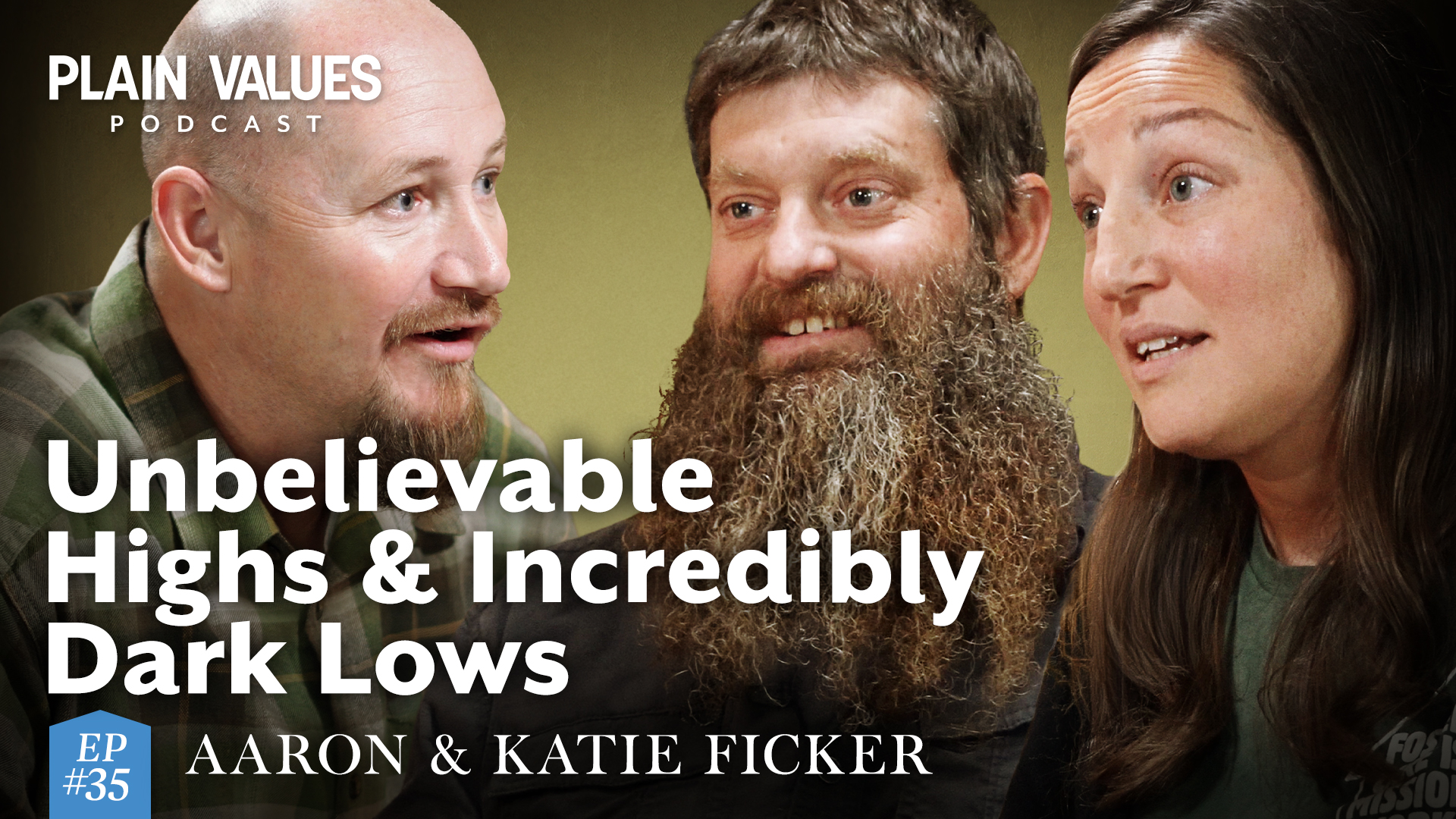
In this episode of The Plain Values Podcast, Marlin sits down with Aaron and Katie Ficker for the first of several conversations.
Aaron, the oldest of eight, shares what it was like growing up as his family followed the Lord’s call from Illinois to Guatemala. His dad, a corporate pilot, gave up a successful career, bought an old school bus, rebuilt it, and drove the family through Mexico to answer what they believed was God’s direction. Aaron describes the adventure, the challenges, and the faith that carried them through a spiritually dark and difficult time in a war-torn area.
Katie shares how she first went to Guatemala on a short-term trip while in nursing school, fell in love with the people and the work, and decided to stay. She talks about the clinics they helped run, the deep needs they saw, and the way the Lord used their obedience in hard places.
The conversation touches on the realities of serving in a remote area during the tail end of civil war… the poverty, the spiritual darkness, the broken family structures, and the hope that slowly grew as trust was built over time. Aaron and Katie reflect on how their parents’ radical obedience shaped their own lives and how they continue to seek the Lord’s leading as they raise their own family.
This honest and encouraging discussion is filled with stories of faith, sacrifice, and the quiet ways God works through ordinary people who say yes to His call.
Learn more about Plain Values at https://plainvalues.com
Transcripts
00:00:00 – Introduction
00:02:29 – Aaron’s Childhood in Southern Illinois
00:05:26 – Adoption Story
00:09:04 – Driving a School Bus to Guatemala
00:12:32 – Sally the Dog
00:16:25 – Katie’s Background
00:20:49 – Bringing in Bush Planes
00:26:16 – Setting Up the Rural Clinics
00:31:48 – Living at the Orphanage & Digging a Well by Hand
00:35:23 – The Harsh Realities of the Civil War
00:41:34 – Ministering to a Traumatized Generation
00:44:31 – Serving Out of Obedience vs. Personal Revival
00:48:36 – How to Pray for Aaron and Katie
Aaron Ficker:
At one time we had nine horses and we were actually riding out to do clinics on horseback. And that was a way we got around. There were very few roads. There was paths everywhere, but no roads.
Marlin Miller:
Your folks felt the call to move. Your dad buys a school bus, right? Rips it apart, rebuilds it, and drives down through Baja all the way to Guatemala.
Aaron Ficker:
I mean, they were seeking the Lord and really felt called to Guatemala. And it wasn’t like we want to go to Guatemala because we could be used. It was like, we need to go to Guatemala because this is what the Lords ask us to do.
Marlin Miller:
Aaron and Katie Ficker have been all around the world. This first time together, we talked about the journey that Aaron’s folks took, his family on. He’s the oldest of a whole bunch of kids and the stories of them packing up an old school bus and driving from Illinois to Guatemala. It is absolutely a wonderful story. Some unbelievable highs and some incredibly dark lows. This is the first of a few conversations that we had that’ll be coming your way. Please meet my friends, Aaron and Katie Ficker. And if you like the content, if you get anything out of it, I will very humbly ask you to like and comment and smash that subscribe button. Thank you. This podcast is sponsored by my friends at Azure Standard. A while back, I had a chance to sit down with the founder, David Stelzer, right here at the table.
And we had a great conversation. I love the Azure story. They started out as farmers back in the ’70s and I think in 1987 they began a nationwide food distribution company. And guys, they are non- GMO, organic. They do it right. They do it so well. And you can get a truck to drop food right in your town. Check them out at Azurestandard.com and tell them Marlin and Plain Values sent you.
Give me a quick summary of how you guys both grew up. As far as your childhood, your siblings, where you lived, what your childhood was like, that sort of thing.
Katie Ficker:
Go ahead.
Aaron Ficker:
Yeah. So we grew up in Southern Illinois in a small farming area. A little acreage, and I’m one of eight. I was one of six at the beginning, I guess, obviously in the America years. Yeah. Small farm. It was a good life, a town of 900. And I guess we were handy. Always kind of think outside the box people. I say that as kind of talking about my parents, but we were always different and okay being different and always kind of go- getters and not scared to take things on that were out of the ordinary or challenging or not afraid.
Marlin Miller:
Are you the firstborn?
Aaron Ficker:
I’m the oldest.
Marlin Miller:
You’re the oldest. Okay. Oldest of eight.
Aaron Ficker:
Oldest of eight.
Marlin Miller:
Now today.
Aaron Ficker:
Yeah.
Marlin Miller:
So are your folks still here?
Aaron Ficker:
Yeah.
Marlin Miller:
Okay.
Katie Ficker:
Well, in Guatemala.
Marlin Miller:
Okay. Yeah. What’s your dad like?
Aaron Ficker:
Dad’s full of energy. I mean, he’s always seems to be happy. He’s always energetic. He’s an encourager. He’s fearless. He’s got a real passion for the Lord and he’s very … What would you say?
Katie Ficker:
Very verbal, very vocal about it. Not in an abrasive way, just very excited to share anything and everything
Aaron Ficker:
About the words. And the Lord touches him and he’s … Yeah. Absolutely. I mean, he is a great father. He’s been volume.
Marlin Miller:
How
Aaron Ficker:
About your mom? My best friend probably, honestly.
Marlin Miller:
Yeah.
Aaron Ficker:
Really? Yeah.
Marlin Miller:
Wow. Boy, that’s great.
Aaron Ficker:
My mom is … Yeah. How do I describe mom, I guess?
Katie Ficker:
His mom is Erin in female form. Is she a steady- She’s the behind the
Aaron Ficker:
Scenes.
Katie Ficker:
Calm. Yeah. Quiet. Steady calm. Very discerning. Observing.
Marlin Miller:
So your folks make just this killer team.
Aaron Ficker:
Yeah. They really do. They’re a good partnership.
Marlin Miller:
Wow. So they had six, you’re the oldest, five behind you, and then they adopted two more?
Aaron Ficker:
Years later, they adopted two more. They were girls that came into the clinics in Guatemala.
Marlin Miller:
How does that work? How does a mom and a dad that move their family to the mission field, how do they care for tons, tons and tons of people, probably tons and tons of kids. And then all of a sudden they’re like, “I think we’re going to adopt this one and maybe that one too.” How does that work?
Aaron Ficker:
I mean, I think some of that might be best coming from them, but they … I think that they … I mean, the girls came to the clinic. Grace was dying of malnutrition. Her parents, they have different stories. Grace was the older one. She was in real bad shape. And actually, Katie was down at that time. She was working as a nurse and did a lot of their care. And so they …
Katie Ficker:
I’ll clarify. I came down when they were about nine and seven months old, but where I thought Erin was going to go is when Grace came in as a little baby, she was severely malnourished and his sister, Hannah, was one who stayed up at night making sure she made it through the night. Oh my. And that’s where I thought you were going. But yes, I did come when they were just, I think, seven and nine months. And yeah, I mean, it’s been a part of my life.
Aaron Ficker:
Grace was her parent, her mom got real sick in the hospital through a bad surgery and she was number 12, I think, or maybe- I
Katie Ficker:
Think so too.
Aaron Ficker:
Something
Katie Ficker:
Like that. Between 10 and 12, yeah. She’s a
Aaron Ficker:
Mayan girl and there was not a bond created between mother and her because mom was in the hospital for so long while we were taking care of her. She was actually being nursed by her older sister and there wasn’t … I mean, they didn’t have enough food, so there just wasn’t enough. And she came to us in bad shape and I think that we basically got her healthy again and talked to the parents and said, “Hey, she’s ready to go back home.” And they were like, “She would be better with you than she would ever be with
Katie Ficker:
Us.” And I think that was more from overwhelmed than anything.
Marlin Miller:
Birth mom said that. Yeah.
Aaron Ficker:
And
Katie Ficker:
Dad’s parents. And really dad, mom was still healing. I mean, it was a pretty traumatic surgery for mom. She just wasn’t even physically there for some of the beginning days of … And so dad, I think, was a big person in saying we’re struggling to get by and we don’t know how we can care for another one.
Aaron Ficker:
And what’s neat about that is that she was given to our family out of love because they knew that was what’s best for her. And it’s cool because we still have a relationship with them. I mean, Grace will see them on a …
Katie Ficker:
Here and there.
Aaron Ficker:
Yeah, every so often, and it’s neat.
Marlin Miller:
You said the typical question is how did you guys end up in Guatemala?
Katie Ficker:
Yeah.
Marlin Miller:
So that’s a little bit … How old were you when your folks built the bus?
Aaron Ficker:
Well- 18? Yeah, it would have probably been around 18.
Marlin Miller:
So just give me 30 seconds here, Aaron. Yeah. Your dad … And I’m going to butcher this because it’s all from memory from our first conversation, I don’t
Katie Ficker:
Know,
Marlin Miller:
Four or five, six months ago,
Katie Ficker:
Which
Marlin Miller:
By the way, we should actually share the story of how we actually met.
Katie Ficker:
Absolutely. Which is
Marlin Miller:
Pretty
Katie Ficker:
Cool. Absolutely.
Marlin Miller:
But your folks felt the call to move. Your dad buys a school bus, right? Rips it apart, rebuilds it, and drives down through Baja all the way to Guatemala.
Aaron Ficker:
Yeah. To make it short, I mean, they were seeking the Lord and really felt called to Guatemala. And it wasn’t like we want to go to Guatemala because we could be used. It was like, we need to go to Guatemala because this is what the Lord’s ask us to do. And it was not easy for them. It was not easy for my dad. He gave up a life of … He was a corporate pilot, flying fast jets, going across the country, flying important people, politicians we all know, and he had
Katie Ficker:
To give that up. And he worked hard to get to that spot that wasn’t just handed him at 20. He had finally hit everything he’d worked for.
Marlin Miller:
And the Lord says, “Go.”
Katie Ficker:
That’s right. That’s right. And he did.
Aaron Ficker:
And we saw, as kids, we saw the Lord touched him. I mean, it was neat because it wasn’t something that you could say, “Oh, should we do this or should we not? ” We knew that this was a calling.
Marlin Miller:
Was your mom right there?
Aaron Ficker:
She always, I think, maybe not always, but I think she always believed that God had something big for our family.
Katie Ficker:
And
Aaron Ficker:
Probably
Katie Ficker:
On the mission field.
Aaron Ficker:
And we had talked about other things in previous times, but we- So
Marlin Miller:
Not a total surprise and
Aaron Ficker:
A- Not a total surprise. Like I said, we were always kind of outside the box people. I mean, people always viewed us as different. We didn’t get … Yeah, we were just different. So yeah, we bought a school bus and filled it up like the Ingalls family and it was a covered wagon essentially that we filled up and started heading south, but we didn’t know where we were going exactly. We didn’t speak any Spanish. It wasn’t like we prepared and went to years of training for this.
Marlin Miller:
Like you get there and you’re like, “Okay, we’re here. Now what? “
Aaron Ficker:
Well, we knew that we had been asked to, my parents had been asked to run an orphanage down there and so we knew where we were headed, but we didn’t know how to get there exactly. And yeah, that’s a whole long journey filled with really neat stuff.
Katie Ficker:
There is one story you should share, I could share about your dog. I thought when you said you didn’t know Spanish.
Aaron Ficker:
So when I was seven, I was given a chocolate lab and for some reason we named her Sally. I don’t know what … We don’t have family members named Sally or I don’t even know where that came from. It just seemed like a good name for a chocolate lab.
Katie Ficker:
Okay.
Aaron Ficker:
And so that’s 10 years prior to us driving through Mexico. So we drive down, get to the Guatemala or get to the Mexican border and we’re in line with a thousand other people and our guide that was supposed to be with us, he couldn’t make it. So we were kind of going blindly and it was dangerous back then and Hurricane Mitch had just gone through. So it wasn’t that it was just dangerous, but there was just a lot of destruction on that. This was on the Gulf Coast of Mexico and they were very adamant that we only follow a certain path, that we couldn’t just go anywhere in Mexico. Anyway, we get to talking to the guy right in front of us and he was a Guatemalan guy and he was basically like, “I’m going to Guatemala and the Lord’s asked me to take you guys.” No.
Yeah. And so-
Marlin Miller:
It was incredible. How did he get there at the right time?
Aaron Ficker:
Yeah. I mean, it was the guy in the truck right in front of us and- No
Katie Ficker:
Way. We were
Aaron Ficker:
Blind.
Katie Ficker:
There’s so many stories like this. Yeah. This is why it could take an hour just to tell about the drive through. Yeah.
Aaron Ficker:
But so he’s bawling and saying, “I’ve been waiting for you guys essentially and we’re bawling because we’re like, we’ve been lost and we didn’t know what to do and we were just doing this because this is what the Lord had told us to do. “
Marlin Miller:
Just this perfect. There it is. Yes,
Aaron Ficker:
Yes. Oh my
Marlin Miller:
Goodness.
Aaron Ficker:
So that was awesome. And it was like, you’re like, “Okay, God, you’re with us. So we’re good.” Exactly. And we crossed the border and we start heading south and there’s all kinds of obstacles. The police want to get on and inspect your load all the time and the military wants to get on and guys you don’t even know want to get on the bus and look at what you got. And there’s people asking for payoffs and even just bandits. We would circle the cars on the highway, park them tight so that robbers couldn’t get in and get to us. But anyway, throughout this journey South, anytime someone would get on the bus to look and see what we had on there, our dog would just go … And she was a 12 year old fat, black or chocolate blast.
Marlin Miller:
And
Aaron Ficker:
This
Marlin Miller:
Is Sally.
Aaron Ficker:
Yeah, Sally. And she would take off after who got on the bus and all of us kids and everybody would just yell, “Sally, Sally, come back.” And boy, these guys just got right off the bus and we were like, “Well, that’s kind of neat.” And anyway, we went all the way through Mexico and it was a long journey and it was neat. But then a few months later or maybe six months later, we’re in Spanish or we have a Spanish tutor and she’s teaching us Spanish and we learned that the verb for to leave is Salier and when we were saying Sally calling the dog back, we were actually telling all these people to leave. We were saying, “Leave, get off the bus.” I have no idea.
Katie Ficker:
No idea at all. They’re just calling their dog and hearing Spanish she’s going crazy and they’re yelling, “Get, get, leave, leave, leave.” Leave alone. I was
Aaron Ficker:
Commanding all these people to leave off the bus, but I thought it was … God had given that name to us for that dog 10 years prior to us even.
Marlin Miller:
Knew exactly why.
Aaron Ficker:
Exactly. To us even knowing about- It’s a
Katie Ficker:
Fun, less heavy story of the way the Lord moves. There’s some others that are … And so that’s always a fun one to
Marlin Miller:
Share. Wow. Oh, okay. Okay. Katie.
Katie Ficker:
Yeah.
Marlin Miller:
Did you grow up in Illinois?
Katie Ficker:
I did not. So I was born in New York. I was the oldest of four and the oldest of four. And during my lifetime, my dad made some big moves in his life. And so we ended up moving every four years of my life. So born in New York, we went and my dad served on the mission field up in Northern British Columbia, Canada for about four years. We came back to New York and then he felt called to go to seminary. He was a pharmacist before that. And so then we landed in Illinois after he went to school and that was where I did like junior high, high school years, a little bit south of Chicago. And so yeah, that’s pretty much where I called home. And then met Erin’s sister in college. We were good friends and yeah, that was how I … I mean, to shorten it, it’s kind of how I ended up in Guatemala.
And so came down on a three week trip. I said to Hannah, I had looked at other mission organizations to go with. I was in nursing school and college and every organization, and understandably so, said,” We want you to have experience, so go work for a couple of years, come back to us. “So I said to Hannah,” Well, looks like I’m banned to the United States, so could I just come for a few weeks after I take the NCLEX, could I come down and just see what your family does and maybe have a place to serve? “I already had a job lined up and an apartment, all these things in North Carolina. Went down for three weeks, balled my eyeballs out through most of it and was like, ” This is all I want to do with my life. “Talked to Erin’s mom in the second week and said,” How did you do this?
How did you come down and have your heart pulled for these people and then go back and know you couldn’t be here? “And so she spoke into that and it was a really neat conversation, but a couple days later she came to me and said,” Look, you have a degree. “I had passed the NCLEX way then. She said,” If you’ll come down, we’ll train you. “We had doctors that oversaw our clinics and she was a nurse and had been there for eight or nine years at that point. So she said,” As long as you’ve got the legal standing, we’ll train you up. “So my poor parents who love the Lord and are very faith-filled people, but we’re not … I’m the oldest, so here’s their first going out into the world to get a job and make it. And I call on a short-term trip and say,” Hey, I’m not going to come back home.
I’m going to sell all my stuff and quit that job that I never started and break the apartment lease and all this. “And they were like, ” Yeah, that just doesn’t sound like a good idea. “But I did and went back and I said,” I’ll be there for a year. “Aaron was just returning after he had been up in the States getting his A&P for aviation mechanic work. And so before Aaron, those first few months, go ahead. I’m going
Marlin Miller:
To jump in
Katie Ficker:
For a second. Absolutely. Yeah, yeah.
Marlin Miller:
Give me a little bit of context because you said that his mom was already in Guatemala eight or nine years.
Katie Ficker:
Yes.
Marlin Miller:
You went down at 18. How long were you there before you showed up? Eight or nine years.
Aaron Ficker:
Yeah.
Katie Ficker:
Yeah.
Aaron Ficker:
We initially went down when I was 14, I believe. 15 maybe. And then we moved down when I was 18. Okay.
Katie Ficker:
And you were kind of 17, 18, right? Oh no, you had just turned 18.
Aaron Ficker:
Yeah. We went a few different times, but yeah.
Marlin Miller:
So how old were you when you guys met?
Katie Ficker:
So I was 22, almost 23. Gosh, that’s such a good question. I was 23 and Aaron was 26. He had stayed in Guatemala, went down at 18, was there for three years-ish, went back for three years, and then went back down. So he was 20-
Aaron Ficker:
We were in a remote area.
Katie Ficker:
You must have been
Aaron Ficker:
Up here. Remote area. So we’re in the Highlands and in the mountains in a remote area, and it was one of the hardest hit areas during the war. And so they were kind of enemy territory, so there was very little support for that people group. This was like the gorilla stronghold of the country. And so they got very little support financially from the government. And so the roads were just terrible. They weren’t open all the time and it was real dangerous, lots of crime and stuff like that. And so during our years, our early years there, we would be driving in when we could, driving out, but sometimes we’d be out in the bush for six months and then at some point we’d have to leave because we could only be in the country so long. But we knew aviation … Well, my dad had, he was a pilot and we actually owned a charter service before going to Guatemala and we could see that like aviation, this makes a ton of sense here.
If we could fly in and fly out and not be on these roads and stuff. And so I went to school, that’s what … There was a time where I was like, we had to do everything on our own down there and so any kind of vehicle maintenance, there was nobody to take it through. There was no vehicles there. So anytime we had something to do, it was like, figure it out on your own. I mean, we had ham radios at the time and we could talk to somebody or you found a book that told you how to do it or just figure it out by trial and error. And I was good. I was gifted in that way. I felt like I kind of gifted me there. And so when we started talking like airplanes would be good to have, even though we had like zero financial ability to consider anything like that, I decided it would be good to go back and get some real training.
And so that’s why I came back up to the States and went to college for a little bit there.
Marlin Miller:
So I’m assuming you’re talking about airplanes that had wheels, not like the pontoons.
Aaron Ficker:
Right. Yeah. You’re
Marlin Miller:
Talking an actual airplane.
Aaron Ficker:
Yeah.
Marlin Miller:
Did you have land for an airstrip somewhere?
Aaron Ficker:
So we moved to an area that had an allocated area that was the airstrip, but it was essentially just like a grassy kind of pasture area. It really wasn’t … I mean, it was just an area allocated for that. And so, yeah, it would be bushflying. Yeah. So we actually brought down heavy equipment and road graders and
Katie Ficker:
Rollers
Aaron Ficker:
And stuff and kind of turned this grassy field into an airstrip.
Katie Ficker:
Which sounds so … Oh yeah, we just turned a grassy field into an airstrip, but we were just at a missions conference this weekend and pulled out some of these old YouTube videos I haven’t thought about in forever. There’s one called Mud in with the Cessna, and it rains six months out of the year there. So you’re taking a grassy field, making it into an airstrip. Well, it’s all dirt, and it took a few years to get it to where finally it was graded to a degree where the water would run off. So we just have these videos of it’s just like, here’s the Cessna landing and it’s like curving all over.
Aaron Ficker:
But we modify these planes, put big tires and big engines and do these modifications so that we can get into these areas and fly in this environment.
Katie Ficker:
And there was a trial and error in that too. You had to learn which aircraft. We had a couple that we tried out that did not work. And by the fifth time you’re repairing the same part, you’re going, okay, we got to do it different. Yeah, this isn’t going to work here.
Marlin Miller:
This episode of the Plain Values Podcast is being brought to you by my friends at Kentucky Lumber. Derek and I were talking this morning and he shared a story about how they like to do business and they like to do business with people that are like them and they like to be treated in a way that they treat their own customers. He told me about a customer of theirs that he had to fire and this was not going the way that it typically does. And this guy was not being happy with anything that they did and nothing was good enough. And finally Derek said, “You know what? You’ve disrespected my team enough and I think we’re done. And so you can go find your lumber someplace else.” And the attitude and the heart behind the way that Derek sees the world is exactly the way that I see the world and I have a hunch you might as well.
If you call Kentucky Lumber, just know that they might fire you if you treat them poorly. I’m kidding, of course, but they will treat you with the utmost respect because it’s how they want to be treated. And I think there’s a golden rule thing in there somewhere, but if you need anything at all to do with any lumber, wood flooring, wood siding, any type of wood product that has character just baked into it and a great team to match, call my friends at Kentucky Lumber. You can find them at drywallhaters.com. So let’s go back to you. You get your RN saying
Katie Ficker:
You
Marlin Miller:
Move down, your folks are totally shocked when you say, “By the way, I’m not coming home.” Right? Yes. So how long … Okay, give me a little bit of context on the clinics. Like you’re talking about plural clinics here, right?
Katie Ficker:
Yeah. So at that time, so that was 2006. I came down in that summer.
Marlin Miller:
That’s 20 years ago. I mean,
Katie Ficker:
That’s almost 20 years. Sorry, just down the list. Wow, that is really true. I know. Yeah. 2006. So we had three, I’ll say three solid clinics at that time. One was right there where we lived in the town area. One was in a village about, at that time it was like a 20 minute drive and that was where Aaron’s family started. I don’t know. We can come back to that story, but so we had a clinic that remained in that area and then we had another one that was out on the side of a mountain and that’s another really incredible story, but that could be very long, but another one on the side of a mountain. And so those were the three that we were running. And then when I came, the airplanes actually … And this explains why Aaron was coming back also. So I came obviously with my heart being to work in the clinics with these people.
But at the same time, the airplanes were coming down, Aaron had finished school and worked a couple years. That’s where you were at 26. And so he was considering coming back and with the airplanes coming back and somebody to maintain them or airplanes coming down and Aaron coming back to maintain them, we were now starting to pray about getting out into rural areas that had no roads to them. And so that was kind of where the situation was at when I arrived.
Marlin Miller:
Were these people that you were serving, were they the gorillas themselves? Yeah. They were.
Aaron Ficker:
For the most part, I mean, it’s hard to define exactly what side some people were on, but for the most part they were, yes. They would
Marlin Miller:
Have done that. How did they receive you guys?
Aaron Ficker:
Well, they were very-
Katie Ficker:
Mixed reviews in the beginning.
Aaron Ficker:
They were very close to … The United States had supported the opposite side.
Katie Ficker:
Absolutely.
Marlin Miller:
In the war.
Aaron Ficker:
In the war.
Katie Ficker:
Well, especially at the end, there was a real push to just be done with the war. And the United States supported the military leader at that time who said, great, we’ll end this. And just massacred. It was brutal. It was a really awful ending.
Marlin Miller:
When did that happen?
Aaron Ficker:
Well, those massacres were early 90s, late 80s, early 90s probably. A lot of this stuff is somewhat secret and-
Marlin Miller:
Was it the
Aaron Ficker:
Santini?
Marlin Miller:
Am I-
Aaron Ficker:
It’s a similar type of situation. That would’ve been in Nicaragua. This is Guatemala. That’s right. I’m sorry. But yeah, I mean, it was the communists essentially were backing, well, through Cuba, but backing this faction in Guatemala that were trying to overthrow the government and the US was back in the other side.
Katie Ficker:
Wow.
Aaron Ficker:
So they were very close to us. I mean, it was not- It
Katie Ficker:
Was our whole area.
Aaron Ficker:
Yeah. It was not good, but we started … So my parents She ran the orphanage, but we started, because my mom had medical, she was a nurse and she had a medical background. She knew how to treat some of these things. And so people were coming to the orphanage really and getting treated. And that wasn’t the best situation because we had kids that were malnourished and not in the best shape to start with. I mean, they were barely surviving and then we’d bring sick people in to treat. And so we knew that we needed to find another spot.
Katie Ficker:
And then the Lord just moved in that and they ended up moving to a house that had a clinic right on the same property that again was about 20, 30 minutes from the orphanage. And then they were also able to find a spot in that same town the orphanage was in to do a clinic.
Aaron Ficker:
That was neat because there was a guy that, he was a contractor from Florida and he believed that the Lord had asked him to go down and build this clinic. And he built a clinic with an American style house on like eight acres or something. And he wasn’t sure exactly why. But then when our paths crossed, we were like, “You’re the reason you built that house.” He never lived in the house. We were the first people to live in the house. No kidding. Yeah.
Katie Ficker:
Isn’t that crazy?
Aaron Ficker:
And so we were able to purchase that. So he
Marlin Miller:
Owned the land, builds the clinic, builds the house, never moves in.
Aaron Ficker:
He built it for someone.
Marlin Miller:
For someone.
Aaron Ficker:
Yeah.
Marlin Miller:
How long in between that time?
Aaron Ficker:
Well, it took him … I mean, the house was not even completely finished when we moved in. I mean, it was a brand new house.
Marlin Miller:
No kidding.
Aaron Ficker:
Yeah.
Marlin Miller:
And
Katie Ficker:
A few years probably to get all of that together. So yeah. Wow.
Aaron Ficker:
Yeah. It was neat because you could see the Lord’s hand in it. And we had been living as a family of six, we had been living at the orphanage with the orphan kids, right?
Katie Ficker:
Okay.
Aaron Ficker:
And it was good, but we never had our family unit necessarily. I think there was maybe 35 kids there, something like that. And it was tough. I mean, we were surviving. We had no water. So I mean, I would drive with a pickup truck and get water, pump water out of a spring and load a truck. And we had diapers to change. We had toilets to flush and there was no water. We had 35 kids.
Marlin Miller:
I was going to say that’s a lot of need for water and you have no water.
Aaron Ficker:
No water.
Marlin Miller:
Were you trucking it back in five gallon buckets or?
Aaron Ficker:
No, we bought a tank and it went in the back bed of the pickup. We had a Toyota four by four pickup and it was like a full-time job for six months. I’d wake up early and drive down, fill up the tank, drive back, drive down, fill up the tank, drive back, drive down, fill … And it was like, I don’t know, maybe an hour round trip.
Marlin Miller:
You did it full time.
Aaron Ficker:
Full time.
Marlin Miller:
Just to provide water for the kids and your family and everything.
Aaron Ficker:
Yeah.
Katie Ficker:
One of those glorious things, you sell these things, you move to the mission field to haul water all day for an orphanage.
Aaron Ficker:
But at a certain point we were like, “Okay, we need to dig a well.” And we dug a well and nobody dug wells in that area. We were the first people to dig a well.
Marlin Miller:
Did you dig one by hand?
Aaron Ficker:
Yeah. Yeah.
Marlin Miller:
Are you serious?
Aaron Ficker:
And we actually brought in somebody from another village and they were digging like septic wells and we said, “It’s like a septic well, just go a lot deeper.” And they didn’t believe us. And then we was like, “There’s water down there. Yeah, by hand.” We dug it all by- How deep did you have
Marlin Miller:
To go?
Aaron Ficker:
The first one, I don’t remember at the orphanage. I mean, we’ve done a lot since then, but the first one was maybe 30 meters. I don’t know, maybe that’s right. But we had 30 meters and then we bought these concrete tubes, trucked them in and then we lowered them down with the Jeep and lined the well with concrete tubes. And the well still is given the orphanage water. I mean, it’s been a great well all these years. And then lots of people have copied the idea, now there’s wells all over there. But anyway, that was kind of fun.
Marlin Miller:
I can’t quite imagine digging 90 feet by hand.
Aaron Ficker:
I could be off on that. Maybe it’s 50 feet. It’s been a while.
Katie Ficker:
Either way. Yeah, maybe 30 feet, maybe not 30 meters. But no, these are not shallow little wells. Yeah.
Aaron Ficker:
And it’s loose ground. It’s not fun.
Marlin Miller:
Wow. Okay.
Aaron Ficker:
Anyway, but the point is we moved to this clinic, moved away from the orphanage, moved to the clinic. And initially, so we did a lot by horseback. At one time we had nine horses and we were actually riding out to do clinics on horseback and that was a way we got around. There were very few roads. There was paths everywhere, but no roads. And so it was fun. It was an adventure. As a boy growing up, yeah. Yeah, it was a dream life.
Marlin Miller:
So, okay, this is probably old hat for you guys, but that’s kind of where I was going in my head, Aaron, was 18, 19 year old kid, five little brothers and sisters. Did you ever get close to getting bit by whatever nasty snakes they have down there? They have all kinds of things.
Aaron Ficker:
Well, yeah, but you have to remember that this was at the tail end of a 30 year Civil War and everybody was carrying down a … Most people had rifles, but if you didn’t, for sure you had a machete and people were starving. So every living thing that crawled or climbed or flew was being killed for food.
Marlin Miller:
Really?
Aaron Ficker:
And so there was no … We hardly saw snakes. There was no birds. There was no birds in the sky. There was dogs in the streets, but there was no-
Marlin Miller:
That is a wild idea.
Katie Ficker:
Isn’t that crazy? I
Marlin Miller:
Think I understand what you’re saying, but I don’t know how to contextualize that to be in the middle of a jungle, but there’s no animals. There’s no wildlife of any sort because they’re all food.
Aaron Ficker:
Yeah.
Marlin Miller:
Exactly.
Aaron Ficker:
We’re up in the mountains a little bit, but I mean, we are in the mountains, but yeah, there was … And it’s neat now because now you go down there and there’s birds are crazy around there and it’s beautiful. It’s all wildlife and stuff. It’s exciting. It’s starting to come back now as people have gotten out of that.
Marlin Miller:
So can you speak to how bad it was as far as the Civil War ends and these people have nothing. Right. They have nothing. They are of a Mayan heritage.
Aaron Ficker:
Yeah, they’re Mayan. Mayan
Katie Ficker:
Indians- Mayan Kiche.
Aaron Ficker:
Yeah. Quiche would be like the tribe and they speak a kiche language, but they … Yeah, during the war, obviously there was orphanage because there was just a lot of orphans. A lot of death from the war. A lot of the men were gone from being killed, but then because of the massacres, there was just missing people groups, but they were very closed, very afraid, very … I mean, there was all kinds of rumors that went out about us when we first came. We were the only real white people there in a big area. There was a Bible translation, a couple that was translating a Bible, and they were in and out, but people initially, they said we came to steal all our gold and we had to resist rumors for that. And then for a while, people said, “We’re here just because there was a rumor for years that we were here to steal kids.” They believed that we were there to steal kids and sell them as parts, and that was the whole purpose of the orphanage.
And so you had to fight these rumors, and witchcraft is just prevalent in that area. I mean, there was active witches that … I mean, the wall to the orphanage on the other side of the wall was a witch doctor, and you’d be sitting there and you’d have all this incense smells coming across the wall and stuff, and you could hear the chants and stuff. And so it was very spiritually dark, very oppressed people.
There was drunks, alcoholism was a huge problem. And you’d walk on the street, like if you went to go into town, I mean, it wasn’t uncommon to pass 10 or 12 passed out men on the sides
Katie Ficker:
Of the
Aaron Ficker:
Roads. And it was just very spiritually dark. There was very limited access to the outside world. I mean, we didn’t have a lot of stuff coming into the village, but people lived like that for … We were coming in at the end of 30 years, so that was kind of normal lifestyle. We had a youth, the young people of that area, when the war ended, they had no other skills. I mean, all they knew was fighting and killing people. So they just took up thievery and we had bus robberies and vehicle robbery. The roads were dangerous. And then houses too. I mean, they would break into houses. It was tough. No police, no, they didn’t want anybody outside from that. But what I’m saying is, over time, people began to trust us. We were treating their physical needs, and the whole model has been, we’re treating physical needs just like Jesus did when he was here on the earth.
He did that as a way to show his love for them.
Katie Ficker:
Spiritually.
Aaron Ficker:
Yeah.
Katie Ficker:
He treated their physical needs as a way to then be able to present who he is.
Aaron Ficker:
We’re doing this because we love you, because Jesus loves you, because you
Katie Ficker:
Have a deeper need. Even though your physical needs are pretty profound right now, you still have a deeper need that can only be met through salvation.
Marlin Miller:
How long did it take for them to start to realize that you’re not there to take their kids and actually bring harm?
Aaron Ficker:
I mean-
Katie Ficker:
I came when they’d been there eight years.
Aaron Ficker:
And do you still remember
Katie Ficker:
A lot? There was a lot of trust in the two clinics that have been established for probably eight or nine years at that point. Talk
Aaron Ficker:
About Gregorio.
Katie Ficker:
Yeah. I was going to say that’s a neat story. And I do want to just say one other thing though, because this was a big theme. We can go back to kind of where the country was at when they arrived. So as Erin said, because it was 30 years long, there was a way of functioning. These kiddos had grown up only ever knowing that, but at the same time, especially that tail end with the mass just massacres and mass destruction that happened, there really was almost that glazed over PTSD kind of look in people’s eyes. I mean, you’d ask women in the clinics their prenatal history and they’d say, “Well, I’ve had 10 pregnancies, three were born dead, five were killed. I have one living and I ate tortillas for breakfast this morning.” It was just like no difference in their mind between any of these things.
I mean, death was so a part of what they had lived through and horrific deaths, horrific. And so-
Aaron Ficker:
The main church in our town was a mass graveyard. It was the Catholic church and the floor was just a mass burial for
Katie Ficker:
The
Aaron Ficker:
Locals.
Katie Ficker:
Wow. Yeah. What they had lived through. And so within that, you had a few big things that
We still see, or how should I say, we are still facing obstacles and even 20 years later where you had a huge family breakdown in the family structure, a breakdown in the family structure. We had a guy come through who said he had married, it was American, he had married a lady from a tribe on the other side of the mountain pass from us. That tribe during the war had moved. If the gorillas or the military were coming into their area, they got up and moved and were able to retain a sense of family structure because of that. They kept traditions, they kept all these things where our area fought and didn’t move. And so you lost a whole generation, really a generation and a half of men. And so it was breakdown of family structure, loss of traditions, all those things that we know men carry and that was gone.
And so you really came into an area of women and children primarily who were, again, just glazed over. They had been through horrific things. And so the men that were left, there was, as Erin said, a ton of alcoholism, a ton of addictions. I mean, it was just a desperation. And so what we’ve seen is, over the last 20 years, there has been advancement. I mean, people have smartphones now and there’s wifi in our area. It’s crazy to see the way that the area has advanced so rapidly in those senses, yet you still have a people that are only 20 years out from mass destruction and loss of family structure. And so those are those deeper spiritual needs that we still encounter daily.
Marlin Miller:
Did your folks know the context of what the Lord was taking them into?
Aaron Ficker:
No, not at all. And truth is, when we first went down there, dad was like, “I’m just going to serve my time. We’re going to do a year.” He said, “I’m not even going to learn Spanish.” He said he was watching his clock waiting to leave.
Marlin Miller:
Because of the desperation?
Aaron Ficker:
No, because he didn’t want to be there. I mean, he was there out of obedience to what he felt like the Lord has asked him to do. He didn’t really want to be there necessarily. It was a different-
Marlin Miller:
That’s amazing.
Katie Ficker:
Their story. So his mom, I’ll speak into this a little bit because to me, it’s such a testimony. We just had dinner with missionary friends a few nights ago and they’re in between terms and so they served their first term. They’re getting ready to go back to their second and she said to me, “Is it okay to just go back out of obedience? Is there a place to just do that? We’re struggling. We’ve been there long enough. The honeymoon’s over. We’re gearing up to go back and is it okay?” And I just thought of Aaron’s parents. So his mom, and again, we don’t want to overblow, there’s so many details you could share in here, but generally speaking, she was one of those who read the missionary books growing up and the move into the middle and nowhere in Alaska books and she really had a heart for that already.
And so when they went down on a short term trip in 96, 97, she was like, “All right, sign me up. I’m ready. Let’s go back.” And Dwayne was like, “Well, that was great and now let’s go back to our life in the States.” Yeah, so it’s a great short term trip. Maybe we can do it again in a few years. And so Leslie really started praying and Dwayne did too, but from a little bit of a different angle like, “Okay, Lord, yeah, if that’s what you have for us.” And so again, to speed the story up because it could be very long, the Lord really, really, really made it clear to Dwayne that they were to go back, as Aaron said. And Dwayne will still cry telling you this. I mean, the way the Lord met him and made it clear, and so Dwayne really went back, yes, out of obedience and faithfulness to the Lord, but I would say, and I think Aaron would echo this, they were also really going through a time of personal revival before the Lord.
In that area there was revival happening, there was in their own hearts. And so yes, it was obedience and faithfulness for sure in the logistics of going to serve in Guatemala, but he was also so desperate to please the Lord, so ready to serve the Lord in whatever he called him to. There was such a love for the Lord in this revival that was happening within him that he is a testament to the fact that yes, you can go back and do this out of obedience and faithfulness. And you’ve been there 20 years. We have plenty of seasons. I speak for myself. I can look at certain seasons during our 20 years where I was like, “This is 100% out of obedience and faithfulness, Lord.” I would rather be anywhere right now than here, but whether you are there on fire and ready to save the world in your first year, or you’re there in your 10th year going, “God, this is … I’d rather be anywhere.
This is not where I want to be. This is so hard. I’m done. I’m burned out. I’m running on fumes. I can’t do this anymore.” Either way, the fueling is a relationship with the Lord that is active and alive and his love in you that you then pour out to the people. And Dwayne has been a testament to that.
Marlin Miller:
So last question. Yeah. How can we pray for you guys?
Aaron Ficker:
Go ahead, Katie.
Katie Ficker:
I was just going to say go for it, Aaron. Gosh, I think, I mean, I’ll go back to what I was just saying earlier. The faith part, I think right now in this season, all of us in our family of seven, except for maybe our littles that are still in that sweet little bubble of childhood, are really saying, “Okay, we have a unique story and I want to say this well, but it might not be a bad thing that even after four years in the States, we’re not quite sure where we fit and where we belong.” You understand there’s going to be a transition home from the field and ours was a weird one anyway. And so we went back for six months in there and learned a lot that time. But I think now we’re going, “Yeah, okay, that’s okay.” And so within that, just coming to accept that, then the Lord is bringing a lot of really powerful truths our way.
Even just today, as we were praying before this, we are first and foremost citizens of heaven. We are not American citizens. We are not Guatemalan citizens. We love Kashockton. We’re not even ultimately Kashockton citizens. We are citizens of heaven. How do we live from that? Our inheritance, homesteading, we love it and we love the small pieces of land that we get. We’re planting fruit trees in our backyard and all of that, and we’re so excited about it. Our ultimate inheritance, and our first and foremost inheritance is not our fruit trees in our backyard. It is treasure stored up in heaven. It’s eternal. And so as we have worked through this and those deep biblical eternal truths are starting to get more rooted as I think just foundational for life, then the prayer has become, let us keep our eyes on that, Lord. Let us never sacrifice faith for belonging, for comfort.
We lived without some things in Guatemala, many things. And then you get here and you’re like, “We could have that. We could have this. ” If the Lord ever asked me to give up my dishwasher, I don’t know what I’d do. I had to give away a dryer because we got a new one and I still didn’t want to give away my old one because I was like, “But it’s a dryer.” So yeah, I think that is our ultimate prayer right now is don’t let us sacrifice faith for the safe things, for the comfort, and just to belong and fit in and let us really wake up each day saying, “It’s for you, Lord.” If it’s adoption, if it’s moving again, if it’s staying put. And I mean, I think for us, that’s sometimes the hardest thing is to stay right where you are and say, “Okay, how do we continue to live in true faith in the middle of a lot of good things even?” And so I think that’s our ultimate prayer in this season.
Yeah.
Marlin Miller:
Final thoughts, Aaron? And if not, that’s okay too.
Aaron Ficker:
Yeah. I think we covered a lot. I think that was
Marlin Miller:
Good. Guys, thanks for being here.
Aaron Ficker:
Yeah.
Marlin Miller:
This is so good. Thank you so much. We will do it
Katie Ficker:
Again. Perfect. All right. We’re looking forward to it. We’d like it. It’s been a blessing.
Marlin Miller:
This episode is brought to you by Homestead Living Magazine. Homestead Living is a monthly print magazine that interviews all the big names in the homesteading world, and they focus and educate in a wonderful way. You can learn more and subscribe at homesteadliving.com. In his book, Rembrandt is in the wind, Russ Ramsey says that the Bible is the story of the God of the universe telling his people to care for the sojourner, the poor, the orphan, and the widow. And it’s the story of his people struggling to find the humility to carry out that holy calling. Guys, that is what Plain Values is all about. If you got anything out of this podcast, you will probably love Plain Values in print. You can go to plainvalues.com to learn more and check it out. Please like, subscribe and leave us a review. Guys, love you all. Thanks so much.
Brought to you by …

🤝THIS EPISODE’S FEATURED SPONSOR: Azure Standard
Talk about a mission-oriented company; our friends at Azure Standard set the standard of excellence when it comes to sourcing nutritious food for your family.
They have a new program called “Around the Table” that nourishes by walking shoulder-to-shoulder with churches and church communities. It’s wonderful!
Learn more: https://www.azurearoundthetable.com/ from Plain Values’ mission to share the gospel amid infertility, adoption journeys, and special needs advocacy, this 194-page volume renews hope and affirms the beauty of simple, purposeful lives.

🤝THIS EPISODE’S FEATURED SPONSOR: Kentucky Lumber
Our friend Derek Guyer at Kentucky Lumber is the type of guy that you want to support. He is a highly-skilled tradesman who exemplifies excellence in everything he does. Kentucky Lumber is an independent lumber yard that truly does world class work!
We would humbly ask you to support them with your lumber needs: http://www.drywallhaters.com

🤝THIS EPISODE’S PREMIER/FEATURED SPONSOR: Homestead Living Magazine
Homestead Living magazine sets the standard for inspiring wisdom-filled homesteading content: actionable tips for organic growing, food preservation, delicious recipes, and uplifting true stories that feed body and soul.
Learn more: https://homesteadliving.com/homestead-living-magazine




Leave a Reply