
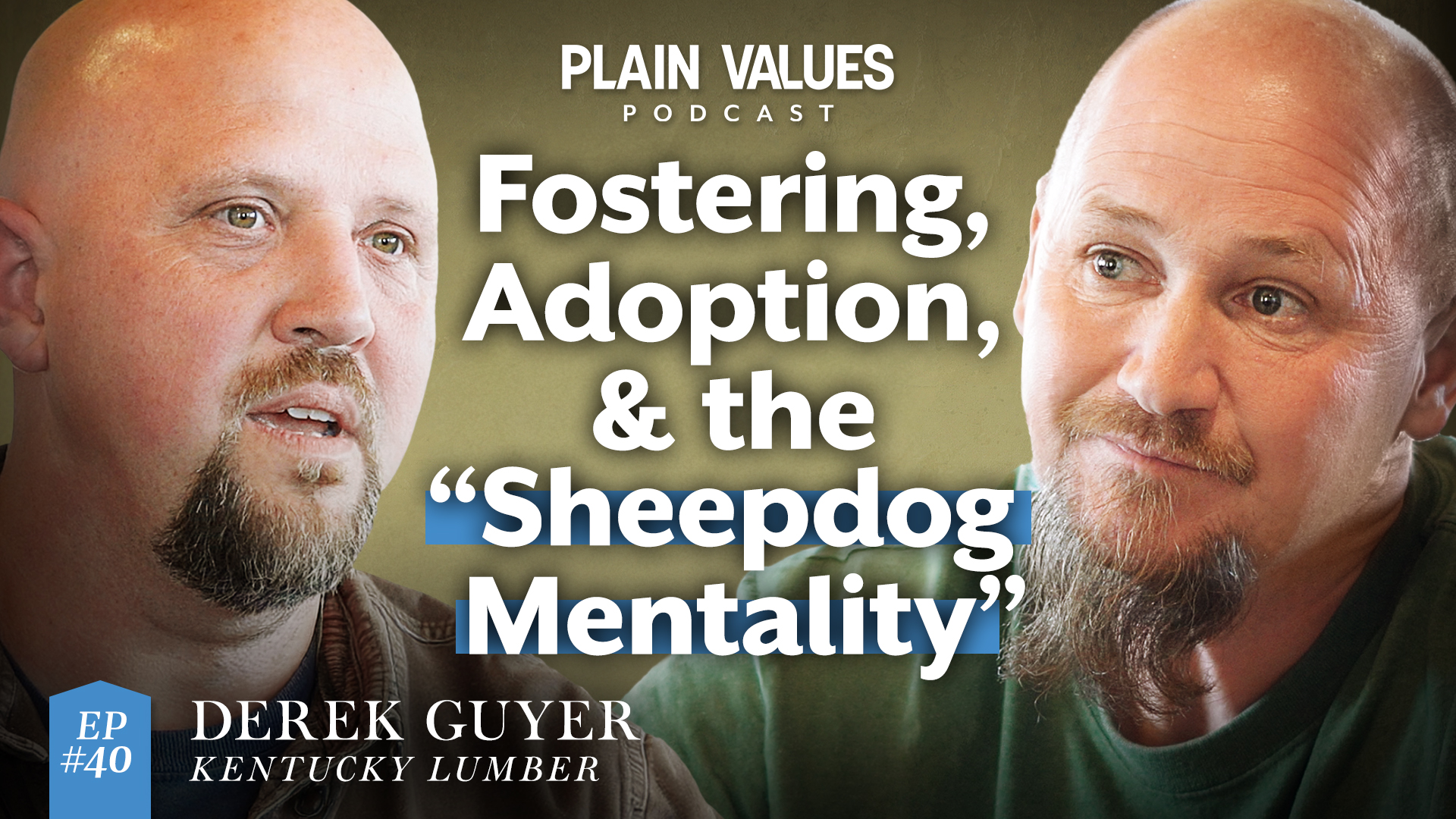
In this episode of The Plain Values Podcast …
Some people build businesses. Others build lives that point to something greater.
In this powerful conversation, Derek and Lisa Guyer share the raw, beautiful story of their journey; from financial brokenness and a tiny two-bedroom home with six kids in one room, to owning and transforming Kentucky Lumber into a place of integrity, character, and genuine care.
Derek openly talks about the early failures, the lessons learned from his parents, and the deliberate choice to create a company culture where employees feel safe, customers are treated like family, and tough love meets real respect.
At the center of it all is their deep commitment to fostering and adopting children from hard places. Derek describes the chaos, the screaming, the fear… and the unwavering decision to be the safe place these kids desperately need.
Through every trial, financial stress, loss, and the daily grind, they return to the same truth: generosity matters most when it’s hardest.
Learn more about Plain Values at https://plainvalues.com
Transcripts
00:00:00 – Introduction
00:04:57 – Derek’s Childhood
00:12:19 – Fostering, Adoption, and the “Sheepdog” Mentality
00:16:56 – A Bold Prayer
00:27:31 – Ultimate Hiring Test
00:29:10 – The Gritty Realities of Foster Care
00:39:16 – Confronting a Hostile Customer
00:47:51 – Mom’s Selfless Act of Love
00:51:35 – Praying with Grieving Customers
00:59:07 – Owning Mistakes
01:01:31 – How to Pray for Derek
Derek Guyer:
Over the years, some of my favorite business advisors have always said in the moments when everything crunches down on you and it gets really difficult, you want to get tightfisted and you want to hold everything back for yourself. And I’ve always heard these guys say, no, that’s when you actually release. That’s when you let go because those are the moments where generosity is necessary the most. They’ve told us over and over again. We don’t even look at prices. We don’t even care what your prices are in comparison to anybody else because we want to work with people who treat other people that way. So we pray, God, if you want us to adopt kids, if you want us to do more, then you’d have to give us a bigger house and you’d have to give us a bigger income. And two weeks later, the guy that owned this place sent me a message out of nowhere.
He had no idea. We hadn’t talked with anybody.
Marlin Miller:
For those of you who have watched any of our previous episodes, you will probably know the name Derek Geyer and Kentucky Lumber. Now we have never shared anything in detail because we’ve never had a chance to hang out and actually talk and get to know each other more. Well, that happened around the Easter weekend of this last year and we shared most of an afternoon into the evening. We had dinner together. Our families were able to just hang out and play and talk. And I cannot overstate how wonderfully aligned we are. If you like anything about Plain Values, you will adore Derek and his family, the things they stand for, the way that they fight for kids that need a family. It is with great joy and a real honor to ask you to meet my friend Derek Geyer. And if you get anything out of this, if you enjoy the episode, I would very humbly ask you to like, share and subscribe.
Thank you. This episode of the Plain Values Podcast is being brought to you by my friends at Kentucky Lumber. Derek and I were talking this morning and he shared a story about how they like to do business and they like to do business with people that are like them and they like to be treated in a way that they treat their own customers. He told me about a customer of theirs that he had to fire and this was not going the way that it typically does. And this guy was not being happy with anything that they did and nothing was good enough. And finally Derek said, “You know what? You’ve disrespected my team enough and I think we’re done. And so you can go find your lumber someplace else.” And the attitude and the heart behind the way that Derek sees the world is exactly the way that I see the world and I have a hunch you might as well.
If you call Kentucky Lumber, just know that they might fire you if you treat them poorly.
I’m kidding, of course. But they will treat you with the utmost respect because it’s how they want to be treated. And I think there’s a golden rule thing in there somewhere, but if you need anything at all to do with any lumber, wood flooring, wood siding, any type of wood product that has character just baked into it and a great team to match, call my friends @kentuckylumber. You can find them at drywallhaters.com. Derek Guyer. It is so stinking good to be here and to just be able to see all that you’ve got going on and have built. You and I have talked over the last probably what, year?
Derek Guyer:
Yep. A little less than that, but yeah.
Marlin Miller:
About a year.
Derek Guyer:
Yeah.
Marlin Miller:
So let me give you a little bit of context. I think I told you this at the first time we talked. So my wife was looking for hardwood all that time ago, I think a couple years ago actually and she reached out. She found you online and reached out and she told me at the time, she said, “Marlon, I am so utterly impressed with this Kentucky lumber place.” She said the service, the answers and just everything she said was just top notch. And we ended up finding wood closer to home and didn’t go that direction, but we never forgot about you.
Derek Guyer:
Interesting.
Marlin Miller:
And then you and I get on the horn and we find out that we have some mutual friends and the friendship kind of just took off from there. So give me like 30 seconds on your childhood, where you were born, your siblings, your parents, just the basic bare bones.
Derek Guyer:
Sure. Yeah. My dad was a preacher. We came from Indiana as a family. That’s where my parents were both born. I was born in Massachusetts, which is where my dad was preaching at the time at a small church up there. And before I graduated high school, we had moved from, what was it? From Framingham, Massachusetts, where I was born to Bloomington, Indiana, West Lafayette, Indiana, west of Cleveland, Ohio to Paydon City, West Virginia. And I graduated high school in Oxford, Mississippi and since I’ve lived almost everywhere you can think of. So no home.
Marlin Miller:
Was that because of your dad’s-
Derek Guyer:
Preaching. Yeah. Yeah. We were just all over the place all the time. And you would think that maybe on some level that would be unsettling for a kid, but as we’re going to talk about with a little bit with the business here, it actually allows me to relate to people in a whole other way because I pretty much know everywhere. I’ve met people that knew my family members in other states just taking care of customers here on the property. Kind of wild the way connections have happened and the way God’s pieced some of that stuff together.
Marlin Miller:
Yeah. How about your siblings?
Derek Guyer:
There are a total of five of us originally through my mom and dad. My mom died when I was 14 of cancer. Really incredible woman, very godly, selfless woman, died of cancer at … She was 52, I was 14. Actually, her mom died of cancer as well at 52 and had a son who was the same age I was. Get out of here. Yeah, it was pretty wild situation. But then now I have three step siblings as well. My dad remarried pretty quickly and especially am really close with one of my stepbrothers. We share a really great relationship together. Wow. Yeah.
Marlin Miller:
So what kind of jobs did you do after high school and college if you went to college?
Derek Guyer:
Oh my goodness. I’ve been all over the place. I never finished school and I think in large part that was because I didn’t learn the way the school’s taught. And so it was very difficult for me to achieve with their tests. I’m one of those people that I can’t memorize useless information and spit it back out. I’m going to fail that test. There’s zero hesitation about that. But if the information is useful and I get it, it’ll never leave. And I tend to grab something and then be able to mold it and move it. So I mean, being in the unique situations that we were in as a family, you learn how to deal with people quick. And my dad, for whatever faults he might have as a father, a husband, a preacher, man of God, he really set the precedence in my mind for leadership, for how to treat other people respectfully.
He was probably a master, in my mind, a master of deescalating situations that were tense, at least for me he was. And as a business owner, you get into tense situations with customers because they’re always right, which I don’t particularly buy into, but it was for me really great to have the skills he taught me and to be able to take lessons that I learned as a kid and say, look, it doesn’t have to be that way. We can talk to each other respectfully and walk away from this with dignity even if it’s not fun. We can still be respectful of one another.
Marlin Miller:
Was your dad … Because you’ve shared some stories with me about your tendencies to be direct and you actually inspire me to be more like that because that’s something I struggle with. I don’t like the tense situations and I’ve done it, but it’s not something that is easy and enjoyable. Was your dad like that to where you saw that in him and you kind of learned it by
Derek Guyer:
Watching? Certainly he was direct. I would say a lot of the directness comes more from my mom. She was pretty brutally candid, a little bit of a warrior in that way. I’ve heard lots of stories about her since she passed about ways that she did that. He had, I think, a little more soft tone than what my mom had and that’s not to take away from either one of them in the wording of it. It’s just that was their ability. Both of them had the ability, I think, to be able to be very direct in situations. I mean, admittedly, I hate confrontation. It makes me sick to be in confrontations, but for whatever I may hate about it, I tend to be pretty good at it.
You asked about work. I mean, I’ve done the whole gamut of almost everything you can think of and I’m one of those people who believes that those things shape you and make you what you are and so much of what this business is and what my family is, they’ve all been built on these lessons learned from the little simple things that you do in day-to-day stuff where you may walk away with it and learn nothing if you lack some humility. And man, in my early days, I certainly lacked that humility and probably should admit that I still do, but I’m very thankful that I’ve been given a platform to stand on from what dad and mom taught me about how you deal with people in a respectful way. I mean, I can literally remember my dad in confrontations where I was thinking, “Dad, stand up and punch that guy in the face.
Please hit him.” And my dad being humble and deescalating, putting his hand on somebody, like I’ve got all these little touchpoints in my brain that when I come into confrontations, I use all the same tools. I’m doing the same things he did. And as much as you may not want to be like your parents, good grief. I’m a little bit like my dad in a horrifying way and probably in some really great ways. But yeah, I mean, I’ve run the gamut of a lot of customer service. We were just talking with our wives. I mean, we worked for in a lot of customer services specifically our first few years of marriage, we took care of people who had disabilities and that was a pretty interesting time in life. I learned a lot about patients and about myself and the lack of patience that I had in being in situations that were out of control.
Yeah, that’s why I found your story yesterday a little bit amusing just because I know what those are like. I know how wild it can get quick.
Marlin Miller:
Okay. I know that we want to get to the business totally. I have to ask because something that my dad taught me was when you get to meet a family with a kid that has special needs, be it Down syndrome, be it anything, CF, CP, anything, they are often, not always, but they are often these little hidden treasures that are often overlooked. And when you look back on that, Derek, how do you think that that shaped you and Lisa to parent your own children? You’ve fostered many children, you’ve adopted one or two,
Derek Guyer:
Right? Two now. Yeah.
Marlin Miller:
Two. How do you think that’s played into your life?
Derek Guyer:
It’s very interesting that you ask it that way. I don’t know that I’ve stopped to directly correlate it that way, but I would say pretty easily we’ve had this sense of don’t screw with the underprivileged, don’t screw with the undervalued and that God gave me a big frame and I think he gave me a big frame to defend those who are defenseless. And I can’t say that I was great at that. I’ve got a lot of embarrassment looking back in my youth just about how foolish I was and didn’t understand how important it was to use what God gave me to defend. Just foolish, just a foolish child, but today I get it better than ever before.
Marlin Miller:
Do you kind of see yourself as a sheepdog style thing?
Derek Guyer:
Yeah. Okay. So my kids love to talk about this. My name Derek means leader of the people. My middle name Edmund means protector and my last name means guide. And my kids are always laughing. They’re like, “Good grief. That is you, dad, 2AT, like to a T.” Wow. And here’s a really good example of a story. Our youngest son is adopted. The mother asked us to be at her wedding and we just thought, “Man, what an incredible gift to be a part of this. ” So we go to the wedding and she’s like family to us now and we share so much love and care for her as a person. And she had asked us if we would pray at the wedding. We didn’t really know what that meant until we got there and the husband, his parents prayed over her and we were asked to pray over him like we were her parents and we’re like, “Whoa, okay, this is a really big deal.
What an honor to be asked into this situation.” But to give you a quick example or story to make the point, as we walked up in front of everybody, I put my hands on his shoulders and I said, “If you hurt her, I will kill you. ” And we hadn’t really even met yet.
Marlin Miller:
And he
Derek Guyer:
Probably took it
Marlin Miller:
Darn
Derek Guyer:
Serious. Yeah, yeah. But it was a great moment between he and I because he understood she needed to be protected and that’s the much the way I deal with my daughters. I want them to feel safe. I want them to know that their dad would do anything to make sure that they felt that safety. So yeah, I see myself as a little bit of a sheepdog and I think that’s God has used that again and again to remind me of my role and the humility of my role because it’s not about me. It’s not about being a tough guy. It’s about the good of the other. That’s the goal of loving your neighbor as yourself.
Marlin Miller:
Man, that’s an incredible thing. Okay. We could spend way too much time on the cultural issues on all of those things and we’ll have to do that later because I do want to get to the whole founding of Kentucky Lumber, because it’s a pretty stinking cool story. Actually, you and I have a lot, there’s a lot of similarity between your founding and even Plain Values founding.
Derek Guyer:
Interesting.
Marlin Miller:
So tell me the story about the Amish guy.
Derek Guyer:
Yeah. Well, okay. Yeah. So I’ll back up a litle bit before it, because I think that’ll give the background to help you understand it. I mean, the reality was we were broker than broke. We had nothing. Lisa and I had six kids at the time. Pretty much everything I was doing was failing. No matter what I did to try and solve the problem, it seemed like it failed on me, but we had six really beautiful kids and they loved us. They were very faithful to us and responded well. So we just didn’t feel like we were supposed to stop with kids. And the short version is that we just prayed one night in February of 2015. We prayed, God, if you want us to have more kids, then for us to adopt, we’d have to have a bigger house because we had all six kids in one bedroom and the two of us in the other bedroom in a- You had a two bedroom house.
In a two bedroom. Eight
Marlin Miller:
Of you.
Derek Guyer:
Yeah. Yeah. It was crazy.
Marlin Miller:
Okay.
Derek Guyer:
And my little business was running out of this little one car garage that was back behind the place. It was a wood business. And for anybody who deals with wood, this place was just constantly holding water in it. So the wood’s getting moldy. I’m like, “I’m fighting everything I can to get this done.” Anyway, so we pray, God, if you want us to adopt kids, if you want us to do more, then you’d have to give us a bigger house and you’d have to give us a bigger income. We wouldn’t even know where to get that. We would have no idea because we have no clue on our end. We had been in ministry for years before that. So my credit was horrible, noth was even in shape to be able to piece this together. So we asked for a bigger house and a bigger income and two weeks later, the guy that owned this place sent me a message out of nowhere.
He had no idea. We hadn’t talked with anybody. He was a former Mennonite and he sent me a message and he said, “Hey, are you interested in buying the house and the business? I want out. ” Well, I literally could not even remember what the business was. I had no idea what was here. And so I asked a couple questions and then I was like, “I mean, don’t be stupid. You need to say yes, I’m interested because this is obviously an answer.” So I mean, I think he was probably taken aback by how fast I was in because it wasn’t really a matter of if, it was a matter of when. And two weeks later I was working here a year later we owned the place and we renamed and redid prety much everything because it wasn’t really what we wanted Kentucky Lumber to be because we had to create an environment more than anything that was going to be healthy for kids to come into.
Marlin Miller:
Did you have a vision for the brand already?
Derek Guyer:
Yeah. I mean, I’m an artist. For me, I really value … How do I word it in a way that makes sense? I value how things look as long as it’s real. I don’t want it to look good but not be good. So I wanted to have the brand to feel like something that felt like it was your neighbor that you were dealing with, like your family. And if you go read the reviews, that’s pretty much what everybody says. They just constantly are saying, “Man, I feel like I’m dealing with my family over there. I see people out in public and they hug me. I don’t even know who they are. They never dealt with me. They dealt with my employees.” But that’s what we wanted. We wanted it to feel safe. And so from the first moments, the goal was create an environment where when we did bring kids in that had maybe come from traumatic backgrounds, there would be a felt safety here on the property because you have people touching the property all the time that you never know who they are.
And the old business model was buy cheap, sell cheap as fast as you can. And that brings some people in that are pretty difficult to deal with and often they’re racist. And we had no idea what kind of races we would be bringing in, nor did we care. That was never an agenda for us. So it became really important quickly to change the business model and the thinking around it because we needed to have a space where every person that walked on the property felt safe and anytime we do have a problem, it’s pretty quick that the customer finds out if they are an issue, you don’t belong here anymore. And they know it. Again, back to the sheepdog thing, you’re creating the tension to be able to protect the person that’s in front of you, whether that’s an employee or one of my daughters or one of my sons or whatever in the moment.
So yeah, that’s a big deal here.
Marlin Miller:
I love it. So you bought it in 15, 16.
Derek Guyer:
Or 10 years, two months ago.
Marlin Miller:
Yeah, 10 years old.
Derek Guyer:
Awesome.
Marlin Miller:
Yeah. What do you really specialize in?
Derek Guyer:
At the beginning, it was just buying and reselling. We bought and we resold finished lumber from mills all over the country. In the very beginning, almost everything we bought and resold was Eastern White Pine. And then we got into some Ponderosa pine, which is a little bit harder, lumber, slightly harder, and slightly different not structure. And so you’re getting into a litle bit more character with some of that stuff. And then we played around with a couple different other types of lumber and that was all fine. Actually, we made way more money in the early days than we probably do now to say the very least. But I think what developed for us was that we saw a problem with control over our brand in the product quality because you’re always left with whatever this mill creates and now this customer, our average customer drives three to eight hours to us.
And so you’ve driven five hours, six hours. I mean, we get people from your area all of the time all of the time, have ever since the very beginning and farther north when we get them out of New York and Pennsylvania, we get them out of Michigan and Minnesota. They’re from all over the place. Wow. So you get somebody who comes in and they buy a pack of lumber that somebody else milled and they drive six hours back home and they find a problem where something was not milled well or a bunch of trash was left inside a pack, that’s problematic. That’s very problematic. That’s
Marlin Miller:
Not a good feeling.
Derek Guyer:
No. Yeah. And you have zero control as an owner in that moment about the quality of what you just put in there or what was put in there, but your name’s attached to it. And you
Marlin Miller:
Didn’t do it.
Derek Guyer:
Yeah. Right. So once the pandemic hit that shift I work with probably one of the best business minds I’ve ever known. It’s the guy who built the Chick-fil-A brand. His name’s Steve Robinson. And Steve and I have become good buddies over the years and Steve, whatever you know of Chick-fil-A, this guy built that brand. He sat right where you’re sitting right now to work with me here in Allensville. And one of the things that he told me about what we were missing was the product quality. Not that he could see it, but when I was explaining problems, he just kept saying, “This is going to be something that you’re going to want to get control over. You can’t let this continue.” So we set out to do what we did with building our own molding operation and milling operation so that we could protect the customer for the long haul of it rather than just maintaining status quo, which in so many ways for me was just about the foster kids and our kids creating jobs, giving them a space where they could feel safety with other people that we trusted working beside them.
Marlin Miller:
Okay. You just kind of sparked something for me there, Derek, with the foster kids. Tell me about this community and the system that is in place here. We’re in the middle of nowhere in Kentucky effectively. It really is. I mean, it really is. We drove in and I told you when we got here, man, it’s nothing but those acre fields. It is. It’s crazy. It’s huge farming, which is great. How many kids were in the system, like in the county?
Derek Guyer:
I don’t actually know that statistic. I want to say that at this moment you have over 300 in this given area. I mean, I’m on the board over an organization that serves foster kids and we, I mean, just last week had five siblings come into the system the same day that didn’t have anywhere to go and they had to separate all of the kids, take them to different places to make sure that the need got met because there are just not enough homes to meet that need. And some of the stories will just crush your soul to hear what these kids are facing. We’ve got one of those in our home now and you just can’t imagine the depth of abuse and neglect and shame that goes along with what is inflicted on these kids. So you’re asking about the community itself. That was one of the most important parts for us is not just having a community that would support that as far as Allensville and the greater community outside of it, but having a core group of employees that would support that as well and understand their role in building up these kids and making them feel like they were important and valued.
Marlin Miller:
Okay. So are you telling me, and I think you are, that your team, your employees buy into everything that you and Lisa are working on?
Derek Guyer:
Yeah, 100%. Yeah. They don’t have a choice. That’s how we hire them. So we have a very, very strict hiring process and I won’t go into the whole process of it, but the very first question that gets asked of me after the first interview, I’m not involved in the first interview. It’s a very strict process, but I walk in the room after they’re done with the interview, I sit down with them and often the very first thing that gets said that ends the entire discussion from the first moment is, “I can’t see them working with your eight year old daughter.”
Marlin Miller:
Really?
Derek Guyer:
And we walk back out of the room and it’s over.
Marlin Miller:
And that’s done.
Derek Guyer:
Yep.
Marlin Miller:
And that’s your team member
Derek Guyer:
Interviewing- Evaluating
Marlin Miller:
The potential. And he or she says, “Nope.”
Derek Guyer:
Yeah, I can’t say I’m working alone with your daughter. And so- Oh, I love that. I love it. I told an employee, I’m sorry, I told a customer that one day that that was how strict we were and he looked at me, he goes, “You’re kidding, right?” And I said, “No, why?” And he said, “How can you be that strict about it? ” And I said, “Well, listen, sir, if I can’t trust him with my daughter, how can I trust him with your money?” And he said, “Yeah, I don’t like that thought.” I was like, “Right.” So it’s a great way to just eliminate people very quickly. And I mean, that’s just one of the things that we do, but it’s one of those where it’s a pretty quick line that you can draw to say, “That doesn’t fit.” Because when you think about what these kids have gone through and the environment that they’ve come from, the levels of abuse, there was one period that we went through here, our house is right here behind me and I remember during on period, it was easily one of the worst we’ve ever experienced in fostering.
I would walk out of the door and you could hear the screaming inside the house and it just wouldn’t end. And then when I would walk in the door of the house, it would stop because they were scared of my big presence and then as soon as the door shut, the screaming would begin again and I couldn’t do anything to relieve Lisa from the pressure because my presence stopped it, but I still had work to do. It was literally the day that we got them was July the 4th we had signed to start our mill on July the 2nd. So I would It’s already in. Everything was already moving and I’m buying equipment, renovating an entire building to get all this started, having to hire all these people and put all these pieces in motion. And two days later we have two foster kids in our home that praise God we get to be a part of their lives still to this moment.
I mean, that’s what you and I were talking about beforehand. We get to be invested in their lives and we get to serve them and God has opened a door. I pulled up here a little bit ago before you guys arrived and one of the boys ran up to me yelling, daddy, daddy, I’m daddy. I’m his dad. And he knows that he’s got a job here in the future if he behaves himself the way he’s supposed to behave himself.
Marlin Miller:
So is that something that I will confess I think a little ashamedly is I don’t know how long it was into our own adoption journeys that I really understood what aging out meant. I didn’t know. I had
Derek Guyer:
No
Marlin Miller:
Idea. It’s
Derek Guyer:
Awful.
Marlin Miller:
It is horrible. And the people that foster for that motive, ma, I’d want to line them up and
Derek Guyer:
Give them everything you have. It’s pretty unbelievable what they’re willing to do, man.
Marlin Miller:
It is insane.
Derek Guyer:
And
Marlin Miller:
As soon as that check stops, they don’t give
Derek Guyer:
A rip.
Marlin Miller:
They don’t. It’s just you’re gone. You’re out. And I think what I saw in my head there, Derek, was that you almost have this inborn or like this built in protection against aging out. Effectively, that’s what it feels like.
Derek Guyer:
We hope. Yeah. I’ll tell you one that was really gut wrenching for me. We had two kids in our home and they went back to their mom. We were really worried about why the system allowed them to go back. Concerned about, does this make sense that she’s getting them with as little as she’s done to get things fixed on her end? It’s not our decision. We don’t get to be a part of that. We just have to go along with whatever. But we invested so that we could stay involved. And we could tell after the kids went back that something was slipping and we became concerned and she told us a little bit about what she was doing and my wife and I were talking on the way there to go see the kids and she said, “I’m really worried about where this is going to go and I don’t want to confront her about it.
” And I was like, “Well, do me a favor. Just loft it up. I’ll take a swing because these are our boys. And so I am not going to sit by idly and watch these kids unnecessarily suffer without taking a few swings.” So you tee it up. So when we got there, she teed it up, sure enough she did, just as I asked her to do in that situation. And I asked a couple questions and she got really aggressive back with me quickly.
Marlin Miller:
Was there a county person around?
Derek Guyer:
No, no, no, no. They were with their mom. We just could tell things were slipping. We could tell she was likely headed back into alcohol and we were worried about what was going to happen to the kids and it ended up happening. But I told her, as soon as she got aggressive with me and I said, “You need to watch how you respond to this because you keep calling me daddy that I’m their daddy and I am and I don’t take that lightly. I have fought for these kids. I have bled for them. I have worked through things you can’t imagine to make sure that they were safe when things weren’t going well for you. And I don’t mind it at all. I’m happy that I got to be a part of it. No matter how it felt at the time, I didn’t necessarily feel that way then, but I do feel that way today.” And I said, “You can’t just run around doing whatever you want and pretend like what we’re all doing to protect you and the kids means nothing now.
Let me help and don’t just dishonor that. ” So she recently got in trouble another time and her first question to my wife was, “What’s Derek going to say?” And that- She
Marlin Miller:
Knows.
Derek Guyer:
Yeah. She knows now how invested we are and that we do love her and we do love the kids. I mean, she’s grown up with a horrible background in deep trauma and you can’t expect her to have perfect responses as an adult because she never got to have that chance as a kid. And so I don’t expect her to do it well.
Marlin Miller:
And there’s no condemnation there.
Derek Guyer:
Yeah, no, no. It’s just a matter of this is the reality that we’re dealing with and we’re going to have to bring some fire to the fire you’re bringing to this. Let’s go after this because I love you. I love you enough to do the tough thing right now. But I mean, going back to what you were asking about the business, I mean that’s the environment we want to create here is an environment where the employees feel safe in this space, where the customers feel safe and protected in the process. You want it to be an environment then when your kids walk in here, where my kids walk in here, where there’s a sense of belonging that allows for the things we’ve taught them all along to get to play into it because I’m dad working with my two oldest full time right now and they love to work with me.
They want to work with me. I love working with them. I want to work with them, but how do I teach you that lesson right now if I don’t have somebody that’s working here that is halfway honorable in what they do? Now we’re just getting spit on in the process and that doesn’t help us achieve the goal of glorifying God with the things that we do here in this space. So it’s super important to me to have that level of honesty across the board, no matter where we go and what we do. I don’t know how to achieve that half the time or maybe more than that, but it doesn’t matter. It’s an effort. It’s an ethic. It’s a desire from the heart to love your neighbor as yourself and even if that means, all right, well then let’s make this uncomfortable for a few minutes and let’s say some tough things because we love each other.
Marlin Miller:
This podcast is sponsored by my friends at Azure Standard. A while back, I had a chance to sit down with the founder, David Stelzer, right here at the table and we had a great conversation. I love the Azure story. They started out as farmers back in the ’70s and I think in 1987 they began a nationwide food distribution company. And guys, they are non- GMO organic. They do it right. They do it so well and you can get a truck to drop food right in your town. Check them out at Azurestandard.com and tell them Marlin and Plain Values sent you. I said earlier that I’m not going to go into the cultural thing. Dude, I don’t think I can grasp the full impacts of our everybody gets a trophy, this coddling. Jonathan Hite has basically, I think he’s wrote the book on the coddling of the American mind and the American kid.
And I don’t know where he stands from a worldview, but I think he’s right about a lot of stuff and it’s the things that we are watching unfold right in front of us as guys who are probably pushing 50. I know I am, you probably are too.
Derek Guyer:
I can’t say- Not
Marlin Miller:
Quite. I’m sorry.
Derek Guyer:
No, I’m getting there.
Marlin Miller:
I remember my dad talking about the things that he was watching and the disrespect, the disrespectfulness of the younger generations and the things that are now unfolding right in front of us are like, man, it-
Derek Guyer:
It’s overwhelming.
Marlin Miller:
It comes back to, I think in my opinion, a lot of the absence of dad, the fatherlessness- 100%. … is everywhere and the kids literally have no solid role model, not much of anything, so they’re just kind of on their own. Give me another story about how a customer has experienced this family.
Derek Guyer:
Yeah. Even before you asked the question there, a story had popped into my head. We dealt with … Well, I mean, he’s bought from us over and over again. There’s a country music singer that’s been buying here for years and we’re close to Nashville, so we get a lot of them in here. If they’re not the ones who come and often they have, it’s somebody working for them. So we know about some of these projects and this guy had been buying from us for years. He’s a well-known name within the industry and we’d never had any problems with him at any point that I had ever remembered awkward. Yeah, sure. Entitled, sure, but we never really cared about that. It was fine.
But we take taking care of people very seriously here and he started messaging our team saying, “Hey, there’s all kinds of problems with this lumber.” And so I mean, we jump on that quickly. We want to know what’s going on. We want to know what’s happening. I mean, I really was kind of lost even with the pictures he was sending. I wasn’t necessarily seeing the problem. I wasn’t understanding, but because of the way he was handling it, I was a little bit terrified of what he was going to do from a PR perspective and how bad of a problem we were going to deal with. So I literally had the mill remill his entire order.
Marlin Miller:
The whole thing?
Derek Guyer:
The whole thing.
Marlin Miller:
And we’re not talking a hundred square feet here.
Derek Guyer:
No, it was several thousand square feet.
Marlin Miller:
Yeah.
Derek Guyer:
And I put two of my kids in the truck and I said, “We’re going to go down and we’re going to check on the situation. We’re going to find out what’s going on. ” And I already had a plan in mind for what I was planning to do, but I wanted to understand the problem. I’m not willing … No, I’m willing to go very far to take care of a customer, very far. That’s why I take firing a customer very seriously. You got to be a dirt bag to not make it through. There’s got to be an issue. Well, when I pulled up to his place, it was all the contractors around and I didn’t really care about that. I was just trying to find the problem as quickly as I could. And so I walked through the garage and I see a bunch of our lumber laying in the garage and they’re like perfectly good boards.
It was all pine and- Okay,
Marlin Miller:
Wait, wait. So you and your kids took off for Nashville with the new lumber?
Derek Guyer:
Yeah, we had it in jail. You were delivering. Yeah. He didn’t know exactly what we were doing,
But we came to solve the problem, end of story. We were there to solve whatever problem needed to be solved. And so I wanted to understand the problem first. I kind of had the feeling that maybe there was some kind of … The wood was wet. I mean, everything we buy is kiln dried. So I wasn’t really understanding that, but he was complaining about a couple different things. Anyway, the long and the short of it is I walk in the garage and I see perfectly good boards, nothing wrong with them at all You’re talking full run boards that look great. And so I’m thinking, “Okay, well, you still got some leftover. I don’t know what’s happening with this. ” And then I get to walk into the house and when I walk into the house, I’m not really seeing any problems except for there was a pocket of missing knots that they had installed and he bought our low grade so that he knew that’s what he’d used that every single time he had bought from us.
The
Marlin Miller:
Character stuff.
Derek Guyer:
Yeah, right. So up in the one top corner, there were a whole bunch of missing knots that had been installed and I was very confused by that. And then down next to the entry door, there were a bunch that had been installed. I’m thinking, “You got all this good lumber out there in the garage. The room is obviously done because you’ve painted it. Why would you install it that way?” So I waited for a while, but while I was waiting, I brought my moisture meter and I start testing the walls. Everywhere I go, I’m testing and you have to be 15% or less, you really want to be 12% or less in moisture. There was nothing above 12%, nothing. So I knew moisture wasn’t an issue, so now I’m just confused. I don’t understand what’s happening. So he comes out and the confrontation goes pretty quick.
I mean, he’s right after me. I had already told the kids, “If this escalates quickly and it gets out of hand, just go get in the truck, but I want them there for the moment. I want them to watch me handle it because I want them to know how to respond.” So he just kept escalating and all I was asking was, “I don’t understand what the problem is. I still don’t know what you’re upset about. ” And nothing he was saying made any sense because he had dealt with this lumber before and I said, “So can you explain to me why they installed all the missing knots when you have all this that’s right here next to us? I don’t understand why they would install this when you got great lumbers sitting here.” And he never could answer the question and that only made him more hostile.
And I’m thinking, “Why are we getting hostile? I’m asking legitimate questions that seem very fair from my side. I don’t know what I’m doing.” Well, as he continued elevating, I just said, “Please stop.” Try not to say his name. “Please stop. I didn’t come here to fight with you. My whole reputation is sitting on this right now and my family, I brought them. My family is watching me talk to you right now and all I want is to take care of you well. I remilled your entire order. I’ve got it all sitting here on the trailer. “He
Marlin Miller:
Had no idea.
Derek Guyer:
No. I said,” I’m ready to give you all of it and I have my checkbook to write you a full refund on everything for all the problems that you’ve had, but I still don’t understand the problem. I don’t understand what we’re doing right now. I’m supposed to be taking the blame, but I still don’t understand the problem that we’re dealing with. So could you talk to me in a reasonable way instead of escalating this? Because I want to do the right thing to teach my kids how to deal with problems. I want to do the right thing for my business because I’m not looking to just make quick money off of you. I’m trying to build something for generations after me and right now you’re faulting me like I did something wrong or evil and I don’t even understand the problem. “And he stopped, he looked at me for a second and then he turned to my kids and he said,” Men don’t do this.
“And then he started crying. I said,” What do you mean? “He said,” Men don’t treat each other with this kind of respect. “He said,” He
Marlin Miller:
Was referring to you.
Derek Guyer:
“He said,” I’m sorry.
Marlin Miller:
“I thought he …
Derek Guyer:
No, he was apologizing for how he was handling himself.
Marlin Miller:
Wow.
Derek Guyer:
And it was within just a few moments, his wife who was 40 years younger than him, walked into the room and I saw a very snobby look on her face and I realized then,” Oh, there’s the problem. There’s the problem. She’s not happy so he’s fighting us now. “And so he’s trying to salvage his sixth, seventh marriage, I think is what he was on at the time. And this is not about me. You were in the way. I was in the way of happiness. But I think walking away, the kids and I have talked about that over and over again. And for me, no matter how many thousands of dollars I lost on that situation and I did, I lost a lot of money on something that still doesn’t make sense to me. I feel like God had a reason to be able to walk my kids through and watch me be humble in response to a situation that I wasn’t really responsible for.
And we wouldn’t just do that for somebody like that. We care about taking care of people. We have tried to take care of people from the beginning and it doesn’t mean it’s done perfectly. I look back and think, man, I really wish we had done that better over and over again. I mean, I could say that about pretty much every part of my life. I can’t think of an area of life where I’m feeling like I really rocked that one out. I’m thinking most of the time I pretty well sucked and I hope that I got it better the next time. But yeah, that’s to me where family really matters the most is I don’t want them to see me take the success of, look at this big sales week or big sales month or big sales year and we’re all going on vacation and think that that’s where life happens.
Life happens when it’s falling apart and we remain faithful, where we remain steadfast and I mean, I’ll walk it right back to the very beginning. Watching my mom die in faithfulness to God, seeing her last days as training ground for us about who we were going to be becoming as kids, there were two of us left in the house. It has never left me watching in the house in Paydon City, West Virginia, little tiny town. My mom never stopped working, never. And I walked in the house from school and my mom is laying in the recliner, laying, not sitting, laying, crying because the pain is so overwhelming in her body. And I ask her immediately, my little sister’s walking in behind me ask her like, “What’s wrong? What’s happening?” And she said, “It just hurts so bad.” And so of course I start crying in the moment now my little sister’s weeping and she stopped, she kicked that recliner down, she stood up, she said, “Nope, we don’t have time for this.
We have today. Let’s go make dinner for Ms. Heasley.” And I was like, “What’s wrong with Ms. Easley?” She said, “She’s got a cold, so let’s go make dinner for her.” And so while my mom’s dying of cancer, we made dinner for a woman who had a cold. And I don’t know how to walk away with anything from that other than that’s selfless love and that’s how you treat your neighbor. That’s what you do. Again, do I do it well all the time? Don’t ask my neighbors.
But man, it has never really left my heart and my mind that if a parent could leave that sort of impact on the world with their kids, then what kind of a world would we live in if that’s the way we treated one another if in the moment of our worst nightmare we could say, “Hey, let’s go make dinner for this person. Let’s think about somebody else.” And over the years, some of my favorite business advisors have always said in the moments when everything crunches down on you and it gets really difficult, you want to get tightfisted and you want to hold everything back for yourself. And I’ve always heard these guys say, “No, that’s when you actually release. That’s when you let go because those are the moments where generosity is necessary the most.” And so we talk about that all the time in this room when things get really difficult and we’re in a tense spot.
“Hey guys, I know you’re going to want to ball up your fists and hold stuff back and not be generous, but right now is the time when generosity matters the most. “And man, thank God for a mom who in her dying steps, dying breaths, live that out because I think I easily would have been a selfish jerk for the rest of my life because I easily was before that point. I mean, I could give you some crazy stories about the stupidity that went on even after she died in the morning of all of it and the grieving and I was a nightmare for those first few years and God’s grace was just poured out on me in the most beautiful ways where he knew I needed somebody to just kind of stretch out. And that’s what we say. I mean, you often come, somebody comes in here to buy lumber from us, who knows what they’ve been going through, who knows what they’ve been going through that makes them so cranky.
Often it has been they had a heart attack the week before and they need to finish this house because the financing is due and they’ve got to get it done and so they need to make the drive down to pick that up or they just lost their sister two days before. Best example of all of them, I’ll give you the best example. We had a couple come in here, it was probably 2017 This couple comes in and it felt a little bit awkward when they got here. We weren’t really sure what was going on, but they were friendly still while they were here, but they felt a little guarded. And at one point the husband grabbed me by the arm and he said,” Can you step outside and talk to me? “And I was like, ” Oh, great. What went wrong?
Marlin Miller:
“Here
Derek Guyer:
It comes. “What went wrong?” And we stepped outside and he said, “Our son committed suicide six months ago.” He said, “I feel the love of God in this place and we haven’t felt that very many places.” He said, “I just wanted to ask if you’d pray with us.” And I was like, “Are you kidding?” “Yeah. I mean, talk about blowing my mind. I thought for sure I was getting ready to get reamed out. We just went in a completely different direction and those people ended up donating to one of our adoptions to serve us and help us. They’ve become good friends through the process. We got to be a part of every part of their home and they’ve told us over and over again. We don’t even look at prices. We don’t even care what your prices are in comparison to anybody else because we want to work with people who treat other people that way.
“And man, that to me is a mark of what I hope that my kids are living as well as they grow.
Marlin Miller:
Dang it. I knew that you and I had a lot in common. I knew we did and there are times that you get to meet that guy and you feel it, you just know and you’re just instant friends and you know you’re going to be friends forever and I think that’s here for sure.
Derek Guyer:
I felt like my brother was coming in town and I barely know you.
Marlin Miller:
I know. Dude, Miles on the way up here, he’s in the middle of the van and he goes,” Hey dad. “He said,” Is Derek your cousin or your uncle? “And I said,” No, he’s just your friend. “And I said,” Yep, that’s it. “And I think he said it like three times. He was trying to figure it out because I’ve talked about you in that same way.
Derek Guyer:
My daughter was sitting here when you and I had our very first conversation, she was like, ” You guys are peas in a pod. This is crazy.
Marlin Miller:
“This is where I was going
Derek Guyer:
To go.
Marlin Miller:
There have been many times that I look back on the ways in which my dad and my mom, they did their very best and I don’t think they did a half bad job of raising us three kids, but I’m telling you, just living life, just living life, just like you said, over half of the time you suck at … I feel that more than half of the time with our kids, with our work, with every part of life, you all as a man, as a guy who takes the biblical charge to be a man seriously, oh my word, do we fall short all the time.
Derek Guyer:
All of the time.
Marlin Miller:
All the time. And yet there is grace unreal. And he blows my mind. And man, I’ve had a chance to talk to some people lately and on lost their kid, had to bury their daughter, on lost his wife. She was gone for 30 minutes, for more than 30 minutes. And he said,” Marlon, “he said,” Listen, what I’m about to tell you is not a formula because the Lord brought her back. He literally brought her back. She was out no heartbeat for over half an hour
Derek Guyer:
In the world.
Marlin Miller:
It’s crazy.
Derek Guyer:
Wow.
Marlin Miller:
I think Derek, I think more and more and more I think I don’t understand it. Oh my goodness, I don’t understand any of it. “But I think his sovereignty is really all that matters and he’s going to do what he’s going to do and I’m also not opening the can to predestination. I’m not doing any of that because I don’t understand any of that either.
Derek Guyer:
Yeah, right.
Marlin Miller:
I don’t understand any of that.
Derek Guyer:
But if he knows how to write a story, like a great creator knows how to do. If he knows what he’s doing, then Ted Gummet, the God of all the universe has to know the end to this mess that we’re in and the problems that we’re facing. And if Job through all of that could continue honoring God after all that loss, I can’t even imagine what this guy went through. It’s so hard to even try and compare my life to his given what he lost in such a short period, but for God to know that there was such a great story being told in the long haul of it and we so selfishly feel like, ” Well, you can’t take that from me. You’re not allowed to take that from me. I own that. That’s mine. “Is he Lord or not? Is he the Lord?
Are we surrendered to him that his plans are far more effective in this? I remember an older man years ago when we were in ministry, he was talking to me and he was talking about all things working together for good for those who love the Lord and he brought the verse up and he goes,” But Derek, don’t ever let anybody stop there because it’s not just about those who love the Lord, it’s those who are called according to his purposes. “Man, that one plays through my head all the time. And are we as a family, are we as a business paying attention to his purposes in what we’re doing or are we busy caught up in what we want? I know the answer to that most of the time and I don’t like the answer, but that it’s an important question nonetheless because it’s a question that forces us to reconcile our actions with our words and we have a constant conversation around here specifically around the idea that I don’t want to preach that sermon, I want to live that sermon.
We want to live the thing that we believe. And so for me as a leader in this space, the first thing we do here when a problem happens, I ask what I did to create the problem. That’s the first thing. Even if I had nothing to do with it, that’s the first thing we do because I want to know what happened and I want them to feel very comfortable doing the same thing because if I’m willing to own it, you can own it too and there’s not any repercussion for that. When you don’t own it, yes, there’s repercussions. You have a responsibility to own it.
Marlin Miller:
And the quicker it’s owned,
Derek Guyer:
The quicker it’s- It means nothing. Yeah, right. Yeah. We talk about that frequently with the kids. I mean, that’s where if you’re going to get me on one thing, it’s probably dishonesty. If I catch somebody being dishonest, I’m like, ” Oh, the animal eyes come out of me. “I start raging within and in It’s because I don’t know what to do anymore because I don’t know how to respond to the fact that we’re not working from the same baseline.
Marlin Miller:
And if you can’t trust that, then it’s all out the window. Yeah. Oh my. There are just … Oh man.
Derek Guyer:
We could go on for days on that one. Okay.
Marlin Miller:
Last question. Yeah, that’s good. Last
Derek Guyer:
Question. That’s great.
Marlin Miller:
We’ve been publishing Plain Values for almost 13 years now and about a year ago the team and I decided to put together a compendium, a best of, if you will, of our favorite stories, the most impactful stories of all those years. And invited is what we built out of those conversations. It is 194 and four pages and it is absolutely a thing of beauty. We do a monthly gathering here where we just simply open our doors. It’s called Porch Time. And the story of how Porchtime came to be and how our family was invited into that and how we are inviting you and every Tom, Dick and Harry, anybody who wants to come can come and hang out at Porch Time here at the office in Weinsburg. So it was such a natural fit to use the home of the founder of Porch Time and to call it invited.
You can find it on plainvalues.com on the shop page and you can now consider yourself invited. How can we pray for you?
Derek Guyer:
I think we’re in a really unique season as a business and as a family, but Lisa and I were talking about it this morning a little bit. It’s a season that is transitioning. And I think this is so hard for most people to imagine because with nine children in the home and multiple businesses that we’re running and running a ministry, that sounds really busy in a way that when you’re thinking of a simple life doesn’t sound simple, but it is simple in that everything is driving the exact same line and we are all united on the same front. The kids are with me on that front. Lisa is with me on that front. When I’m serving that ministry, we are serving together as we serve that ministry. Pretty much everything is done united. So you’re not abandoning the family to go to work because that’s a lot of what my dad had to do was be disengaged from us as a family to go serve the church.
I don’t ever want to be a part of that. So in those transitions, I think the devil likes to play in the details a lot and stir the pot and create tension and not even necessarily among us but outside of us because people think that we expect them to live the way we do and we don’t care whether you live like us. I’d say if you’re trying to live like us, then you miss the point. We were all called according to his purposes. So are you living according to the purpose he has for you? David and Abraham lived very different lives and I don’t think either one of them should have felt guilty that they didn’t live each other’s life. I think they should have just been thankful that God worked through them in that period. So yeah, I think as we’re headed into this transition, there’s some stuff happening on the foster end, probably a child leaving our home that came in one of the worst case scenarios imaginable who is leaving I think healed in many ways of some of what he had gone through.
But transitions within the business and transitions in the family where I think it really requires wisdom that I don’t know anybody who’s experienced any of these things so I don’t know how to go ask a question of somebody else, but I think the wisdom to step back and ask the one who does know what it’s like to walk through all this stuff with people and who’ve seen it thousands of times before, once you’re in that busyness, it’s hard to slow down and capture what God’s saying in those intimate moments. And I’d love for you to pray for us to be intimate enough with Father to hear it when he says it, not just caught up in our own nonsense.
Marlin Miller:
Derek, thank you.
Derek Guyer:
I love it.
Marlin Miller:
I
Derek Guyer:
Love being with you, man.
Marlin Miller:
This is great. It’s almost five o’clock. We could sit here for another hour and a half.
Derek Guyer:
Yeah, we sure could. We sure could. Yeah. Thanks for letting me do this with you.
Marlin Miller:
Well, it’s not going to be the last one. It’s not going to be the last one.
Brought to you by …

🤝THIS EPISODE’S FEATURED SPONSOR: Kentucky Lumber
Our friend Derek Guyer at Kentucky Lumber is the type of guy that you want to support. He is a highly-skilled tradesman who exemplifies excellence in everything he does. Kentucky Lumber is an independent lumber yard that truly does world class work!
We would humbly ask you to support them with your lumber needs: http://www.drywallhaters.com

🤝THIS EPISODE’S FEATURED SPONSOR: Azure Standard
Talk about a mission-oriented company; our friends at Azure Standard set the standard of excellence when it comes to sourcing nutritious food for your family.
They have a new program called “Around the Table” that nourishes by walking shoulder-to-shoulder with churches and church communities. It’s wonderful!
Learn more: https://www.azurearoundthetable.com/ from Plain Values’ mission to share the gospel amid infertility, adoption journeys, and special needs advocacy, this 194-page volume renews hope and affirms the beauty of simple, purposeful lives.

🤝THIS EPISODE’S FEATURED SPONSOR: Invited: Collection 001
If you’re craving stories that restore faith in hard times, Invited: Collection 001 is a handpicked “best of” from Plain Values magazine … uplifting accounts of triumph, simple joys, adoption beauty, homesteading wisdom, and gospel-centered living.
Learn more: https://homesteadliving.com/invited-collection-001/










Leave a Reply