
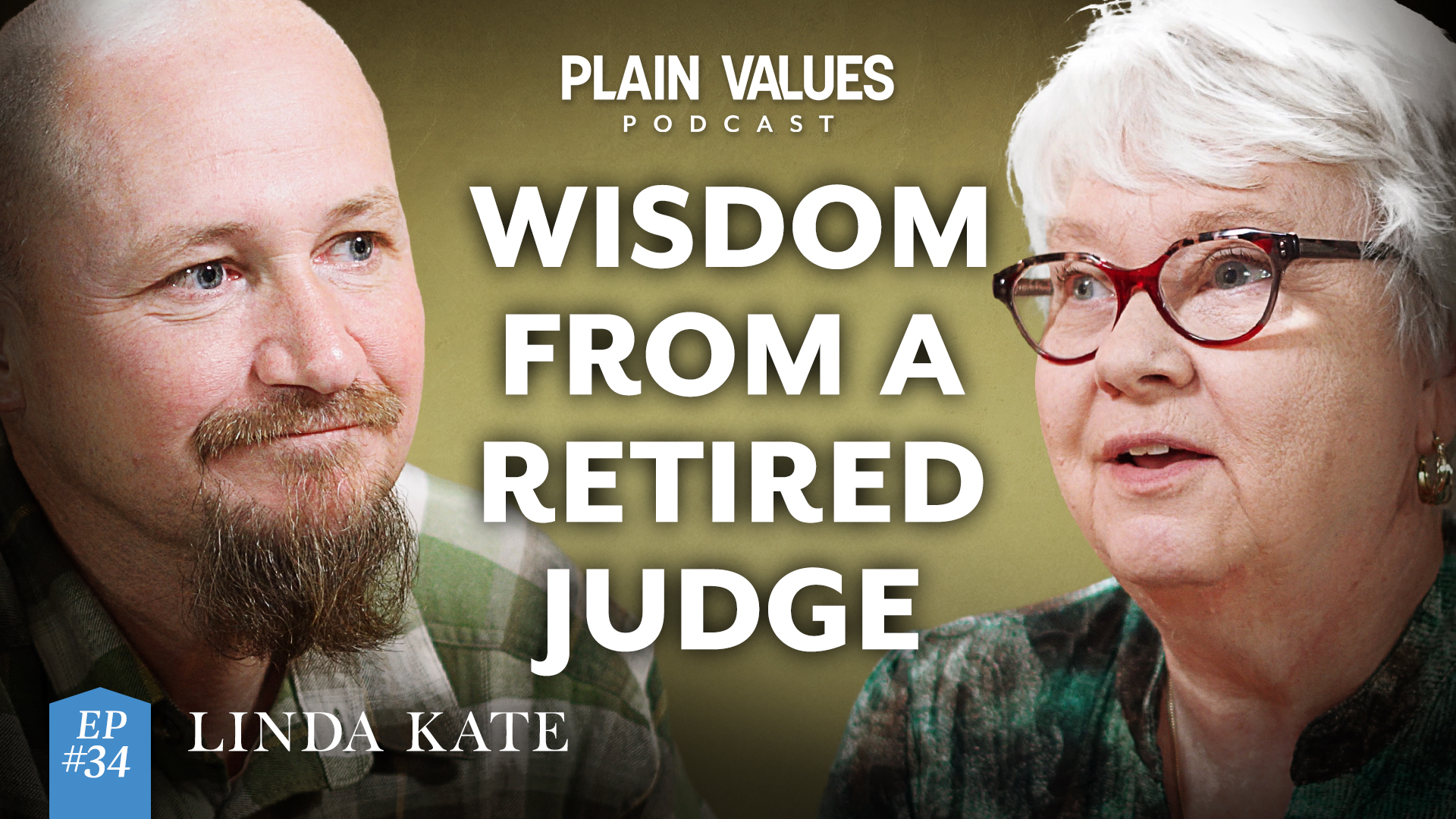
In this episode of The Plain Values Podcast, Marlin sits down with his neighbor and friend, retired judge Linda Kate.
Linda shares her journey from a small-town Catholic upbringing in Tuscarawas County to becoming one of the youngest judges ever elected in Ohio. She reflects on the weight of responsibility she felt the day she was sworn in, the exhausting good days and excruciating bad days in juvenile court, and how she learned to lean heavily on prayer and the support of fellow judges and staff.
The conversation touches on the deep impact of seeing the worst of human nature… and the hope that still remains when someone steps in to protect a child. Linda opens up about the spiritual moments that confirmed her calling, including a powerful sense from God that this was the work He had for her.
She also talks about her marriage to Kevin, raising their family, and the many mission trips they’ve taken together, especially to Haiti, where she witnessed both heartbreaking suffering and profound moments of human connection and compassion.
Throughout the episode, Linda’s quiet faith, steady wisdom, and deep compassion shine through. From the courtroom to the mission field, her life has been marked by a willingness to show up, serve, and trust God in the hardest places.
This honest conversation offers encouragement for anyone walking through difficult seasons or seeking to live out their faith with integrity and courage.
Learn more about Plain Values at https://plainvalues.com
Transcripts
00:00 – Intro
02:18 – Linda’s Childhood
04:42 – Meeting Kevin
07:39 – From Public Defender to Judge
12:37 – How Faith Guided Decisions on the Bench
16:08 – Encouragement During Exhausting Days
22:59 – The Human Capacity for Anything
24:41 – Medical Ministry
34:30 – Experiencing a Stroke
39:38 – The Rehabilitation Process
45:11 – Pain as an Invitation to Grow
46:29 – Finding Joy in Retirement
53:26 – Reading Charles Dickens
55:56 – How to Pray for Linda and Kevin
Linda Kate:
I had a case that involved job and family services, allowing a baby to remain in the home of sex offender. I had to put a lot of things in motion that day that weren’t popular with job and family services, obviously, to get that baby out of that home and the baby was fine. I remember feeling God say to me, “This is what I want you to do for me. ” I always say there in juvenile court, our good days were exhausting, our bad days were excruciating.
Marlin Miller:
Recently, I had the chance to sit with my neighbor and friend, Linda Kate. Linda is a retired judge, and she actually did one of our adoption finalizations, and they have just simply become wonderful friends. I think they’re like a third set of grandparents for our kids. And we talked about life and the good and the hard things that she lived through and worked through with her time on the bench. It was a great conversation. Please meet my friend, Linda Kate. And if you like the content, if you get anything out of it, I will very humbly ask you to like and comment and smash that subscribe button. Thank you. This podcast is sponsored by my friends at Azure Standard. A while back, I had a chance to sit down with the founder, David Stelzer, right here at the table. And we had a great conversation.
I love the Azure story. They started out as farmers back in the ’70s and I think in 1987, they began a nationwide food distribution company. And guys, they are non- GMO organic. They do it right. They do it so well. And you can get a truck to drop food right in your town. Check them out at Azurestandard.com and tell them Marlin and Plain Values sent you.
Tell us about your childhood.
Linda Kate:
Well, I grew up in a really small town in Tuscarawa County. Typical family, mother, father. I grew up in a very Catholic home. I have three brothers. I had good grandparents on both sides that I really enjoyed. I have an aunt who’s only five years older than I am.
Marlin Miller:
Really?
Linda Kate:
Yes. So
Marlin Miller:
You’re like sisters?
Linda Kate:
Yes. And she was a wonderful part of my childhood. She lived on a farm in Newcomerstown with my paternal grandparents. And her and I just had great times there in that farm. That’s cool. And I remember Marlon telling my grandmother when I was 10 that I was going to have a farm like that when I grew up. And she just kind of laughed. My grandfather had pulled Herefords, which is what Kevin raises. Yeah. So here I sit on this farm with these poled Herefords.
Marlin Miller:
That is cool. Had no idea.
Linda Kate:
No.
Marlin Miller:
Wow.
Linda Kate:
No. No.
Marlin Miller:
Okay. So you retired from being a judge in Tuscarawas
Linda Kate:
County
Marlin Miller:
For how many years?
Linda Kate:
About, give or take, about 25 years. I was a magistrate a few years before that also.
Marlin Miller:
Were there things in your childhood that you remember that gave you a hint or a nudge in that direction?
Linda Kate:
Not to be a judge. I never expected that. There were two things that really influenced me to become a lawyer. One was the character Atticus Finch in the Kellemachingbird.
Marlin Miller:
Yeah. Yeah. The book.
Linda Kate:
And one was one of our local judges taught an evidence class that I took as an elective, and that’s how I actively got involved in it academically. I was just completely captivated and it took off from there.
Marlin Miller:
Where did you go to college and then law school?
Linda Kate:
I went to Kent State to college and I went to law school at Akron University.
Marlin Miller:
Okay. How’d you meet Kevin?
Linda Kate:
Bowling.
Marlin Miller:
Bowling?
Linda Kate:
Bowling. I had a friend who told me, she had a friend named Cheryl. And she said, “Cheryl has a brother that I think maybe you ought to meet.” And my friend and her husband were going to have a New Year’s Eve party. And she said, “And we’re going to invite his sister Cheryl and we want you to come and maybe you guys can come together, but let’s just go do something as a group because you might not even like each other.” So we decided we would all go bowling and it was the day after Thanksgiving. And I remember being in the bowling alley because we were there first and I didn’t know what any of them looked like. I’d never met any of them. And I looked up and I saw some people coming in the door. Marlon and I remember hearing God impress upon me, your husband’s about to walk through that door.
Marlin Miller:
Really?
Linda Kate:
Yes. Wow. And Kevin was the next one through the door.
Marlin Miller:
No kidding.
Linda Kate:
Yeah. Wow. And what’s interesting about that is I had had a situation that was very upsetting to me with someone that I dated for a while. And that was the last thing I wanted. And my friend Elizabeth said, “Okay, enough of this, you feeling bad and whining around now. We’re going to get on with this. ” And I didn’t really want to go and my mom made me go.
Marlin Miller:
That’s funny. So did you guys date a long time or not? Was it like, bam, you’re the guy and let’s make it official?
Linda Kate:
I was very, very gun shy at that point. And Kevin said he knew that and he just knew to tread lightly.
Marlin Miller:
I can imagine he would have been rather patient.
Linda Kate:
Yeah. He said, “I knew.” He said, “I wanted to tell you that I loved you long before I did, but he said, I knew if I did that, you would just run the other way.” And what he did tell me was, we were kind of talking about it. He said, “Well, let me put it to you this way. I would marry you to keep you from being
Marlin Miller:
Deported.” To keep you from being deported.
Linda Kate:
Yeah. How he ever came up with that is beyond me. I have no idea.
Marlin Miller:
You are an American citizen,
Linda Kate:
Right? Yeah. Right. Yeah.
Marlin Miller:
Okay, that’s pretty
Linda Kate:
Funny. And way back then, of course, we didn’t have any issues with the deportations that we have now. So where he came up with that is beyond me.
Marlin Miller:
I love it. I’m going to have to mention something next time I see
Linda Kate:
You.
Marlin Miller:
Yeah. That is too funny. So how did your law career begin?
Linda Kate:
I was a public defender for two years in Stark County and then I was a prosecutor for about two or three years in Massillon and I really liked that job. I would do that job again if I was going to work again. And then, let’s see, I had a private law practice for a while.
Marlin Miller:
Doing what kind of work?
Linda Kate:
Just general stuff. Okay. I did a lot of family law. I did criminal defense work.
Marlin Miller:
So I got a question for you. On the family law side of things, what is it like to sit there and listen to people bicker to the tune that they want to sue someone or get divorced or whatever the situation is, right. Did you ever want to just get up and smack someone? I mean, I know you, and I can imagine that you’d have a hard time sitting there, but-
Linda Kate:
I wanted to get up and smack somebody a lot more as a judge than I did as a lawyer. Yeah. Because usually I would just have the one party, but I represent the one party. I’m sorry. Now sometimes I did dissolutions for people and they both would be there and they were pretty much agreed upon everything. And so there was not a lot of arguing and fighting in my office. Yeah.
Marlin Miller:
Wow, that’s interesting. How old were you when you became a judge?
Linda Kate:
I was one of the youngest judges ever elected in Ohio and I think I was about 33. You
Marlin Miller:
Were 33. Okay.
Linda Kate:
Give or take.
Marlin Miller:
Yeah. Okay. How does the election process for a judge work? Is it the same as any other?
Linda Kate:
I think I was about 36 because Emily was three years old, so that would have made me about 36.
Marlin Miller:
Okay. Still incredibly young. I mean, 36 years old.
Linda Kate:
Yeah.
Marlin Miller:
Oh, wow. Okay.
Linda Kate:
You just have to put your name on the ballot and you get your name on the ballot by passing around a petition in the party that you’re running on, the ticket you’re running on. And I think you need 250 signatures, I think. It’s been a while since I had to do that, but I think it’s 250 signatures. You file that, the Board of Elections looks at all the signatures to make sure they’re all good and they’re all registered voters and their name’s on the ballot and then-
Marlin Miller:
Do you have to be a lawyer
Linda Kate:
To become
Marlin Miller:
A judge?
Linda Kate:
Yeah.
Marlin Miller:
I mean, I couldn’t walk up and put
Linda Kate:
My name
Marlin Miller:
On a ballot.
Linda Kate:
No, there are some states where you do not have to be, but in Ohio you do.
Marlin Miller:
Is that a good idea or is that not a good idea?
Linda Kate:
To have to be a lawyer?
Marlin Miller:
Yeah.
Linda Kate:
I think it’s a good idea.
Marlin Miller:
What would happen if you had someone like me behind the bench?
Linda Kate:
Well, I don’t know, Marlon. Boy or not.
Marlin Miller:
That’s a dumb question. I’m sorry.
Linda Kate:
I don’t know. I think it would be very hard. Let’s put it that way.
Marlin Miller:
Yeah. Because you’d have to learn all sorts of things.
Linda Kate:
You would still have to be a pretty good legal scholar, a pretty proficient legal scholar to do it.
Marlin Miller:
Okay. So you’re 36 years old. You’re a new judge. Were you intimidated? Were you nervous walking up to the bench the first couple times?
Linda Kate:
Well, I had been the magistrate for like three years, so I had had a lot of experience by then, but I remember being terrified the day they swore me in.
Marlin Miller:
Really? Yeah. What about it was so
Linda Kate:
Intense for you? Just the weight of the responsibility that I was taking on.
Marlin Miller:
There’s nobody else to pass the buck to at that point.
Linda Kate:
You’re it. Especially here with me because I was the only juvenile probate judge. Like Stark County, for example, has three of them. So they always had a buddy, so to speak. But the two common please judges that were there, we were all good friends, had good associations, and I would go bounce things off them a lot too, so that was helpful.
Marlin Miller:
Wow. How did your faith play into your work?
Linda Kate:
Remember that I told you that I felt God say to me, “Your husband’s got to walk through that door?” Yeah. That only ever happened to me one other time. And it happened to me before I actually got elected. I was still a magistrate and the judge that I worked for was retiring and he had talked to me about running, and so that hadn’t happened yet. I had a case that involved job and family services, allowing a baby to remain in the home of a sex offender. And I had to put a lot of things in motion that day that weren’t popular with job and family services, obviously, to get that baby out of that home. And the baby was fine and the baby got into a good foster home and he had not harmed the baby at all, which was good. But I remember walking through into the judge’s office for some reason.
I don’t know. He wasn’t in there, but I remember walking in there and sitting down, just being so thankful that everything had come together. And I remember feeling God say to me, “This is what I want you to do for me. ” That’s the only two times that’s ever happened to me.
So that of course pushed me further down the road. And you know, Marlon, I shouldn’t have won that first election because the daughter of the chairman of the Democrat Party was also a judge of municipal court.
Marlin Miller:
The daughter of the who in the Democrat party?
Linda Kate:
The chairman of the Democrat Party locally.
Marlin Miller:
Right in Tuscros County.
Linda Kate:
Yes. His daughter-in-law was a municipal court judge. She decided that she wanted to be the juvenile judge, so she ran also. And I had no political connections. I had people that worked hard in the community to help me get elected. A lot of the lawyers helped a lot. And my husband, Kevin, helped a lot, but if you just looked at it on paper, I should have never won that election. Did
Marlin Miller:
You expect to lose?
Linda Kate:
I didn’t know what was going to happen.
Marlin Miller:
Had no idea.
Linda Kate:
Except I did continue to feel that that was what I was supposed to do. And I won by a landslide.
Marlin Miller:
Really?
Linda Kate:
Yes. I never ran unopposed. There was always someone that ran against me and every time I won by a landslide.
Marlin Miller:
Wow. Wow.
Linda Kate:
So those things just kept me encouraged that that’s what God wanted me to do. One of the common pleas judges, Roger Lyle was a good, good, good man. And he has since just passed away, but Roger was a really good man and I got some of my best encouragement from him. And I remember one day, I don’t know what took place in court, but you had days where you were just exhausted. I always say there in juvenile court, our good days were exhausting, our bad days were excruciating. So there was a really bad day and I remember going up to his office and I said, “I don’t know if I want to do this. This was an awful day.” And he listened and he said, “Well, you don’t have to do it, but you better make sure you understand who’s going to do it if you don’t.”
Marlin Miller:
Wow. What did a bad day look like?
Linda Kate:
Let me add one other thing and then I’ll get to that question. Roger was also the person who said to me, because I remember probably in the same conversation, I said to him, “How do you even do this day in and day out? ” And he said, “I remember I was standing in front of his desk and he said, Sit down and I’ll tell you, which I did. And he said, I can do it because I pray a lot.
Marlin Miller:
Wow.
Linda Kate:
So I’m sorry, what was your question?
Marlin Miller:
So when you said that good days were hard and bad days were excruciating, what did a bad day look like?
Linda Kate:
The really bad days, Marlin, I wouldn’t even divulge to you because it’s sort of like you can’t unring the bell. And if I tell you, you’re going to have that stuff in your head and I don’t ever want to do that to anybody. I just saw horrific things happen to children and the devil is alive and well. And so those things were just, just horrific. And I was fortunate. I had a wonderful, good staff. A lot of Christian people worked for me, a lot of believers, and we kept each other encouraged and looked out after each other. And so that’s how we got through the excruciating days. But there would be days when Kevin would come home and I might be sitting in the corner of the bathroom just crying because what I just saw that day was just so awful. But I just remained thankful that eventually someone was there to intervene and I was able to guide what happened from here on out.
Marlin Miller:
You’ve told me many times that you’ve seen it all.
Linda Kate:
I’ve seen a lot, if not at all. I’ve seen a lot. There isn’t anything anybody can ever tell me to shock me. I mean, it’ll shock me, but not surprise me. Let’s put it that way.
Marlin Miller:
Yeah. I don’t know that I’ve ever really taken time to think about what that actually could mean. And I don’t know that I want to, but did you take Roger’s advice and just
Linda Kate:
You
Marlin Miller:
Kept on going
Linda Kate:
By- Absolutely.
Marlin Miller:
… hanging on to the Lord.
Linda Kate:
Yeah. My goodness.
And I just would got very used to praying over what I was doing and there would be days when I just would have my fill of what I heard in court and I would tell everybody, “We’re done today. We’ve all had enough and you’re all going home.” And I think the lawyers appreciated that because I could just sort of look around the room and tell when everybody had had enough. Yeah. And I would start over the next day and I prayed a lot over my decisions and if there were decisions that I didn’t know what to do, how to resolve, I would leave them lay on the corner of my desk and I knew that before too long God would tell me what to do with them and that in fact happened.
Marlin Miller:
And after doing it for a while, you probably built a bit of a habit and a pattern and you just expected an answer.
Linda Kate:
Oh yeah, absolutely.
Marlin Miller:
You expected it.
Linda Kate:
Absolutely.
Marlin Miller:
Can you share a time like one of those moments or like one of those cases where you were really in a bit of a quandary where you didn’t know what the right thing was to do? Because for me, a total layman, bit of a lovelight in many ways, I don’t … It’s one thing to read the story of Solomon, the baby comes in, the two moms are fighting over the baby and, “Oh, hey, go get me a sword.” And you think, “Well, that is a genius way.” Well, who would have ever thought of that?
Linda Kate:
Yeah. The decisions that probably I really had to give a lot of thought and struggle over were the ones … The juvenile court in Tuscarawa County has jurisdiction over all the paternity cases, and those are the people that have children that aren’t married to each other, and those could really, really be a big mess. So those were the ones sometimes that I had to just let sit there for a while until I was sure what to do. Wow. Yeah. Roger always told me, “You do what’s right, and then you find the law to support it. “
Marlin Miller:
Wow.
Linda Kate:
And that’s what I always tried to do. And it’s not faking the law or anything. It’s just knowing that if you’re doing what’s right, the legal analysis will come together for you.
Marlin Miller:
And it’ll make sense.
Linda Kate:
Yeah.
Marlin Miller:
Yeah.
Linda Kate:
Yeah, absolutely.
Marlin Miller:
Yeah. Wow. In the 25 years or 30 years that you were a magistrate and a judge and just your entire legal career, how has that time influenced your worldview and the way that you see people in general?
Linda Kate:
Well, I would say there’s a certain part of me that is a lot more cynical than the average person. And I also think, I also know that people are capable of anything and so I never assume that someone is not capable of something. If I hear that someone that I really care about, really love, really respect, has done something really bad and tragic, I’m not going to be shocked by it because I just know that people are capable of anything. And there’s a part of me that’s always wondered how Nazi Germany unfolded. How could people do those things? But there’s a part of me that understands how it can happen and in the right circumstances, I think it would happen again. Yeah. So I don’t know that the average person would describe humanity that way.
Marlin Miller:
Yeah. Over the years, you have done a lot of ministry work over in Africa. Well, I’ll ask it in this way.
Linda Kate:
Egypt. Egypt. Egypt and Iraq and Jordan.
Marlin Miller:
Okay.
Linda Kate:
Yeah. And Haiti with Kevin.
Marlin Miller:
Right. Can you share a few of your best and favorite stories from all that work?
Linda Kate:
I don’t know if it’s a favorite story. It’s a sad story. Some of the work I did was with medical teams, and I remember a couple bringing a young baby to us. We would just be inundated with people if it got out in the community that there was American doctors there. And I think this baby was probably … Well, it was less than a year old. It was a baby. And the baby had been sick and they had taken the baby to doctors nationally there and that the child had a heart defect and they brought documents from the doctors so the doctors I worked with could read them and see exactly what was the problem with the baby, and that baby was going to die. And they were so hopeful. They had been told that. They were so hopeful that if they came and the American doctors were there, that the American doctors could do something.
And there wasn’t anything to be done. I mean, had that baby been here in the states, that baby would have died. That was very heartbreaking. It’s something that I remember a lot and them asking us if we could at least pray for the baby. Of course, God can do anything and then who knows what really happened with that child, but those kind of things were really, really difficult. So many people would see the Americans as people coming who had answers that they couldn’t get in their own country, but we a lot of times didn’t.
Marlin Miller:
Yeah. Did the best you could and-
Linda Kate:
Yes.
Marlin Miller:
And then you have to at some point disconnect and go … I’ve not done a lot of overseas travel. I’ve not done a lot of ministry work in other places. And at times I wish I would and could and would just go. Other times I realized I’ve got enough going on here with our family.
Linda Kate:
Yeah.
Marlin Miller:
I don’t know how well I would handle things like that. I don’t know that I would handle it well. I
Linda Kate:
Love learning. I remember there was a doctor in Haiti that I worked with every day when I was there on that trip and he was an ER doctor and he knew I was interested. He knew I was interested in being a paramedic and I was interested in learning anything he could teach me. And he taught me a tremendous amount of things, but we just saw an awful lot of things that you had to just know you couldn’t do anything about. In Haiti, we saw a lot of people that would come that had cancer. Medical treatment there in that island is very poor and some places non-existent. And so that was hard to know that those people … There was nothing for them. There was lighter moments there. I remember there was a woman that we were treating and I don’t remember what made her come to us, but she walked away and the doctor said to me, “Okay, just remember in a month or two, if you’re coughing up blood, we were just exposed to TB.” And there were lighter moments that you could … I mean, you had to just laugh about it.
You just had to laugh.
Marlin Miller:
It’s not exactly light. I mean- No,
Linda Kate:
But it was. It was because … I remember, Marlon, this is my biggest memory of medical work in Haiti. They brought us a woman on a stretcher. They had walked seven hours or so, eight hours to get that woman to us. She was in advanced stages of AIDS. Now there was nothing anybody could do for her. They did transfer her to a hospital in St. Mark’s where they could give her oxygen and make her last hours a little less painful. But Marlon, no one had touched that woman in a year because Haitians are very Superstitious. They had no real understanding how she got sick and they weren’t going to touch her because they didn’t want to catch what she had. And I had gloves on just in the course of what we were doing. I took those gloves off and I held her hand. And she was still aware enough that she knew somebody was doing that.
That’s a little thing, a really small thing. I feel like that was one of the greatest gifts I ever gave anybody on the mission field. Yeah. And I would do it all over again.
Marlin Miller:
So your husband has been in Haiti many, many times.
Linda Kate:
Yeah. I don’t remember how many times he’s been there.
Marlin Miller:
I think he told me a long time ago that he’s drilled like 120, 130 some wells.
Linda Kate:
Probably.
Marlin Miller:
I think. And that’s probably all the good ones. And
Linda Kate:
He’s drilled many
Marlin Miller:
Bad holes too. He went
Linda Kate:
Twice a year. And I just can’t remember how many years it was. It was quite a few.
Marlin Miller:
How did Haiti get so … I’m not sure what the best way to say this is other than how did it become so overrun with darkness? It seems like it’s-
Linda Kate:
Well, it is very dark.
Marlin Miller:
Really, really dark.
Linda Kate:
It is very dark. Some people believe in these things and some people don’t, but I can tell you that’s an island that worships the devil. And there is a lot of black magic kind of things that go on there.
Marlin Miller:
Yeah. Voodoo.
Linda Kate:
Openly. Yeah, sure. In every little village, there is going to be a witch doctor and he is going to be practicing black magic for anybody that comes and pays him enough for whatever they want. I think those kinds of things have a big impact on what goes on in the island. And Haiti never gets any better. And now it’s just chaos there. And it’s not been safe enough for several years now for Kevin to go or for anybody to go.
Marlin Miller:
Yeah.
Linda Kate:
I’m sure there’s still some missionaries there. I
Marlin Miller:
Think a lot of them have moved back.
Linda Kate:
I know a lot of them have. I know the compound where we would go and stay. We had a really nice safe walled and guarded compound there, but that’s been vacant for a long time now. Yeah.
Marlin Miller:
I mean, you’re talking like digging out huge holes in the middle of the road and covering it up
Linda Kate:
And
Marlin Miller:
You’re driving along and all of a sudden-
Linda Kate:
Lots of kidnapping. You got a problem. Yeah.
Marlin Miller:
Wow.
Linda Kate:
Yeah. Lots of violence.
Marlin Miller:
I’m going to change gears.
Linda Kate:
Okay.
Marlin Miller:
We’ve been publishing Plain Values for almost 13 years now. And about a year ago, the team and I decided to put together a compendium, a best of, if you will, of our favorite stories, the most impactful stories of all those years. And invited is what we built out of those conversations. It is 194 and four pages, and it is absolutely a thing of beauty. We do a monthly gathering here where we just simply open our doors. It’s called Porch Time. And the story of how Porchtime came to be and how our family was invited into that and how we are inviting you and every Tom, Dick, and Harry, anybody who wants to come can come and hang out at Porch Time here at the office in Weinsburg. So it was such a natural fit to use the home of the founder of Porch Time and to call it invited.
You can find it on plainvalues.com on the shop page, and you can now consider yourself invited. How long ago was it that you had your stroke?
Linda Kate:
It was June 1st, 2018.
Marlin Miller:
- Okay. And this might be a bit juvenile. What happens in a stroke? How did it go for you, your experience with that?
Linda Kate:
Well, medically what happens in a stroke, a blood vessel in your brain bursts or you can get a blood clot and that has the same kind of effect.
Marlin Miller:
Okay.
Linda Kate:
Does it
Marlin Miller:
Cut off the oxygen to your brain?
Linda Kate:
Cuts off the blood flow.
Marlin Miller:
It cuts off the blood flow. Okay.
Linda Kate:
It blocks not … You’ll have other arteries where there’s still blood coming in, but it’ll block an artery. The stroke I had was very, very small, and it was in the back of my brain, down by my brainstem, which was very fortunate because brainstem strokes, actual brainstem strokes are just devastating. It was very, very small. I mean, tiny, but I know the neurologist said, “If you had had this stroke, if it had been in a different location, you wouldn’t have even known you had. It was so small.”
Marlin Miller:
Really?
Linda Kate:
But it blocked a neuropathway, which caused my right side to not function.
Marlin Miller:
Did you know what was happening right
Linda Kate:
Away? I knew. You knew. I was coming home from the grocery store. I just got to the top of our lane and I was turning down the driveway and my vision got brown. It was like somebody pulled a shade down.
Marlin Miller:
Brown.
Linda Kate:
Yeah. It was like somebody pulled a shade down. And I knew I was either … At that point, I had had training as an EMT and I knew I was either having a stroke or I had a detached retina. So you’ve been down my lane, it’s a half a mile long. Yeah. The interesting thing was I didn’t plan it, but I got the car stopped down there. As I got the car stopped, at that point, I couldn’t use my right hand at all, but I got the car stopped and it just so happened that I got the car stopped. And the only place in our driveway where you have cell service, at least back then, that was the only place you had cell service.
Marlin Miller:
It was right there. Because if you would have gone a little further, you couldn’t have called out.
Linda Kate:
No, not back then. No. And so I called myself an ambulance and told them to call my office and let them know. And they called Kevin for me. And I don’t know why I tried to do this. This was really stupid, but I tried to stand up. I tried to get out of the car and stand up. Well, that was really stupid. And so I fell down. It was a beautiful day and I’m just laying there in the grass on my back looking at the sky thinking, “Well, I wonder if this is what it would be like to be shot.” I don’t know why I was thinking that. I don’t know why I was thinking that. But I could hear the ambulance going up and down the road. I could hear the siren and it took them a long time to get there and I don’t know why they couldn’t find my driveway.
Marlin Miller:
They went past and-
Linda Kate:
Yeah. Yeah. They kept going past. And our driveway’s marked with our address and all that, and I don’t know why it took them forever.
Marlin Miller:
Hold
Linda Kate:
On.
Marlin Miller:
Hold on. Were you at the front part of the driveway or had you gone over the hill
Linda Kate:
Back to the house? You know where our garage is?
Marlin Miller:
Yeah.
Linda Kate:
It was right … I was past the doors on the garage and had turned up to go to the house. Okay. So it was right there.
Marlin Miller:
Okay. So you were back in there. I initially thought that you had pulled into the drive and right there before the little pond, the creek.
Linda Kate:
Oh, no. I
Marlin Miller:
Thought it was way out there. And then I thought, well, they would’ve seen you.
Linda Kate:
No, I was way back towards the house.
Marlin Miller:
Okay.
Linda Kate:
In fact, it took them so long that at a later time I met an EMT from Weinsburg and he said, “We were monitoring that call and we were about to come and get you because we knew where you were.” And they-
Marlin Miller:
Dundee couldn’t find you.
Linda Kate:
Well, Smith Ambulance came.
Marlin Miller:
Okay. I’m sorry. I’m sorry.
Linda Kate:
No
Marlin Miller:
Offense to the Dundee fireman.
Linda Kate:
No, they just dispatched the Smith Ambulance to come and get me.
Marlin Miller:
But they couldn’t find you. So they get there. So
Linda Kate:
I get there and I’m laying in the grass and the guy, the driver of the ambulance, now I’m sure he just wanted to see whether or not I could respond. But he’s getting out of the ambulance going, “Hey, judge, are you okay?” And I said, “No, not really. I’m laying here on the ground.” Oh,
Marlin Miller:
Man.
Linda Kate:
They scooped me up then and
Marlin Miller:
Got
Linda Kate:
Moving with me.
Marlin Miller:
What was that healing process like for you?
Linda Kate:
Well, first of all, God again was incredibly faithful because the ambulance driver wanted to take me to a local hospital. There was an EMT in the back with me and she said, “Absolutely not. We’re taking her to Altman.” And they had about had an argument over it because he said, “No, it’s closer to go local.” And she said, “No, they’re going to mess around. We’re going to Altman.” Which is where I told him I wanted to go. So God was faithful in providing me with excellent medical care, excellent rehabilitation care, but it sucked and it stunk. I mean, I was just shocked. So I lived in shock for a while, and then about a week or so, maybe 10 days after I actually had the stroke, I got transferred to Woodlawn and Canton, which is a rehabilitation place, and they were absolutely fantastic. And the physical therapists just are my new heroes.
I mean, they were just incredible. Wow. They were incredible. I had a young man, his name was Mason, and Mason was probably right out of college, and he just was terrific. What
Marlin Miller:
Was it like for Kevin? I mean, I’m trying to put myself in Kevin’s shoes. You guys were married for-
Linda Kate:
Ever.
Marlin Miller:
… for a long time.
Linda Kate:
Yeah.
Marlin Miller:
And he loves nothing more than to help and serve and give his left pinky for anything.
Linda Kate:
Well, I guess on the one hand, you would have to ask him, but he just was steadfast and did what he had to do, just like you know him to be now. Yeah. And by the time I got home, I was up and moving around with a walker and I just kept up with the fit therapy and that just continued to get better and better. And I ended up with a really great local therapist who was probably the absolute best one I ever had. And he got me walking better and better. And I have a cane now that I walk with, but other than that, function came back in my arm and my hand and my shoulder and …
Marlin Miller:
Yeah.
Linda Kate:
Wow. So God is faith with all of those things. And I was angry about that for a good while because it wiped out everything I wanted to do. It didn’t keep me from being a judge, but I wanted to be a paramedic as soon as I got retired. And I was good at it, Marlin. I was good at the EMT things I learned. I could whip through those things. I could intubate somebody in just a heartbeat.
Marlin Miller:
Yeah.
Linda Kate:
And-
Marlin Miller:
I’m so not surprised.
Linda Kate:
I was angry because I said, “You give me this ability and then you take it away.” You know what, what is up with that? Yeah. I guess I did hear God convey something to me a third time, which was, “Well, I kept you from dying from something like this, and now I’m going to save your life.” And that had to do with spiritual discipline, I guess. I can remember standing out in my patio there praying one morning in the sun, and I don’t know what I’d been reading or what I’d been listening to, but that day I remember praying and saying, “Okay, God, whatever you need to do to make me what you want me to be, I give you permission to do it. I just let it happen.” And then I remember later on thinking that day, “Oh, what in the world did I
Marlin Miller:
Pray?” Why did I do that?
Linda Kate:
Yeah.
Marlin Miller:
Yeah.
Linda Kate:
And I’m not so sure that he wove all of that together. I don’t think he made me have a stroke. I think he let me have one. So I don’t know, but I guess I won’t know those things, this side of heaven.
Marlin Miller:
Yeah. I just had a friend tell me about a book that a friend of his wrote and it was Nancy Kane and she basically- She read the book? Yeah, I’m sorry. Yeah. Nancy wrote the book and if you give me two seconds, it’ll come back as far as the title, but she says that pain and suffering is our invitation, God’s invitation to us to grow, but God is always a gentleman. And he doesn’t actually force it. No. He doesn’t make us grow, but he gives us those opportunities to grow. And I’ve thought about that a lot. That’s really, that’s really profound.
Linda Kate:
I think it’s really, really true.
Marlin Miller:
There’s really a lot of wisdom there because he doesn’t … The whole free will thing is a can of worms that I love to dive into, but we do have free will. He doesn’t make us do something.
Linda Kate:
No. I really felt like the time came when I realized that I wasn’t God’s first Israelite and that he was willing to walk through the desert with me, but he was going to let me walk through the desert as long as I wanted to.
Marlin Miller:
Yeah.
Linda Kate:
And yeah.
Marlin Miller:
Wow. What brings you the most joy in your retirement?
Linda Kate:
Our daughter and Kevin, you and your family. Man. That brings us lots of joy and being able to provide comfort to people. I’ve been talking with a friend of mine that I went to high school with. She had a situation in her family and it’s been going on for several months and it’s all resolved itself in a very good way, but she called me yesterday and was talking about it some more and was wondering if she should still do A, B and C. Okay? And I said to her that, “Okay, this is kind of over and done now, and you need to just put this to rest because your family is doing fine now. You did all the right things. You can stop trying to do things now.” And I didn’t think there was anything profound in what I was saying. I said, “It’s time for you to let this go now.” And she thanked me over and over.
She said, “I just needed you to tell me that.
Marlin Miller:
” For someone to give her permission to do
Linda Kate:
That. She said, “You understand what happened because of what you did for a living. You understand what’s happened and I just needed you to tell me it’s okay now and I can just lay this down.” And just things like that. I just like to talk to strangers. I like to … I hate going to Walmart. I really do. I don’t ever do that unless I absolutely have to, but there’s usually someone in there that I can stop and speak to. It’s amazing if you say to someone, “How are you today?” “Oh, I’m fine. “And you look at them and you say,” No, how are you really? “It’s amazing how many people that’ll start to cry.
Marlin Miller:
Really?
Linda Kate:
Yeah. And then if I just take a … Because life is hard and nobody’s asking. Nobody does that.
Marlin Miller:
Nobody does that, do they?
Linda Kate:
And I remember talking to a man that had, I think I told you this story, but he was stocking the shelves and I did the same thing to him. And he said,” I’m fine. “And I said,” How are you really? I’m fine. “He said, and he went back stocking shelves and I still stood there and looked at whatever I was looking at. And all of a sudden he stopped what he was doing and he turned around and he looked at me and told me that someone very special to him had died. He said,” I’m very sad and I don’t know what to do. “Now, what in the world ever made that man tell me that is beyond me, especially the circumstances that he shared with me. He took a big risk telling those things to a stranger.
Marlin Miller:
Standing in the aisle in Walmart, okay?
Linda Kate:
I told you this. I
Marlin Miller:
Don’t think I remember that. I don’t think I
Linda Kate:
Remember that. Maybe I’m
Marlin Miller:
Forgetting
Linda Kate:
It. I’ll keep his details to myself, and it was such a blessing to be able to do that.
Marlin Miller:
Is it the fact that deep down, a lot of us have that authenticity meter, if you will, where that other person can sense when the person standing in front of him is being real.
Linda Kate:
Something’s happening. I mean, I don’t know what it is, but I just knew I was supposed to talk to him and I passed him a couple times in the aisle and then went over to the next aisle and thought I need to go back and just speak to him, and I did. Wow. And I don’t know what made me tell him or what made him tell me what he said.
Marlin Miller:
Oh, man, I love that. What’s on your bucket list?
Linda Kate:
It’s not that I don’t want to do things, okay? I have got the ability or had the opportunity to do so many things in my life that I don’t have one particular thing that I’m still dying to do. Our daughter and son-in-law are going to be moving to England next year, probably sometime. And so I’m interested to go to England and see Scotland and do some more traveling, but I’ve been to all kinds of places in the world and done an awful lot of things.
Marlin Miller:
So does that mean that he is in fact getting the job at Oxford? That’s pretty incredible.
Linda Kate:
What’s happening now is it is a long, long process because he will be hired and do research there for probably six years or so, and then they’ll put him in a classroom. What’s happening now is he’s filling out grants for funding for the lab. So Emily told me the other day that he will not know if he even made it through the first cut of the funding until February.
Marlin Miller:
So it is a long, long journey.
Linda Kate:
Yeah.
Marlin Miller:
My goodness. That’s incredible though.
Linda Kate:
Yeah.
Marlin Miller:
That is so cool.
Linda Kate:
But I know I told you before, Emily qualifies to be a magistrate in the English court system, and she’s still planning on doing that.
Marlin Miller:
She would make a wonderful judge.
Linda Kate:
Well, she’d be a magistrate. They work in a three magistrate panel. Okay. I just cannot believe that she would be doing that. I was just stunned when she told me about that. And then I actually sat and thought about it for a while, but yep.
Marlin Miller:
Wow. That’s amazing. I have just a few more questions here. Okay. What is the favorite book of the year so far that you’ve read?
Linda Kate:
Well, I’ve just read The Kill a Mockingbird again, and I’ve read that I don’t know how many times, but that’s still a favorite book for me to read. I love that book. I
Marlin Miller:
Will confess, I don’t remember
Linda Kate:
Actually reading this. You need to read that Marlon.
Marlin Miller:
Okay. All right. You
Linda Kate:
Need to read.
Marlin Miller:
I know I have a copy right here somewhere. Okay.
Linda Kate:
Cool. I love that. And I mean, I read a lot of just popular novels. I like John Grisham’s novels. I love A Tale of Two Cities and I’ve read that, I don’t know how many times since I was a freshman in high school when we were forced to read it and I absolutely hated it.
Marlin Miller:
I forget where I read this, but I remember reading that Dickens was writing that book and I think a few others at the same time, and I think he was … Boy, I should probably double check this before I say this, but I believe he was writing these novels simultaneously and publishing them in story form in the local newspaper.
Linda Kate:
I think I read that also.
Marlin Miller:
I think it was something like that. And it was one
Linda Kate:
Of those
Marlin Miller:
Things that I remember reading it and going, “That’s absolute craziness to do a Dickens novel, which is that they’re one of the most incredible things by themself and he’s writing multiple novels at the same time.” It just blew my mind.
Linda Kate:
I don’t remember which novels it was, but I’ve read that too.
Marlin Miller:
Yeah. Yeah.
Linda Kate:
If you read A Tale of Two Cities, I’m just fascinated with the way Dickens writes, you can smell the stench in the streets and … Yeah. Yeah.
Marlin Miller:
Yeah. The Count of Money, Christo-
Linda Kate:
I’ve never read that.
Marlin Miller:
Wait, no, that’s not Dickens. That’s Alexander Duma.
Linda Kate:
Yeah.
Marlin Miller:
I’m sorry. That’s
Linda Kate:
Okay. I’ve never read that though.
Marlin Miller:
Yeah. The Count is unbelievable and great expectations. I mean, that’s another
Linda Kate:
Dickens.
Marlin Miller:
Anyway, yeah. Last one.
Linda Kate:
Okay.
Marlin Miller:
How can we pray for you?
Linda Kate:
I guess that Kevin and I continue to be healthy and Kevin continues to be able to do things on the farm there that he loves to do. And I personally always really appreciate it that you come and help him do stuff because he really loves spending time with you. I guess I really appreciate that you do that because he really loves spending time with you and just that we continue to be healthy and continue to do things. God’s blessed us with everything else that we need and we’re very comfortable and …
Marlin Miller:
Yeah.
Linda Kate:
So yeah, that’s something that can continue to always pray for us.
Marlin Miller:
Linda, thank you for doing this.
Linda Kate:
Oh, thank you for inviting me.
Marlin Miller:
This is a great-
Linda Kate:
It was wonderful to get the opportunity to do it.
Marlin Miller:
Well, thank you. This episode of the Plain Values Podcast is being brought to you by my friends at Kentucky Lumber. Derek and I were talking this morning and he shared a story about how they like to do business and they like to do business with people that are like them and they like to be treated in a way that they treat their own customers. He told me about a customer of theirs that he had to fire and this was not going the way that it typically does. And this guy was not being happy with anything that they did and nothing was good enough. And finally Derek said, “You know what? You’ve disrespected my team enough and I think we’re done. And so you can go find your lumber someplace else.” And the attitude and the heart behind the way that Derek sees the world is exactly the way that I see the world and I have a hunch you might as well.
If you call Kentucky Lumber, just know that they might fire you if you treat them poorly. I’m kidding, of course. But they will treat you with the utmost respect because it’s how they want to be treated. And I think there’s a golden rule thing in there somewhere, but if you need anything at all to do with any lumber, wood flooring, wood siding, any type of wood product that has character just baked into it and a great team to match, call my friends at Kentucky Lumber. You can find them at drywallhaters.com. So hold
My hair. In his book, Rembrandt is in the wind, Russ Ramsey says that the Bible is the story of the God of the universe telling his people to care for the sojourner, the poor, the orphan, and the widow. And it’s the story of his people struggling to find the humility to carry out that holy calling. Guys, that is what Plain Values is all about. If you got anything out of this podcast, you will probably love Plain Values in print. You can go to plainvalues.com to learn more and check it out. Please like, subscribe and leave us a review. Guys, love you all. Thanks so much.
Brought to you by …

🤝THIS EPISODE’S FEATURED SPONSOR: Azure Standard
Talk about a mission-oriented company; our friends at Azure Standard set the standard of excellence when it comes to sourcing nutritious food for your family.
They have a new program called “Around the Table” that nourishes by walking shoulder-to-shoulder with churches and church communities. It’s wonderful!
Learn more: https://www.azurearoundthetable.com/ from Plain Values’ mission to share the gospel amid infertility, adoption journeys, and special needs advocacy, this 194-page volume renews hope and affirms the beauty of simple, purposeful lives.

🤝THIS EPISODE’S PREMIER/FEATURED SPONSOR: Invited: Collection 001
If you’re craving stories that restore faith in hard times, Invited: Collection 001 is a handpicked “best of” from Plain Values magazine … uplifting accounts of triumph, simple joys, adoption beauty, homesteading wisdom, and gospel-centered living.
Learn more: https://homesteadliving.com/invited-collection-001/

🤝THIS EPISODE’S FEATURED SPONSOR: Kentucky Lumber
Our friend Derek Guyer at Kentucky Lumber is the type of guy that you want to support. He is a highly-skilled tradesman who exemplifies excellence in everything he does. Kentucky Lumber is an independent lumber yard that truly does world class work!
We would humbly ask you to support them with your lumber needs: http://www.drywallhaters.com







Leave a Reply