
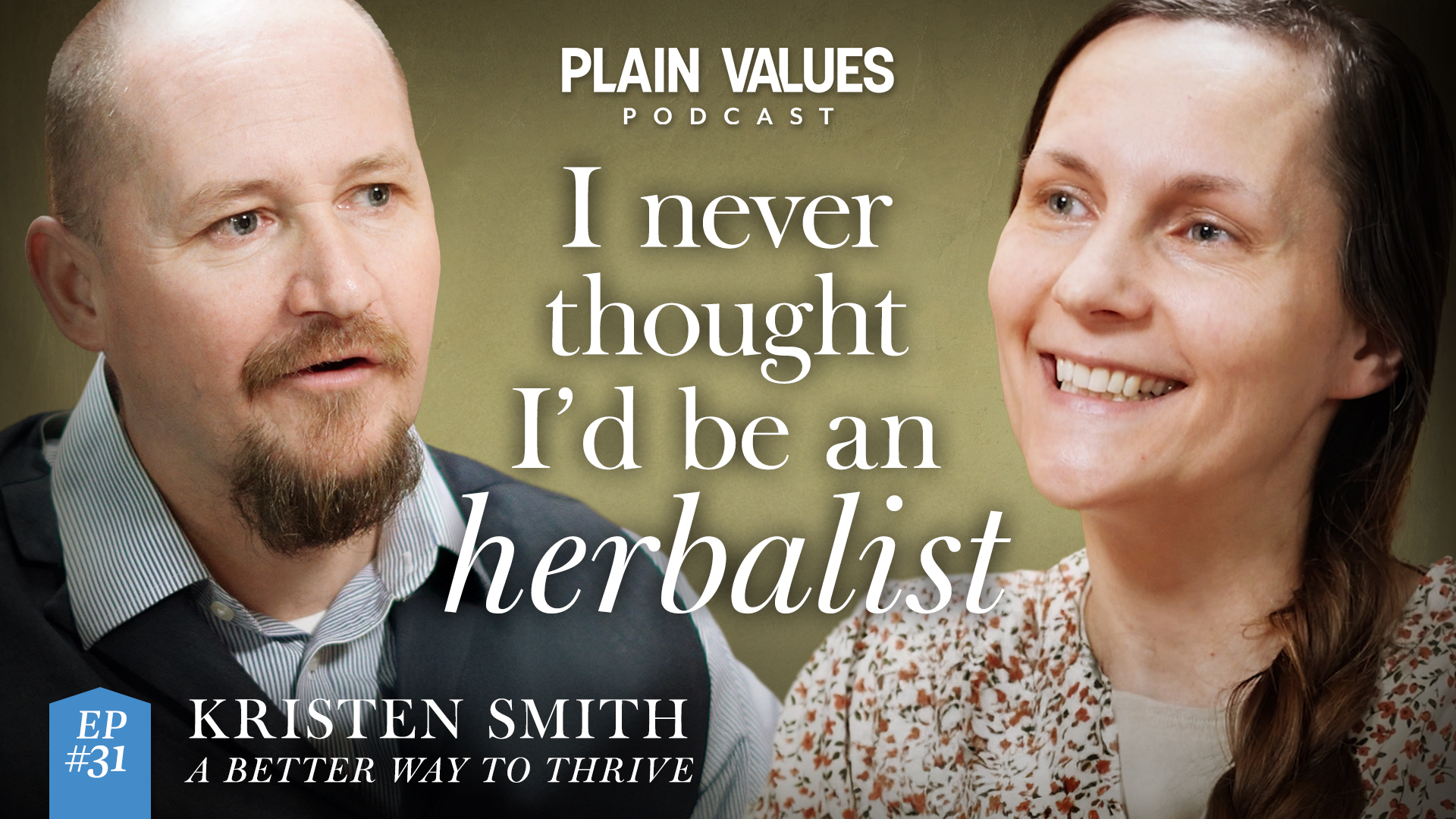
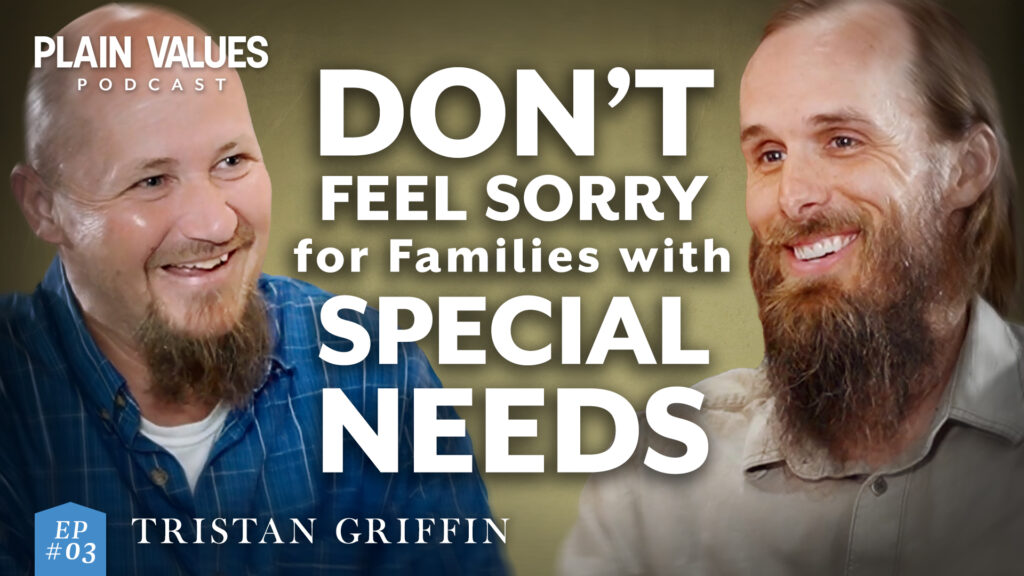
In this episode of The Plain Values Podcast …
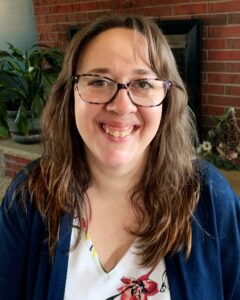
Kristen Smith never planned on becoming an herbalist.
As the oldest of three, she grew up surrounded by farmland in northwest Ohio, helping grandparents with conventional crops and meat chickens.
But life shifted after marriage, college, and her first baby. A routine blood test at 22 revealed severe hypothyroidism. The doctor offered medication for life with little explanation. That moment sparked questions: Why did this happen? Could food help?
With no home internet and young kids, Kristen loaded her children into a stroller and walked miles to the library, checking out every book on nutrition and health she could find.
Changes came slowly… first toothpaste and deodorant, then deeper shifts toward whole foods and away from processed items. Her thyroid still requires medication, but the journey opened a world of natural remedies.
Years (and nine children) later, Kristen turned her one-acre yard into a “backyard medicine cabinet.”
She grows medicinal plants, keeps chickens, and experiments with herbs. Her faith anchors everything. With a large family on limited land, she relies on God’s strength daily.
Kristen’s story shows how one health crisis, met with curiosity and grace, can grow into a life of stewardship, healing, and passing natural wisdom to the next generation.
Learn more about Kristen’s work at https://abetterwaytothrive.com
Learn more about Plain Values at https://plainvalues.com
Transcripts
00:00 – Intro
01:57 – Kristen’s Childhood in Ohio Farm Country
05:10 – A Thyroid Diagnosis
11:09 – Navigating Comments as A Family of 11
14:19 – How Kristen Connected with Plain Values Magazine
15:45 – What Does It Mean to Be an Herbalist?
18:27 – The Plantain Miracle
24:05 – Finding Healthcare Balance
32:57 – Seeking Whole Health Conference
47:27 – Grace and Forgiveness
Kristen Smith:
I’ll never forget that doctor’s visit because I’m sitting there in my chair thinking like, why did a part of me break? So I decided I will turn my yard as much as possible into my backyard medicine cabinet. So he comes, he pulls his pant leg up and it’s abscessing underneath like this is nasty red infected. So I went out and I got the plantain leaf, get it all mashed up, stick it on his knee. So half hour goes by and I take the poltis off. I’d never seen anything like it.
Marlin Miller:
Wow. I recently sat down with Kristen Smith. She writes for plain values and she doesn’t live that far away. And we’ve never really had a chance to get to know each other on a deeper level than just simply working together on the magazine. And we sat down and had a wonderful conversation. Please meet my friend, Kristen Smith. And if you like the content, if you get anything out of it, I will very humbly ask you to like and comment and smash that subscribe button. Thank you. This podcast is sponsored by my friends at Azure Standard. A while back, I had a chance to sit down with the founder, David Stelzer, right here at the table. And we had a great conversation. I love the Azure story. They started out as farmers back in the 70s and I think in 1987, they began a nationwide food distribution company.
And guys, they are non- GMO organic. They do it right. They do it so well. And you can get a truck to drop food right in your town. Check them out at Azurestandard.com and tell them Marlin and Plain Values sent you. Tell us about your childhood.
Kristen Smith:
My childhood. What angles of it would you like to hear?
Marlin Miller:
Siblings and your folks. What were they like?
Kristen Smith:
So I’m the oldest, oldest daughter of the family. I have a younger sister and younger brother. And my parents divorced when I was eighth grade-ish. So we grew up out in Northwest Ohio. So farmland near Michigan and Indiana. It’s really flat and everything’s laid out in squares. And there’s nothing but like soybean fields and cornfields. Both my grandparents were farmers. So we grew up doing the 4-H thing. And that was a big part of our lives. But the extended family all lived really close together. So it’s all really strong. Both sides of my family, like German Lutheran. They all immigrated like 1880s and settled in this same area of Northwest Ohio. And so yeah, we’d spend a lot of time with grandparents on Sundays growing up and cousins. That was all really close knit. And let’s see. What else growing up?
Marlin Miller:
Did you help on the farm?
Kristen Smith:
We did a little bit. So one side of my grandparents, they did for a while growing up, along with the corn and the soybeans. They did chickens, so meat chickens. And we would like once a year have to go and help catch the meat chickens. And I just hated that so much. Really? Because they’re just not nice birds, like the mass production kind of meat chickens. And I wasn’t that big. And they’d flap their wings. And I just remember hating that job so, so much. But we would do it to support grandma and grandpa.
Marlin Miller:
Did they chop the heads off?
Kristen Smith:
No. So we would load them all up. We’d have to … I was always too scared to grab them by the feet and then just take off with them. So my uncles would be there and they’d grab them by the feet and then hand them to us and I’d have to like, with both my little hands, walk with this chicken hanging upside down. And if they started flapping, it’d be like, “Take this one. I can’t handle it. ” But we’d load them up into wooden crates and then they would take them to the processing plant. So that was about as much as we did helping on the farm. By the time my siblings and I were all around, the grandparents had mostly started transitioning to just the corn and soybeans. So there wasn’t as much for us to do.
Marlin Miller:
More of the conventional farming,
Kristen Smith:
The
Marlin Miller:
Spraying
Kristen Smith:
And all of it. Yes. I used to go outside in my yard when the crop sprayers were flying over and like cheer them on because I just thought it was the coolest thing. And I am horrified at that now.
Marlin Miller:
Well, I’m sitting here and I’m thinking about you
Kristen Smith:
And
Marlin Miller:
Your family’s practices and the things that you guys are really all about.
Kristen Smith:
Yes.
Marlin Miller:
And that’s the antithesis
Kristen Smith:
Of
Marlin Miller:
All that.
Kristen Smith:
I live a lot of the antithesis.
Marlin Miller:
Wow. Oh my goodness.
Kristen Smith:
Yeah. Raised on margarine and Kool-Aid. I love
Marlin Miller:
It. I love it. Okay. So jumping way ahead, why did you make that switch?
Kristen Smith:
Like a lot of, it usually starts with the wife or the mom and the family. And a lot of times it comes about from you’re pregnant with your first baby and all of a sudden you think like, “I’m responsible for a new human and I get one shot at this for this baby. So I have to take it seriously.” And so my husband and I, we got married young. We got married in college and we had planned to postpone having children until we had both graduated, but that didn’t happen. And so we’re pretty young. I was 20, he was 22 and I didn’t know a whole lot then. I was still in college, but I tried to learn as much as I could. And so I would eat a lot of fruits and vegetables and tried to stay away from fast food, but I was really just getting started.
And then after we had our first baby, I had switched. I was trying to find a family doctor for us and in the process, found someone, she wanted to do some routine blood work on me and found that my thyroid wasn’t functioning well at all anymore. And that, I’ll never forget that doctor’s visit because I’m sitting there in my chair thinking like, “Why did a part of me break?” And I asked her questions. I said, “Well, why did this happen?” That was my first question. Why? And she’s like, “Oh, I don’t know. It just sometimes happens. Don’t worry about it. You’ll take a pill the rest of your life and you’ll be fine.” And I was like, “But are there foods I could eat or something?” And I was not at all raised to think that way, but that was just the first question I had.
And she didn’t have a ton of guidance. And so that was really what started me out on realizing that all the things I thought were okay and were not a big deal actually for me led to something that did affect me.
Marlin Miller:
So when your thyroid issue came up, you were 22, 23 years old.
Kristen Smith:
I was 22.
Marlin Miller:
Was it not making enough?
Kristen Smith:
Correct. Yes. Yeah. And so she had asked me, “How are you feeling?” And I thought, “Well, I feel fine.” And it wasn’t until way later that I realized, “Oh, wait a minute. At two or three o’clock in the afternoon, I physically can no longer keep my eyes open.”
Marlin Miller:
You were falling asleep?
Kristen Smith:
I was falling asleep. I remember watching our oldest, she’s like, at that time, eight months old, and keeping my hand on her while my head just dropped onto the couch with my eyes closed. I just physically couldn’t keep them awake. And I thought, well, this is just what being a mom is like. You’re just tired because you wake up with this baby, but I didn’t realize that’s really dysfunctional. Hypo. Yeah,
Marlin Miller:
Hypothyroid.
Kristen Smith:
Ju super, super common, especially in women and especially after pregnancy. Not fully understood, but …
Marlin Miller:
Okay. So you started asking questions about your food and then made some changes.
Kristen Smith:
Yeah. Very, very, very slowly. Okay. Because this is like 21 years ago and we were young and not a lot of money. And so we didn’t have the internet at home. I know people can’t hardly remember what that was like, but we did not have the internet at our house. We didn’t have smartphones. And so I would load my kids up when we had just the two, I would load them up into a stroller and because like I was a stay at home mom and my husband was a new teacher, public school teacher, and they don’t make a ton of money starting out. And so I had a stroller for one child and I would put my little girl in there and I would either strap on my baby boy and we would walk to the library and it was not just down the block.
I mean, it was a hall from where we lived. And I would walk to the library with my two kids and I would check out books on health and nutrition and just trying to understand like, what should I eat? Is meat okay? Can you eat fat? Is that bad? And so this like world started opening up to me, but it was through the public library. And so because I didn’t have the internet at my fingertips at that time, I made changes like- Super slowly. I think the first things I changed, I changed my toothpaste and my deodorant.
Marlin Miller:
Did you go onto the medication?
Kristen Smith:
Yes. You
Marlin Miller:
Did? So you-
Kristen Smith:
Yes.
Marlin Miller:
You’re still or you’re not? Yes.
Kristen Smith:
No, I still am. Yeah. So thyroid medication, some people are able to … And I think if I had known more back then, it’s possible that I would have been able to address some of the root underlying causes or contributors to why that happened for me. But again, not knowing what I didn’t know, making changes slowly, thyroid hormone is one of those things that sometimes you just need to be on. I would love to get to a place where I never have to take it again. And I still ask God to take that away from me and heal me completely, but I can look back and see if it hadn’t been for that, my life would be radically different right now. And I think for the worse, through this, I’ve just learned so much and it’s opened up a whole new world to me. So
Marlin Miller:
Yeah. Yeah. Our middle son has the same issue. And so yeah, we’ve dealt with that. So you just gave birth to number nine.
Kristen Smith:
Number nine.
Marlin Miller:
Number nine. That’s what I thought.
Kristen Smith:
Number nine.
Marlin Miller:
I love big families. I think they’re just wonderful and it’s rare. I mean, these days when you see a family of four, five or six, it’s like, wait a second.
Kristen Smith:
What happened there? And you start getting the comments.
Marlin Miller:
That’s amazing.
Kristen Smith:
If only that was the only comment you got from people, that’s amazing.
Marlin Miller:
So can I ask you about that?
Kristen Smith:
Oh yeah, sure.
Marlin Miller:
You say that as though you get some nasty comments. That doesn’t fit in my head. Why would people slam that?
Kristen Smith:
So I get it more when I’m closer to Akron.
Marlin Miller:
Okay.
Kristen Smith:
Down in this area-
Marlin Miller:
It’s no big deal.
Kristen Smith:
It’s no big deal because there’s big families everywhere. Our church is located in Akron. And so when we’re around there, it started for us when we had more than three children. Once we hit four, people started … They just
Say stupid things. They say very stupid things, like inappropriate things in front of my kids. We also have a lot of daughters, so seven girls and two boys. And I have heard just horrendous things said in front of my daughters that my husband is sorry that he has so many girls or my oldest son, he’s the second of the family, he must feel bad having so many sisters. I’m like, “My girls are standing right there.” And we just refuse to accept that. These are the people that God brought into our family and we’re grateful for them and … Yeah. Yeah. So we try to just when people say something negative when that does happen, find something positive to say because these are strangers and sometimes we all say stupid things when maybe we’re surprised. Maybe they’ve never seen a family this big and they just say the first thing that pops in their head and then later maybe they think like, “Oh, probably shouldn’t have said that.
I’ve done that too.” Right. So try to have a little bit of grace and think we could be the first big family they’ve seen. And if that’s the case, I want them to see that we like this.
Marlin Miller:
Right.
Kristen Smith:
“We’re not sorry we’re in this situation.” So try to throw in some humor or something. And if people are really out of line, which has only happened a few times, I’m not afraid to push back a little bit on it because those are my kids and I’m going to stick up for them.
Marlin Miller:
Yeah. Something that I have only recently started paying attention to more is the birth rates in countries all around the world. I mean, Japan and numerous countries are under one. They’re not even replacing themselves.
Kristen Smith:
It’s way below.
Marlin Miller:
And it is, and I think we’re at what, 1.3 or something,
Kristen Smith:
I think? Yeah, something like that.
Marlin Miller:
I might be wrong,
Kristen Smith:
But it’s close.
Marlin Miller:
It is not that far away from that 1.0 and-
Kristen Smith:
We did our part.
Marlin Miller:
You did. Yes, you did. Oh, man. So let’s talk about the herbalism side of things. And by the way, before we go there, I was thinking about this this morning as I was preparing. How did we meet?
Kristen Smith:
Through the conference.
Marlin Miller:
Was it through the Food Summit in Walnut Creek?
Kristen Smith:
No. We first met when I started Seeking Whole Health, I had learned about plain values because I got Joel’s emails. And when he was starting to write for you, he mentioned this magazine and he spoke very highly of it. And I’m like, “Wait a minute, that’s not far from me. Who were these people? ” I’ll go on the website and I’m like, “This looks delightful. I’ve never heard of him before because I’m not from the area. I’m a transplant and so I’m making my connections and- You
Marlin Miller:
Had no idea we were here.
Kristen Smith:
No idea. So I reached out to you and emailed you and then you were really excited about what we were doing and then that was it.
Marlin Miller:
Yeah. The rest is history. I for some reason thought that we had met at a local food summit.
Kristen Smith:
In person, I think that might have been the first time we met.
Marlin Miller:
Okay. Okay, cool. And then you brought your family down.
Kristen Smith:
Yes.
Marlin Miller:
Yeah, you brought your kids in. I
Kristen Smith:
Remember. Yes, put my kids down because my daughter was interested in starting a magazine.
Marlin Miller:
Yeah.
Kristen Smith:
I know she’s on the …
Marlin Miller:
So now, back to the herbalism side, you are … And forgive me, I know that I’m not going to get this
Kristen Smith:
Correct. You just do your thing.
Marlin Miller:
You’re a certified herbalist aromatherapist. I don’t know.
Kristen Smith:
That is such good work.
Marlin Miller:
Am I close?
Kristen Smith:
Yeah, you’re super close. Okay. So a lot of natural health fields are unregulated in the United States, meaning there’s not like a government body that says you’re licensed to practice, you’re not. So it’s different from medicine. So I’m not like a licensed healthcare provider. Nobody could come and see me and I can diagnose them with whatever. Right. We don’t do that. We also don’t look at health that way. So I’m an herbalist and anybody can call themselves an herbalist, Marlin. If you decide leaving this podcast that you have found a new passion in life and you’re like, ” I am now Marlin the herbalist. “You could do that.
Marlin Miller:
That will most likely not
Kristen Smith:
Happen. I would not guarantee or recommend it, but you could. So for me, what that means is I got really interested after my own health struggles started in, then you just dive down the rabbit hole and everything starts opening up. So I got really interested in using herbs. You can use herbs. That was just a mind blowing concept to me. My husband and I early on also had gotten involved in a CSA, community supported agriculture. And when we would go down and visit the farm, they would have these different herbs growing. And I was like, ” Oh, okay. I was familiar with mint for tea, but that was like maybe it. “And I would ask them questions and they knew just a little bit too, but it was more than I knew. So it just really sparked my interest. And then I started experimenting with a lot of things and in the process had some failures, you could say, some mishaps with the things I was trying.
And unfortunately some of those happened on my kids. And so after a little while I thought, okay, if I want to use this stuff, I want to know what I’m doing. So I started out just taking some courses just like personal enrichment so I would be more equipped to better handle things just at home for my family. And then I just loved it so much. So I kept taking courses and then, yeah, I mean, I still am at a slow pace because I do have nine children.
Marlin Miller:
What are some of the coolest stories from treating something with
Kristen Smith:
An
Marlin Miller:
Herb that most people, myself included, might never have heard.
Kristen Smith:
I wouldn’t know. Okay, this one’s kind of gross. When my oldest son was around like, I don’t know, eight or nine, seven, somewhere in there. Okay. So when my son was around eight years old, he had skinned his knee playing with friends somewhere and I told him, “Go wash that out really well. You’ll be fine.” And I don’t know how many days it was he went by and later he comes to me, he’s like, “Mom, my knee really hurts.” And I was like, “Okay, what do you mean? Like a bruise or and I’m asking some questions.” I said, “Well, let me see it. “
Marlin Miller:
You just assumed it was gone,
Kristen Smith:
Probably
Marlin Miller:
Forgot about it.
Kristen Smith:
Completely forgot about it because I told him to clean it and you’ll be fine. So he comes, he pulls his pant leg up and it’s abscessing underneath like this is nasty red infected. There’s stuff under it. And I’m like, “Oh my goodness, did you wash it out? ” Well, I ran a little water over it, so he cleaned it out like an eight year old boy would clean it out. Yeah.
Marlin Miller:
A bit of an assumption made on your part there.
Kristen Smith:
Oh yeah. And I was too busy with little babies and I’m like, “Yeah, you’re on your own for this one. You can clean something.” Yeah,
Marlin Miller:
You’re fine.
Kristen Smith:
Well, here’s what happened. So my sister at the time was an ER nurse and so I’m looking at it and I’m like, “Based on the experience I’d had at the time, I just wasn’t sure what I wanted to do with that. ” So I called her and we consulted a little bit and she’s like, “Well, draw a line around it with like a Sharpie or something so you can make sure it doesn’t … You can keep track of if it’s spreading.” She’s like, “Maybe if you want to try some things today, but you might need to take them in because it’s looking kind of nasty under there.” I said, “Okay.” So I had some salves that I’d made, but I didn’t want to put those on. I’m like, “I need something that’s going to draw this out. ” So it was summertime. I said, “Well, I’m going to go out and I’m going to get some plantain leaf.” So plantain leaf, broadleaf plantain is a really common yard weed.
It’s not the same plant as like the banana kind of vegetable called plantain using like African and Central American cooking. So completely different plant. This we’re talking about is plantago, major of plantago lanciolada. Those are the two kinds that grow most often around where we live. Super common backyard weed. And my kids are really familiar with it because it’s also great for like chew up and put on a bee sting. Okay. So I said, “Well, we’ll try a poultice.” So that’s just like smashing up leaf and then putting it on the skin.
Marlin Miller:
And then wrapping it?
Kristen Smith:
And then, yeah, wrapping it or something just to hold it in place.
I thought, “Well, I’ll try that. Let’s try that first and see what happens.” So I went out and I got the plantain leaf, get it all mashed up, stick it on his knee and I tied it on and it hurt. If you have skin infection or some infection under the skin, you kind of poke it. It feels like needles, like hot iron needles going through. So it was sore. So I put that on there and I was like, “Well, give it a half hour, I’ll switch it out, we’ll see what it looks like. ” So half hour goes by and I take the pultus off and everything was completely cleared out of that. And I don’t even know, I’d never seen anything like it. And it was like the plantain miracle.
Marlin Miller:
In half an hour?
Kristen Smith:
In half an hour.
Marlin Miller:
Wow.
Kristen Smith:
And the reason it has stuck with me for 10 years because I believed that herbs would help in this case and I was pretty sure we’d be able to get a handle on this, but I did not expect that to happen. I thought this is something we’re going to be babying the whole day to try to get ahold of. Yeah. And I took it off. And the crazy thing was there was no like, not to get too graphic here, but there was like no puss on the herbal mash. I don’t even exactly know where it went. We just took it off and it was pink. That’s amazing. It had been scraped, but just pink.
Marlin Miller:
And the abscess was gone.
Kristen Smith:
Completely gone in half an hour. Kristen- That may not always happen, right? But it happened that time. And for such a common yard, it’s not an exotic plant. It grows everywhere.
Marlin Miller:
Wow.
Kristen Smith:
And it was so quick and so easy and was just like … For me, that was a moment for me being like, “This really works.” I thought it worked, but this really works and it gave me a lot of confidence to then keep going, keep learning, keep trying things.
Marlin Miller:
That’s amazing.
Kristen Smith:
Yeah, it was
Marlin Miller:
Really- So not to piggyback on the gross side, but after high school I worked at a butcher shop
Kristen Smith:
And
Marlin Miller:
I know what abscesses look like because when you cut into a beef or a pig and they get wounded, they have some nasty growth
Kristen Smith:
From
Marlin Miller:
Those wounds. And I’m just imagining some of the things that I’ve seen and how quickly, like how amazing it is to think about that going away that fast.
Kristen Smith:
Yeah.
Marlin Miller:
It
Kristen Smith:
Was mind blowing.That’s
Marlin Miller:
Pretty cool. Yeah. Wow. This episode is brought to you by Homestead Living Magazine. Homestead Living is a monthly print magazine that interviews all the big names in the homesteading world and they focus and educate in a wonderful way. You can learn more and subscribe at homesteadliving.com. Let’s change gears a little bit to the culture at large with the pandemic. I actually prefer to call it the lockdowns. What do you think changed in a lot of people when that went down?
Kristen Smith:
Yeah. A lot of people lost their confidence in medicine completely. I hear from people maybe a little less now because I have a feeling most people, when that lockdown and then shakedown, everything happened, people kind of sorted themselves now into almost like new groups. Like I align with this now because this happened before COVID and now we are after COVID. But for years, I heard from people who would be like, “I refuse to ever see a doctor again. I refuse to ever go to a hospital again.”
Marlin Miller:
Cold turkey.
Kristen Smith:
“I will never trust another medical professional.”
Marlin Miller:
Whoa.
Kristen Smith:
Which is extremely unfortunate because- That’s
Marlin Miller:
Hardcore.
Kristen Smith:
That is hardcore. And I’ve heard from a lot of people who have gone to that side. Now, my hope in time is that they’ll be able to moderate themselves a little bit and realize like, okay, yes, we were failed through this and a lot of unfortunate things happened, but not to be super cliche here, maybe we don’t need to throw the baby out with the bath water and stay open-minded that you may still need to go there. I mean, modern medicine is not great with all the chronic conditions that we face today. There just aren’t a lot of great answers there. And so that’s why people often need to turn to functional medicine and integrative approaches and nutritionists and herbalists and all these other modalities. But if you’re in a car accident or you’re facing a medical emergency, modern medicine is absolutely lifesaving and you would … I used to joke, like if someone comes to me with a broken leg, I’m not going to put lavender essential oil on it and tell them, “They’re there, you’re all better now.”
Marlin Miller:
That’s exactly
Kristen Smith:
Where I was going. That
Marlin Miller:
Doesn’t work. That’s exactly where I was going. It doesn’t seem like there’s a lot of wisdom in throwing the baby out.
Kristen Smith:
Right.
Marlin Miller:
I don’t-
Kristen Smith:
Just like with our friends who maybe are more medically minded, they do themselves a disservice. Also, if they look at all the things that maybe my circle is into and wants to just toss all that aside, because there are some wacky ideas out there. Sure, of course. And so they would do a disservice. So I would love to see things come to a place where there’s a little bit more, maybe not integration, maybe it’ll just be collaboration, maybe it’ll just be mutual respect. I think that benefits everybody. Our last baby, for instance, I had my previous, so first two were born in the hospital, next six at home. Our eighth child was born unassisted at home. That was a big, not plan that was surprise, but we did it and it was really cool. And then five years go by where I had recurrent miscarriages and it was very difficult.
And then all of a sudden I’m pregnant with our ninth and I just the whole time through just had this uneasiness. “Is everything going to be okay? “And I thought maybe it’s just because I had such a rough five years and it’s kind of shaken me and it’s messed with my confidence that I used to have. And anyhow, we get to the point where the day before I went into labor, I was just crying. I was just like, ” I don’t know. I just don’t feel right. I don’t feel like I can do this again. “And I thought,” I must just be nervous. “Labor starts and something wasn’t right. The whole time I’m like, ” I don’t know. Something’s not working right. This isn’t like before. “And I felt really uneasy. So after 36 hours, talked with my midwives at home and we decided to transfer to the hospital.
I said,” I feel better about that. “Whereas previously I had said,” I’ll never go back there unless I absolutely have to. “But there was something in me that felt like I have to this time. So we go to the hospital. It had been 36 hours at home, labored for 12 hours at the hospital trying just anything and everything and something wasn’t right. I couldn’t push. Something was wrong and ended up, we needed a cesarean, my baby’s heart rate was dropping and there was just nothing more we could do all to find out that I had a very rare birth complication that would not have allowed my baby to be born. Whereas previously before cesareans, when this happened to women, they just died in birth and their babies died.
Marlin Miller:
Both.
Kristen Smith:
Both. They just died.
Marlin Miller:
Wow.
Kristen Smith:
And so this is where we have to recognize modern medicine can be absolutely lifesaving. When I had my cesarean, it is not what I would’ve chosen. I’ve given birth now just about any possible way and like, yeah, I’m a home birther all the way. And so people felt bad for me. They’re like, ” Oh, I’m really sorry. That must be hard. “And in one sense,” Well, yeah, it’s not what I picked, but I told people like, boy, it just sure beat the alternative, which was dying.
Marlin Miller:
“You’re
Kristen Smith:
Here. I mean, yeah, you’re here. Which is dying. Your
Marlin Miller:
Baby is
Kristen Smith:
Doing
Marlin Miller:
Great.
Kristen Smith:
So I look at those situations and that’s where I say we can’t be so … I don’t think it’s healthy to be so dogmatic that you would say,” I’ll never go to a hospital. I’ll never go see a doctor again. So for those people who felt that way, in time, I hope that they can maybe their heart soften a little bit, they can forgive the system that failed them and the people that were involved Because I think there are still good people in the medical system. They’re not there because they want to hurt people. They went there because they wanted to help people. Yeah.
Marlin Miller:
I have a feeling that some of the people that are holding those grudges, perhaps they lost a loved one
Kristen Smith:
Because
Marlin Miller:
Of those calls that were made. And I can’t imagine that wouldn’t be an easy thing either.
Kristen Smith:
No, it absolutely would not be. A lot of people went through horrible experiences and watching a loved one suffer in that way, that would be a lot.
Marlin Miller:
And often in that time, they were alone.
Kristen Smith:
They were alone.
Marlin Miller:
They were alone.
Kristen Smith:
Right.
Marlin Miller:
Which makes it unbelievably just a lot harder.
Kristen Smith:
Oh, absolutely. I
Marlin Miller:
Can’t imagine
Kristen Smith:
Watching
Marlin Miller:
Through a window or something.
Kristen Smith:
Oh no. I think the word trauma gets overused a lot in our culture now, but that is one of those situations where it’s actually traumatic to go through. And so that just takes a lot of time to heal and that takes definitely a work of God’s grace to get past that.
Marlin Miller:
Yeah, to forgive. Do you guys live on a farm now?
Kristen Smith:
We don’t. No. I would love to. I am a homesteader at heart. My husband was raised in town in an apartment and the first time he had a yard to care for was when we bought our first house and it had a little postage stamp size yard. And I wanted to move back out into the country so bad. Did not like living near city stuff. So we have just under one acre and that is right now enough for him, but we keep nudging and maybe. So no, it’s not a farm, but I do a lot of what I would call backyard homesteading. And so we try to make that space as not necessarily food productive. I’ve decided because we’re blessed to live in an area where there’s so many produce stands and people that are doing awesome things, raising food, I don’t have the space and the manpower to make that happen at my house.
That’s a whole family commitment, right? If you want to raise all your food, and that’s not our family dynamic. And so I decided I will turn my yard as much as possible into my backyard medicine cabinets. So I just grow as many of our medicinal plants as I can. So I’m always adding little things here and there. Some of the things we grow are just for fun to look at because it’s hard to maybe grow enough to actually use here in our location. And we keep chickens and we do a little food gardening and have fruit bushes and trees.
Marlin Miller:
How did the whole conference thing come together?
Kristen Smith:
So that’s a fun story. The conference came together partially because of COVID. A friend of mine, Karen, we were at her farm one day talking, Karen Geiser, and we had been talking about health events. I was looking at herbal conferences and she used to go to different events with laymans and we noticed the cultural and the political shift happening at those events to where for me as a Christian, looking at the herbal events in the area and the speakers and the presentation topics and everything, I’m like, it wouldn’t even be like going there and you pick out a few good things to pull from and then toss the rest aside. Because within the herbal community and a lot of other fields, but herbalism in particular, there’s a lot of neopaganism, there’s a lot of new age thought, there’s a lot of higher consciousness, new spirituality, and you can be a lot of different flavors of spiritual, but if you’re a Bible believing Christian, that one’s kind of like, yeah, but we don’t go there.
And so when I look at these events, I’m like, “I would like to go. I want to keep learning. I would love to learn in person and be around other people interested in the same things I am.” I would look at the sessions and look at what is being presented. And I’m like, “I can’t get anything out of this. And not only can I not get anything, they don’t want me there.” This is a hostile environment. It’s not like neutral and you’re going to find different flavors of a lot of stuff happening there. It’s hostile.
Marlin Miller:
I’m going to cut you off for a second.
Kristen Smith:
Yeah,
Marlin Miller:
Go ahead. Were you talking about going to go or going to show?
Kristen Smith:
I was just going to go as a learner at that point. Just to be
Marlin Miller:
A student.
Kristen Smith:
Just to be a student. Yeah. And just to learn and make connections with people and see things in person that I’d only been able to learn about online and through books. And so Karen and I would talk about these things and I don’t remember which of us said at first like, “Wouldn’t it be cool if we did something and we put something together where we can learn about these things, but from a Christian perspective or with just a Christian foundation that all of these plants and these foods and these systems and habits and all these things, we didn’t come up with them. God did. We’re just trying our best to follow his plan, follow his program, follow his pattern, but do all this, learn all this with an emphasis on our Christian faith. That’s the foundation. That’s the thing that’s going to unite us.” And so we talk about it a little bit.
And then as COVID happened and we kept watching things and we watched just like the radicalization in the culture, like you are either over here or you are over here and there’s hard lines in the sand and we’re going to cut off family members because this one didn’t want to wear a mask and this one said you had to, or this one didn’t want to get the vaccine and this one said you had to. And we no longer will speak. We saw all that happening and we just kept talking. We felt like there was just such a strong need for it and it was like, went from, maybe we’ll try that someday too, you know what, let’s do it. Let’s just do it.
Marlin Miller:
Was there an urgency in you guys?
Kristen Smith:
I don’t know that it was so much an urgency as it just, it felt like the time was right. Okay. Karen and I had done some small things together like at her farm and different places and we worked really well together and we’re great friends and she’s just wonderful. And so we felt like we wanted to do it. And so I brought in another friend to help and she brought in another friend to help and we just bootstrapped it and got 50 people ended up coming to hang out with us. And it was such a fun time and we loved it. We just all had a great time and we had a Q&A session at the end of it and people could just ask us anything. And I think we had like 50 attendees and it was like 49 women and one man. We had one guy- Are you serious?
So if he was our token dude, we joked and we loved having him there. We thought he was a very good sport to come and hang out with a bunch of women. He was also very engaged with what our different class offerings were. He was great. And so we had a Q&A session at the end and one of the questions was, “Okay, when’s the next one going to be? ” And so that just kind of gave us the nudge to like, “Okay, there’s a real need for this. Let’s keep trying. Let’s keep doing this. Can we get more people coming?” And then one of our goals early on was how can we get more men involved Because it’s often in a family, it’s the wife, it’s the mom that wants to start going in this direction. I want to start feeding my family better food.
I’m interested in using natural remedies, all those types of things. But if dad doesn’t get on board, if he doesn’t support it, if he mocks it or is hesitant or anything like that, the family can only get so far and then they’ll just stall out. You have to have that positive male leadership involved or you just are spinning your tires. And so that became like our goal for a number of the next few years was we need to bring in strong male speakers, we need to have topics that appeal to men. We need to really, what can we do to get more men involved? And so that’s been tremendous is seeing our audience shift from a 49 to one ratio to maybe now like, it’s still going to be predominantly female. That’s just probably the way it’ll always be, but maybe we’re like 65% women there to 35 men or 60 / 40 about that.
Marlin Miller:
How long ago did you guys do the first
Kristen Smith:
One? Our first one was in 2022.
Marlin Miller:
Okay. So this would be number four.
Kristen Smith:
Yeah. Right? Right.
Marlin Miller:
And last year you had Joel-
Kristen Smith:
This will be our fifth coming up.
Marlin Miller:
Right. I’m sorry. Yeah,
Kristen Smith:
That’s okay. No, it’s a blur for me too.
Marlin Miller:
Yeah. So you have, I mean, it has grown
Kristen Smith:
Unbelievably.
Marlin Miller:
And I’ll just tell you a quick little story. This last year when Joel was here, I had told a couple friends of mine about it and you have no idea, Kristen. They came, they bought tickets for the whole thing and they did not stop talking about how much they loved it.
Kristen Smith:
That’s awesome.
Marlin Miller:
For months. And they’re looking forward to this upcoming time and they are just absolutely … Michelle had been following for, I think a number of years. I’m probably off on the details, but she had been following Dawn Combs and they were over the moon that Dawn was there
Kristen Smith:
With
Marlin Miller:
You and yeah, it’s a pretty great event. When is the next one coming?
Kristen Smith:
The next one for 2026 is April 16th through 18th. So we usually have it mid to late April. 2025 ended up being like the first weekend of May, but it’s usually in that area. So we’re 16th through 18th of April this year.
Marlin Miller:
And if anybody has interest or wants to learn more, where do they go?
Kristen Smith:
They can just go … The conference is called Seeking Whole Health. So you go seekingwholehealth.com and …
Marlin Miller:
Okay.
Kristen Smith:
Yeah. There’s a bunch of information there about it.
Marlin Miller:
Who do you have coming in?
Kristen Smith:
Yeah. So this year we have Alex Clark. She’s one of our keynote speakers. She hosts the Culture Apothecary podcast that’s through Turning Point USA. So she’s really just catapulted as one of the leading podcasts in the health and wellness space from a conservative perspective and a Christian perspective. And she just has fantastic guests on. And so Laurie and I direct it together now. We listen to her podcast a lot and are always finding like new people who would be great to come. So we listen to her podcast to find speakers for our event. Thank you, Alex.
Marlin Miller:
You’re like, wait a second. What about her?
Kristen Smith:
So we thought she would be great to have because she just has a real handle on the issues, the whole Maha movement, make America healthy again. She’s definitely a strong proponent of that. And so we’re excited to have her come. We’re also going to have Dr. Bob Sears. He is an integrative pediatrician out of California. He’s from the Ask Dr. Sears kind of family dynasty. Yeah. We’re really excited to have him. He’s been a leading voice in medical freedom and supporting … He lives in California, right? So medical freedom doesn’t maybe exist there like it does in other places. Wow. Yeah. And so he helps guide families who are interested in … They have questions about vaccines. They maybe want to vaccinate, they don’t want to, they want an alternative schedule. He’s been a really strong proponent for medical freedom, so we’re excited to welcome him.
That’s like a super full circle moment for me too, because as a new mom, I was introduced to the Dr. Sears family and it was like a lifeline to me. I read their books and it was one of those things that made me feel like I could listen to my intuition as a mom. And it really shaped the type of mother I became. So it’s really fun for me that he’s coming. He’s one of our keynote speakers. Also, Matthew Gay, who’s not really well known yet, but he runs an organization called Fit Church United. And his goal is to try to encourage churches. They’ll have all sorts of different ministries and fellowships. And he says, why don’t we start encouraging like fitness fellowships or fitness ministries at church because God’s given us one body to steward. And when we take care of it and we’re as healthy as we can be, we’re able to serve one another, our family is God.
We’re able to do all of that better. And so he sees health stewardship in the same way we do. It’s just an extension of your faith. And so I’m really excited to have him come. So those are our three keynotes. Wow. We also have Sally Fallon is going to come this year and Holistic Hilda, who does their podcast for Weston A. Price. Okay. She’s going to be there. Dr. Ben Edwards we had last year and he is just absolutely phenomenal. He was really instrumental in helping the families in Texas during the measles outbreak that happened. Yeah. In 2025, he was there on the ground helping a lot of those families, but he just has a wonderful heart for health, but also like from a holistic perspective, he was trained as your conventional MD and did all things that way. And then some different things happened in his life and he completely changed course, but also does it from a place of recognizing like we have to have our spiritual lives in order.
We have to recognize God as our heavenly father. We have to embrace forgiveness and grace and all these things to be truly healthy. So he’ll be there. Again, he was there last year for us. But yeah, I mean, that’s just a little tiny sampling of our lineup.
Marlin Miller:
How much of the health issues that people struggle with and through do you think could be tied back to a spiritual thing, maybe not forgiving someone or- Absolutely. All of those types of things.
Kristen Smith:
I don’t think you should ever discount it, especially for our chronic conditions, that there could be a spiritual component. And by that, I’m not necessarily saying like someone is demonically possessed or something like that. I want to make sure to-
Marlin Miller:
That’s not what I was
Kristen Smith:
Thinking. I know you were there to delineate there. Right. I talked with people who work in integrative cancer care and they’ll say that working with their clients or patients, depending on type of practice they have and talking through, is there anyone you haven’t forgiven? Is there any bitterness in your life? Is there any …
Marlin Miller:
Hold on. You’re saying that people who are working in the field, what is … I’m totally blanking out on the Department of- Oncology. Oncology. Right. Oncology. Which by the way, let me just say, I don’t know how those people do it. Day in and day out, day in and day out, they are looking at that all the time, which I have a ton of respect for.
Kristen Smith:
Yeah.
Marlin Miller:
You’re saying that people that work in oncology are literally asking people if there are people in their lives that they have not forgiven.
Kristen Smith:
Some integrative practitioners.
Marlin Miller:
I’m sorry, I missed the integrative part.
Kristen Smith:
Yes.
Marlin Miller:
My bad.
Kristen Smith:
Okay.
Marlin Miller:
Wow. But that’s still, that is incredible.
Kristen Smith:
Yeah. They’ll work through the spiritual side of things. Are there people you need to … Is there anyone you need to forgive? And just to clarify, it’s not saying at all to those people who are struggling through cancer, this happened to you because it’s your fault, because you have bitterness, because that. Not that at all, but that spiritual healing can be and often is a part of healing from some of our illnesses and our chronic conditions.
Marlin Miller:
The older I get … My goodness, the older I get, the more I realize there are almost always more layers to almost everything. Yeah. There’s almost always … You run into someone who says something or treats you poorly, or you see them treat their wife or their spouse or poorly or their kids, and I’m trying instead of just to mentally just … Boy, what a jerk. Instead of doing that, to go to … I wonder …
Kristen Smith:
What did they experience growing up as a child? What did they see modeled before them? Do they just have bad day and they reacted poorly?
Marlin Miller:
Yeah. It’s so quick. It’s so easy for me to just rush to a conclusion and bam, that’s it.
Kristen Smith:
Yeah. Well, I think most people- My goodness. I like that. I catch myself doing it. I catch my kids doing it when we’re talking at home. It’s like, okay, well, wait a minute, let’s give that person some grace. A friend once at church was just talking and he said something that’s always stuck with me. And I try to remember it and I will sometimes forget and I have to go back to it. He said, “If a blind man stepped on your foot, you wouldn’t get mad at them because they’re blind. They couldn’t see your foot was there.” And so when we interact with people who are sometimes doing things or acting in a way that we think like, “What is wrong with them?” I have to stop and say, “Okay, spiritually, what’s going on in their lives? Where are they? Are they saved?” Do they even feel forgiven in their own sins?
Because if people don’t feel forgiven themselves by God, that’s going to flow out of their life in all sorts of ways. And so sometimes I think that, for me at least, helps me take a step back, reframe my mindset. Yeah. Okay. Now let’s move forward.
Marlin Miller:
Yeah. And in how many other ways are we blind?
Kristen Smith:
Right. We ourselves.
Marlin Miller:
Tons. Wow. Last question.
Kristen Smith:
Okay.
Marlin Miller:
How can we pray for you and your family?
Kristen Smith:
Oh man, that’d be great. I have told people, having a big family, I never expected to have a big family. I was never on my radar. I think I found an old high school paper of mine not too long ago and I was reading through it and I said I didn’t think I wanted any children. I was just going to maybe adopt one or two, but-
Marlin Miller:
You wrote that.
Kristen Smith:
Oh yeah. That was in my senior year high school paper. Senior year me would not have pictured current me. Yeah. But I used to tell people that having two to three kids when they’re little is like in the trenches, hardest phase of parenthood because you don’t have helpers, they’re little, they need everything from you and you’re outnumbered. It’s really, really hard. And then after that, things got easier because I had a whole team of people, but maybe it’s being a little older. I’m not sure. Maybe it’s, I have every phase of like childhood and now young adulthood living in my house except for toddlers. I heard a woman say like a little, not enough butter spread over too much toast. And I really just felt the stretch and the strain of realizing like, this is hard, this is more than I can handle. And okay, if it’s more than I can handle, God, that means you want to be my strength and you want to be my help.
And so I have to pray for that a lot. And that would be like my number one prayer is that God would be my strength and I could just rely on him when I feel that big stretching.
Marlin Miller:
Yeah. Well, that sounds great. Kristen, thank you for coming down. Thanks for making the time.
Kristen Smith:
Thank you.
Marlin Miller:
Is there anything else that we missed or that you’d want to share?
Kristen Smith:
Yeah, I don’t know. It’s been great writing for Plain Values. I love it.
Marlin Miller:
How long is it now? Is it a year?
Kristen Smith:
It’s just a year.
Marlin Miller:
Just a year. Okay. Well, I hope you know how much we appreciate it.
Kristen Smith:
Yeah, I love it. You do a great job. It’s super fun. Thank you.
Marlin Miller:
So good.
Kristen Smith:
All right.
Marlin Miller:
You want to talk a little bit about like what exactly you write about and play
Kristen Smith:
Values?
So I write a column called A Better Way to Thrive. That’s also the name of the website that I run where on my website I just publish articles. I used to write more often. I might get a new one up once a year now, but they live there and so that’s my column and plain values. And I just try to share natural health, either stories or guidance or different thoughts from like an herbal health perspective. And then I include three recipes with every column. So you’ll sometimes see like food-based recipes. So bringing herbs into your kitchen and that feels super approachable, especially if people have never like done anything with an herbal remedy outside maybe like a cup of peppermint tea, this will feel really approachable. And I’ll often include also maybe tea recipes and like different drinks that feels really comfortable for a lot of people.
And then some things will get into more actual like herbal remedies. So we might make a salve or I think this last one that I submitted was like an essential oil diffuser blend, things of that nature. But everything’s really simple. I always try to keep the ingredients as accessible as possible and also as budget friendly as possible because some things get pretty pricey and most of the time we don’t need to use those. And yeah, hopefully everyone, my hope is that there’s one of those three recipes that someone looks at and thinks, “Okay, I’ll try that one.” Even if they’re not all in.
Marlin Miller:
Yeah. Well, we can easily put maybe a shot of a spread, something like that and-
Kristen Smith:
The final podcast.
Marlin Miller:
Yeah. And be able to show it. Oh,
Kristen Smith:
That’d be fun.
Marlin Miller:
Because it is beautiful and you do a great job.
Kristen Smith:
It looks really nice.
Marlin Miller:
That would be Seth right there that
Kristen Smith:
Makes it all crazy. It’s a great job. He makes my iPhone photos look good.
Marlin Miller:
I love it. Well, good. Thank you
Kristen Smith:
Very much. Yeah. Thank you, Marlon. I appreciate it. Thanks, Seth.
Marlin Miller:
My wife loves Jill Winger’s old-fashioned on purpose planner, and this year’s is better than ever. It has all sorts of tabs from your gardens to your animals, to your meals, anything and everything that you can imagine that needs planning, Jill has built a spot for it in here. You can find this at homesteadliving.com. Order yours today for 2026. So hold my hair. In his book, Rembrandt is in the wind, Russ Ramsey says that the Bible is the story of the God of the universe telling his people to care for the sojourner, the poor, the orphan, and the widow. And it’s the story of his people struggling to find the humility to carry out that holy calling. Guys, that is what Plain Values is all about. If you got anything out of this podcast, you will probably love Plain Values in print. You can go to plainvalues.com to learn more and check it out.
Please like, subscribe and leave us a review. Guys, love you all. Thanks so much.
Brought to you by …
🤝THIS EPISODE’S FEATURED SPONSOR: Azure Standard
Talk about a mission-oriented company; our friends at Azure Standard set the standard of excellence when it comes to sourcing nutritious food for your family.
They have a new program called “Around the Table” that nourishes by walking shoulder-to-shoulder with churches and church communities. It’s wonderful!
Learn more: https://www.azurearoundthetable.com/ from Plain Values’ mission to share the gospel amid infertility, adoption journeys, and special needs advocacy, this 194-page volume renews hope and affirms the beauty of simple, purposeful lives.
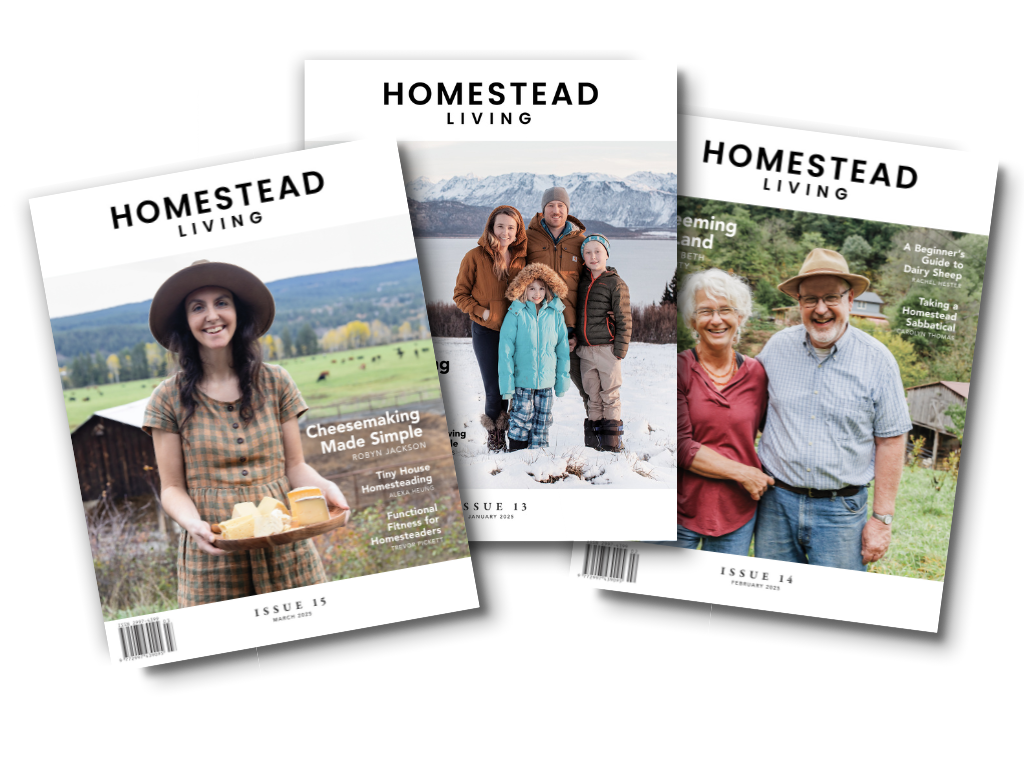
🤝THIS EPISODE’S FEATURED SPONSOR: Homestead Living Magazine
In 2023, we joined forces with Homestead Living on a mission to help inspire today’s world to pursue a healthy and sustainable life. They produce the magazine written for homesteaders, by homesteaders. Ready to build YOUR homestead? It’s a must read …
Learn more: https://homesteadliving.com
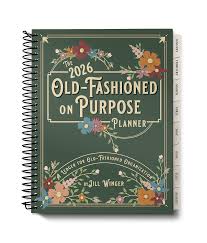
🤝THIS EPISODE’S FEATURED SPONSOR: The Old-Fashioned On Purpose Planner
Talk about a mission-oriented tool for homesteaders; my wife loves Jill Winger’s Old-Fashioned On Purpose Planner from Homestead Living … it sets the standard for organizing real life with wisdom and hard work.
The 2026 edition is better than ever, packed with tabs for gardens, animals, meals, food production trackers, habit builders, and goal-setting pages to tame the chaos and amplify your dreams.
Learn more: https://homesteadliving.com/the-old-fashioned-on-purpose-planner/


Leave a Reply