
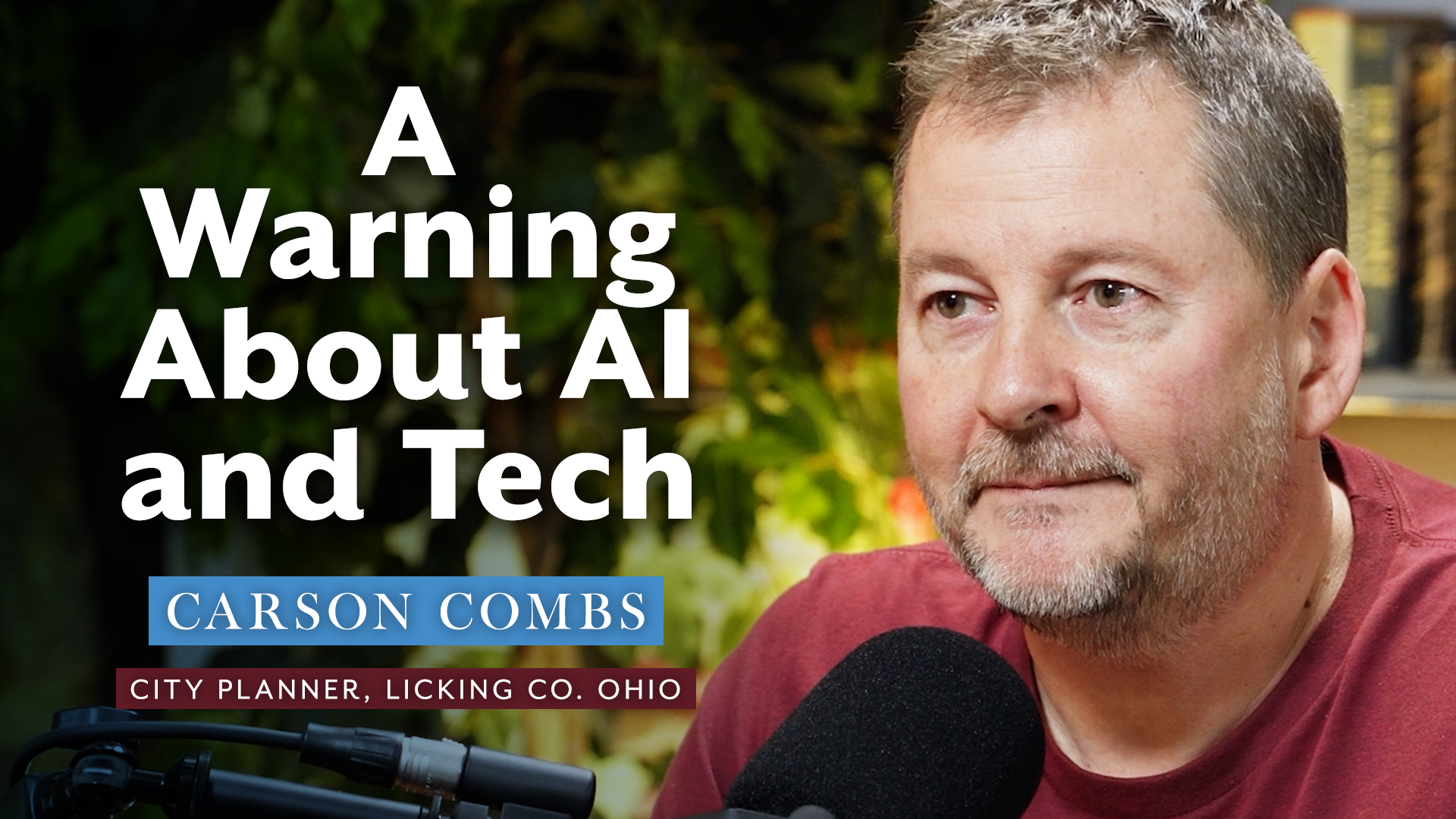
In today’s bonus conversation from the Plain Values Podcast, Marlin talks with Carson Combs about AI, the danger it poses, and the consequences it brings.
Carson questions the power that AI uses just to have information at your fingertips. It’s like any tool, the user’s intent dictates whether AI is used for good or evil. His long-term concern is that AI is another way for people to isolate and stop communicating in face to face conversations.
The conversation then turns to busyness. Carson asks, “What are we really doing in our life, and how does that tie back to what the Bible says?” It’s not just about the “stuff” we collect, it’s also about how we’re filling our time. When we don’t take the time to pause, we don’t realize how far removed we’ve become over time.
Our culture has been fed the lie that AI will help us have more time to slow down and connect with people again because we’re not focused on the details. And nothing could be farther from the truth. The advancing technology has only sped our lives up, causing us to work harder to keep up, and most of us just burn out. Carson shares that if we don’t put boundaries in place, we’ll never be free.
Everything comes down to priorities and intentionality. Are we living for the world or are we living for God?
Transcript
Five years ago, five years ago, it would– it was easy to spot a fake video. It was easy to spot that, you know, AI-generated, you know, CG. Mm-hmm. I mean, my goodness, I’m dating myself here, but CG was the, you know, basically the catchphrase for movies, what? Ten, twenty years ago when we were kids. Yeah. And now CG is a, is a forgotten thing. I mean, who, who cares? Because it’s not really even being, uh, talked about. A-AI obviously is the new thing, but what– how concerned are you, Carson, around the entirety of AI? I, I think it can– it’s like everything that we have in society. It, it can be used for good, or if you want to use it for something evil, you know, it can be our worst enemy . Yeah. Um, it just depends on what your intent is when you use it. Um, I, I’ll be perfectly honest. Um, it, it’s something that I try not to use at all. Um, you know, you do a, a web search now, and, you know, there’s an AI box that pops up with an answer whether you want it or not now, and- Mm-hmm … and every time I see that, I think, “Okay, how much more power is that, you know, eating up just to provide that information, you know, at your fingertips?” And I’m from the generation where we had rotary phones, and if you wanted to talk to somebody, you, you called them up. Um- Yeah … it was much more personal, you know, direct, and now we’re to the point to where everything is… You know, we used to say email. Well, we’ve gone beyond that, and now it’s everything is texted back and forth. So, you know, at what point does technology take us so far away from talking and interacting with people that we just, you know, our society kind of falls apart by default? Yeah. Um, that, that would be my long-term concern. Do, do you feel like there is a, like a larger… You know, conspiracy is, is, is this word that has been over-hyped in so many ways, obviously. Mm-hmm. Um, you know, big picture, a good friend of mine who’s– He’s, I think he’s pushing 80. I asked him one time, just point blank, I said, “Are you a conspiracy theorist?” And he said, he said, “You know, I think all of life is a giant conspiracy- … as far as, as far as, y-you know, the Lord is on high, and the enemy is conspiring in every way he possibly can against Him and against us as His people.” And I thought that is– that’s a pretty profound thing. I– it, it’s just a fascinating thing. W- I, I think, you know, something that, that I see a problem in myself is I get so tied up in the day-to-day, you know, what I have to do today, that you never really stop to, to actually look at, you know, what all are we doing, you know, in our life, and are– how does that really tie back to, to what the Bible is saying? Yeah. And, and that’s an issue that our, our pastor’s been talking about recently. And I’m sure for a lot of us, we, we never really pause to do that reflection, and, and that’s a, a big thing that my wife has been on me about, is to actually stop and, you know, reflect on things. Uh, but yeah, when you start to think about it, it’s like, how much more complexity am I adding to my life, and is it taking me further and further away from where we should be? Yeah. And so we’ve been looking at this whole idea of, you know, we have too much in our lives. Our lives are too complex. We’re trying to add too many things, and it’s like we need to get back to what is simple and, and more pure. A-and it’s not just all the things that we have, you know, the, the physical things in our life, you know, all the trinkets and gadgets and stuff. It, it’s, you know, how we’re actually filling our time. Um, we’ve just– You know, running a small business and a small farm, it’s like for years we were just so, like, heads down and focused on, we have to do more and more and more and more. And then you s- pause for a second, you’re, you’re just exhausted, and it’s like, “How did we get here?” Yeah. And you don’t even realize just how far removed you’ve become over time because you’re, you’re striving at something that, you know, probably isn’t really what you’re supposed to be focusing on. Yeah. Um, and, and so, you know, we’ve always questioned. It’s like, why has all of our life been so difficult? Well, it’s like, because we’ve been throwing roadblocks in our own way, uh, and not really taking everything back to, you know, what is truly important. Yeah. So we’ve, we’ve kind of lost it. And, uh, society as a whole, I think, is just so far away from reality that, yeah, it’s, it’s… It, again, it’s, it’s easy to, to see how, you know, when you, you stop and look at w- everything that we put into our lives every day, it, it’s no wonder that we are really out in left field and, and can’t find our way back. Yeah. I wonder at times how far all of this artificial intelligence is gonna go until maybe one day we all wake up and f- and … find out that we’ve lost most of the things that make us human. That, that’s, I think, I think keeping our humanity is, is the bigger thought or concern in, in my own mind because every, every little bit of technology from the intro, you know, of the iPhone to, uh, all of those things always promises the s- you know, the same thing. I mean, they- Mm-hmm … you know, effectively they’re all promising us, “You have more time, and you’re gonna be able to be more real and authentically yourself,” and it’s all the same thing, and it never happens. And, and that’s a lie. It’s a total lie. So, you know, we’ll step back from AI back to, back to just, you know, the, the iPhones and, and all of that. You know, uh, you know, I was kinda joking about the rotary phone. Um, for the longest time I stayed away from that. I had a flip phone that I used to call people- … and I was perfectly fine with that un- until they took all of those away. Yep. But the thing that I would notice is we would go to a, you know, we would go up to see family and, and my nieces and nephews, it was just heads down using the thumbs the whole time. Uh, and, and I guess that was… that’s one of the things that I’ve been super glad about is that we didn’t give our kids an iPhone. Mm-hmm. You know, we, we basically, you know… A- and this is all my wife’s doing and, and I th- I’m thanking her right now. Um, our kids aren’t addicted to that. Um, they use it, sure, but it’s not like an appendage of their body that they have to have at all times. Yeah. Uh, and that’s the difference. It’s like, can you use it, uh, to help your life? Sure. But then you’ve gotta be wary that you don’t cross that line to where, you know- Yeah … it does what they probably planned for it to do. And, and you see that in the news now too of where, you know, eh, social media and all, all of that, and using the phones, and Facebook, and all of that stuff is, you know, getting us into a place in, in which we basically, we, we interact with a f- a piece of technology. We don’t interact with people anymore. Yeah. Uh, and that’s, that’s what kinda scares me. I would much rather speak to somebody on a phone like we used to or, you know, face to face, uh, than to do all of this- Yeah … back and forth. Because what it does is it’s, it’s sped up everything to where now, you know, when I’m at work, I have to spend a good chunk of my time trying to manage the immense amount of data that’s coming in- … that you have to deal with, and it’s like, I, I physically can’t do that. You know, we’re not made to do that. But what technology has done is sped up our life so much that we’re struggling to keep up with it every day. A- and that burns everybody out. So- Yeah … it can be good, but where we’ve, where we’ve taken that to over the last couple decades is to a really unhealthy place. Yeah. Um, I’m gonna start landing the plane. I have a thought and then I have a question for you. Okay. Uh, last question: Do you know who Ben Sasse is? Yes. I, I don’t know a whole lot about him. I kn- I know he’s, you know, in Washington. Well, he was. Okay. He… He’s the retired senator from Nebraska. Okay. Um, I have been watching a fair amount of his conversations lat- lately. Today is April 17th of 2026, and I believe he is still, um, here. He’s still alive, but he is dying very quickly of pancreatic cancer. He is- Okay … full of cancer, multiple types. And instead of retreating, Ben is out there doing podcasts. He… I l- I’m a huge Monty Python fan, okay? I- Yep … I love- Me too. … all the lines that go with it, you know, obviously. I told him we’ve already got one. Um, his, his podcast that he, I believe, just started is an ode to our friends at, you know, Monty Python. It’s called Not Dead Yet. And when I grow up, I wanna be more like Ben Sasse. He has said multiple times inside these conversations that looking back… He’s only 53, or 54. I think he’s 54 now. Um, he has, he has alluded many times to if he could go back, he would, he would move his family. He would spend more time, in his words, he would live very, very thickly with his family. He would love it if he was with his, you know, folks, and his kids could live right down the road from Grammy and Grandpa and, you know, that sort of thing. And I think they, they live with a lot of gallows humor. They are trying to figure out how to best honor the Lord in these last couple days, and it is a f- it is a fascinating dive into what really matters in life. And I, I, I’m bringing it about, I’m bringing him up because I’ve wanted to bring him up because outside of this room, I’ve been listening and studying him quite a bit, and it’s impacted me a lot. And- I don’t want to hear those kinds of conversations and then just ignore it and toss it to the side and then go back to my life the way it was before because we are not– I mean, my dad died at 55. I’m not promised, you know, you know, this afternoon. I don’t wanna, I don’t wanna miss those, you know, those chances to make an impact, um, for our family and, and everybody around. How– when, when you look at your kids, they are how old? Um, sixteen and fifteen. Sixteen and fifteen. Yeah. When you look at them and the next ten, twenty, thirty years, what comes to your mind? I’m– I’ve been working through some of the, the same issues. It’s like w-watching them growing up, we were always so busy, you know, with the job, with the farm, with the farmers’ markets and the travel and all of that stuff that, you know, I, I basically kind of missed a lot of, a lot of their growing up. Um, so for me, yeah, the, the challenge r-right now is, uh, you know, how do I not continue that pattern and, and get back to, you know, actually- Wow … spending time with the kids. Uh, a-and Dawn’s been working on me, you know, to, to make sure that I’m, I’m doing that and really need to thank her because, yeah, it’s a blink of an eye. It’s like– ’cause continually along the way you tell yourself, “Oh, we’ll do that, you know, next week,” or, or whatever. And there was always an issue, you know, with the farm or the business. Yeah. And we’ve got to take care of that now and it’s the thing that, that she’s, you know, been on me about for years. It’s like, “Get your priorities straight. What are your priorities? You know, have you even thought of that?” Um, a-and yeah, it’s like our real priority should be our family. Yeah. And the Bible says that too. It’s like we should be focusing on, on our family and God. Um, and yeah, you, you get so wrapped up in all of the things that, that happen in society. You know, it’s the, the whole issue of, you know, are we living for the world or are we living for God? And, and that’s a lesson that I’m struggling with right now and trying to, trying to get back on track. Yeah. A-as are lots of other people. Yeah. Uh, last question: How can we pray for you? Uh, just, uh, the biggest thing would be to, you know, pray that every day as I’m doing everything in my life, that I am constantly looking back to the Bible, to God. It’s like, is this what we should really be spending our time on? That’s been the biggest thing that I’ve been struggling with w- that we’ve been trying to change in, in our lives. It’s like are we truly doing it for God or are we tr- doing it because we think we’re supposed to be doing it? And, and I’m– yeah, that, that’s the area of my life that really needs the most help. It’s like, you know, can I truly say, you know, the, the decisions I make, you know, what I do day to day, does it go back to- Yeah … to the right purpose? Yeah. Or do I think it’s the right purpose and, and is it really something that the world’s asking for? Yeah. Well, thank you very much. Absolutely. This has been fun. This is great.






Leave a Reply