
The current darling of the industrial food system is fake meat or lab meat. Proponents argue that this will save the planet from the ravages of domestic livestock, offer better nutrition, and eliminate the ethical and moral dilemma of killing things for human sustenance. I’ll deal with the first two quickly to put attention on the third one, which can be a stumbling block for people of faith.
The “animals are destroying the environment” mantra has numerous flaws, but the biggest one is that 500 years ago, the world had more pounds of animals on it than it does today, including people. In other words, if you could put all terrestrial non-plant life on a scale, the weight centuries ago is more than it is today. In fact, in the U.S., the pounds of domestic livestock have not changed in more than a century. In 1900, a third of the weight was in draft power: mules, horses, and oxen. Even with industrial factory farming, the total pounds of animals has not exceeded what it was in 1900. I’m including wildlife here as well.
Clearly animals are not the problem. I agree that the protocols to raise animals in confinement are not ecologically beneficial but blaming animals for farmers’ failure is neither honest nor fair. Animals can be—and have been—grown in ecologically beneficial ways for millennia. The deepest soils on the planet are all under grasslands, not forestlands.
The second argument is about nutrition. Supposedly red meat increases the risk of cardiovascular problems and colon cancer. The only problem with this notion is that America’s per capita consumption of beef has been falling annually for the last thirty years, while these diseases have been increasing. Without getting into the scientific nitty-gritty, the red meat = disease theory simply doesn’t stand the test of even cursory perusal.
But what about this moral and ethical dilemma? It’s touted by fake meat proponents in every flier, every news interview. It’s a big deal. As a livestock farmer, I’ve certainly been accused of being a murderer or being unable to love because I kill animals. This sentiment is not going away; in fact, it’s getting stronger by the day. As a Christian, I really don’t like to be called a murderer.
As a livestock farmer, I’ve certainly been accused of being a murderer or being unable to love because I kill animals. This sentiment is not going away…
A bit of historical context can help us appreciate the roots of this issue. The year 1837 was an interesting confluence of three things. First, a British scientist named Charles Darwin set sail on The Beagle. Father of evolution, Darwin’s observations led him to conclude the biblical creation narrative is a myth and that humans evolved from monkeys. He took God out of life.
The same year, an Austrian chemist named Justus von Liebig, trying to solve the soil fertility problem, used vacuum tubes to isolate nitrogen, potassium, and phosphorus (NPK), announcing to the world that all of life is simply a rearrangement of these three elements. Think about how that supplemented Darwin’s ideas that God wasn’t necessary. Life was simply an inanimate pile of protoplasmic structures.
The third 1837 occurrence was Cyrus McCormick’s invention of the reaper in his blacksmith shop on the family farm in Raphine, Virginia. This is now viewed as the official start of the Industrial Revolution because it made the scythe obsolete. McCormick’s reciprocating cutter bar is still the backbone of modern grain and forage harvesting equipment. With Darwin’s Godless existence, Liebig’s lifeless existence, and McCormick’s mechanical invention, the new enemy of biblical faith was not paganism, animism, or pantheism; it was no-theism and a mechanical view of life.
Gradually, life became less about biology and more about mechanics, physics, and chemistry. Today’s effort to take life out of food is a natural extension of taking biology out of life. We should not be surprised that artificial food follows artificial fertilizer. Our nation has embraced artificial food for some time, from squirtable cheese to high fructose corn syrup.
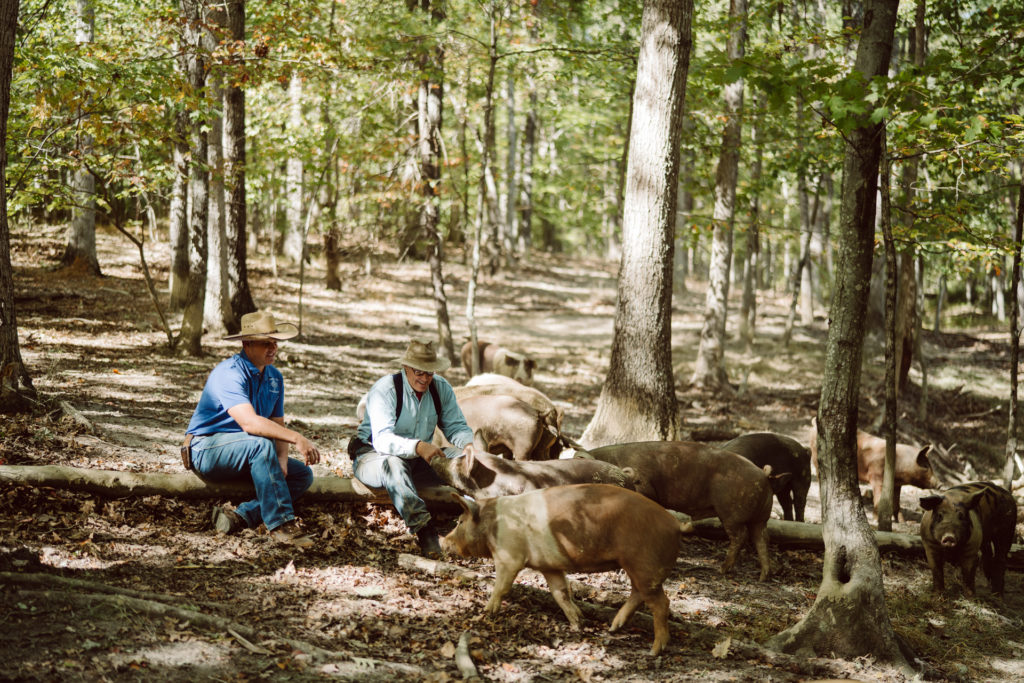
The foundational idea that you can have life without death is not only fairly new in human history but is also fundamentally an assault on truth. Something has to die in order for something else to live. Everything is eating and being eaten. Lie down naked in your flower bed for a week and see if that’s not true. Or in the pig pen.
Nothing provides a more poignant object lesson of Jesus’s sacrificial gift of life than when an animal gives its life for human sustenance. The problem is that our western culture does not ascribe spiritual and attitudinal protocols to our domestic livestock. The average person does not see farmers asking how to make happy pigs or how to respect the pigness of pigs, in normal agriculture.
What the average person sees are agricultural experts seeking only four objectives: how to grow pigs fatter, faster, bigger, and cheaper. They aren’t asking how to make pigs happy. They view pigs as mobile piles of inanimate protein to be manipulated however cleverly human imagination can conceive. For folks who do think it matters how we treat pigs, such thinking is egocentric, selfish arrogance in its worst manifestation.
Too many Christians make fun of these folks who care, rather than repenting of our own disrespect and mindless exploitation of the beings God entrusted to our management. It’s not just nuts and bolts in a bucket; these are beings, much lower than humans, to be sure, but beings that need our stewardship nonetheless. No less than bumblebees and earthworms.
The other issue that clouds thinking today is the ubiquitous disconnection from life and death. For the average person, pets represent the only animals in their personal frame of reference. When the only animal you ever encounter has a name and sleeps in your bed, it fosters a jaundiced view of animals in general. Suddenly every cow is a dog. Every chicken is a cat. Every pig is a pet gerbil. I’ve actually debated with people who said since I had no problem killing a chicken, I’d probably have no problem coming to their house and killing their cat.
Too many Christians make fun of these folks who care, rather than repenting of our own disrespect and mindless exploitation of the beings God entrusted to our management.
Interestingly, then, we have both the desecration of life on the one hand and the inordinate elevation of it on the other. Combine that with a disconnection to the barnyard, and you have a recipe for dysfunctional philosophy.
Sacrifice can be either sacred or sacrilege, depending on the circumstances. For example, the thieves crucified with Jesus on the cross do not elicit our sympathy; they were bad guys being punished. Nothing is sacred about their sacrifice. Jesus’ sacrifice is sacred because He didn’t do anything to deserve it.
In like manner, nothing is sacred about the sacrifice of an industrial factory-farmed chicken; it was never respected as a chicken in its life. Dispatching that chicken carries no emotional impact. But a chicken you raised, fed, watered, protected, loved—that sacrifice occupies sacredness in our thinking. It’s how we honored and respected the being in life that makes the sacrifice sacred or sacrilege.
When the proponents of fake meat invoke the moral and ethical dilemma argument, of course, they do not separate the two kinds of sacrifice as I’ve just done. It’s not that nuanced for them. What they do know is that animals in western domestic livestock culture are not respected; they’re not in a habitat that engenders happiness. With one broad swoop of fake meat, therefore, they think we can rid the planet of this kind of atrocity.
The problem is that you can’t have life without death. A compost pile is a shining example of the life, death, decomposition, and regeneration cycle. Indeed, the regenerated compost, ready to feed new life, looks nothing like the components that went into the pile initially. The finished compost doesn’t look the same, smell the same, or feel the same. I love reaching down and picking up handfuls of compost; manure, not so much. Manure after composting is wonderful; you can put milk on it in a bowl and eat it for breakfast. That’s a joke. But it’s really good-smelling stuff.
How do I truly live? I lay down my life for others. This is fundamental to biblical living, but the faith community too often fails to apply the respect for the sacrifice prior to death in order to make it a sacred thing. The sacrificial lambs of the pre-Christ Israelite object lesson were chosen carefully, often raised as pets. This connection brought to each person the specialness of life and the gift of death.
Eliminating death from life does not indicate some new elevated plane of spiritual nirvana; it’s a devolution into profound misunderstanding about what true life, what true living, depends on.
Eliminating death from life does not indicate some new elevated plane of spiritual nirvana; it’s a devolution into profound misunderstanding about what true life, what true living, depends on. When Liebig dismissed earthworms, actinomycetes, and the billions of soil microorganisms as critical for life, he missed an important truth. In fact, he was incredibly wrong, and the world is still suffering from the simple NPK mentality he brought forward with such assurance.
Sometime in the future, fake meat will be found to be as lacking to sustain life as NPK to sustain fertility. Sometimes it takes a while for the truth to come out, but it does eventually. When someone exalts their spirituality by claiming nothing has to die in order for them to eat, you can ask them, “Why are you opposed to sacrifice?” See where the conversation takes you.
Indeed, our intestines are full of beings eating each other. Everywhere we look, we see life and death. On our skin. In our immune systems. The notion that we can have life without death is not only wrongheaded, it’s antithetical to the gospel’s core message. Food and farming offer wonderful object lessons to represent truth to our world; let’s be consistent in the physical aspects of the object lesson so we can be attractive in the spiritual aspects. //
What would you like Joel to write about? Joel is always looking for reader suggestions on which topics to cover. Please email all suggestions to: re******@*********es.com.
Joel Salatin co-owns, with his family, Polyface Farm in Swoope, Virginia. Four generations of his family currently live and work on the farm, and his farm services more than 5,000 families, 50 restaurants, 10 retail outlets, and a farmers’ market with salad bar beef, pigaerator pork, pastured poultry, and forestry products. When he’s not on the road speaking, he’s at home on the farm, keeping the callouses on his hands and dirt under his fingernails, mentoring young people, inspiring visitors, and promoting local, regenerative food and farming systems. Salatin has published 15 books, and he is the editor of The Stockman Grass Farmer, granddaddy catalyst for the grass farming movement. He passionately defends small farms, local food systems, and the right to opt out of the conventional food paradigm.





Leave a Reply