
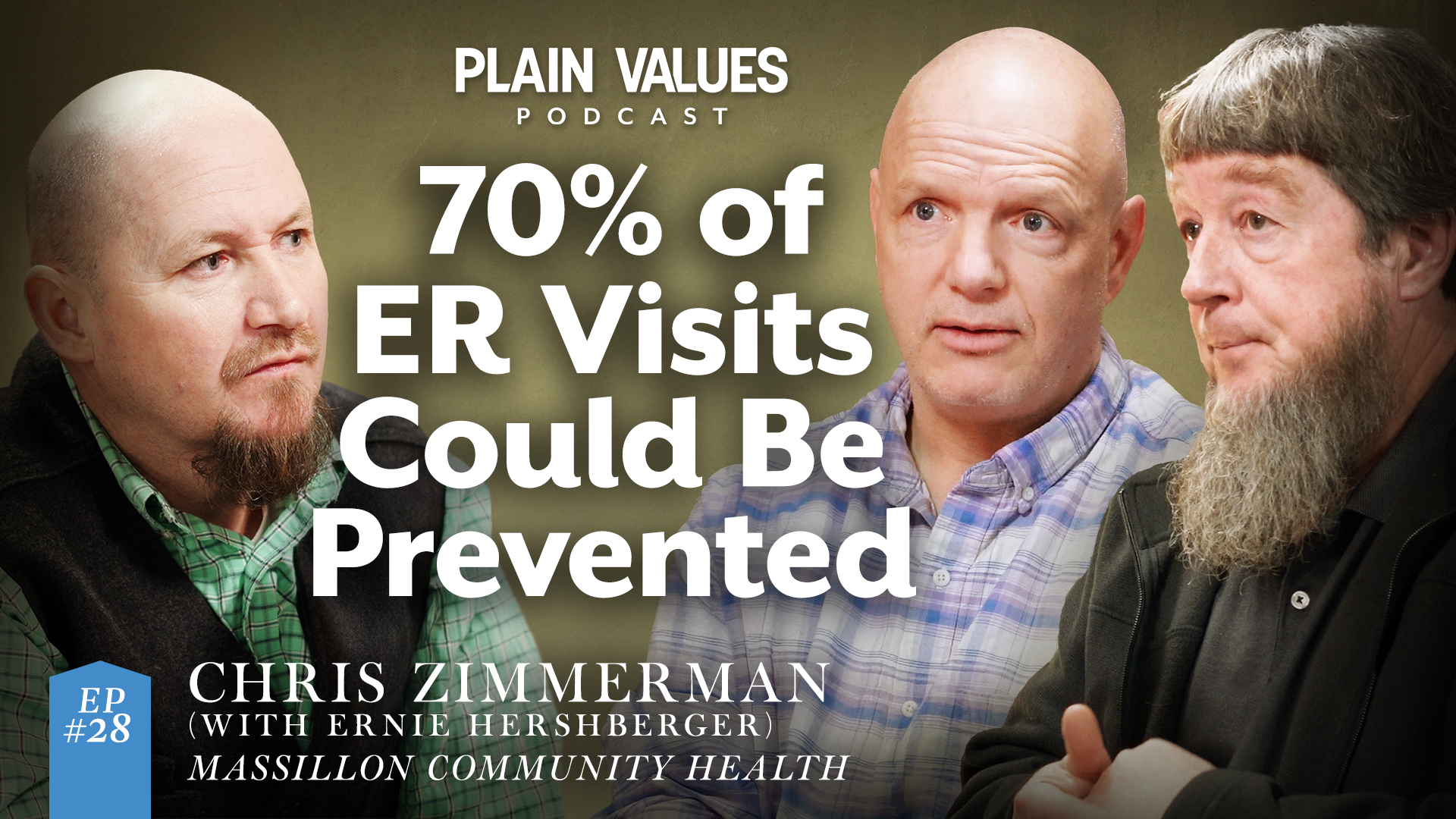
In this episode of The Plain Values Podcast …
Most of us have felt it… that quiet exhaustion when the body is running on empty and the spirit feels even emptier. Chris Zimmerman lived it for seven long months.
Successful on paper, hollow inside, he reached a point where getting out of bed felt impossible.
Then he found cold water.
Not as a gimmick. As a last resort. What started as brutal cold showers became daily ice baths, and something profound shifted.
The constant noise in his head went silent. Trauma he didn’t even know he was carrying began to release. Energy returned. Purpose returned. And with it, a fire to help others escape the same trap.
Today, Chris owns a former hospital in Amish country in Ohio. But he’s not running it like every other hospital. He’s building something different… a place where patient choice actually means something.
Where metabolic health, real food, and honest stewardship come first. Where the 70–90% of ER visits driven by preventable chronic illness might finally start to drop.
This conversation is raw, hopeful, and long overdue. If you’re tired of feeling stuck (in your body, in the system, or in the daily grind), this one’s for you.
You might just find the spark you’ve been praying for.Learn more about Plain Values at https://plainvalues.com
Transcripts
0:00 – Intro
2:32 – Chris’s Early Life, Martial Arts, and the ‘08 Crash
10:28 – Wim Hof & Overcoming Depression
23:04 – Inflammation, RX Drug Ads, and Chronic Stress
28:55 – Moving to Amish Country
36:23 – Ernie’s Story
39:21 – Working For Flexibility of Choice
45:56 – What is MCH?
52:41 – The Fight for Patient Choice
55:52 – The Burn & Wound Treatment Journey
1:00:06 – Decentralizing Healthcare
1:14:38 – How Can We Pray For You?
Chris Zimmerman:
Most of the country is dealing with some degree of chronic illness. The stats are unbelievable. I mean, you go into any ER in the country, somewhere between 70 and 90% of the people in that emergency room are there for unmanaged chronic illness.
Ernie Hershberger:
How the medical system functions is so upside down toward patient, to serve a patient to the level that we do in every other industry, and it’s all held hostage by it, and it doesn’t have to be that way. So I’m committed and to do my part till the day I die to help change the system.
Marlin Miller:
I sat down with my friend Chris Zimmerman and Ernie Hershberger. Chris bought a local hospital about a year ago and we talked about that journey to the vision for what he wants that to become and where it all began. It goes all the way back to his struggle with depression. Although he was successful in every part of life, he lost the purpose and the drive behind it all. And to jump in and learn about the journey to recovery and intense meaning and purpose in life, and then to have Ernie, an Amish preacher speak into that from his own chair is just a real joy. So please meet my friends, Chris and Ernie. This podcast is sponsored by my friends at Azure Standard. A while back, I had a chance to sit down with the founder, David Stelzer, right here at the table. And we had a great conversation.
I love the Azure story. They started out as farmers back in the ’70s, and I think in 1987, they began a nationwide food distribution company. And guys, they are non- GMO, organic. They do it right. They do it so well. And you can get a truck to drop food right in your town. Check them out at Azurestandard.com and tell them Marlin and Plain Values sent you.
Well, Chris, thank you for coming. Thank you for making the trip with Ernie. Tell us about your earlier life, your earlier work before you moved into Ohio.
Chris Zimmerman:
Sure. Okay. Well, I’m 57 years old now, so this could take some time, but I’ll abbreviate it to the best of my ability. I was born in Boston, Massachusetts. Grew up there in the Boston area and really struggled with school, always. And not that I didn’t love to learn, I just found that the traditional path was very, very hard for any number of reasons that we might speculate on. And I’ve continually flirted with that over the years. I’ve even thought about going back, which it’s never really stuck for me. So when I was in my 20s, I had been learning martial arts and I started teaching martial arts in my early 20s. And that was my first real foray into business of any sort. I stuck with that. I worked with a few other guys. In time, we opened six schools nationally. We had thousands and thousands of students.
And in that period of time, I also started learning Chinese medicine. And the Chinese medicine that I learned specifically, it was nothing mystical or anything like that at all, but very grounded in the body’s relationship with gravity and how all the systems of the body work together. And if they don’t work, how that dysfunction can show up in things like structure and manifest like that. So it’s kind of like where physics meets medicine as I see it. When I was in my late 20s, I got introduced to the world of finance by way of residential real estate financing. So I started working in mortgages. From there, I went into commercial lending, which is a really interesting field in the sense that you’re working with small and medium businesses, and they typically are coming to you because from their point of view, well, I need money.
But in the process of working with them and making them financeable, what ends up happening is you become a business consultant by another name. And so I learned an enormous amount about the psychology of business in that phase of my life. Through that, I got introduced to more complex types of real estate development. I was doing what are called HUD, HUD subsidized financing for very large projects. And then that became something that I got involved with financially where I and other partners were developing property and that all went okay, I would say. It went really well, truthfully, but up until the great financial crash of 08, and I found myself having to start from zero, which is very challenging.
Marlin Miller:
Can I ask a question? Sure. So you were buying and then operating large apartment complexes and probably some commercial property as well, right?
Chris Zimmerman:
Yeah. Predominantly multifamily, but yes, definitely mixed use as well,
Marlin Miller:
Commercial
Chris Zimmerman:
Real estate.
Marlin Miller:
When the 08 crash happened, the real estate market totally tanked. When you say you had to start all over, did you lose the property itself?
Chris Zimmerman:
Oh, sure. Yeah.
Marlin Miller:
Really?
Chris Zimmerman:
Yeah. The misperception, I would say, is that we had a mortgage crisis. The reality is that was like the foot in the door of a lot of really bad behavior, which has never stopped.
What happened was at a very large scale, there were increasing layers of abstraction. It’s basically casinos betting on other casinos, betting on other casinos, and all of those bets enormously eclipse the size of the real underlying market on which the whole thing was based. So it just had to collapse at some point. This, directly speaking, had nothing to do with construction or apartments or any of that, but by extension, it did. So back at that time, for example, the way a lot of developers would work is they had enormous lines of credit from Bank of America and institutions like that, where they would have these huge unsecured lines of credit. I’m talking 25, 50, 100 million dollar credit lines, and they would go out and they would buy land and they would develop that land and somewhere around 60, 70% into selling off the property they had built, they would break even.
And then once a year, they would have to pay that credit line down and just keep doing it. But imagine that there was a week, I think it was in September of 08, where all these guys, literally within a week, they woke up, logged into their computer like they always do, and their lines were closed. Oh my goodness. And that put the brakes on an entire industry nationwide. And so what you had is a situation where there were developments around the country, particularly where I was, which is in Texas and the Southeastern United States, but there were developments where these guys were losing their shirt. They couldn’t cover payroll. So they would say, these were homes they were planning on selling for two, $300,000. And they said, “Come rent them, $600.” So in our projects, you had people fleeing, breaking leases because they were paying say $1,500 a month.
And they’re like, “Well, I’ll move over here, get a brand new builder home for a few hundred bucks.” And the model in which we were working was heavily leveraged. So that dip in occupancy translated to just an inversion of the cash flow. So instead of money coming in, it’s going out and you just can’t do that for very long at all. So we were like a second or maybe third order effect of the crisis, and that happened to a lot of people. Yeah.
Marlin Miller:
Wow. So you make it past 08. Right. Did you start again in the same industry?
Chris Zimmerman:
Kind of.
Marlin Miller:
Yeah.
Chris Zimmerman:
I had the ability to … So in 2010, my wife and I got married. There was a kind of period of wander. I would say after that, and just trying to figure out what’s next, I did start working in real estate again, and I was part of a team that worked with a large portfolio of property, a couple thousand commercial tenants. And it was kind of a synthesis of everything I had done up to that point, which is a theme for me. But what I was doing was working with commercial tenants, i.e., Small and medium-sized business owners, and then helping them to optimize the business to get back in good graces for the company for which I worked. So the company that I worked for at that time, their business model was essentially buy these things, buy these properties, get them occupied, get them performing economically, and then leverage that to buy more property.
And they’re doing that to this day. They’re literally twice as big now as they were when I worked for them.
But that was another masterclass I would say in small business operations and psychology. It was really cool. My life took a major turn in 2015. So my wife and I got married, but my son’s mom and former wife was living in Illinois. And so through these years, I had been traveling back and forth to Illinois, but contact with my son was increasingly difficult to get. And so that was very challenging. And by the time he was about 14, we were estranged entirely. It’s just a terrible, terrible situation. All the frustration, unable to get purchased anywhere, I just really struggled in whatever the actual catalyst I couldn’t say, but the net result was I found myself in crippling depression to the point of being suicidal in 2015, which is about seven months where I just literally couldn’t function. And this would prove to be a life defining process for me.
So somewhere in that year, towards the end of the year, December, I guess, I saw a documentary about a gentleman named Wim Hof, it’s a Dutch guy, and his story really resonated with me. I think he’s maybe six or 10 years older than me now, but back when he was in his 30s, his own wife took her life. So his wife fell victim to mental illness, and he found himself father of four young kids
Just in a world of hurt. And he was depressed, understandably, but for whatever reason, he was drawn to cold water and he just literally jumped in a cold lake just in desperation and experienced the moment of real clarity in like, okay, there’s something here. And what resonated with me deeply, not only was what he was trying to overcome, but we had similar backgrounds. He had a background in martial arts and yoga and these things that I had been doing all of my adult life. The thing that was so ridiculous and so hard is here I was allegedly a wise person. I’ve got this, I can kind of quote these spiritual maxims and whatever, but I was just useless. I couldn’t function. So I was unable to apply anything that I had learned, nothing I did seemed to make any difference. I was truly desperate. So he still has an online course.
It’s like a 10 week class and it’s a combination of learning certain ways to breathe, learning certain ways to move and very graduated exposure to cold water. And so I made the commitment. I started on January 1st of 2016, and that process was very hard.
For reasons I wouldn’t understand for a long time, I couldn’t stand the cold. I just couldn’t bear it. I was living in Florida. It’s not even cold, but I would get in the water and I would be in the shower. You start with cold showers, so it would be really hot and you just kind of slowly, slowly dial it down to just cool. And I would just panic. It’s awful. And so I would just stick with it, right? I would breathe. And I was just doing these things every day. But by about a month in after daily practice, I could be in a fully cold shower for a few minutes. And I was in there, this was maybe like four weeks in or so, and I just, something broke in my brain. It was profound. Just something just ripped open and I just started laughing.
I was just in the shower. I’m hilariously laughing. And you got to understand, I mean, my wife at this time was really scared because she would tell me later that she would go to work and she was not sure if I would be alive when she got home. It was very, very bad. And so she runs into the bathroom like, “What is going on? ” I’m just laughing. I’m like, “I don’t know. ” She’s like, “Are you okay?” I’m like, “I’m great. I feel amazing.” And I’m just laughing and laughing. And so she starts bawling, just crying, right? I start crying and there’s a naked wet man crying and laughing. It’s just not a good scene at all. But anyways, I get out of the shower and slowly but surely, I mean, like in a matter of maybe an hour, two hours, kind of the clouds roll back in.
But at that point I was hooked. I’m like, “Okay, there’s a way out of this thing.” So I really just doubled down on that practice. And the next big shift was when I did my first long ice bath, which was at about week eight or nine. And that was the first experience I ever had of real … It was not as dramatic, but it was more profound in the sense that we all have a sense of who we are, right? But that’s not it. It’s not who we are. It’s almost like an app. It’s like you got an app running. You’ve got your own little Marlin GPT running in your head just talking baloney. And that was the first moment where that aspect just crashed and I was just in the quiet and I was still here. So I was like, “Well, that’s not me, whatever that is.
” I guess some people would call it your ego or who knows what it is. But in my experience, it’s not a good friend. It’s not a good … It might be a good servant. It’s a terrible master. And in that space of absolute silence, I never felt up until that time, more alive, more happy, not in a way that is excitable, but just deeply, deeply fulfilled.
Marlin Miller:
Almost a joy.
Chris Zimmerman:
Joyful, blissful, right? But not silly. Just I felt so close to God in that moment, truly. And so the process since then has been a one-way process where, gosh, that was in 2016. It’s 2026 now. I can’t tell you the last day. It’s been at least eight years since I’ve had any kind of pain, joint pain, bad mood. I don’t take any kind of medication. I mean, I feel unbelievable. What I learned is what it was not … And no one explained this to me. This is just me putting the pieces together later. When we’re anxious, when we’re depressed, and again, this is my take. So I’m not a doctor, but this is just something I believe to be true from experience. The part of me that was cringing against the cold is the same part of me, the part of me that regulates things like vasodilation or processes that are connected to the brain, but not conscious to us.
Okay?
So there’s an impasse between that part of the mind and the part of me that can think, or in my case, not think at that time. And so that part of me that was resisting the cold is the part of me in which was dwelling trauma, stress, depression, anxiety. And I believe this is true for everyone. And so the cold in and of itself doesn’t do anything. It’s a catalyst. What it does is it forces a conversation between the thinking wakeful part of me and the unconscious part of me. The unconscious part of me is like, “Hey, I want to hold onto this trauma. I want to hold onto this victim identity, I don’t want to change.” And the conscious part of me is saying, “Well, I’m not getting out of the cold. What do you want to do? ” And it forced a connection.
So there is a very famous neuroscientist by the name of Ramashandran, and he devised an experiment for people with phantom pain, people who’ve lost an arm or something like that, and they feel cramping. They feel like fingernails digging into a palm of a hand that they don’t even have anymore, okay? And they’re on medication and they’re having talk therapy. Nothing works. All he did is he built a box that has a mirror in it and they stick their hand in and their brain sees two hands now and they’re like, “Ugh.” And they feel relief. So all that the brain needs is a feedback loop.
Marlin Miller:
Hold on.
Chris Zimmerman:
Sure.
Marlin Miller:
It doesn’t hurt anymore? The phantom pain disappears.
Chris Zimmerman:
It’s gone. It releases because there’s no mechanism for the brain to update. So in other words, there’s a perception that the forearm is cramping. There’s a perception that I’m making a fist and I can’t stop.
Marlin Miller:
And because they see the fact that it’s not actually there, the disconnect causes the pain.
Chris Zimmerman:
They can’t find it. There’s a disconnect because it’s accessing through a nerve for something that’s not physically there, but the perception, the visual connection, it updates their somatic model, let’s say, and they’re like, “Oh my gosh, I can let go of my hand again.” It bridges the gap. So my point being is that cold is not magic, right? Like lifting weights. Lifting weights doesn’t make you strong. Adapting to lifting weights makes you strong. So we’re projecting these abilities and powers onto things outside of us when really all we’re doing is we’re connecting dots in our own neurology. And I would argue spirituality too. I think a lot of what we think of as so- called spiritual is more, these are ideas that help us reconcile with things that we can’t perceive, but they’re no less real. They’re just outside of our frame of reference. So we kind of come up with beliefs to help us make sense of a world that affects us, but we can’t … We’re operating without that mirror box in this world, right?
So the trick is connecting those pieces again. Now, that’s specific to the whole depression thing for me. There’s a bigger picture here though, and this is truly the foundation of what I’m doing now and I will do for perpetuity.
What I was experiencing ultimately can be traced back to something that is of the common origin for most of what we’re dealing with now, right? Which is metabolic dysfunction. At a cellular level, I was out of gas. So I wasn’t sad, I was just done. And what the cold did, in addition to forcing this neurological adaptation, is it also put high pressure on my cells to produce energy, or I was going to freeze. So it just broke through, but there are many ways to do that. But when we look at what’s going on right now systemically, epidemiologically, it all has common root back to that. So inflammation, it’s funny, right? I was joking with someone the other day, it’s like, imagine living in a town where there’s a different fire department for every kind of fire. Instead of just calling the fire department, you’re like, “Well, I got an attic fire.
Call the attic fire department.” That’s a ridiculous idea. Okay. But when you have inflammation in the soft tissue, we call it lupus. When you have it in your joints, we call it rheumatoid arthritis. When you have it in the nerves, we call it multiple sclerosis, but it’s one thing. It’s fire, it’s inflammation, it’s the driver of cancer, heart disease, all of these things. And dealing with inflammation is the bulk of what we’re doing by fostering greater mitochondrial health, greater cellular health.
Marlin Miller:
So I have wondered so many times, we don’t watch a ton of TV, but when we do, almost all the commercials are for pharmaceuticals, almost all of them. Sure. And the side effects, they will tack cancer and death and liver damage and kidney disease, and they just ramble them off in the list as if it’s-
Chris Zimmerman:
While
Marlin Miller:
They’re
Chris Zimmerman:
Playing badminton on
Marlin Miller:
The beach. Beautiful people, all fixed and better, and
Chris Zimmerman:
Oh,
Marlin Miller:
There’s a risk of dying and all of those, but it’s all quick and quiet and it’s … And every single thing that you listed, they have a plethora of pharmaceuticals to treat that one thing-
Chris Zimmerman:
To mitigate it, right?
Marlin Miller:
And then-
Chris Zimmerman:
Not treat it.
Marlin Miller:
Right. And then- Suppress
Chris Zimmerman:
It.
Marlin Miller:
You have to take more to deal with all the side effects.
Chris Zimmerman:
That’s right.
Marlin Miller:
It blows me away.
Chris Zimmerman:
Yeah.
Marlin Miller:
And I believe that Europe, much of the other world has banned pharmaceutical advertising.
Chris Zimmerman:
The only two countries in the world that haven’t are the United States and New Zealand.
Marlin Miller:
Wow. I mean, it’s not funny, but it is rather kind of comical. So the cold plunge literally forces your body to generate … I’ve never thought of that before, Chris. It makes you generate heat and energy, ATP, the mitochondria, all that stuff, because you put yourself in a situation where you’re going to die, you’re going to freeze if you don’t, in a way.
Chris Zimmerman:
Well, yeah. I mean, there’s an idea called hormesis, and it is the idea being that it is a stressor that precipitates some type of adaptation. And those are … Stress is not the problem. Chronic stress is the problem. We could do with more short-term stress. We need less chronic stress.
Marlin Miller:
Where do you think most people’s chronic stress actually comes from?
Chris Zimmerman:
Where does it not? I mean, we’re in an increasingly toxic environment. We’re swimming in plastic, literally. We are glued to screens night and day. And this is part of where I think, and this is probably a good segue, but so much of where I overlap with the Amish is understanding that the complexity of the world is overwhelming, right? And the concessions that we make along the way in interacting with the world, we’ve long since lost track of where that started, right? And
So it’s all stress. And I think one of the … You bring up an excellent point because we are looking for single variable solutions to system-wide problems. So for example, if I’m boiling a pot of water and I’m looking up close and I see little droplets jump and turn into steam, okay? Would I ask, “Well, why did that? Why did that droplet jump out? What’s special about that drop?” Nothing. This is how a boiling pot of water works, but when society produces sick people, produces a school shooter, God forbid, or any of these things like that, we do that. We’re like, “Where did we go wrong with him?” Instead of saying like, “Hey, the burner on the culture is too high.” We’re missing the signal from the system and we’re honing in on the one little thing. So we’re often trying to map undesirable outcomes to these very specific antecedents incorrectly in my view, instead of saying like, “Look, the system is destabilizing.
It’s overwhelmed.” So we’re saying like, “Well, which microplastic causes Alzheimer’s?” It doesn’t work like that.
Marlin Miller:
I
Chris Zimmerman:
Don’t know which straw broke the camel’s back. The problem is there’s 800 pounds of straw on the camel. You see what I’m saying? I do. So I believe this is where the plain community and I fully align is understanding that this calls for a systemic solution.
Marlin Miller:
Changing much more than what-
Chris Zimmerman:
Your whole way of thinking.
Marlin Miller:
Yeah.
Chris Zimmerman:
Your whole way of living is the solution if there is one.
Marlin Miller:
Yeah. So how in the world did you end up here in Amish country, Ohio? I mean, you’re half an hour from us.
Chris Zimmerman:
Yeah, if even. Sure.
Marlin Miller:
Yeah.
Chris Zimmerman:
Well, I was brought here by the facility in Massillon. So I had had this open question in my mind for some time since 2012 or so, back when I was doing the other real estate stuff. And a lot of the doctors I was meeting were wanting to branch out on their own and I was unable to really offer them anything because everything that they wanted to do, if it was beyond a certain threshold of care, necessitated infrastructure that could only be found in a hospital. And I had this question, is there a way to provide hospital grade infrastructure outside the setting of a hospital system and all of the nonsense that comes with that? I was working on a different project in Boca Raton in 2024, and I became aware of this facility out here. So I was not interested at all.
Why would I go to Ohio? It didn’t make any sense to me. So I had a conversation with a guy in Massillon who’s a recently retired judge. He’s since become a really good friend. But he really compelled me. On the basis of his sincerity, I decided to come out. I met the owner of the building, a guy who’s since become like a brother, truly. And we talked and there’s really something special there. This is a 400,000 square foot former hospital that closed in 2018. And my friend who owns it has put so much love literally and money into this property that it’s nicer than the hospitals in the area, truly. I mean, it’s unbelievable. And so what we found in that is an opportunity is just too good to pass up. So I moved here. I actually thought, before I even moved here, I had it under contract to purchase.
And then that whole financing fell through. So I said, “Well, it’s not meant to be.
” And moved on looking at other things. In October of 24, the owner called me and said, “Look,” kind of a long story there, but essentially wanted to know if I was still interested and if I would be willing to work with him to develop the property. I said, “Absolutely.” And I was here 24 hours later. And I was going back and forth from here to Florida, but more or less here full time, which gets old when you’re married. So my wife and dogs joined me in February of 2025, and we’re still here. And fun epilogue to the other story is my son’s here too.
Marlin Miller:
No kidding.
Chris Zimmerman:
The son with whom I was formerly estranged. Yeah, he moved here this year in 25, but we reconnected in 2019. So that’s another story, but it’s very cool.
Marlin Miller:
Oh man, praise the Lord. So how did you guys meet?
Chris Zimmerman:
I mean, I can take that or- Yeah, go ahead. Yeah.
Ernie Hershberger:
I’m having fun listening.
Chris Zimmerman:
Okay. Yeah. Well, she’ll get my
Ernie Hershberger:
Time.
Chris Zimmerman:
Shoe’s on the other foot now. So the obvious alignment, okay? So this is just to get a little bit in the weeds here for a second. When people complain about healthcare, a common complaint that can be hears, “Oh, my doctor doesn’t want me to be healthy. He just wants to give me a pill.” Well, I think we need to give our doctors a break because the truth is healthcare by and large doesn’t get paid. It gets reimbursed. There’s a difference. Okay? So I’m not saying all the time, most of the time. And if you think about that with any other business, if you had to work and work and work for months before you got paid back, that changes your whole business model. And the other part of that is that the people paying the bill are your customer. So not the people you deal with necessarily, but whoever’s writing the check is truly the customer.
So the people writing the checks to the doctors are insurance companies typically. So if I’m a doctor and you’re my patient, you come in, you want X, Y, and Z, I say, “Well, I’d love to help you, but if I want to get paid, I need to do this first. I can’t do this test before I do this test.” I’m not deciding that. These are rules laid down by the payer. So I knew from the outset for our approach to work, we had to align with groups that are self-paid, like the Amish, like the plain community broadly in some cases, like faith-based health share groups, like self-funded employers who are no longer wanting to pay, say Aetna, and they’re going to pay the healthcare because that’s critically important because they have the ability to make decisions as to what care they pay for. They’re not captive to the policy of the insurance provider, which is the middleman of the process.
Does that make sense?
Marlin Miller:
It does.
Chris Zimmerman:
So I reached out to, quite fortunately, Ohio Medical Aid. So my first meeting, this is a funny story actually as I think about it. So my first meeting was with Ohio Medical Aid and I had a couple meetings with them and Paul Hershberger there asked me, “What do I think about maybe talking to some community leaders?” And I said, “Great.” I said, “Okay.” So he calls me back and he says, “Well, here’s when that’s going to happen.” And I say, “Okay.” And I go down to the medical center in Mount Eden and there’s like 45 guys there from four states, from Wisconsin, from an Indiana, from … I’m like, “Oh wow.” So this is like a congressional hearing. So I sat there, got grilled for three hours and it was great. It was truly, it was wonderful, but it was intense, but it was fantastic.
And I became friends with most of the people at that table. The takeaway from that was we formed a committee that was chaired by people from that committee. And then those guys know Ernie really well, and that’s how we got connected. And Ernie’s obviously more than capable of speaking for himself, but just where Ernie’s so invested and so passionate about the health of his community and he’s like me, he’s self-taught as to what’s wrong with the system such as it is. And we’re working in common cause ever since.
Marlin Miller:
Well, your brother is the one that told me about Chris the very first time, Andrew. And so, let’s go back to your early on … How did you and Barb get into the whole field?
Ernie Hershberger:
Well, so Barb has had a life … I mean, one of her life goals was to be a master herbalist, and she took that very seriously, but with seven kids in the house, it never transpired into doing the actual tests, but she did all the research, did all the reading, and then became part of the B&W team that goes into hospitals to treat burns and stuff like that. And then her knowledge of just the whole herbal world of stuff. And then our youngest daughter, 23 years ago, was born with spina bifida, and that spurred it deeper for her on top of what she was already doing. And then she got exposed to young living essential oils, which is an essential oil company that basically takes herbs, plants, trees, and draws a lifeblood out of these plants that actually have frequencies that match up with your body organs and stuff like that.
And she dug into that with that. And it’s amazing to watch how that works in your sicknesses and things that you’re struggling with, just like what Chris was talking about. And that has taken her into a whole different realm, and especially now with our youngest are 21, and we’re almost empty nesters, and she’s just poured her life into it. And she’s feeling an immense amount of calls from people from all over the United States that say, “What do I do with this? What do I do with that? What type of oil do I take for this or that? ” And we kind of have an interesting family mix because her family, if the arm wasn’t completely detached, you could heal it some way naturally with God given plants rather than a pharmaceutical drug. I come from a family where if mom thought that we would get the cold next week, we were on some type of antibiotic this week.
And so here we have opposites attract them some sense. And so, and I didn’t argue with her. I mean, it was fascinating to me because when you start researching, even the Bible, a Bible talks about a lot of different oils that are being used and I’m a historian kind of crazy, not over some of that, but when I discovered that the founder of Young Living actually traced Frankensen’s back to Solomon’s root and Oman and from the original sacred frankencens that was given to baby Jesus, now I started putting some of those dots together. So I’m in full support with what Barb is doing and what Chris is doing. And here’s the interesting, so the dividing line for me. So 17 years ago, I was asked to join the Palmerine Hospital Board as a board member and have served in that capacity and still there from vice president to president of finance and all that.
So I’m exposed to all these numbers and as a representation of our culture and the plain community and seeing firsthand how hospital systems are held hostage by the insurance, payer scales of how that works, and then just the pharmaceutical industry itself and then the FDA rules. And my position on this is that in most other applications, and maybe all other applications in our life as an American citizen, is that we have choices and we should have choices. Yet when we get to medical or health or sick care, I’d rather … Hospitals are more sick care than what we have healthcare. I mean, what Chris is trying to do is bring us back to healthcare, which is the food and the soil and the pesticides and all these things that line up in our unhealthy bodies is I just want to see a system that you can, as a patient, you have flexibility of choice.
If you would like to start in more holistically or natural that you have that choice and that docs work together, but there’s a very decisive line between this friction. I mean, it’s almost worse than Republican and Democrat. And I’m neither. I’m an independent that voted once at 18. So I don’t look at that stuff. I look at data and facts and some of that comes back to my experience as a youngster getting thrown into a lean operating system that I discovered from a Toyota perspective is just simply lean is the heath and term of good stewardship. And so good stewardship forces us to go to the cornerstone. Just like we do from a spiritual perspective, we have to do the same thing here. And when you uncover all that, you uncover a lot of things that we realize that are slanted toward a patient’s choice of what they want.
And I just think that it’s time and we have a lot of underlaying pressure from people across the United States, from Liz James Blessed by his blood to what we’re now organized as five of us guys started an unvaccinated blood bank and we’re going to, with a singular goal not to offset. I recognize and endorse that pharmaceutical drugs have their space, but not without choice toward a person’s need or want to explore the natural side of medicine. And there needs to be a fifty fifty. To me, I’m not going to slant one way or the other way. I want to go right down the middle and make sure that people have choice. I mean, all the businesses I’m about, I mean, a customer walks into our facilities, they have choices. I mean, 10 species, 6,000, well, 3,000 finishes and unlimited width height and depths. I mean, so you have full control over what you is appealing to you and how you would want your home to look.
Yet we get to healthcare and we have all kinds of roads, barriers, guardrails that are, I think, put up with not the best of the patients in mind. Now, there’ll be people that argue that to say, “Well, it’s all tested and it’s approved and all that. ” But if anybody takes the time to research how FDA actually approves the vaccines and medication, you will change your mindset. Most people don’t take the time to ask the question why five times and get to the solution of the actual culprit of how things are started, and then they just go with news media or printed magazines that are slanted one way or the other. And so that’s where I sit. That’s why I’m fascinated with what Chris is doing and the plain community has a huge interest. And well, going back to originally, so I got involved and a couple of these initial group of 40, and I wasn’t part of that, said, “Hey, we got this guy from out of town that’s doing this so- and-so up there at MCH and we need you to meet him and straighten him out a little bit.” And so me and Chris had a couple of really, really interesting conversations of, “Well, this isn’t going to work or that’s not going to work or what do you expect?” And so we’ve learned to respect each other’s positions and deep down we want choice available.
We understand both sides of the story. And I was very adamant to him. I said, “Chris, I’m not going to allow you to do something that will destroy our local emergency room and our local hospital. We need docs, we need emergency room, we need suites where we can go and somebody has an accident and we need to be able to serve trauma.” I can’t put Frankenson’s on a arm that’s detached that we need to get to a searchy suite. And so that’s my decision while I’ve got … I mean, I’m trying to stitch both sides together and I’ll be honest, Barb and Chris have responded to my concerns and have made adjustments and asked a million questions about what are your thoughts about this? What are your thoughts about this? Where’s your heart on this? What do you see biblically, spiritually, holistically, and all this.
And the medical side of the community at this point has been fighting me tooth and nail and they think I’m out to destroy one or the other and that’s not the case. All I want is patient choice right down the middle.
Marlin Miller:
So I sat here thinking, what in the world you have, I don’t want to say been thrown into, but you’ve kind of allowed yourself to be on … You’re on the board of a standard hospital and you’re also working with this, which how do you actually define what MCH is really all about?
Chris Zimmerman:
It’s difficult. It’s difficult specifically because of how, in my view, indoctrinated we have become and how married we are to application, right? I would say that you didn’t need MCH probably in 1948, right?
A lot of the infrastructure that we’ve gotten accustomed to in this country, in the medical space, most of these hospitals were built in the wake of World War II. There was a big push from the government to increase availability to critical and acute care because in the 1930s, you fall off the tractor, like some guy with a little black bag comes to … It doesn’t work. So what has happened in the intervening years since most notably in the 80s when we kind of went off the rails in terms of our food supply, but it’s really started ever since the 50s, but there’s been a shift metabolically in the country. So back in the 1940s when these hospitals were built, you had people, they were rail thin, they would smoke two packs a day probably, and they’re using a push mower, but if they did go to the hospital, they might be there for 10 days because they had a heart attack.
Fast forward to now, most of the country is dealing with some degree of chronic illness. The stats are unbelievable. I mean, you go into any ER in the country, somewhere between 70 and 90% of the people in that emergency room are there for unmanaged chronic illness.
Marlin Miller:
This episode of The Plain Values Podcast is being brought to you by my friends at Kentucky Lumber. Derek and I were talking this morning, and he shared a story about how they like to do business, and they like to do business with people that are like them, and they like to be treated in a way that they treat their own customers. He told me about a customer of theirs that he had to fire, and this was not going the way that it typically does. And this guy was not being happy with anything that they did, and nothing was good enough. And finally, Derek said, “You know what? You’ve disrespected my team enough, and I think we’re done. And so you can go find your lumber someplace else.” And the attitude and the heart behind the way that Derek sees the world is exactly the way that I see the world, and I have a hunch you might as well.
If you call Kentucky Lumber, just know that they might fire you if you treat them poorly. I’m kidding, of course. But they will treat you with the utmost respect because it’s how they want to be treated. And I think there’s a golden rule thing in there somewhere, but if you need anything at all to do with any lumber, wood, flooring, wood siding, any type of wood product that has character just baked into it and a great team to match, call my friends at Kentucky Lumber. You can find them at drywallhaters.com. 70 to 90%-
Chris Zimmerman:
In any ER, right? So I’ll give you a really morbid statistic, okay? I’ll give you two. The hospital that Ernie sits on the board for answers directly to 44 different agencies between state and federal. That’s real. That is an enormous financial burden just keeping up with that, right? Now add chasing payment from payers to that. I mean, so just the operating costs of this whole system is insane. Here’s another one. The typical hospital, let’s say I own a hospital, I have a relationship with a community member, and if you define that relationship over the life of that person, 80% of the dollars my hospital collects from that patient are going to be collected in the final 60 days of that person’s life. How is that healthcare?
Marlin Miller:
80% of the lifetime value, if you want to- Correct. 80%. Is in the last two months.
Chris Zimmerman:
Correct. So rather than hugging my grandkids and getting my affairs in order, I’m getting tubed and scooped and cut and everything else. And I would argue that at a minimum, my life’s not being extended. Clearly, my quality of life is not improving.
Marlin Miller:
Ernie, let’s go back to the question that I asked you. How do you see the position that you find yourself in?
Ernie Hershberger:
Well, I mean, I’ll be honest, it’s a tough spot, but I’m also extremely passionate about it because it’s the only industry from … I have customers in every state of the United States and in 10 countries. And with all the stuff that I’m dealing with in multiple different companies, I don’t have … How the medical system functions is so upside down toward patient … To serve a patient to the level that we do in every other industry, and it’s all held hostage by it, and it doesn’t have to be that way. So I’m committed, and to do my part till the day I die, to help change the system of what it needs to be changed, because there’s a couple of things. I mean, it’s either going to implode on itself, but there’s players like Chris, and there’s no reason why Palmerine Hospital, and even the surrounding hospitals, I’m working with a couple different in making this transition.
And I have solutions in my head about how to make all this happen, but people have to be able to see the light. And most of … And it’s fascinating, the entrepreneurship in the world around us in a capitalist society, how fast things move and improve, but then you get to the culture and operations of a hospital. And I remember the first time I talked about lean manufacturing and lean perspectives in medical, and I got almost laughed out of the boardroom, and I put my foot down, and now we have some lean perspectives at Palmerine. And things like you’d get to the emergency room, unless you were on your deathbed, you’d wait three, four hours before somebody saw them. And it’s like, no, we need to … Why aren’t we taking care of the patient in 10 minutes or less? Or if I have a customer in my store, when do I go take lunch break when I don’t have a customer anymore, right?
If I walk away from them, “Hey, why don’t you wait over there by that dining room that you’re making choice? I’m going to go eat, have a lunch break.” Well, the time space is … Well, I’ll give you an example. So my son, one of the 20, I have twins, they’re 21, so he injured his knee playing basketball. And so this is … And he knows I’m in the board, obviously, and I talk some at home, but not a lot, but this was his experience. And he came home to me and said, “This is absolutely ridiculous.” I said, “Yes, son, this is what I’m trying to change in the healthcare industry.” And that is, so he had to take off from work, so that cost him money, had to hire a driver to go to the doctor in Millersburg, and then he paid 150 bucks to see the MP or the FP and doctor was with him about three minutes, looked at his knee, touched his knee, said, “Allright, we need to get an MRI.” Now he’s fighting to get a schedule at the hospital to get an MRI and to have all that done.
And he’s like, “Why can’t I just walk into the hospital and get an MRI?” And so the pushback is, well, it needs to be insurance improved and all this, but one of the caveats right now with the high deductibles is that we’re paying for it anyhow.
And so why don’t we have patient choice? I mean, if the patient wants to walk into a hospital or any facility say, “I want an MRI,” give them an MRI. I mean, why not? I mean, the concept that we as people are uneducated that we don’t know what we want, well, why aren’t we saying the same thing about Marlon, you don’t know what kind of gas you want to put into your vehicle. I mean, why are you not putting a high octane? No, it’s your choice, but there’s no choices in healthcare. And so it’s that fight. I mean, it’s this, we need doctors that align with the vision of patient choice and maybe have to do some education to a patient, but the concept overall is that we are uneducated as a people across the spectrum and we have no clue what we’re talking about when it comes to healthcare.
And that is just categorically false. And it’s one of the things that I’m seeing. It’s like, no, patients need choice. And so that’s my whole push. I mean, I’m not going to give up. And I wholeheartedly believe that the healthcare system is broke. It needs to switch to sick, not from sick care to healthcare. We need to get in front of it and there’s a lot of stuff happening underneath and hospitals need to pay attention. I mean, we need them, but they need to be in a different role than what they are currently.
Marlin Miller:
So you very, very quickly made a point to the BNW team. As you were saying that, Ernie, I thought from what I have heard about the BNW burn and wound-
Ernie Hershberger:
It’s a salve
Marlin Miller:
And
Ernie Hershberger:
A process.
Marlin Miller:
Right. So what I’ve heard is that it has been a really long and hard and slow journey to get that burn treatment to be taken seriously inside of the medical system. How has it gone and has it actually made any inroads into local hospitals?
Ernie Hershberger:
It has. I mean, there’s quite a few … I mean, in the perimeter, most of the hospitals locally and then the Columbus, I’m not going to name the hospital because I’m going to get it wrong. And same way in Cleveland, Akron Children’s, some of those, they’re fully receptive with the burn docs because they’ve seen the results. So none of this stuff is FDA approved because it … Here’s what’s so fascinating is the FDA requires everything to be sterilized. If it’s sterilized, it now no longer works. And so you can’t sterilize an herb because then you’ve taken all the value out of it.
Marlin Miller:
I’m sorry to laugh, but that is pretty sticky funny.
Ernie Hershberger:
Well, it’s the ridiculous side of the FDA of the pharmaceutical sides of how they control the stuff. So that’s a control spec to make sure that we can’t have a herb that we say, they call it snake oil or whatever. Well, that’s not true. I mean, try to tell God that he created snake oil for us. I mean, there are bad players out there that are selling bad products, but if it’s a capitalist community or environment, they don’t last anyhow. And so what’s happening with the B&W is there have been research granted, the research has been done, and the burn doctors that are sitting in the perimeter around us have actually seen the value. They’ve been in our house. I mean, you have a kid that has a coffee burn that’s two, three inches or whatever it may be, and they’re screaming with pain and Barb administers the B&W SAV and the ointment of the process with the burden leave, in five minutes, that two-year-old goes and plays and the docs that are standing together like a two-year-old doesn’t lie.
I mean, if you were a 40-year-old and you’re saying it doesn’t hurt anymore, I wouldn’t believe you, but babies don’t lie. If it stops hurting, they go play, and that’s exactly what happens. And so they receive the result. I mean, don’t put your kid in a burn tank, or the brine tank and the … I mean, if up to 20% of your body burns from second degree, first and second degree, third degree have been some successful, docs say it’s impossible to grow skin right out of the wound, but that has happened. I’ve seen it. Now, I’m not on the burn team, so I’m just talking from a visual distance of what we’re seeing, but it’s a phenomenal process that has been self-developed over 30 years. And there’s teams from Canada, all over the United States and the plain communities that have been taught this process and they’re connected, they can call each other if they get into a situation or whatever.
And in 30 years, there’s only been two examples nationwide of an infection with this treatment.
Marlin Miller:
Only
Ernie Hershberger:
Two. Only two. Many, many, many. And that’s because that they didn’t follow protocol of a natural health diet when they’re in that situation.
Marlin Miller:
Wow. So is it fair to say or to wonder if the same approach to integrating that care into the medical, dare I say, establishment, is that the same fight that you’re facing, Chris?
Chris Zimmerman:
Not at all. No. Not
Marlin Miller:
At all?
Chris Zimmerman:
No, because what I’ve identified is a open lane, right? So you asked me earlier, I didn’t And just answering the … You asked me how you define MCH. There is a gap between acute care. So what I really hope and pray no one is hearing either Ernie or me say is that doctors are bad, hospitals. No, no. They’re critically
Marlin Miller:
Important. If I break my arm,
Chris Zimmerman:
You
Marlin Miller:
Need
Chris Zimmerman:
Them. The issue is that just because you have a hammer, it doesn’t mean everything is a nail. So you’re trying to make that system fit every scenario, and that’s really where the problems lie, among many other places. But a good way to think of this is everything in MCH is elective, 100%. None of us choose when we go to the hospital. Nothing about the hospital is volitional. We go because we have to. When we get there, we don’t say what we want. They tell us what we need. I’m not criticizing that. I’m saying that there’s a whole other universe of options between critically ill and super healthy. And that’s where most of us live. Unless we’re eight years old, we’re somewhere on that spectrum. So what MCH is structured as is a decentralized health system. A hospital is a centralized health system. That meaning that there’s a legal entity at the head, that legal entity has relationships with payer groups, with government agencies, state agencies, et cetera.
MCH doesn’t have any of that. So you’ve got individual practitioners. Maybe this one takes insurance. Maybe this one doesn’t. Maybe this one does this. Maybe this one does essential oils. Maybe this one’s a chiropractor. The point being is that we’re not imposing any of these silos on these different approaches. We have one goal, which is thrive. We want you to thrive. How do you get there? Well, that’s the north star that guides us in curating these different providers because ultimately you need on ramps to this idealized outcome. So if you think of that as like this river, well, the tributaries to that river would be meeting people where they are. Maybe this person needs help with mental health. Maybe this person needs help with addiction. Maybe this person needs to fix their knee. I don’t know. But that would be what’s guiding us in terms of what practices are we kind of pulling into this ecosystem.
The purpose of the hospital building, and the reason it’s important to separate from the hospital entity is because there are practices that require a certain level of underlying infrastructure, surgery, other things. It’s a devil’s bargain though because the infrastructure does not necessarily mean, and this is really the big aha moment. They are not one and the same. So I’ll give you a great example. You have a lot of orthopedic groups in the US where you can go to them, they have their own buildings, they have their own offices, and you need a certain type of surgery, say like a spinal surgery, something like that. And they’ll say like, “Well, we’re going to do that at the hospital.” It’s not because they can’t do the surgery, it’s that because from a contingency management standpoint, you need to be down the hall from an ER. But once you’re in that ecosystem, when you get that bill for your surgery, you’re going to see three things on that bill.
One is a professional fee. That’s the doctor. Two is a technical fee. That’s the equipment. The third, and the biggest part of that bill, like 80% or more, depending on the bill, is going to be a facility fee. Well, what the heck is that? Well, that’s that entity and all that work and all that chasing money, they’re amortizing that and passing that on to you. So MCH does not have a facility fee. We’re not a hospital.
Marlin Miller:
Okay. Hold on. Hold on. So I’m the doctor. Ernie needs a knee replacement. Sure. And it’s a little complex. And I say, we’re going to do it at the hospital, your hospital. And I come and I do the thing and then the hospital is billing for him being there. It provides me with a level of CYA.
Chris Zimmerman:
Correct.
Marlin Miller:
Right? Yeah. If something goes wrong, there’s … But the biggest expense on the bill is to do it there.
Ernie Hershberger:
Correct.
Marlin Miller:
Could that not appear as though I have … I mean, especially if there would be a kickback of any sort for the doctor to bring the knee guy to the … I mean, maybe
Ernie Hershberger:
I’m- I mean, it’s illegal to have a kickback there, but I mean, if he needs to be there because of the- Risk. … the risk involved, then he has to be at the hospital. Otherwise, he would’ve done it at his own facility, then he would’ve built his own facility fee to the patient. So it still comes around.
Chris Zimmerman:
Yeah. Yeah. But it’s much smaller. So you have these things called ASCs or an ambulatory surgical center. And so by law, you can do surgery there, but I’ve got to be able to leave. It’s ambulatory. I got to be able to leave under my own power in less than 24 hours.
Marlin Miller:
Okay.
Chris Zimmerman:
Okay? So that’s the issue, right? Is there a workaround that is fully compliant under all applicable regulation, still optimizing for risk mitigation, but not captive to the same forces that are crippling the efficiency of the hospital? That’s the question. We’re not there yet, but ultimately, what is MCH? MCH is everything in the middle, which is if 90% … And this is why we’re not a threat to hospitals in any way, quite the opposite. We actually augment their model because imagine that you own a hospital. You’re losing money, and Ernie can back me up on this because he’s on a hospital board. They’re losing money in their ER. They’re losing money in their OBGYN. Those are their biggest losers from a financial standpoint. But if 70 to 90% of the people in the ER don’t need to be there, you’ll make more money when they’re gone.
So we want to service those people, keep them out of the hospital until they need to be in the hospital.
Marlin Miller:
And 70 to 90% of them shouldn’t be there
Chris Zimmerman:
Or
Marlin Miller:
Don’t need to be there.
Chris Zimmerman:
Well, they do now, but they’re there for reasons that are objectively avoidable. So if they’re there for untreated wounds arising from untreated diabetes or … There’s all kinds of reasons that … I mean,
If they’re in the ER, they need to be there today. I’m not suggesting that we want to send them to an urgent care or something, but I’m saying that the circumstances that brought them there, there is no economic incentive or model within the traditional health systems that allows people to intervene meaningfully. Whereas we have all kinds of … And think about this too. The way that hospitals work economically is kind of insane. Because it’s a reimbursement model, and there’s a variety of reasons here, a lot of them are regulatory, but if you’ve got, say, a 200 bed hospital, come January one, listen, you’re fully staffed, fully insured, you’re paying all the bills. So you’re starting the year, in some cases, hundreds of millions of dollars in the hole. And because these operations typically run at like single digit profit margins, I mean, think Ernie’s a businessman.
You couldn’t do that. You can’t just give people their furniture and hope they pay you in a few months and then operate at a three to 4% profit margin. I mean, so what? You’re going to find out on December 18th if you made money that year? That’s insanity. And so because of all that pressure … I had a friend of mine who’s a president of a hospital here locally said, “Look, I love what you’re doing. I just can’t afford it. I would do it. I can’t because my board is constantly on me to chase the highest dollar procedure because we’re in debt, we’re in the hole. So we got to do more surgery, more high tech stuff, more cutting edge drugs because we’ve got to make up the gap that we started the year with. ” You see what I mean? Or they’re out of business.
And you know what? Hospitals are closing all over the country.
Marlin Miller:
Is that why it seems like there’s a lot of acquisitions going on?
Chris Zimmerman:
Well, if you can’t change the regulatory structure and you can’t change the cost of doing business, the only way you can eke out more profit is economies of scale.
So every time there’s a hiccup in a vertical, like we had what, thousands of banks in 2007, there’s like 10 now, right? So consolidation is an effect of that. When complexity of operation gets overwhelming, you group, right? And so you’re seeing fewer and fewer health systems in operation, very few. And the areas hit most hard areas like this one. It’s rural hospitals around the country. Here’s the crazy thing. So we just had this thing called the big beautiful bill that allocated an enormous amount of money to fix rural healthcare. But the plan is we need more hospitals. What?
How’s that going to work? So if you build a bunch of hospitals, you have the same issues that made them close in the first place. So the government seems to really lack imagination when it comes to solving things. The answer is usually we just need to print more money, which at the end of the day is a burden that sits on all of us. And so our solution is lower the barrier to entry to behavior. And this is something that the plane community just gets. When you’re dealing with overwhelmingly complex issues, it’s not even necessary to understand them if you’ve got the right culture. And this is where we really align. So if MCH is driving culture that supports better health, it’s an easy conversation to make available providers, resources, things like that. The problem and the solution across the board is a cultural one.
You can’t fix healthcare. Be healthy. That’s it. Fix health. Then it doesn’t matter. But we can’t overfeed ourselves and live spiritually bereft and toxic lives and say, well, someone’s got to fix this healthcare system. I don’t know who’s going to fix it. But it’s like, wait a second, we are fully empowered as a people to create the solution, fully empowered. We need to stop looking outside of ourselves. And this is, I think what the Amish just understand innately is no one’s coming to save us.
We’re going to figure it out. They’ve been that way for 500 years. So truly the epiphany that I think is going to happen is that we thought that these guys were a bunch of simple farmers. They’re ahead of the rest of us when it comes to understanding system dynamics. And those are the dynamics that govern the complexities of the life that we have. And that’s where all our problems are coming from, is the breakdown of systems. And this is something the Amish understand very, very, very well. I
Ernie Hershberger:
Mean, that’s an interesting statistic in lean manufacturing when something goes awry, it’s 94%, it’s systems failure
And 6% people failure. And that’s true across the board. You can dice that into front office to all kinds of manufacturing perspectives or whatever. And so this whole process people … And I’m at odds with board members and docs and administrative staff at the hospital because they just don’t think in carving out the waste and be bringing solutions to problems and there’s a systematic way of approaching it. So it is a very, very complex ecosystem, but it’s very obvious and clear in my mind when you dissect that of where the problem child sit and what you have to do to fix it. And it’s really not that hard. What’s hard is to get varying opinions of people aligned where we could create that structure. And so my hopes are that people will continue to ask questions and listen, and I’m going to continue to prod and push and plead because with
The payer mix and the structure and the flexibility of patient joys, once we go over the edge, I think en masse. Well, I already know the pressure that’s there from even national organizations like Blessed By is Blood of people that are so fed up with the system of how it’s structured and the flexibility that’s taken away from it, when it goes over the edge, it’s just going to race like wildfire. And so we’ll see. I mean, my hope and prayers, I mean, like I said earlier, it’s singularly, just like Chris said, we need docs, but we can’t have docs belittle the holistic part of it. We need a blended model that goes right down the middle and it’s all about patient choice and patient focused, and then all the rest of it’s going to fall in place. I mean, the payer system’s going to have to align with it, that or we create a captive, which we’re working on and we’re held captive by FDA, pharmaceutical, and the payer system.
That’s where it’s at.
Marlin Miller:
How can we pray for this whole project? I mean, we are talking, you guys are talking about really trying to change the mindsets and the approach, everything.
Chris Zimmerman:
It’s a human problem, fundamentally. We are talking around, in my view, a set of emergent phenomena that have a spiritual origin in the sense that if I am someone and Ernie’s talking to me, I’m responding not so much to what Ernie’s saying, I’m responding to the feelings of being threatened at a level of my ego. And so between us people, often you have two people having two conversations and there’s a lot of misplaced in my view anyway. There’s like a misperception of vulnerability, and it’s like two guys in the same boat that don’t realize they’re in the same boat. And like, while you guys are arguing, the boat’s leaking. And so the prayer I would humbly offer is pray for self-awareness and pray for empathy.
Marlin Miller:
I mean, Chris, this points right back to the ice bath.
Chris Zimmerman:
Sure.
Marlin Miller:
Because, which by the way, I was going to ask you earlier, do you have any ice baths at MCH?
Chris Zimmerman:
Yeah. You want to get in it? I was in it this morning. Wow.
Marlin Miller:
I am blown away. I did not know that you were trying to straddle offense and bring people together on both sides.
Ernie Hershberger:
I’ve been on that path for probably 15 years and have made baby steps and baby steps, but I mean, with the hospital integration that’s happening across the nation, and we desperately want Palmerin Hospital to stay independent, and we want to protect our culture of what we’ve got. Employees want to stay independent, but we’re at a crisis situation with a lot of other hospitals, and that’s what I find fascinating. When I looked at Chris originally, and he told me his initial plan, these 40 guys that brought us like … I looked at Chris and I was like, “There needs to be some refinement.” And I know that hospitals look at him as a threat, but I am straddling the fence because I think we have to. I mean, if you look at any other type of business, that’s what happens. And people think I’m trying to push docs away.
No, no, no. I’m just saying, be respectful to the patient’s choice and be respectful to some other profession that has an opinion from the other perspective. Because when we get together and we serve at a high level with the patient in mind, then the egos have to go and they’re alive and well in the medical facilities. And not all docs across the board, but I’ve been told, “I make 150 life or death decisions a day. Who are you? You’re only eighth grade educated or whatever.” Well, what’s eighth grade education have to do with taking the talent that God gave you and be a really great steward of it and serve at an extreme high level to whoever you’re serving. Now you listen, now you make adjustments, now you make it successful and the outcomes then can multiply it. In all reality, the whole spiritual realm is multiplication spiritually, physically, and that’s how we all connect as a culture or as a country, or even in the globe, in my opinion.
Marlin Miller:
Guys, thank you. I love it. This is great. Okay. Before we turn the cameras off, is there anything that we missed? Is there any big aspect of this that we should …
Chris Zimmerman:
I think there’s an opportunity to offer an exhortation, right? Which is that I’ll give you my 10 second compressed Bible lesson, which is that if you look at all the books of the Bible from the beginning to the end, it’s really a story about God endowing humans with agency and humans giving it back. And there’s this push from the creator, be free, right? That comes with responsibility. Nevertheless, be free. And we’re constantly stepping into some kind of net or snare or something in an effort to shake off that freedom. So I would just say that is a call that has gone out since the Book of Genesis. It’s still here and we need to embrace our freedom. We need to choose to be free and it starts with choosing to be a steward of what you already have, which is most namely your mind and your body.
Yeah.
Marlin Miller:
Wow. Well
Ernie Hershberger:
Said. Amen. Amen.
Marlin Miller:
Guys, thank you. My wife loves Jill Winger’s old-fashioned on- purpose planner, and this year’s is better than ever. It has all sorts of tabs from your gardens, to your animals, to your meals, anything and everything that you can imagine that needs planning, Jill has built a spot for it in here. You can find this at homesteadliving.com, orders today for 2026. In his book, Rembrandt is in the wind, Russ Ramsey says that the Bible is the story of the God of the universe telling his people to care for the sojourner, the poor, the orphan, and the widow, and it’s the story of his people struggling to find the humility to carry out that holy calling. Guys, that is what Plain Values is all about. If you got anything out of this podcast, you will probably love Plain Values in print. You can go to plainvalues.com to learn more and check it out.
Please like, subscribe and leave us a review. Guys, love you all. Thanks so much.
Brought to you by …
🤝THIS EPISODE’S FEATURED SPONSOR: Azure Standard
Talk about a mission-oriented company; our friends at Azure Standard set the standard of excellence when it comes to sourcing nutritious food for your family.
They have a new program called “Around the Table” that nourishes by walking shoulder-to-shoulder with churches and church communities. It’s wonderful!
Learn more: https://www.azurearoundthetable.com/ from Plain Values’ mission to share the gospel amid infertility, adoption journeys, and special needs advocacy, this 194-page volume renews hope and affirms the beauty of simple, purposeful lives.

🤝THIS EPISODE’S FEATURED SPONSOR: Kentucky Lumber
Our friend Derek Guyer at Kentucky Lumber is the type of guy that you want to support. He is a highly-skilled tradesman who exemplifies excellence in everything he does. Kentucky Lumber is an independent lumber yard that truly does world class work!
We would humbly ask you to support them with your lumber needs: http://www.drywallhaters.com
“WELCOME TO THE HOME OF WOOD, PEOPLE, AND SERVICE WITH CHARACTER.”

🤝THIS EPISODE’S FEATURED SPONSOR: The Old-Fashioned On Purpose Planner
Talk about a mission-oriented tool for homesteaders; my wife loves Jill Winger’s Old-Fashioned On Purpose Planner from Homestead Living … it sets the standard for organizing real life with wisdom and hard work.
The 2026 edition is better than ever, packed with tabs for gardens, animals, meals, food production trackers, habit builders, and goal-setting pages to tame the chaos and amplify your dreams.
Learn more: https://homesteadliving.com/the-old-fashioned-on-purpose-planner/



Leave a Reply