
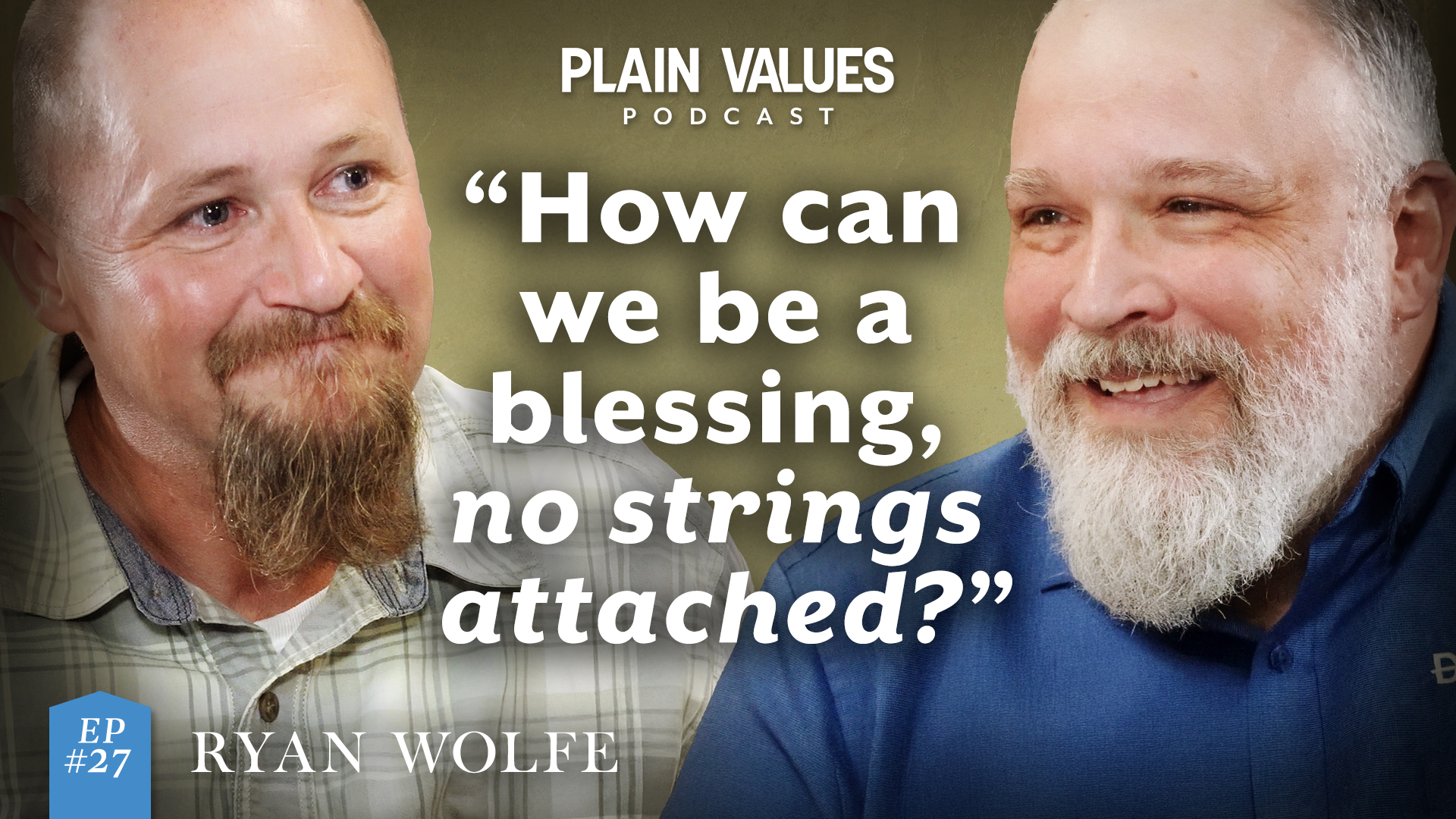
In this episode of The Plain Values Podcast …
It was in his hometown church where Ryan Wolfe grew up and was drawn early to adults with intellectual disabilities who prayed, cross-stitched, and taught him more about friendship than any textbook.
From coaching Challenger baseball with his young family to building a field when no one else would, he asked one question, “How can we be a blessing, no strings attached?”
That simple obedience birthed Shine Ministry, guardianship programs, Jesus Proms that draw hundreds, and a faith-based adult day program funded by Medicaid.
Now leading Ability Ministry, Ryan equips churches nationwide to welcome every gifted image-bearer.
Because the overlooked are often the greatest treasures.
Learn more about Ryan Wolfe’s work at https://abilityministry.com/
Learn more about Plain Values at https://plainvalues.com
Transcripts
0:00 – Intro
2:50 – Ryan’s Roots & Journey to Ministry
9:06 – A Pull Toward Disability Ministry
14:51 – Coral’s Story
22:15 – Clyde’s Story
28:09 – Launching the Shine Ministry
30:58 – Challenger Baseball & Being a Blessing
38:20 – Raising $50,000 to Build a Baseball Field
45:54 – The Guardianship Program
49:24 – Hosting Jesus Proms
53:55 – Starting a Faith-Based Adult Day Program
1:05:39 – Taking the Mission Further: Ability Ministry
1:18:27 – Why Do 85% of Churches Ignore Disability Ministry?
1:20:26 – Finding Hidden Treasures
1:26:40 – How to Pray for the Ministry
Ryan Wolfe:
People with disabilities, people with intellectual developmental disabilities, we’re all more alike than we’re different. They are as sweet as can be and as funny as can be, sometimes as spicy and as anybody, but God was shaping and changing my heart to see the world differently. She had a plastic pencil box that you would send your kids to school with, with scraps of paper in it. And she would ask your name and ask how she could pray for you. And she would write that in there, put it in her plastic pencil box, and she would just hold it and hug it. And she would just say that she was
Marlin Miller:
Lifting those prayers up to God. I just got done sitting with my friend Ryan Wolf. Ryan is a local and the story of how the Lord has used him and his heart for the community with special needs, the community of folks with special needs is … I don’t think there’s a better word than just simply spectacular. Ryan has simply asked the question, “How can we be a blessing no strings attached?” And to see how that question has been answered and where it has taken him and his family and his work, it’s just incredible. If you have a heart for those that are differently abled, that are maybe on the fringe, this is an episode that you will not soon forget.
Please meet my friend, Ryan Wolf. This podcast is sponsored by my friends at Azure Standard. A while back, I had a chance to sit down with the founder, David Stelzer, right here at the table, and we had a great conversation. I love the Azure story. They started out as farmers back in the ’70s, and I think in 1987, they began a nationwide food distribution company. And guys, they are non- GMO, organic. They do it right. They do it so well. And you can get a truck to drop food right in your town. Check them out at Azurestandard.com and tell them Marlin and Plain Values sent you. Well, you and I met through mutual friends, Ryan and Sarah Hecker, which ironically, Ryan and Sarah both sat here. Okay. Yeah. Seth, what was it? A month ago, two months ago. Something like that. Nice. Nice. And afterwards, Sarah looked at me and she goes, Marlon, I got a guy you got to meet.
You got to meet Ryan Wolf. And I thought- Love the Heckerts. Done, done. Love the Heckers. If they say that, I love them. I’m all in
Ryan Wolfe:
And here we are. Had the honor of marrying Ryan and Sarah Heckert. Really? Yes. Yes. I officiated their wedding many, many years ago. Got to know Sarah first when we hired her to help us start our day program at First Christian Church.
Marlin Miller:
So my wife asked me this morning before I left, obviously. Where’s Ryan’s church? And I said, “I think it’s in Canton or North Canton or something.” I wasn’t even exactly sure.
Ryan Wolfe:
Yeah.
Marlin Miller:
First Christian Church, is it in Canton?
Ryan Wolfe:
It’s a Canton address, yes. Okay. Yes. But it’s kind of just beyond the North Canton area. We’re on Market Avenue just around the corner from Walsh University.
Marlin Miller:
I know right where it is.
Ryan Wolfe:
I think we saw Tim Hawkins there one time. Yes, you did. I think so. Yes, you did. So he’s
Marlin Miller:
Been there a couple times. He’s been there a couple times.
Ryan Wolfe:
That’s cool. So
Marlin Miller:
Yeah. So let’s go all the way back. All right. Did you grow up in Canton?
Ryan Wolfe:
I did. Okay. I did. I did. I grew up in Canton. I live now in North Canton, but only moved away for college and graduate school. But yeah, my family’s from the area and just one of those guys that found his way home. And I’m super glad to be able to say that. As far as First Christian Church goes, I think my kids are now a fifth or sixth generation of our family being at First Christian Church. So a lot of history there and proud to be able to call the church my home.
Marlin Miller:
Yeah. So there’s so much to dive into. The first time you and I met, was it Einstein Brothers or? Panera. Panera Bread, that’s right. Yep. And you started telling parts of your story and it blew my mind how far it went. Let’s go all the way back. You went to college for being a pastor,
Ryan Wolfe:
Right? Yeah. Yeah. Went
Marlin Miller:
To seminary.
Ryan Wolfe:
Yeah. I felt the Lord calling me to go into ministry when I was a junior in high school. Didn’t know what that meant or looked like, but just wanted to be obedient to that. So went to Mount Vernon Nazarene University. It was college back then. And got my ministry degree in religion and minor in Christian education and still didn’t quite have an exact feeling for what that calling looked like. Did a lot of stuff in children’s ministry. But yeah, when we graduated, my wife and I got married a month after we graduated,
And then we moved to Cincinnati like two weeks after that and started in a graduate school at Cincinnati Christian University, which is no longer a university, one of those Christian schools that have closed, sadly. But we got our master’s degrees in Christian counseling and kind of had the idea of starting our own Christian counseling agency. So that was kind of like where we thought the Lord was taking us as far as our ministry path goes. But the Lord had a different idea, at least for me. After we graduated from seminary with our master’s degrees, my wife got a job at Job and Family Services downtown Canton right away. I applied for 10 plus different counseling jobs, never got a call back, which was just kind of weird because like, all right, I got a master’s degree in counseling and couldn’t get a call back. And so we moved back to Canton.
My wife started working at Job and Family Services downtown just to fill time. I started working on a paint crew, which was actually my father’s paint crew. A retired school teacher decided to keep working and he’s still painting. He’s 80 now.
Marlin Miller:
Wow.
Ryan Wolfe:
Yeah. So yeah, he’s 80 and he’s still running his own paint crew. So yeah, so I jump on his paint crew because I couldn’t find a counseling job. And about a month later, I got a phone call from John Hampton who was the senior pastor at the time at First Christian. And he said, “Hey, we have a children’s ministry job opening and would you be interested in interviewing for that? ” And I’m like, “Yeah, absolutely.” I had quite a bit of children’s ministry classes undergrad and some even at graduate school, even though we got our master’s degree in counseling. And so yeah, I went in for that interview, got hired at my home church as my first official ministry job. Most people never get the opportunity to minister at their home church or some people kind of work their way back there towards the end of their ministry careers, but I got the honor of starting there, which was awesome.
That was 2002 when I started at First Christian.
Marlin Miller:
Can I pause you for a second? Sure. Don’t lose your train of thought. I know you won’t. Yep. When did you graduate from NVNU or MVNC?
Ryan Wolfe:
MVNC, we graduated in 1998.
Marlin Miller:
My wife graduated from NVNC in 02. 02. So she would have been entering as you guys were- As we were leaving. As you guys were leaving. Yeah. Yeah. Yeah. We love that school. As do we. So anyway, keep going. So you’re now in charge of the kids’ ministry at your home church.
Ryan Wolfe:
Home church.
Marlin Miller:
Just freshly married. Did you have any kids at the time?
Ryan Wolfe:
No, no. So by that time we had been married for four years, no kids at that point. And my wife’s working in counseling downtown and I started off in children’s ministry. And in addition to my children’s ministry stuff that I was doing, I was really passionate about a different people group. And I’d love to just talk just a little bit about them for a second. At the time it was called our lifestyles class. And that name has since changed a couple times, but I grew up, again, growing up at First Christian, this people group, the lifestyles, was a class for adults with intellectual developmental disabilities. This class has been around for over 40 years, and I want to kind of go backwards before I go forwards here. But as a kid growing up, this group called the Lifestyles, different people group walk different, talk different, look different than me.
So like as a kid and even as a teen, I’m like, “I’ve never seen any people like this before in my life.” Because growing up at school in the 80s, even early 90s, special education was in a different wing of our public schools and we never had any interaction with anybody that maybe looked different, walked different, talked different than we do. So I’m running into these folks at First Christian Church, and for me, I was strangely attracted to this people group, to the point where I found myself sitting closer and closer and closer to them at church, to the point where I was sitting right behind them at church and they were just so fascinating and grew the courage to just introduce myself to this class of adults with intellectual developmental disabilities at my church. This is back in the 80s.
Marlin Miller:
How many kids were there at the time?
Ryan Wolfe:
So this class, it was class for adults. There was no more than 10, 10 to 12 in that range, but over time, like I said, I grew up the courage to start interacting with them, became my friends. Every Sunday morning, I would go and just hang out in the lobby, talk to them, sit near them at church, got to know them by name. They knew me of just shared conversations. One guy in particular, Don, Don Cohen, a huge Cleveland sports fan. So we would talk about Cleveland sports every Sunday in the lobby at church. So I wanted to go backwards, touch on that as I go forwards. So I become the children’s pastor at First Christian, and here’s this lifestyles class that’s still kind of hanging out there on their own, not much care from leadership at the church. And I’m like, “I know I’m doing children’s ministry, but can I give some leadership to the lifestyles class?” And there was absolutely no opposition to that because nobody was really giving leadership to it.
They just kind of fell under adult discipleship and they were just kind of off on their own. So here I come as a children’s pastor, here are my friends, they’re just not this random group of people, they’re my friends. So they become kind of part of what I’m doing and we kind of begin to grow together and I invest in them a little bit. Obviously I’m spending almost all my time in children’s ministry. So that’s kind of where I got my first exposure to people with intellectual developmental disabilities and always kind of a part of my story because of growing up at First Christian and having that exposure that I never got in school. One cool thing, and I’m sure we’ll get to this, but as that ministry has grown, I got to know people that, believe it or not, graduated in the same class at high school as me.
Yeah. And you never knew- Never knew them. Never knew them. So a friend in our ministry at First Christian, an adult with Down syndrome, his name is Bob. And I come to find out Bob graduated from Glenoak High School in 1994. And I’m like, “I graduated from Glenoka in 1994, never once met him because of how segregated schools were at the time kind of growing up.” But yeah, so this class of adults with intellectual developmental disabilities kind of falls under my leadership while I’m doing children’s ministry and then things just kind of … God does some amazing things. I had no idea what I was doing in that area because there was no such thing as a college course in disability ministry. There still almost is no college course and disability. There are some cropping up and you know, I’ve got some friends in ministry.
They’re doing some really great and new and exciting things, but at the time there was no such thing. So God would drop people basically into my lap to open my eyes to this world and this reality that I had no idea was there. And I credit a lot of kind of how my ministry evolved to basically two people. One, her name is Coral and another guy named Clyde. And I’ll talk just briefly about each of them because I wouldn’t be where I’m at here without either of them.
So I’m working as the children’s pastor at First Christian and every Wednesday there was this lady named Coral that would just show up in the church office. And as I’m going in, checking my mailbox, going in for meetings and stuff, she’s always sitting on the couch in the church office kind of waiting area. And most people would say hi to her, and that was about it. And you could tell Coral was an adult with some form of an intellectual disability. So instantly, like my radar is going up, I’m like, “Who is this lady and why is she here?” So like I said, most people just say hi and keep going. I sit down on the couch next to her, I’m like, “Hi, my name’s Ryan.” And just get to know Coral. And I come to find out that Coral’s a part of our church. She took it upon herself.
She lived independently in an apartment not far from the church, but she took it upon herself to get the bus and come to the church every Wednesday morning. She viewed it as her ministry to come to the church on Wednesdays and pray for the church from open to close. Wow. From open to close, eight in the morning- Till whenever the church was closed and she would take the bus home. Wow. How old do you think she was at the time? At the time, I would say Coral was probably in her 50s-ish, 50s. So how did that …
Marlin Miller:
Okay, so you meet her, you learn because you sit down and- And talk to her. … and just visit, you learn what she’s doing, what happened? Yeah, I feel kind of silly because I’m just jumping in the middle of the story. How did that whole thing play out? Did you ask her to start praying for you and that ministry then or?
Ryan Wolfe:
Well, she was the one that was proactive about that. She had a plastic pencil box that you would send your kids to school with, with scraps of paper in it, and she would ask your name and ask how she could pray for you and she would write that in there, put it in her plastic pencil box, and she would just hold it and hug it. And she would just say that she was lifting those prayers up to God. And she is one that I credit so much of my upbringing, wisdom, everything to Coral. So she would hold the pencil box or she’d put it on her lap and she would put her hands in the air to pray. And I’m like, “Coral, what are you doing?” She’s like, “I’m imagining I’m giving a hug to Jesus as she’s praying with the prayer request and this pencil box with scraps of paper on it.
” And as our relationships begins to develop, one of the things that she would do to pass the time would be to cross stitch. So every single pastor had a cross stitch of their name that she would make. It was either a bookmark form or a bigger form. And so when she gave me mine, I sticky tacked it up to the wall, like my name plate, which was so special. But she only ever sat in the lobby and prayed. And I shouldn’t say only because that’s probably the most powerful thing that anybody can do, but she was there every Wednesday. I’m in children’s ministry, a church of couple hundred kids, a couple hundred volunteers at the time, like massive church with tons of stuff going on. And I never had enough help. I had a good team around me, don’t get me wrong, but I was never at a point where I didn’t need more help.
When you’re in ministry, you never have enough volunteers. So she’s sitting in the lobby and I said, “Coral, would you be willing to be my assistant?” And you would not believe how her eyes just began to glow. And of course the answer was yes. So she moved from having a spot on the couch on Wednesdays where she was praying for the staff to having a chair in my office where as I’m doing children’s ministry for hundreds of kids, she’s cutting out the crafts, she’s bagging the crafts, she’s organizing the snacks and everything. And so she’s doing that during the day and we had a Wednesday night program for kids on Wednesday nights. So she becomes my assistant on Wednesday nights. And it’s just an amazing thing that kind of our relationship just kind of evolved in. And through that relationship, God opened my eyes to the fact that Coral’s an amazing woman.
She may have had intellectual developmental disabilities, but she was capable of doing ministry at a level that I was not aware of. And God taught me so much through that relationship. And just as our relationship grew, Coral’s mom ended up passing away. She has had a sister that she was fairly close with, but as sisters go, don’t always get along. So as Coral’s aging, she lost her mother, she has her sister, don’t always get along with. And just you could tell that she’s on her own. And God began to kind of like convict my heart to come up with this thing where like, what if everyone of our adults with intellectual developmental disabilities in our church had somebody that kind of adopted them into their family? So what does that look like? You sit together at church, you’re never at home by yourself for a birthday or for a holiday.
And it was just like an unofficial thing, like we adopted Coral into our family. And at this time, we have kids, our kids are growing up and my kids, Coral’s not related to us, but I always referred to her as Aunt Coral, because she was always there for all the holidays and stuff like that. And she like literally became kind of part of our family and she took that title, Aunt Coral, as like one of the greatest blessings of her life because she never had kids. And it was just like one of the biggest and greatest things ever. And it was just small stuff like to you and I, we would consider small stuff, but like God opened my eyes through that relationship to just what people need. We stop categorizing as someone who might be labeled as neurotypical versus someone with intellectual development disabilities.
We all need love and relationships. We all have the capacity to be ministers to the gospel. There’s so many things that Coral taught me. So this was as, as I’m just doing children’s ministry, I’ve not started into like full-time disability ministry.
So Coral taught me so much. And then Clyde, I mentioned a minute ago, Clyde was another guy, intellectual developmental disabilities, not a part of our church ministry. Clyde was a street walker. This is when First Christian Church was downtown Canton area, but very much a street walker, lived in a lot of different shady areas, didn’t take care of himself. And one of his stops on his daily walks was to walk into the church building. Church is air conditioned. He could always get food out of the kitchen. He was a very colorful guy to put it lightly, very colorful guy.
But again, like here’s this really interesting dude walking in the front doors of the church. I can tell he’s got some stuff going on and I’m like, “I got to get to know this guy.” So Clyde and I develop this friendship and to the point where almost daily, in addition to Clyde’s stop on his street walking that he did, he would take a nap on the afternoons, on the couch in my office. On a regular basis. On a regular basis. So I’d come in and Clyde’s sleeping on my couch and I’m not mad at all. I love it. I’m like, “This is awesome.” I’m like, “This is so stinking cool.” And again, all this time, like God is shaping … Now that I look back on this, God was shaping me to see the world differently,
To see all these individuals in my community and every community that are people just like any one of us that need Jesus, need relationships, need love, need a place to use their giftedness that God has given them. The purpose. Yeah. Yeah. Absolutely. Did Clyde have a family? Did he have a home? Was he … Clyde did have some family members, but really not any interaction with them. He bounced from really bad apartment to apartment, and he didn’t want to be in those apartments because there was always drugs, deals going on, people getting hurt, guns getting shot. So he didn’t spend much time in any more time in his apartments than he had to. But yeah, loved Clyde. And when I say our friendships developed over the years, we would go out for lunch. So we would take him out to lunch with us whenever he was hanging around and go to a Chinese restaurant and he’s got Chinese jokes that are not appropriate, but Clyde’s just letting him rip.
And we love Clyde. And over the years, Clyde got a tumor on his brain and without a family member, without people caring for him, it was my wife and I that were at the hospital with him.
Really?
And I’ll never forget it. We’re walking in the morning of his procedure and he’s laying on the bed with the hospital gown, but his knee’s up on the bed so the gown is up and he’s completely exposed. And my wife and I walk in and we’re like, “Whoa, Clyde.” And he doesn’t care. Right. He doesn’t care, so we can cover him up and we’re just kind of hanging with him there. And the surgeon comes in before the surgery and he’s like, “So Clyde, we’re doing a surgery today. We’re going to try to get that tumor out. ” He asked Clyde, he’s like, “Which side is the tumor on? ” And Clyde’s just like, “This side?” And as a surgeon would do before surgery, he takes a marker and puts a mark on where he’s doing the surgery and the surgeon walks out and Melissa and I are looking at each other and we’re like, “Are we sure?
Are we sure? Is Clyde sure that this is the side that the tumor’s on? ” We don’t know. We hope he knew, but it was just one of those moments that we’ll never forget and
God bless Clyde. He had the brain tumor removed, but it was to the point where there was only so much that they could get. And Clyde after that didn’t live much longer, but just so many fun and funny memories with Clyde. And Coral’s so sweet. Clyde was just so funny. And I think those were two of the things that I took away from those relationships. Coral ended up passing away recently, cancer, but just the sweetness and the funniness. And as I look back on that, God was helping me to see people with disabilities, people with intellectual developmental disabilities, we’re all more alike than we’re different. They are as sweet as can be and as funny as can be, sometimes as spicy and as anybody, but God was shaping and changing my heart to see the world differently, specifically through those two relationships. And as I’m going forward in my children’s ministry days, I find myself spending more time with the lifestyles class.
We ended up changing the name because lifestyles had different connotations, as language evolves, as it always does. So we changed the name to Hidden Treasures, because we felt like this group of 10 to 12 adults are truly a gem and a hidden treasure in our community.
And then I’m beginning to lean in more and I’m like, “I want to spend more time with this group than I do with the kids.” God’s kind of pulling my heart as these relationships begin to develop with different folks. And that’s where God put it on my heart to just say, “Okay, here’s Clyde, here’s Coral, here’s this dozen adults that have been here since the ’80s, there’s got to be more in our community.” We’ve got to be busting in our community with people with disabilities. Why aren’t they here? Why aren’t they in this class? So God’s shaped my heart and then he’s pricked my heart
And
He’s like, “Or where is the disability community and why aren’t they here and what can we do about it? ” And so as I’m working, I worked at First Christian from 2002 to 2017, so 15 years at First Christian. It was about at the halfway point where that process, where God is just like, “Go find…” He sends out his disciples. I felt like that was my moment where he sent me out. He’s like, “Go find the disability community, bring them in. ” That kind of the whole Luke 14 moment where Jesus is talking to the religious leaders of his day, that whole chapter, he challenges the religious leaders of his day three different times in that chapter to go out quickly and bring in all who are poor and disabled. Those are the words directly from the lips of Jesus, go out quickly, bring in all who are poor and disabled.
I felt like I had kind of that moment where God was pushing me out and saying, “Hey, you’re doing a great job with several hundred kids In children’s ministry, it’s time to go out and start bringing in this community that’s been forgotten that you didn’t even know existed and wouldn’t
Had it not been for this small group of adults. So team of volunteers were like, okay, what can we do? And we knew that there were some kids with disabilities at our church. Some of them were integrated. Some of them weren’t coming to programming at all. So we started our Shine Ministry. This is back at the old building, kind of in that front half of the 15 year ministry at First Christian with their parents, their kids. So we start the Shine Ministry. So Ministry for Kids. So we have kids that are integrated into children’s ministry and then we have a standalone classroom that we started. We’re like, this is awesome. They have a place to be now. They didn’t have a place to be before or they wouldn’t drop their kids off in children’s ministry before. We’re like, “This is great. Things are moving forward.” And as we got to know some of the kids, we got to know what they were doing.
And we found out there’s this thing called Challenger Baseball. And everybody knows their Special Olympics, but we found out Challenger Baseball is around. And then I had a friend, his name is Tom, still my friend. Don’t see him as much as I would like, but he’s like, “Well, why don’t we go coach in Challenger Baseball?” And I’m like, this is funny. I’m like, Tom, at this point I’ve got kids, they’re very young. I’m managing, like I said, a couple hundred kids on a Sunday morning, a couple hundred volunteers. I’m like, “Tom, I don’t have time to go coach somebody else’s kids.” Because he was like, “Let’s go coach a challenger baseball team.” And I’m like, “No, I don’t have time for that. ” And God bless Tom’s heart. He wouldn’t let it go. Really? He came back to me, he’s like, “We need to go and coach.”
Marlin Miller:
You specifically?
Ryan Wolfe:
Yep. Yep. He was a volunteer in our shine ministry at the time. So he’s connected to these kids and their families. And he kept recruiting me to go coach this baseball team. And I’m like, “I don’t have time for it. ” And I told Tom, “I won’t do it unless I can bring my whole family with me. ” Because I’m just like, “I can’t do one more thing away from my family.” And they’re like, “Cool.” So my wife and I go and my kids, and I’m saying my kids are little at the time. My son was like maybe three. My daughter was about two young and we’re like, “All right, if you want us, you got all of us.” So we show up at this Challenger baseball, we’re playing on the Cardinals. We weren’t like the main coaches or anything, but we’re going to help coach this team.
So Tom and myself and my family, Challenger baseball team in Canton, Ohio. And an amazing thing happened instantly, like connections were made that I didn’t expect to happen instantly. And we were accepted and loved. And even to the point where connections were made between like my two year old daughter and one of the players on the team named Danny. So Zoe and Danny were connected. Danny wasn’t like young, like Zoe was two, but it got to the point where Danny wouldn’t run the bases unless Zoe ran with her as a two year old. No kidding. And I’m seeing like these connections being made. I’m like, “My kids are doing ministry here on the ball field.” Did the players have a buddy already? No. They
Marlin Miller:
Did not.
Ryan Wolfe:
No, it was just teams of kids with disabilities playing baseball. To the best of their ability, they’re going
Marlin Miller:
To go play. See, our kids play at a local thing, kind of like Challenger Base. It’s called Dream League, I think, and they specifically will assign a buddy to the player and our kids adore it. Oh my goodness, they live for those three, four weeks in August. They just live for it. That’s what I figured you were talking about. The Challenger is a little different where they don’t have a buddy.
Ryan Wolfe:
Not necessarily.
Marlin Miller:
But Danny says, “Zoe, let’s go run the bases.” And she’s all in.
Ryan Wolfe:
And he won’t run without her.
Marlin Miller:
Held her hand?
Ryan Wolfe:
Yeah, sometimes. Wow. And Challenger’s different. You got coaches in the field, they’re assisting and stuff, but instantly connections being made. And again, God’s doing something in my mind, like he’s helping me to see my two year old can use her giftedness, just her presence
To do and to do ministry. And another thing that happened really quickly, as we’re in the field, we’re assisting, whether it be in the outfield or running bases or coaching first base or third base, after games, parents would walk up to us and they were like, “Hey, my name is so- and-so. What’s your name?” And they were like, “Is your kid on the team?” And we’re like, “No. No, we’re just here coaching.” And they’re like, “Why are you here then?” And that was like the instant question because at the time, Tom, myself, my family were the only coaches in the league that didn’t have kids on the team. So we stuck out like a sore thumb and everybody instead was like, “Why are you here?” Almost distrustfully
Marlin Miller:
Probably.
Ryan Wolfe:
Yeah, they’re sniffing things out like, who are these people? This is weird. People don’t come to us type of thing because we’re a closed, tight knit community where outsiders aren’t upon their own willfulness coming. There’s only one
Marlin Miller:
Way to get into the club at that point is
Ryan Wolfe:
To have a child. Yeah. Yeah. So it’s fairly close club. So here’s this small group, a handful of people that are coaching that are outsiders and tons of conversations. “Why are you here? Why are you doing this? “And it’s just constantly coming back to, ” Hey, “and this is just a phrase that kind of came about, not something that is a brilliant thing that I came up with, but I would just continue to say,” Hey, we just want to be here. We want to be a blessing. No strings attached. “That’s it. “We want to give you the opportunity to have a typical little league experience where you can sit on the sideline, you don’t have to stand in the field, you can cheer for your kids and not have to hold their hands.” We just want to be a blessing, no strings attached. That phrase became something that I just continued to repeat, continue to repeat.
And the reactions of people was just like, they were blown away that we would choose to be there because oftentimes I would hear from parents, and this is not the reaction from every parent, but oftentimes I would hear from parents is, “We didn’t choose this lifestyle. We had a child. We were drafted in. You’re choosing to be here to spend time with my kids.” And they just couldn’t process that. And it blew me away and blessed my socks off to know that just my presence with their kids was a blessing. And it was, again, one of those moments God was opening my eyes to something bigger and it wouldn’t have happened if Tom didn’t ask me a second time
And
If I didn’t say yes to Tom. And I quickly began to see that there were more ministry opportunities outside the walls of the church than there were inside the walls of the church. And that was another kind of one of those revelations where I’m like, “Okay, it’s happening out here more than it’s happening in here. So how can I get more out here than in here?” And so that whole phrase, “We just want to be a blessing, no strings attached,” was kind of one of those light bulbs that went on for me. And I was just like, “Okay, we’re here in Challenger Baseball. We’re showing up to be a blessing.” I’m like, “Okay, how can we kick this up a notch?” So I go to the leader of the Challenger Baseball League Bonnie McClellan and I just throw that phrase out. “How can we be a blessing, no strings attached as a church?
I’m here as an individual, but I represent First Christian Church and you’d be surprised when you throw that phrase out what people respond with and Bonnie, without hesitation, said,” We need more baseball fields to play on. “She said,” With all these travel teams that rent fields, Challenger Baseball kind of gets left in the dust and we don’t ever have enough fields to play on because Challenger Baseball was growing at the time too. “And I’m like, ” Okay, we got a lot of property. Church had just moved up to Market Avenue. “I’m like, ” What if we built you a baseball field? “And I’m saying this as a volunteer in Challenger Baseball, as a children’s pastor at First Christian Church without asking the leadership of First Christian Church,” Can I build a baseball field on a property? “Because it was just one of those moments, it felt like the Holy Spirit was moving me to say,” Hey, what if we built you a baseball field?
“And she was obviously blown away by that. And so I’m kind of committing myself and the church to do that without asking for permission to do that. And at the time, it wasn’t a great time financially for our church. Our lead pastor that had hired me had moved to Florida. We had a new lead pastor. Transitions don’t always go as you would hope we saw a lot of people leave. We went from a church of like 2000 to a church of 900 and this at the time was a multimillion, it still is a multimillion dollar property and I’m going to the leadership of our church and I say,” I know this isn’t a good time. Budgets have got cut. Staff have got cut. Can I build a baseball field? “How did they respond? And believe it or not, I was shocked by the response and I give a lot of credit to the senior leader at the time there, Scott, because he could sense like something was happening here and he simply said this, he says,” You can do it if you can raise all the money for it.
“And I’m like, ” Oh. “Okay. So you’re telling me there’s a chance. So I’m like, ” Oh, okay. All right. All right. So I’m like, there’s the open door and it’s just my job to step through it. So I come to find out it’s not necessarily a cheap thing to build a baseball field if you want to do it right. So I come to find out we need like $50,000. And
Marlin Miller:
This is in what year?
Ryan Wolfe:
Oh gosh. This would be like 2007, eight-ish.
Marlin Miller:
So 50 grand back then was like a hundred today. 80 or 100. I mean, it’s a lot of money. Yeah, sure felt like it. It’s a lot of
Ryan Wolfe:
Money. Sure felt like it. And so again, the church didn’t have the money. They weren’t going to give me a penny for it, but they said if I could raise it, I could do it. And again, the church is in a downswing at the time. So I’d never written for a grant before, no experience whatsoever for that. But I just like, I start writing letters and sending them all over the place, send it to Cleveland Indians, send it to family foundations, send it to hospitals, talk to everybody I know about it. And believe it or not, within like a couple weeks from sending that first letter out, I get a call from the Cleveland Indians. They were the Cleveland Indians at the
Marlin Miller:
Time. Yeah. I still can’t
Ryan Wolfe:
Call the Guardians, the Guardians. I just can’t do it. I won’t either, but get a call from the Cleveland Indians. So they say, Hey, we’re really excited about this project. We’d like to send you a check for $5,000 so that’d be okay. First one. First one was Cleveland Indians.
Marlin Miller:
Opening shot of five grand. You got 10%.
Ryan Wolfe:
Yeah, I’ve got 10%. And I’m like, oh my gosh, this is happening. And it was interesting too because like once I had the stamp of approval from the Cleveland Indians, everybody wanted it on board. And I was thinking the same thing. And then checks started rolling in.
Marlin Miller:
And that is the biggest stamp of approval you could have gotten. Absolutely. The biggest one. Absolutely. My wife loves Jill Winger’s old fashioned on purpose planner and this year’s is better than ever. It has all sorts of tabs from your gardens to your animals to your meals, anything and everything that you can imagine that needs planning, Jill has built a spot for it in here. You can find this at homesteadliving.com. Order yours today for 2026.
Ryan Wolfe:
And it gets down to the point where like we’ve got 30 of the $50,000 and we need to move. Timelines are, we want to get this done and ready for the next upcoming Challenger baseball season. We need that last $20,000. And I’ll never forget, we were at a staff meeting, I’m like, “I need $20,000 more dollars.” I just asked the staff to pray. I don’t know where it’s coming from. I’ve sent out a bunch of letters, I’ve approached a bunch of different people. Can we just pray? We prayed together at that staff meeting at nine o’clock in the morning, the staff meeting was over. I went back to my office at 10 o’clock, opened up my email and in the email was a response to one of the letters that I wrote out and said, “Hey, we’d like to give you $20,000.”
Marlin Miller:
Get out of here.
Ryan Wolfe:
And there it was. Goodness. And in less than 12 months from the first letter I sent out to the Cleveland Indians, I had $50,000 and we built a baseball field on our campus because I went to the leader and I said, “How can the church be a blessing? No strings attached.” And I had no idea what kind of response I would get. It was just a matter of using that phrase, “How can I be a blessing, no strings attached, waiting for a response and just walking through the next open door and obedience.”
Marlin Miller:
Ryan, that is one of those stories where it’s so incredible. It’s so incredible that no matter how good you are, you and I both know you are not going to take any of the credit. No. You can’t. You cannot. And those are the best ones. Yeah. Those are the best ones where you just say, “Okay, Lord, I’m open.
Ryan Wolfe:
Just
Marlin Miller:
Throw me in the direction you want me to go. “
Ryan Wolfe:
Yeah, so let me tell you how this evolves. Obviously, we work really hard, get the baseball field done. We make the announcement that we’re going to have our opening day celebrations, paper comes, it gets picked up by radio stations. So I’ve got family that live in Indiana and they’re like, “We just heard you on the radio.” I’m like, “I didn’t even know it was on the radio.” And it’s just like word spreads like crazy about this. And like I said, it was in the newspaper and then the next day, so I was in the newspaper, I think it was Sunday newspaper, on Monday morning after that article came out about us doing the baseball field for Challenger Baseball, Special Olympics, I get a phone call from our county judge, Judge Dixie Park, and she was like, “Ryan, I’d like to see you in my office.” And it was another one of those moments I’m like, “Okay, did I do something wrong?” And she was like, “No.” She’s like, “I just read this article about how you guys did this amazing thing for Challenger Baseball in our community.” And she’s like, “I just wanted to ask you if you’d be open to doing something else for our community.” And I’m like, “Okay.” So I go to her office like a week later, I’m sitting in the judge’s office in our county and she says, “Ryan, obviously you’ve got a heart for the disability community.
You wouldn’t have done what you did if you didn’t.” She said, “We have a big problem in Stark County. We have 60 adults that we are in charge of. ” The guardianship thing. Yeah, the guardianship thing. So she’s like, “The county has guardianship of over 60 adults with intellectual developmental disabilities in Stark County. They have no family members. If they do have family members, they’ve disowned them.” And she’s like, “This isn’t right.” She said, “Do you think the people in your church would be willing to become guardians for these 60 adults that have no one?” And my heart is just breaking in that moment. I’m like, again, I’m like, “Yes.” Without asking permission for the church leadership, without talking to any of my volunteers, it was just one of those Holy Spirit moments where it’s just dropping something in your lap and just asking you to be obedient.
And I’m just like, “Okay, I don’t know how I’ll do it, but Lord willing, we’ll do it. ” And so we go back and start talking to all my volunteers and it’s just like, we get connected to a couple of different agencies that are doing that for the county and we recruit 20 people to become volunteer guardians for adults with intellectual developmental disabilities in our community. And it was life changing. But again, it was ministry outside of the box of Sunday morning. And that’s where all these opportunities started cropping up and we’re doing ministry, we’re seeing amazing things happen. As we continue coaching in the baseball league and doing the guardianship thing, we’re having these conversations with families. We had a dad come up and approach me, he’s like, “I don’t do the church thing.” He said, “But anybody that’s willing to do this much for my son, I’m going to give him a chance.” He said, “I’m going to show up at your church.” And then we started seeing these things happen.
Families start showing up at our church. Our disability ministry starts growing on Sunday morning as a result of us going out and doing these things and I ended up baptizing the whole family of … It’s just like God continues to bless, but he continues to prick my heart saying, “Okay, what more can we do outside the walls of Sunday morning?” And so I’m like, “How can we be a blessing of strings attached?” Kind of that phrase. I’m like, “Okay, I’m going to start having meetings with every leader in the disability community that I can. And we line up as many meetings as we can. ” And then we meet with Bill Green, superintendent of Stark County Board of Developmental Disabilities. And the only question on our agenda is how can we be a blessing, no strings attached? And he’s seen the baseball field, he’s heard about the guardianship, and he’s like, “Well, this was at the time where there were still workshops, they were still handling a lot of different things.” And he’s like, “We’re getting ready to scale back.
As fun gets cut, we can’t do as much as we’ve always done.” He’s like, “We’re getting rid of one of our monthly social events. Would the church be willing to step in and do a monthly social event for Stark DD?” “Yeah, churches are good at doing parties, for lack of better words, churches are good at that. ” So I’m like, “That’s a no brainer.” I’m like, “Okay, what does that look like? ” And he said, “Well, typically we’ll run out a hall and we’ll run out a DJ and it’s just a place for people to gather and have fun, dance.” And I’m like, “Okay, we can do that. ” But in my mind, I’m super competitive. I’m like, “We can do that, but we can do it better. We can do it better than it’s ever been done before.” So we put together this committee, as our ministries is growing over the years because of the different things that we’re doing, more people are getting involved in it.
So I’m like, “Okay, who’s doing this? Because I want to see who’s done it well, because I just don’t want to do anything poorly.” So I find this church, Southland Christian Church in Lexington, Kentucky was doing Jesus proms and they had been doing Jesus proms for a long time. So I take a team of people down to Lexington to see the Jesus prom happen. I’m like, “This is a slice of heaven.” If you could take a cross section of heaven, this is what it looks like. And we caught the vision for that. Was that before or after Tibo’s night to shine? This is before Tibo.
Marlin Miller:
Really?
Ryan Wolfe:
This is before Tibo. And so we take the group down to Southland, we see their prom and we come back and we try to start seeing how can we do this at First Christian as best as we can. And we didn’t know this first event that we’re doing for Stark DD, we didn’t know if 50 people would show up. We were like, “Oh, 50 people show up, that’d be great.” Because at our class for adults, we used to still have that same 10 to 12 adults, so 50 people would be amazing. Our first prom that we did, 250 people showed up to. And we were blown away by that. And of course, we did it on Saturday night and we extended the invitation to everybody that was there, “Hey, you had a great time here tonight. We’d love to have you come back Sunday morning.” We have a class for adults with disabilities and we’d love for you to join that class.
The week before, we had the same 10 to 12 adults. The Sunday morning after that prom, we had 30 adults in that class. That class had never grown in like 25 years.
Marlin Miller:
And the original 10 and 12 are just, they’re just busting
Ryan Wolfe:
Joy
Marlin Miller:
Of having
Ryan Wolfe:
All these other new friends. And the thing is, within the disability community, as I know you know, they’re all connected. They all know each other. And so they’re seeing people that they know, like showing up in Sunday morning. Instantly, we outgrew our Sunday school classroom that we were in.
Marlin Miller:
And because of the fact that they have disabilities, they have family members, they have friends bringing them by.
Ryan Wolfe:
Yep, yep. So instantly we have this bitch chunk of new people show up and just because we were willing to say yes, first we were willing to ask the question, how can we be a blessing, no strings attached, and then say yes to the need that was presented to us. And we continued to do the proms. At our height, we were having over a thousand people come to those promos.
Marlin Miller:
Get out of
Ryan Wolfe:
Here. Yeah. It’s nuts. Oh my goodness. So over a thousand people come to these proms and we continue to lean in because we built this amazing relationship with Bill Green at Stark DD. And we just continued to say, “Hey, the problem’s going great, guardianship’s going great, baseball league is going great. We want to do more for our community. How can we be a blessing? No strings attached. We don’t know the needs of the community. You do, you live it. It’s your work.” And he’s like, “Ryan, right now we’re getting ready to shut down the workshop.” And there was that period of time where everybody was, workshops were shut down, people were pushed into community programs, which is a great thing. More people in community is better. He said, “One thing that Stark County doesn’t have is a faith-based adult day program.” He says, “There are a lot of good faith-based people at day programs.
We don’t have one that’s truly a faith-based day program for adults that want that. ” He said, “I think your church would do a great job at that. ” And I’m like, it was again, one of those Holy Spirit moments. I’m like, “Okay, we can do that. ” I don’t know how- Starting a day program is a monster ordeal. It is a monster ordeal. But again, it was one of those Holy Spirit moments where I couldn’t say no. So I’m like, okay. That’s Kevin Costner. Just build it and they will come. And I’m like, “Okay, I’ll go talk to church
Marlin Miller:
Leadership.” But they’ve gotten used to this by now. I mean, they know you.
Ryan Wolfe:
Yeah.
Marlin Miller:
And they’re just, “Well, here he comes again. Now- Here it comes again.”
Ryan Wolfe:
Unbelievable. So Bill Green says, “We’d love to have a faith-based adult day program, Star County.” I go to the church leadership at the time again, it’s still Scott, still at a point in our church’s history where we were way down. We don’t have any money, anything like that. And I’m like, “Scott, I really feel like God’s calling us to do this. ” And at this time, our disability ministry was growing because we were investing in the community, people were responding. I’m still the children’s pastor, but I’m also doing disability ministry things, though I didn’t know that’s what the name was really, because no one’s doing that. Making it up as you go along. Making it up as I go
Marlin Miller:
Along. Were you spending 30, 70?
Ryan Wolfe:
At that point, it was like fifty fifty. Okay, fifty fifty. And Scott looks at me and he’s like, “You can’t physically do that full-time and be the children’s pastor full-time.” He said, “Here’s what we can do. ” He said, “You got to choose full-time children’s pastor or full-time disability ministry pastor.” And I’m like, “It’s not a choice. I know. I know what I’m going to do, but here was the next sentence.” He said, “We don’t have any money to pay you if you choose to be the disability ministry pastor.” He said, “If you do that, we’re going to treat you like a missionary and you got to raise your own money to do that. ” Wow. And I’m like, “I don’t know how to do that. I’ve never done that, but if this is where God’s leading, God will make a way.”
Marlin Miller:
In that moment, did your heart sink or did it go, “Wow.” Yes and yes. Both. Yes. Because it’s this, oh no, what am I about to …
Ryan Wolfe:
Yes, yes. It was one of those moments where my heart was screaming because I’m like, I’ve found my unique calling and then it sunk because I’m like, “I have no idea if this is going to work.” And no money to back you. No money to back it. And so I began to looking more into the state program thing, come down and find out that it’s Medicaid funded if you do it through the state. So come to find out-
Marlin Miller:
Can I pause you for a second? Yeah, absolutely.
Ryan Wolfe:
What’s your
Marlin Miller:
Wife’s name? Melissa. Where was she in all this? Did she think you were half nuts or … Now she’s working for the city of Canton.
Ryan Wolfe:
Well, so kind of take you back there. So when we had kids, she decided to stop working.
So she stayed at home with them when they were young. By the time they got school aged, she decided to go back to work. So she did that by … She started subbing in the building that the kids were in. So it was like a K1 and two building and she was subbing in special education. Really? And she became a sub, she became a long-term permanent sub, and then they said, “Hey, we want to hire you, but you got to go back to school, get your alternative license,” because she wasn’t licensed as a teacher. So it was in this process, in this kind of window where she’s going back to school to become a special education teacher in North Canton City Schools, where I’m having all these revelations. And it was because of that, that I felt like we’re going to take this chance, because God had placed her in a position that if I failed, her family wouldn’t necessarily fail.
Marlin Miller:
And by the way, let me clarify what I just did. I didn’t do this like you were crossing your fingers. I did this because it sounds like you guys were lockstep in rock solid together. Absolutely. And she was with you.
Ryan Wolfe:
Absolutely.That is so awesome and so important. Yeah, because again, we volunteered together as a family in Challenger Baseball. It unified our family around disability. Oh my goodness. So it was like our whole family in synergy. And I mean our whole family because like our kids became volunteers in our disability, ministry as buddies, as respite volunteers. So like whole family’s bought in. It’s just like, okay, let’s do this. So I work on the paperwork to get us certified by the state of Ohio as a Medicaid provider. I have no idea what I’m doing. Absolutely no idea what I’m doing. And it’s
Marlin Miller:
You.
Ryan Wolfe:
It’s just me. It is just you. It’s just me. It’s just me with this calling and because we’re invested in the community and we’re saying yes to everything when it comes to disability in our community, we were doing things like we were hosting Stark DDs like staff days. Their entire staff would come to our church and do their trainings at our church and we would charge them no rent because we wanted to build relationships in the community. So we began to become known as like the church that cared about the disability community. So while I’m working on A certification, there ends up being a sign language choir performance at our church. Because again, people from the community know that our church is all about disability. So Sarah Heckert comes in on one night, doesn’t know us from anybody. She’s leading the sign language choir performance in our building, her choir in our building doing a performance.
And my wife and I and our kids were like, lack of better terms, like we’re junkies. We’re groupies. We’re like, anywhere there’s a disability, anything, we’re showing up just because God kind of put on our hearts. So out of the blue, we show up at the sign language choir performance at our church that Sarah Hackett’s leading. After the performance is over, I walk up to Sarah and just introduce myself, say, “Hey, my name’s Ryan Wolfe. I’m the pastors at the church and glad that you’re here.” And so we just start a conversation. So she’s really interested like, “Oh, you guys are doing something here.” And I’m like, “Yeah, I’m trying to start an adult day program here at the church, Medicaid funded. I have no idea what I’m doing.” And instantly her antennas are going up and she’s like, “I’d love to be a part of that.
” And I didn’t know her background at
Marlin Miller:
That point. I mean, they probably wouldn’t have adopted at all at this point, or was this after they adopted
Ryan Wolfe:
Their daughter? This was before they did their adoptions, before they were married.
Marlin Miller:
Okay.
Ryan Wolfe:
And I’m like, “Okay.” I’m like, “Can you come to my office this week?” So she comes to my office, I think it was the Wednesday after their performance, and I’m kind of just sharing the vision of starting the adult day program. And she’s like, “I want to be a part of this. ” And so I go to church leadership and I’m like, “I’ve got us this far in this journey, but I don’t have the connections. I don’t know Medicaid. Sarah knows Medicaid. She has connections I don’t have. ” I’m like, “We need to hire her so we can start this together because I’ve gotten us this far, but I’m out of my league when it comes to knowing exactly what to do. ” And the church was doing okay, still on its downswing.
And the response was, “Okay, well basically we’re treating you as a missionary. We will pay for the first six months of you and Sarah starting the program.” At that point, you got to figure it out on your own. Sync or swim. Yep. So I’m like, yes. So I hire Sarah, we start working together. So at that point we’re two employees. We got to the point where we were finished with our certification. We opened the day program with four clients. We only took out one newspaper article ever and that was all we ever had to do. Actually, we didn’t even have to do that because here’s what happened, because we had this reputation growing in the community as the church that cared about people with disabilities. When they heard that we were opening up a day program, so many of these parents were like, “Okay, my kids, my adult kids go here, there, and there, but they’re people of faith.” And they’re like, “Oh my gosh, there’s a faith-based option.” So even though we took out one newspaper article and we started with myself and Sarah and four clients, we never did advertising after that because the word spread and we grew, we actually grew too fast.
Really? Which is awesome. It’s a problem. And a problem. It’s a good problem. Yeah. So we quickly were to the point where the program was paying for everything, including me and my salary. So again, Scott says, “You can do it, but you got to find a way to pay for it. ” God steps in and says, “Okay, guess what? Medicaid’s going to pay for it, ” which is one of those awesome things. I’m like, “Okay, state of Ohio is paying me to tell people about Jesus.” And people are like, “You can’t do that. Separation of church and state.” I’m like, “No, Medicaid gives the clients the right to practice the religion of their choice.” So we are advertising as a faith-based day program. So they’re actually exercising their right of religion by choosing us. So it is not illegal for me to tell people about Jesus and get paid by Medicaid to do it.
And the day program grows super fast, almost probably too fast, like I said, different things that we ran into along the way. But again, it was like God just continued to bless our socks off as we continue to ask the question, how can we be a blessing? No strings attached and just taking that next step of obedience. So it’s just a beautiful story. And I know we’ve spent so much time on kind of like where God has taken me up through 2017, because at 2017, I took another step of obedience. Well, jump in, don’t stop
Marlin Miller:
Because this is exactly why you’re here.
Ryan Wolfe:
Yeah. So things are growing. I’ve been at First Christian for 15 years. The day program’s now at the point where we’ve got about 40 employees, almost a hundred clients, bringing in quite a bit of money. Like I said, the church at a downswing, the day program’s actually bringing in enough money to help support the church where the church didn’t have enough support necessarily to even keep its doors open at times. Wow.
So how God kind of rescued our church through our obedience to reaching the disability communities, it’s just a whole amazing story. And I was just so thankful that through that, kind of the church being here and then here and then our program rising from the ashes, kind of like the Phoenix that rises from the ashes, changed the DNA and heart of our church, just massive things happening. Our ministry is growing like crazy. We have a hundred adults in our class on Sunday mornings. Remember we had- The 10 or 12? 10 or 12. Now we’re at 100 on Sunday mornings. Our children’s ministry version shine is growing, baseball field, all the guardianship, all the different things that we’re doing, and then I feel that prick on my heart again. And God’s like challenged me. He’s like, “You’ve done a great job here in Stark County, but imagine if you could do this everywhere.” And I’m like, “I don’t know how to do that.
I don’t know how to do that. ” It was like my whole thing, my whole ministry career. I don’t know how to do that. Whenever I’m presented with an opportunity, I’m just like, “But I’ll be obedient to that if the opportunity presents itself.” And then I tried to start thinking beyond just Stark County, start speaking at conferences, start speaking. I was the main speaker at the Johnny and Friends Family Retreat at their headquarters in California, like two, three years in a row, just because people were noticing what we were doing in Stark County and God’s taking my eyes beyond just Start County. And as I continued to try to invest in other places, whether it be conferences and speaking different places, I come back to Christian Church’s disability ministry, their executive director at the time, Gary Spankler, he’s still with us, getting ready to retire now.
He came up to me and he said, “Hey, our ministry’s doing a great job providing residential care for adults with intellectual developmental disabilities in a couple different states.” He said, “But I’d love to move beyond just residential care and take the message of Jesus to the world. Would you be willing to take my place as the new executive director with that mission?” And it was another one of those moments like I’m just like, “Oh my gosh, yes. I can’t say no to that. ” That’s what God’s calling me to. I’m just waiting patiently for that opportunity. And at the time, CCDM didn’t even have a functioning website, had no outreach to churches, was just doing residential ministry. I shouldn’t say just doing residential ministry, which it’s an awesome thing.
He’s like, “I’ll raise support for you for two years.” He said, “I’ll give you a two year runway to do whatever you want to take the message, the good news of Jesus to the disability community around the world. If you can get it off the ground in two years, it’s yours to run with. ” But it’s the same thing. It’s the same thing. Sink or swim. Sink or swim. He’s like, “It’s yours. I feel like God’s calling me to ask you to do that. ” And I’m like, “How do I say no to that? ” I’m like, “I don’t know what I’m doing, but if God presents me this opportunity, I’m going to take it. ” And so again, things were going good at the church. Church had begun to turn around by this point, we’re growing again. We went from 900 to about 1500 and things were great.
There was no reason for me to change. Everything was perfect for a Christian, but here’s this kind of prick on my heart, this calling, this opportunity, this chance to sink or swing.
Marlin Miller:
So you had already been … The Lord was already pricking your heart before Gary came to you.
Ryan Wolfe:
Yeah.
Marlin Miller:
Got it.
Ryan Wolfe:
Yep. Got it. Because he was challenging me to say, “Hey, what if you could duplicate this? What if you could do this beyond Stark County?”
And then the opportunity came and it was like, this is 2017. So I did children’s ministry for like half of that 15 years and I did disability ministry for the other half of that 15 years at First Christian. So I’d been doing it for eight years and the opportunity presented itself. And again, it was one of those opportunities where we’ll raise funding for you for two years for you to take over this ministry, shape it however you want to do it. And at that point, if you can get it going, it’s yours. And again, we didn’t have a functioning website. We had a name and brand that needed changed, but God did amazing things. Again, it took what I learned at First Christian. Again, I’m not a genius. I have mentioned several times I had no idea what I was doing. I was just being obedient.
I was just trusting God would do the same thing when I went to CCDM, which we changed the name to Ability Ministry. Talk about the logo for just a second, and we built the website. We started offering free consultation to churches because we found out some other disability ministry organizations and there aren’t many. We’re charging for consultation, doing different things like that. So we’re like, “Okay, let’s differentiate ourselves from that. Let’s offer free church help.” And so we started doing free consultations. You start talking to churches. I’m creating resources that I used at First Christian to help other churches get started. Come to find out there’s not a lot of great disability ministry curriculum specifically for adults out there. There were a couple other competitors that were doing some stuff, but we’re like, “Okay, maybe that’s our niche. We’re going to do consultation and training for churches, but we’ll become the ministry that creates curriculum for churches to use in their adult discipleship for classes with adults with intellectual developmental disabilities.” And that’s where I spent a lot of my time and the early going was creating this curriculum and it’s really caught on.
And so I’ve been with Ability Ministry now for eight years, so believe it or not, it’s gone super fast. But over the course of eight years, starting from nothing with not even a functioning website, we have gone from that to today being able to say we have resourced churches in all 50 states, either through consultation, resources, training, or curriculum, and we’ve worked with churches in over 50 different countries in the last eight years. And again, it’s not because I’m a genius, because I’m clearly not. It was just because I’m just saying, “Okay, God, this is yours. You open the door, I’m just stepping through it. I’m just going to be obedient to the everyday grind, the everyday grind of working with churches, creating resources for churches, and giving as much away for free as possible.” And that’s been kind of our mantra is we’re going to give away 90% of what we … Kind of like the reverse tithe.
So instead of giving God 10%, my idea was let’s give away 90% of what we create for free to churches. So when it comes to training materials and different resources, and God’s really just blessed that. And I always tell people, we have a really bad business model, but we have a huge kingdom heart. And we feel like as long as we’re willing to lean into that kind of 90 / 10 idea, give away 90% of what we create for free, we just feel like God will bless us. And God has blessed us over the last eight years to be able to work with churches in over 50 states and 50 countries to resource them, whether it’s a first step in disability ministry, because that’s where most churches are at, or it’s a next step, or it’s starting something big like a day program. I’ve helped probably three different churches now start day programs in different parts of the country because of what I learned at First Christian.
So like if you’re looking at like a first step and a final step, there’s lots of steps in between, but like most people don’t start with a day program. So a couple churches that I helped start day programs were really far along, but I was able to do that because of the different experiences that I had at First Christian.
Marlin Miller:
You just jumped in and just kind of figured it out as you went.
Ryan Wolfe:
Yeah.
Marlin Miller:
How is Ability Ministry funded?
Ryan Wolfe:
Okay. So we are funded. We act as essentially a missionary. So churches can adopt us as a mission partner and they give to … So some churches give to us monthly, some churches give to us like a yearly gift. So we’ll get support from churches, we’ll get support from individuals. We still do our residential ministry. So we are not a Medicaid provider, so we raise support for the residents that we have, and that’s where a lot of churches will buy in and they’ll say, okay, we’ll help support your residents. So money comes in for the residents that we provide homes for. So money from that, from residents, from churches that support us as a missionary, from individuals, and from curriculum sales, apparel sales. So
Marlin Miller:
You’ve got a residential program and a property that … Is it in Ohio?
Ryan Wolfe:
Nope. Nope. Our biggest residential hub is in Lewisville, Tennessee. Really? And then we have another residential hub in Versailles, Missouri. Wait, wait a second.
Marlin Miller:
Louisville … Am I thinking of that outside of Columbia? It’s outside of Knoxville. Okay. Knoxville. I think I’m thinking of Lewisburg maybe. I’m not sure.
Ryan Wolfe:
Anyway. Wow. So yeah, so we’re doing residential ministry in Tennessee and Missouri. We’ve been doing that, like I said, from the 80s, that’s where our ministry got its start. So we continue to do that and we continue to provide excellent residential care. We do have an opening right now for a male resident in Versailles, Missouri. So if anyone’s listening and wants to move to Missouri, we have a spot for you. Yeah.
Marlin Miller:
I tell you what, Ryan, our oldest son lives in a residential facility and I never knew how hard those things are to operate well. They are. You’ve probably got a constant staffing issue.
Ryan Wolfe:
We do.
Marlin Miller:
And to do it well is not an easy thing. Without Medicaid money, yes. Especially
Ryan Wolfe:
Because we’re always on the fundraising side of things.
Marlin Miller:
That’s exactly where I was going to go. Yeah. I could talk for a long time and we don’t have that amount of time.
Ryan Wolfe:
It is very difficult to not function from a constant deficit, especially because of how prices have gone over the last few years when it comes to just food, fuel, utilities, supplies. So yeah, the prices have gone up. It’s impossible for us to compete with the wages when it comes to hiring part-time people. It is a struggle. It is a struggle, but it’s something that we feel called to do.
Marlin Miller:
I mean, I’m making a huge assumption here, but I’m trying to put myself in your shoes. You are literally looking for the people that have the heart that are willing to take a lower wage and all of those things
Ryan Wolfe:
To be able to serve. Yeah. And it’s tough. Like in Tennessee, thankfully we’re not terribly far from like Johnson University, which is a Christian university, but out in Versailles, Missouri, it is slim pickens because it’s just not a-
Marlin Miller:
You’re in the middle of nowhere.
Ryan Wolfe:
Yeah. It’s not a highly populated place, so it’s very difficult to find the people that we need to run the ministry, but we continue on.
Marlin Miller:
Man, I’ve got so many questions. What stops most churches and families from getting involved? And here’s where that question’s coming from. I talked to a friend of mine who actually works for Johnny and friends, and his job, his job is to go encourage churches to open their mind to a disability ministry. And he has told me some stories that literally blow me away, where people, “Oh, we want nothing to do with that. “
Ryan Wolfe:
Yep, yep. It’s very true. Research that we’ve done and others have done show that 85% of churches have no disability ministry, programming, outreach, or intentionality at all. 85%. 85% of churches have either not thought of it or don’t want anything to do with it, somewhere in between. So it’s either a lack of awareness or it’s a lack of obedience. It’s really what it comes down to.
Marlin Miller:
How are they missing the calling? I mean, Jesus didn’t give it as a, “Hey, I think you should consider it. “
Ryan Wolfe:
No, it’s a command.
Marlin Miller:
It’s a command.
Ryan Wolfe:
Luke 14, verse 21-
Marlin Miller:
Go
Ryan Wolfe:
Get him. … and go bring him in. And Jesus says, “Go out quickly.” He doesn’t say form a committee. He doesn’t say pray about it. He doesn’t say, “Ask your church leadership.” He doesn’t say, “Check the budget.” Simple couple words, “Go out quickly and bring in all who are poor and disabled.” That’s his instructions. So churches that choose not to do it, make the choice not to do it, they’re being disobedient to Jesus, not to me, not to Johnny and friends, not to key ministry, not to the other ministries out there like us that are trying to push this giant boulder up the hill. They’re saying no to Jesus, and that’s heartbreaking.
Marlin Miller:
Oh man, today there are so many … I mean, I’m thinking of big fertility, the IVF issues that are coming, and basically we’re playing God in so many ways. I can’t even imagine designing that PhD, dad, blonde, mom with certain IQ and then they select everything else out that’s not absolutely exactly perfect. And how can we help people understand that the people that are among us that might not be that designer person are those hidden treasures that we overlook? How do you get people to take a new look at that?
Ryan Wolfe:
It’s really hard to change a worldview, a mindset. And a lot of times, I really want to believe that people aren’t evil, people aren’t so dismissive. They’re just not aware. They’ve not had that experience. They’ve not met that Clyde. They’ve not met that choral that I met that God used to change my heart and my worldview. If they don’t have a child or a family member with a disability, they’ve not been exposed to it, I really want to believe in my core that they just don’t know and they’re not aware. And I want to believe if presented that God will work on their heart too, to open their eyes to this amazing people group, because there’s a Clyde and Coral in every community.
The disability community is the only mission field that exists in every community across the world that you don’t have to travel to. They’re in your backyard. They’re waiting for you to open the doors to your church, to your family, to your home, just to say that you’re welcome. We love you. We’re here. We care. Just that little bit is just transformative. And I really want to believe that people just aren’t aware. And it’s just our job to try to raise awareness, tell the stories of transformation and just kind of how God can do amazing things if we’re just willing to say yes. So I want to believe that people aren’t evil. I know there are some people that just say no, they’re not interested. And that does happen. We’ve run into that several times where churches are like, “Yeah, that’s not for us. That’s for the big church down the road.” We don’t do that.
And even to run into … We were at a conference, a Christian conference. We were exhibiting that and there was an older gentleman who was a pastor of a smaller church. He came up to us and he patted us on the back and he said, “God bless you for doing what you’re doing, but I don’t understand why you’re doing it. ” He said, “You’re wasting your time. All these folks have a free pass to heaven.” Oh my goodness. This is a senior pastor at a small church patting us on the back saying, “Thank you for what you’re doing, but I don’t get it. Why you waste your time?” People with intellectual developmental disabilities get a free pass to heaven.
Marlin Miller:
Ryan, it is so hard for me not to be really judgmental. I know, I know. It is so hard for me.
Ryan Wolfe:
I was a deer in the headlights when he said that. I didn’t even know how to respond in
Marlin Miller:
That. Does that not imply that he’s never spent more than a second?
Ryan Wolfe:
Absolutely.
Marlin Miller:
With anybody that’s different. Absolutely. Anybody. Absolutely. Because if you spend more than a second, you know. Yes. And so here’s my last question, almost. I have one more. Okay. And it’s a version of what I asked you before, but how do you get that pastor to see the ability instead of the disability?
Ryan Wolfe:
Right, right. Sometimes there won’t be … There’s no magic wand that will lift the scales off the eyes of a person. And I equate this to the words of Jesus with his disciples. After Jesus sent his disciples out and some of them came back and they were discouraged and Jesus said, “It’s okay. Shake the dust off your sandals and move to the next town.” For some, they will never get it. Either they’re so steeped in a improper worldview, a non-biblical worldview, just they bought into society’s lies about disabilities that they’ll never get it. And those are the really difficult situations where you shake the dust off your feet and you move on to the next church. But it has to break your heart though. It does break my heart. Because
Marlin Miller:
They are missing out on the best.
Ryan Wolfe:
They are. Disability ministry is the best ministry in every church that it exists in. It’s the most fun, most exciting, most unpredictable ministry. It makes everybody better. Absolutely. Yeah. Absolutely. It just does. Our friends with disabilities are gifted by God just like every other follower of Jesus. It’s oftentimes the churches that sideline our friends from using their giftedness, but if we can see them as gifted by God, by the Holy Spirit, like the scriptures tell us, and if we employ their giftedness within the body of Christ, it transforms the heart and DNA of every church that it’s employed in.
Marlin Miller:
Wow.
Ryan Wolfe:
And shame on the churches that miss that for whatever reason. But it’s our job and organizations like us to raise that awareness to help them see what they’re not seeing. And we pray that God will soften hearts and open minds to see what could be and what should be.
Marlin Miller:
Last question. How can we pray for you and ability, ministry, your family, everything?
Ryan Wolfe:
Gosh, just pray that God would continue to just expand his kingdom and use us as a part of that. I’m blessed, blown away, shocked, humbled, that he uses a guy like me where I’ve said multiple times, “I don’t know what I’m doing.” Just being obedience. So just pray that God would continue to use our obedience to grow his kingdom, not for our glory, but his. And if that’s happening, we know that God will take care of our financial needs as a small religious nonprofit that he troubles to pay its bills like every other small religious nonprofit. So pray as God continues to increase his kingdom and use us to do that, that he would bless us financially as well. As far as family, just always pray that one of my biggest prayers is that my kids’ impact on the kingdom would far exceed mine. That’s always been my prayer for my kids.
So just pray that God would use them in amazing ways.
Marlin Miller:
Ryan, it is an honor
Ryan Wolfe:
To sit here with you. It’s a joy. Thank you for having me. Thank you. I really enjoy it. Anytime I get an opportunity to tell the story of what God’s done, not what Ryan has done, I truly enjoy that.
Marlin Miller:
Thank you. Thanks for doing it. Thanks for not giving up and- Yeah, absolutely. Oh my goodness, this has been great. Cool. So thank you. Thank you. This episode of the Plain Values Podcast is being brought to you by my friends at Kentucky Lumber. Derek and I were talking this morning and he shared a story about how they like to do business and they like to do business with people that are like them and they like to be treated in a way that they treat their own customers. He told me about a customer of theirs that he had to fire and this was not going the way that it typically does. And this guy was not being happy with anything that they did and nothing was good enough. And finally Derek said, “You know what? You’ve disrespected my team enough and I think we’re done. And so you can go find your lumber someplace else.” And the attitude and the heart behind the way that Derek sees the world is exactly the way that I see the world and I have a hunch you might as well.
If you call Kentucky Lumber, just know that they might fire you if you treat them poorly.
I’m kidding, of course. But they will treat you with the utmost respect because it’s how they want to be treated. And I think there’s a golden rule thing in there somewhere, but if you need anything at all to do with any, you know, the lumber, wood flooring, wood siding, any type of wood product that has character just baked into it and a great team to match, call my friends @kentuckylumber. You can find him at drywallhaters.com. So hold my hair. In his book, Rembrandt is in the wind, Russ Ramsey says that the Bible is the story of the God of the universe telling his people to care for the sojourner, the poor, the orphan, and the widow. And it’s the story of his people struggling to find the humility to carry out that holy calling. Guys, that is what Plain Values is all about. If you got anything out of this podcast, you will probably love Plain Values in print.
You can go to plainvalues.com to learn more and check it out. Please like, subscribe and leave us a review. Guys, love you all. Thanks so much.
Brought to you by …

🤝THIS EPISODE’S FEATURED SPONSOR: Azure Standard
Talk about a mission-oriented company; our friends at Azure Standard set the standard of excellence when it comes to sourcing nutritious food for your family.
They have a new program called “Around the Table” that nourishes by walking shoulder-to-shoulder with churches and church communities. It’s wonderful!
Learn more: https://www.azurearoundthetable.com/ from Plain Values’ mission to share the gospel amid infertility, adoption journeys, and special needs advocacy, this 194-page volume renews hope and affirms the beauty of simple, purposeful lives.

🤝THIS EPISODE’S FEATURED SPONSOR: The Old-Fashioned On Purpose Planner
Talk about a mission-oriented tool for homesteaders; my wife loves Jill Winger’s Old-Fashioned On Purpose Planner from Homestead Living … it sets the standard for organizing real life with wisdom and hard work.
The 2026 edition is better than ever, packed with tabs for gardens, animals, meals, food production trackers, habit builders, and goal-setting pages to tame the chaos and amplify your dreams.
Learn more: https://homesteadliving.com/the-old-fashioned-on-purpose-planner/

🤝THIS EPISODE’S FEATURED SPONSOR: Kentucky Lumber
Our friend Derek Guyer at Kentucky Lumber is the type of guy that you want to support. He is a highly-skilled tradesman who exemplifies excellence in everything he does. Kentucky Lumber is an independent lumber yard that truly does world class work!
We would humbly ask you to support them with your lumber needs: http://www.drywallhaters.com
“WELCOME TO THE HOME OF WOOD, PEOPLE, AND SERVICE WITH CHARACTER.”



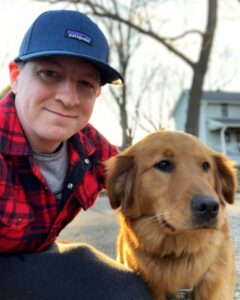

Leave a Reply