
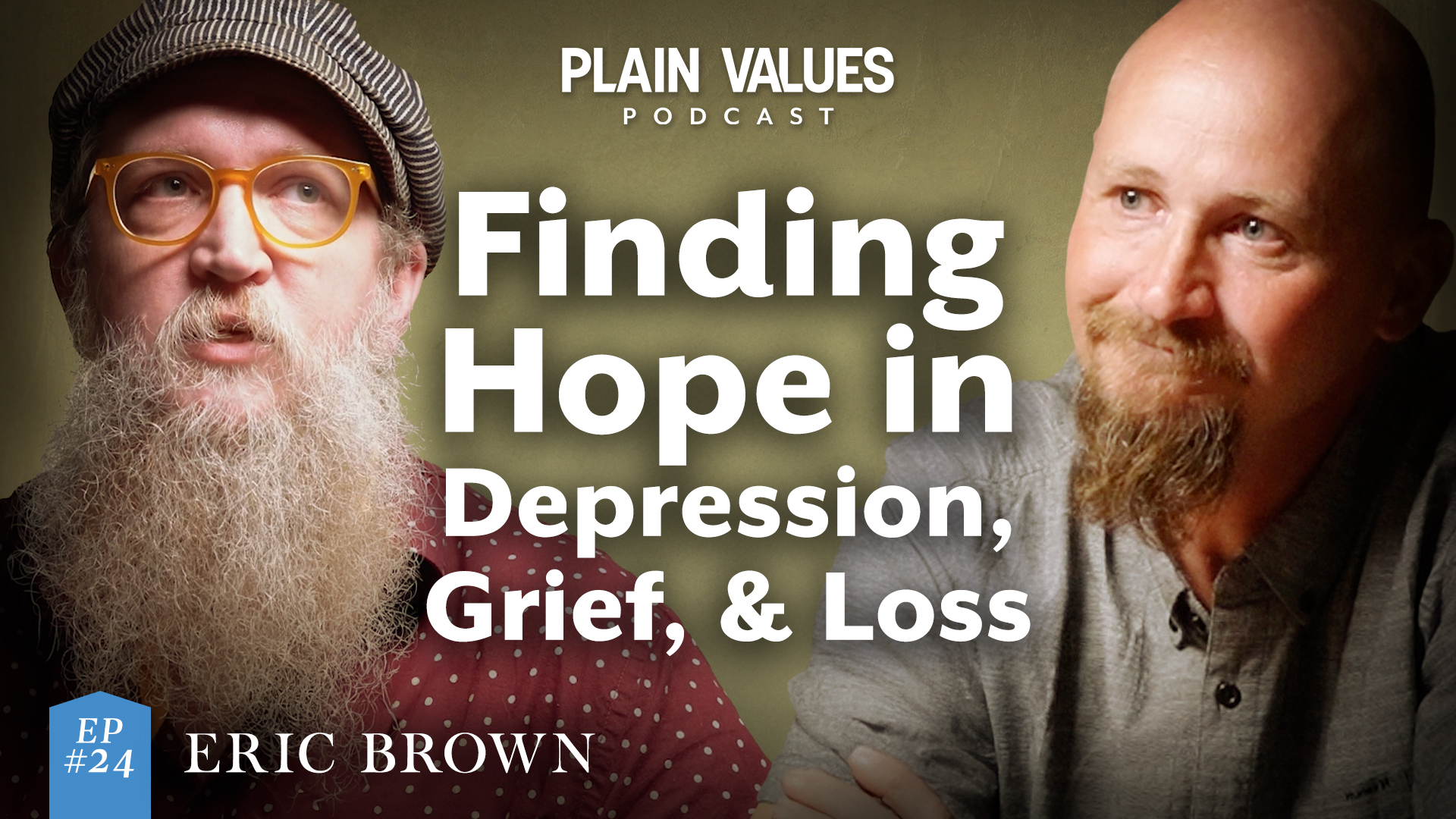
In this raw and unforgettable episode of The Plain Values Podcast, photographer Eric Brown opens his studio in rural Eastern NC and his life.
He talks with Marlin about his time in Nashville, family, and the six miraculous years with his daughter Pearl … born with holoprosencephaly, doctors called incompatible with life.
Eric shares the gut-punch diagnosis, the choice to welcome siblings into the room, the relentless care, and the beauty that flooded their home like Kodachrome.
Pearl’s death in 2018 left a void: his theology cracked, the darkness crept in, and alcohol numbed.
But in the end, Christ alone held everything together.
Learn more about Eric Brown at https://www.ericbrownphoto.com/
Learn more about Plain Values at https://plainvalues.com.
Transcripts
0:00 – Intro
2:04 – Moving Back to North Carolina
4:21 – The Skate Park: Misfit Toys & Community
10:43 – Pearl’s Diagnosis: “Not Compatible with Life”
17:22 – Including the Siblings in Pearl’s Life
22:38 – Cupcake Friday: Celebrating Every Week
32:31 – “Theology Failed Me, But Christ Didn’t”
36:28 – You Can’t Unsee How Bad It Can Get
40:37 – The Effects of Grief
47:10 – Sustaining a Marriage Through Tragedy
49:23 – A Master Class in Church Care
54:19 – “It’ll Do”: A Book About Finding Home
1:01:44 – The Darkest Days & Numbing the Pain
1:08:33 – Friends That Stay and Friends That Leave
1:14:26 – AI Perspective
1:20:22 – Final Thoughts: The Promise of Heaven
Eric Brown:
We went to the 20 week ultrasound and we found out she had a diagnosis that they deemed not compatible with life. They had told us that if she does make it through delivery alive to prepare for moments with her because we’re a split second away from all bad things becoming untrue in the grand scheme of things. It’s a split second.
Marlin Miller:
Can you talk about some of your darkest days? Sure.
Eric Brown and his family have been through a hard road. They buried their daughter pearl a few years ago. She was only six, and we had a wonderfully raw and hard and yet very hopeful conversation. If you’re struggling with grief or pain or depression, this conversation, it could be a real blessing for you. Just know that it gets pretty real and pretty hard. Please meet my friend Eric Brown. This podcast is sponsored by my friends at Azure Standard. A while back I had a chance to sit down with the founder David Stelzer, right here at the table, and we had a great conversation. I love the Azure story. They started out as farmers back in the seventies and I think in 1987 they began a nationwide food distribution company. And guys, they are non GMO organic. They do it right, they do it so well. And you can get a truck to drop food right in your town. Check ’em ou*@***********rd.com and tell ’em Marlon and plain values sent you. So hold,
Eric Brown:
Tell us where
Marlin Miller:
We are.
Eric Brown:
We are in my studio in Eastern North Carolina, rural Eastern North Carolina. Yeah. I have half this building for photography work and the other side, my son does woodworking on.
Marlin Miller:
Yeah. So can we go all the way back? Where were you born? Where did you grow up?
Eric Brown:
I grew up here in this town and, well, I was raised here. I think I grew up in Nashville, Tennessee, and we were there for almost 20 years and then we were part of the Great Pandemic migration and moved back here and trying to figure it out.
Marlin Miller:
Wait, you moved from Nashville back here. Tell me about that. I kind of was thinking that was going to be the other way around.
Eric Brown:
Say that differently.
Marlin Miller:
Okay. A lot of people after the lockdowns and after the pandemic started and in those years after a lot of people have been moving to Tennessee, you moved out of Tennessee.
Eric Brown:
Give us time. Who might go back?
Marlin Miller:
You’re totally hoping to go back. Okay, got it.
Eric Brown:
I wouldn’t say totally hoping. It has been hard to restart here. The world has changed so much in the last decade and we’re still giving it a shot here to try to restart.
Marlin Miller:
Can you tell me about your family?
Eric Brown:
Sure.
Marlin Miller:
Ruth, and you are married for how long?
Eric Brown:
20 years.
Marlin Miller:
20 years. Very nice. How’d you guys meet?
Eric Brown:
We met in Nashville, Tennessee waiting tables on, there’s a riverboat cruise called the General Jackson, and we were waiting tables there and she had really good taste in men and here
Marlin Miller:
I love it. So, okay, your oldest son, actually your only son, right? One son, two daughters. Your son is something of an amazing craftsman.
Eric Brown:
He is. Yeah. That was part of us moving back here. He was frustrated with how the move had worked and decided he was either going to go crazy or get himself busy. And so he started teaching himself woodwork. And we didn’t have this space when he first started. And he would sit out in the driveway for hours on end with sandpaper and wood because he didn’t have saws or anything like that and just started shaping stuff
Marlin Miller:
Really.
Eric Brown:
And the more we watched his grit and determination, the more we fed into making things more accessible.
Marlin Miller:
Now he ended up making skateboards for a long time, for a while. Was he also a skater?
Eric Brown:
He had started to skate, but he found more enjoyment from building it. But then he started to find his people out at the skate park. The skate park’s interesting. But if you’re not familiar with that world, it feels like such a gnarly punk rock group of guys. And they are, but it’s also been where he and us have found some of the sweetest human connection because everyone was welcome at the skate park.
Marlin Miller:
So hold on that. Sorry.
Eric Brown:
You’re okay.
Marlin Miller:
I told you that I grew up skating and snowboarding. Did you two?
Eric Brown:
No, you did
Marlin Miller:
Not.
Eric Brown:
Uhuh Ruth and I tried it because when your son is doing something, you try to participate and he made us each skateboards and we tried it and we’re just too old and fragile. Man. I wish I had gotten the bug. I’ve still got the board that he made me.
Marlin Miller:
But you would literally go and hang out at the skate park. And it sounds like you made some friendships with kids that were there actually hanging out to skate.
Eric Brown:
I’m an artist and I feel like the skate world and the arts world has this thing in common where we’re all a bunch of misfit toys and misfit toys seemed to find one another and find ways to connect and welcome and accept. It was so odd. It was very odd. The welcome that we received out there.
Marlin Miller:
I’m not totally surprised. So just a quick story. One of our best friends during the years that my brother and I were skating hardcore all the time was a guy named Jeremy. And we ran into Jeremy in a barn in Amish country that happened to have about an eight or nine foot vert pipe.
Eric Brown:
Awesome.
Marlin Miller:
It was great. And the very first night that Merle and I went there, there was this kid just ripping it up. I mean, he was pushing six feet out of the pipe. He was cranking good heirs, and he was really, really, he was the best kid there by a mile. And I remember Merle and I were talking and we both said, man, we got to get to know that guy. He’s got to be so such a cool guy, yada yada. And I think I’m the one that said, there’s probably no chance he’s going to pay attention to us. He probably has tons of friends. We got to talking and we became such good friends. He didn’t have any friends. He didn’t have any friends, Eric. It blew my mind. He was as lonely and goofball ish as we were. And we ended up moving to Colorado together.
Eric Brown:
I love it.
Marlin Miller:
And shared a six by eight little dorm room on the mountain. And it just taught me to try hard to not to judge that book by the cover because man, it blew my mind. It just blew my mind.
Eric Brown:
And he didn’t judge the book by the cover either. That’s what I found at the skate park. I’m a middle-aged guy. I’m not cool. My wardrobe comes from the clearance racket, TJ Maxx. I’m as plain as they come. They didn’t care. No one at the skate park cared. If you wanted to sit there and have a conversation with them, they wanted to have one with you. It is really lovely. And there’s so many lessons for the church there a bazillion lessons on how to be a welcoming presence.
Marlin Miller:
It’s pretty incredible at a skateboard park. That’s pretty cool. So tell me about your daughters.
Eric Brown:
Abigail is 15, she just started at the community college this year. She is a fantastic writer. She did all the texts for the article that you guys had done about Brennan’s guitar bill. They had collaborated. She interviewed him for it. And if there’s any good text there, it’s because Abigail did it. So she spends her days writing, spends her evenings doing theater. She’s going to be a misfit toy just like her old man and her older brother and it’s fantastic.
Marlin Miller:
So they are how old now?
Eric Brown:
15 and 17.
Marlin Miller:
15 and 17. And then your youngest daughter
Eric Brown:
Pearl.
Marlin Miller:
Pearl was born when?
Eric Brown:
2012.
Marlin Miller:
Okay. 2012.
Eric Brown:
Can you tell me her
Marlin Miller:
Story?
Eric Brown:
Sure. When we were pregnant with her, we went to the 20 week ultrasound and we found out she had a diagnosis that they deemed not compatible with life and wanted us to go ahead and terminate that day.
Marlin Miller:
They wanted you to terminate that very
Eric Brown:
Day? Yeah, there was
Marlin Miller:
Wow.
Eric Brown:
So much discussion in the medical community about this. And there’s a lot of shade that gets tossed on the medical community by the pro-life movement. We didn’t encounter that at any other point other than that one day. So I want to make that clear. But yeah, that guy, that particular doctor, if you were to make a propaganda movie and you needed the evil doctor to push abortion on you, he was straight out of casting. He was the guy, but everyone we encountered was not that. And I don’t know what kind of day that guy had. Maybe he and his wife argued at breakfast and maybe his mom’s sick and maybe he’s had a child with a condition not compatible with life. I don’t know his story, but that was a bad day. But she lived almost six years. She passed in 2018 and those years were the richest years I think anybody could ever want out of life. So much so that honestly, everything kind of feels black and white since she’s gone because it wasn’t just her that was gone. It was everything that she brought into life and her community. And
Marlin Miller:
So when you say that those were the richest, they were the richest years, how do you mean that?
Eric Brown:
I mean, we had a miracle living in her home, a miracle that required 24 7 very attentive care. There was no break from caring for her. And so we were on all the time and paying attention all the time and had front row seats to this beautiful orchestration that the hand of God was bestowing upon us in our home. Can I ask what she had? She had a condition called pro cephalic. So in utero her brain did not split into two spheres. It was one hollow sphere at the top of her brainstem and it affects all midline development, but it also means she never spoke or engaged in any way that anybody else would recognize as meaningful. We recognize things because we were attentive 24 7 with her.
Marlin Miller:
So the doctor said it’s not compatible with life. She lived six years. What is the average lifespan of a child that has that?
Eric Brown:
I don’t know. And I know that a lot of that stuff changes and holo pros, Celi is a spectrum. There’s a top Hollywood actor that everybody would know his name if I were to tell you, but he has the same condition. It’s just on the mildest extreme of it. Some kids don’t make it to birth. Some become teenagers, some grow into adulthood. It just varies so much. Okay.
Marlin Miller:
So for you and Ruth to see what goes through your mind when you see your daughter for the very first time now, you knew that she had this prior obviously, so I mean there was a little bit of a time to try to process. Yeah. Was there a grieving process inside that?
Eric Brown:
Yeah, they had told us that if she does make it through delivery alive to prepare for moments
With her, there was no talk of, if she lives
Marlin Miller:
For a week or a month, they assumed she would not live more than a day.
Eric Brown:
So I remember even driving to Vanderbilt with Ruth to induce labor. Things had gotten bad and they needed to induce. And I remember being on 65 and I did not want to take that Vanderbilt exit because at that moment she was safe. She was alive always right as it could be in the situation. And I just wanted to drive to the coast. I wanted to keep going all the way to the gulf, but we had to take the exit and had to do this. And so you’re just thinking this whole time that if we get a chance to say hello at all, then goodbye is going to follow immediately. And even cutting the cord, you’re cutting the very thing that’s keeping your daughter alive. And as far as we all knew, she was not going to be equipped to survive past that. And you still have to cut that cord.
Marlin Miller:
Yeah. How open were you guys with your two other?
Eric Brown:
Very open,
Marlin Miller:
Very open,
Eric Brown:
Very open. The doctors had advised us, even most of my family advised us to not bring them in to meet her based on the ultrasounds. Her appearance was going to be much different than it was.
And they all told us, during your hardest moment in life, your older kids are going to run out of this room screaming and disappear down the hospital hall and you’re creating chaos and you’re inviting all of this onto yourself. And if you just would decide now to not have them be present, you could alleviate all that. But we don’t hide image bearers from image bearers. That seemed ridiculous to me. And she’s not less than her siblings. God didn’t take his hand away and an accident happened. He had lovingly created her in the same way. He had lovingly created her sister and her brother, and it seemed countered to all of that to operate in any different way. And so as soon as she was born, they came into the room and it was really lovely. Really, really lovely. Wow.
Marlin Miller:
How did Brandon and Abigail, it is Brandon, right?
Eric Brown:
Brennan,
Marlin Miller:
Brandon. I’m sorry.
Eric Brown:
That’s okay. He gets it from everybody.
Marlin Miller:
Yes. After Brendan Manning. Yes, I knew that. I knew that. I’m sorry. How did Brennan and Abigail handle those first couple
Eric Brown:
Weeks? Amazingly, they handled all those years incredibly. Even now, all these years later, her fingerprints are all over everything that they have become. And they can tell you that for sure. Yeah, she molded them, molded them through her.
Marlin Miller:
What do you think would’ve happened had you listened to everybody and said, Hey guys, just stay home.
Eric Brown:
I don’t know. I’ve never thought about that. Honestly, we never considered it, but they were brought in on everything. Even the morning that she passed, they were in the bed with her as she was passing.
Marlin Miller:
It makes me think of all the times and all the stories that I have heard of families that adopt and they will say things like, well, we want a very, very closed adoption and we are not going to talk about this stuff. And I’m only 48 and our oldest is now 21. But much like you and Ruth, we’ve never hidden anything from our kids. And I think I see it a bit like a rubber band that if I don’t tell the truth, they’re going to know that something is fishy or funky. They can feel it. And then I feel like it pulls that rubber band tight and then when they can go, they’re 18, then it shoots ’em out into the world with all these questions and all these things that they have to figure out. And instead of just laying that book wide open and saying, Hey, I don’t know exactly why the Lord did this or allowed this, but I’m here. Let’s talk about it. I think what you and Ruth did is absolutely just admirable to be able to just very openly say, Hey guys, here we go. We don’t know how this is going to go. I mean, you don’t know anything about how it’s going to go. Did you expect her to live? You had literally set your mind and your heart to this is going to be a day or two, maybe an hour.
And
Eric Brown:
It was either going to be a miraculous healing, full healing or it was going to be immediate death, and I did not think of a third way.
Marlin Miller:
So then what goes through your mind when you’re a week in? We celebrated her birthday a weekend. Are you kidding me?
Eric Brown:
Did you really? Wow. Yeah, that first Friday. No kidding. We bought cupcakes and it was Pearl’s birthday. And funny enough, that turned into every week for years we had Cupcake Friday and celebrated her birthday.
Marlin Miller:
She was born on a Friday.
Eric Brown:
Every Friday.
Marlin Miller:
Did the intensity of the situation ever go down a notch or two?
Eric Brown:
The logistical intensity increased, but it’s kind of like grief and that the shock wears off. So the intensity might not wear off, but you get better adjusted to the intensity. Does that make any sense?
Marlin Miller:
I’m not sure. I’m not sure that I can say that I can actually understand it, but I think I can imagine it.
Eric Brown:
You just start adjusting your expectations and
Adjusting
What you’re aiming for. And early on we decided that if we were going to do life with her, well, we were going to do very little else. And we were all on board with that. And so home life did revolve around her.
Marlin Miller:
How long was she and Vandy,
Eric Brown:
I mean, when she was first born? Not long.
Marlin Miller:
Not long.
Eric Brown:
Just a few days. And we went home on hospice care because again, we were all expecting that outcome and it just kept not happening. She kept fighting and we had always decided if she was going to fight, we were going to fight alongside of her.
And
When she seemed to be done fighting, we would stop fighting also. And so yeah, for all those years we were in the thick of it.
Marlin Miller:
So how far did you have to go to the hospital from your home?
Eric Brown:
Not far. We lived in Nashville. We lived in East Nashville for the first part of her life, and then the last couple of years we had moved north to Madison, which is just on the outskirts of town.
Marlin Miller:
Okay. You’re a photographer. So I will confess, I don’t remember how I learned of you. I don’t remember what I read or what book I was. I don’t remember. That’s okay. I’ve tried to think of it as we’re driving down here, I’ve tried to think back over how I learned of Eric Brown and I can’t remember, but I remember looking at your site and one of my favorite things to do is always the about page. That’s what I love to read up on and just learn about. And I came across your page about Pearl and the photos. They just stopped me dead in my tracks. And I’ve thought about this quite a bit. Did you must have known that you’re in this incredible spot to capture her life with your family, all of those things. What was that like to capture those moments, not knowing how much you would have?
Eric Brown:
I mean, originally I started it. A family member had called and was just inquiring is how life has been the last nine months. I didn’t know what to tell him because so much was always happening. And unless you were present for that, I could not explain it to you, especially not in a 30 minute phone call. And so originally I started taking photos and sharing on social media just to do that, to kind of open the door to people that knew us and loved us. Like, Hey, here’s going on and here’s falling apart right now and here’s going well today. So I didn’t actually know in the midst of it how much I was capturing. It was just life
Marlin Miller:
Due. How do you see those photos now?
Eric Brown:
Most days? I can’t look at those photos.
Marlin Miller:
Really.
Eric Brown:
I miss it so much. It’s really hard for me to go back and look at those. Hopefully one day I get asked all the time about doing a book of her life and anytime I’ve attempted it or even started down that rabbit hole and I quickly go dark and I don’t know how you can I possibly ever end up with the finished book that I would be satisfied with of like, Hey, this tells the story of life with Pearl. I don’t think I could ever hit that.
Marlin Miller:
Does that sound crazy? No, I don’t think it does. I have a few friends who have buried their children and no, it doesn’t sound crazy at all. I, a pastor friend of mine whose name is also Marlon, buried his son years ago, he drove his motorcycle into a moose in Alaska and was gone and I think Ryan was 28, I think it’s 11 or 12 years ago. And the two Marlins will go for coffee usually once or twice a month, often. And we talk about Ryan a lot and it is not uncommon for him to tear up and cry a bit still today. And so the idea of putting together a book like it’ll do about your daughter who’s now, yeah, I don’t do that. Yeah. How do you do that? I cannot
Eric Brown:
Imagine and I don’t feel the need to most of the time now because we’re a split second away from all bad things becoming untrue in the grand scheme of things. It’s a split second and all of a sudden there was no merit to that book. Anyway, we’re here. That’s a comfort to me.
Marlin Miller:
So when my dad died, my uncle told me, I forget how Jonas and I got to talking about this, but he said something that I’ve never forgotten. He said, he said, there’s a bit you think about the whole thing of a year or a thousand years is as a day and a day is as a thousand years and all that stuff. And Jonas said something to the effect of he sees it as though pop is down a hallway on the other side of that door just inside that
Eric Brown:
Room.
Marlin Miller:
And he knows that we’re coming around the corner in just a second. In just a bit. That’s right. And I thought, wow, that’s, that’s a really cool way to look at it.
Eric Brown:
We use the words around this stuff so frequently that they can lose their actual meaning. But the idea is revolutionary. If you can sit with that and let your head go there and let your heart go there, and maybe it’s coping for me. If it is, I don’t care. I still think it’s true.
Marlin Miller:
It surely
Eric Brown:
Doesn’t
Marlin Miller:
Matter.
Eric Brown:
It doesn’t matter.
Marlin Miller:
It does not matter.
Eric Brown:
And it’s just really sweet to think about through all of life’s trials, through all of life’s uncertainties and the brokenness we’re so close, there’s just that veil.
Marlin Miller:
So Pearl passed in 2018, how was life after she was gone trying to
Eric Brown:
Adjust? How is life after she’s gone? Maybe I wasn’t prepared for any of this. I had very robust theology, very robust view of guide, read all the great books and listened to all the great pastors. And honestly, I was concerned that Ruth was going to be the one that never came back from it because that’s what I had been warned of, that like, Hey, there’s a chance that Ruth is going to go dark and sometimes when people go dark, they don’t come back from that. And so I was completely floored when my theology failed me. The books failed me.
The only part of the faith that did not fail me was Christ himself. Everything else failed me because I had leaned on that stuff and I had had this self-assured view that proper thinking and proper perspective was going to get me through man when she was gone. I had such a twisted view of God. All that stuff failed me. He did not. He not He sustained still sustains full disclosure. I still have days that I really, really, really struggle to just get out of bed and put my feet on the floor and we’re several years into her passing, but when she died, that version of me died too, and no one gave me the heads up that that was coming
Marlin Miller:
Really
Eric Brown:
Either. That’s very normal.
Marlin Miller:
When you say that version of you, does that mean that chunk of Eric that includes all the intensities, all the fears, all the, Hey, is this okay or is that on a much deeper level of how you see the world and how you see God and what do you actually mean when you say that version of me?
Eric Brown:
The one who could go through life with more hope in the here and the now? It’s a big part of that.
Okay.
The particular grief of losing a child, my understanding is it’s one of the heaviest things a human being can experience. I’m not going to argue with that. I’m not going to say that other people aren’t going through the deepest of depths that haven’t gone through this. I can’t say that, but all my perspective was you can’t unsee how bad it can get. And when you’ve seen how bad it can get and experienced how bad it can get, that is now your threshold. Where before that, oh, as bad as it can get is I might have a kid who’s not healthy. That doesn’t even measure on my scale anymore. That just seems like a normal human thing to go through. And I bet people a hundred years ago would say, yeah, so is bearing a child. We live in a different age. Humanity has always buried children, so it’s not a new thing that we’ve gone through. Does that make sense?
Marlin Miller:
Well, I think it does.
Eric Brown:
When we first got the diagnosis, I heard from a lady that I had gone to church with as a kid here. The only time I heard from her in the last 35 years, she had had a child with the exact same condition as Pearl. The doctors took her child and let the child pass in the other room and she never got to meet her child. That just shows you what was normal then versus what is normal now.
Marlin Miller:
And she called to tell you about that situation
Eric Brown:
Because everybody, we all with our griefs, if we can spread them out on more shoulders, then all of a sudden it gets a little bit easier to bear. And so we all do that. There was plenty of people at her funeral who wanted to talk to me about their own child loss and it seems so inappropriate at the moment and now I 100% totally get it. I hopefully would filter myself knowing what it’s like be on the receiving end of that. There’s so much hurt and we’re all looking like, please, can you take a little bit of this from me and put it in your backpack? Mine is too heavy. If you do that with enough people, it gets a little bit lighter.
Marlin Miller:
This episode of the Plain Values Podcast is being brought to you by my friends at Kentucky Lumber. Derek and I were talking this morning and he shared a story about how they like to do business and they like to do business with people that are like them and they like to be treated in a way that they treat their own customers. He told me about a customer of theirs that he had to fire. This was not going the way that it typically does. This guy was not being happy with anything that they did and nothing was good enough. And finally Derek said, you know what? You’ve disrespected my team enough and I think we’re done so you can go find your lumber someplace else.
The attitude and the heart behind the way that Derek sees the world is exactly the way that I see the world. And I have a hunch, you might as well if you call Kentucky Lumber, just know that they might fire you if you treat them poorly. I’m kidding. Of course. But they will treat you with the utmost respect because it’s how they want to be treated, and I think there’s a golden rule thing in there somewhere. But if you need anything at all to do with any lumber, wood flooring, wood siding, any type of wood product that has character just baked into it and a great team to match, call my friends at Kentucky Lumber. You can find th**@***********rs.com. How has your view of the world and the church changed? Have you just become so and forgive me,
Eric Brown:
We can talk about any of this.
Marlin Miller:
I think I would just become really, really cynical and mean.
Eric Brown:
Oh yeah. Yep. Condescending. Judgmental. I don’t care. Yep,
Marlin Miller:
I don’t care.
Eric Brown:
Yep.
Marlin Miller:
Wow.
Eric Brown:
That’s the kind of ways that you change that you never saw coming. When I saw myself turning into that guy, I am still that guy. I’m a little bit better at fighting it or maybe hiding it most days, but I’m still that guy. When it first started happening to me, I just wanted to make a t-shirt that says, I did not mean to turn out this way because I was changing in these crazy ways and I felt like I had no say so in what was happening to me.
Marlin Miller:
You didn’t even realize it. You didn’t even realize it.
Eric Brown:
No, I knew You knew. Yeah, I knew because all of a sudden I turned into the guy with road rage. I had the family in the car. We were at the dumpster.
Marlin Miller:
I’m sorry to
Eric Brown:
Laugh. No, we were at the dumpster taking the trash out and the dude in front of me had done something that crossed me and I got out of the car ready to fight this guy. I’m a pacifist, I’m a pacifist, and all of a sudden I saw red with my kids in the car with my wife and Ruth is just like, Eric, get back in the car, get back in the car. For whatever reason, I did actually get back in the car. I’m sure he would’ve cleaned my clock. I have never been that guy. Now all of a sudden I understand road rage and so there’s grace when I see road rage because what you’re dealing with is people whose lives are out of their control and when they get behind the wheel, they’re king of this little teeny tiny mountain, but they’re king and they’re going to have their say so and so. Now I understand it’s not just people being bros, like hurting people everywhere are trying to get some sense of control
Marlin Miller:
And they’re just trying to make it,
Eric Brown:
Make it, man, shoot. That sounds so awful. I know, I do. I don’t care. It’s just me. You can edit all this stuff down if you
Marlin Miller:
Need to. No, I don’t know. I mean, we’ve talked about this. There’s a part of me, there’s a part of me that has had the thought that with the way that the world is and the way that the world is going and all of these things, I have had the thought maybe it would be good if I could bury our kids because I don’t know what life would be like for them after we’re gone. And then at the exact incident that I have that thought, then it is, it’s an embarrassment. It’s a shameful thing to think about actually wishing something like that because I know that I don’t want that. Of course not. I don’t know what to do with it. I don’t know what to do with it because kids with Down syndrome are being eradicated so crazy. I don’t have to wonder what the medical establishment thinks or what they would want to do if they would get a chance. I know what they’re going to do and so I can understand it, but I don’t want that. I want them to live. But then like you said, why are we trying to hang on to this? It’s a crap hole. There’s so many balances and tensions and everything that I am not that bright. I don’t know.
Eric Brown:
Christ covers all that too though, right? He does. He’s not caught off guard by those dark thoughts. He’s not like, whoa, I had no idea Marlon was capable of that thought. I don’t know what to do with this. He’s already done with it what he needed to do with it. So yeah, we repent and get on with our day man and keep trying to
Marlin Miller:
Trust Eric, what happens when you meet another guy who has gone through the same thing or a version of that? Can you tell?
Eric Brown:
Not usually.
No,
But we’ve been so vocal about stuff, those guys find me and I’ll get those phone calls sometimes.
Yeah.
When I got very public about alcohol and darkness and all of these things, after Pearl passed, I started getting the calls of, Hey, well mine was alcohol, but it was this and it wasn’t this, but it was this. And again, it was just hurting people, looking for connection, encouragement. Because the only stories that ever go big are the ones that get tied up with the pretty bow. There’s never the stories of like, man, I’m still in the trench and Christ is still on the throne. It’s always after I’m out of the trench, after I’ve been sober for years and after I kicked that addiction and after I got out of jail. It’s always that. And so many of us are still living in the brokenness of these stories and desperately looking for Christ in there.
Marlin Miller:
How did you and Ruth survive as your marriage?
Eric Brown:
We were at a church called the Village Chapel in Nashville. Whenever we first got the diagnoses, we are still the people that prefer to be flies on the wall in whatever church we’re at. That has not changed. So we had just been flies on the wall there for the longest time and emailed through the contact us section of their website. We emailed the pastor and his wife and we’re like, Hey, you don’t know us. We don’t know you. We don’t know who else to tell, but I feel like you need to know about this diagnosis. And they’re like, please come see us on Saturday and we’re going to sit down. The very first thing they told us was the crazy high percentages of marriages that fail with these kinds of diagnosis.
That was the very first topic of discussion, was to give one another wide birth that none of us know how to do this stuff well. So remember that on the days when your spouse feels like a narcissist, feels oblivious to you, feels to be ignoring everything that you’re going through, remember that they don’t know what they’re doing either and watch out because your marriage is in dangerous territory with this. So we’ve had to think about that a lot. We have had our share of nights where we went to bed unresolved weeks, months where we’ve gone to bed with something unresolved.
Marlin Miller:
Did that pastor and his wife, did they walk a road like this that they had that kind of wisdom?
Eric Brown:
I don’t actually know, man. I should know that. That makes me want to find out because
Marlin Miller:
That’s pretty incredible.
Eric Brown:
And the way that church handled all things Pearl, I could write volumes of books.
Wow.
It was a masterclass
Really.
And here’s how you handled this absolute masterclass.
Marlin Miller:
So can you tell us about it?
Eric Brown:
I mean, it would take me hours. We were never alone or left to our own devices, any step of pearl’s life because we had moved, we had started going to a different church towards the end of her life and when she passed, I called the pastor at the Village Chapel just to say, can Pearl come home for the funeral? And I couldn’t even get the words out. And he was like, absolutely, absolutely. Like come home. And they threw out the welcome mat and just did everything beautifully. Even now there’s so many times when me and Brennan are talking about how to help people in certain situations and one of us will bring up something that somebody at the Village Chapel had done to shoulder some weight on our behalf.
It’s just incredible. They taught us so much. I never knew how to care for people until they cared for us for years. For years. When they eventually put a cooler outside of our house, we had so many hospital stays that they’re like, we’re not picking up the cooler. Just keep the cooler. And that way you got a permanent place where we can drop meals. For years, for years and anytime whoever was at the hospital was getting texts of, do you need a gut bomb for lunch or do you need something healthy? And then everybody at home was getting a different text. We walked in for her six month birthday, not thinking anybody even knows it is a six month birthday. Nobody marks that. And there was six balloons at the front of the church and we were offered. There was a couch up front and we’re offered to sit there on the couch and just be there with all her equipment.
Marlin Miller:
Where does that come from, Eric? I don’t know man. I’ve never heard a story like that. Literally. I have never heard that ever.
Eric Brown:
This is why her life was lived in the most vibrant coder chrome film you could ever imagine. And it was why it felt like the Lord had pulled the veil back and just been like, Hey, here’s just a little hint of what’s to come. And it was beauty piled on top of beauty and wow.
Marlin Miller:
Was it because you were more aware of his presence or was it that you were living like this micro slowed down version of that life?
Eric Brown:
I don’t know, man. I have no idea what it was. I’m just so thankful. But it makes everything else. When your bar has been set and you have seen what the kingdom of at its healthiest can do, it’s impossible to settle for less. So of course you become cynical when you’ve seen that. Not that this is an appropriate comparison, but imagine getting an hour in heaven and then coming back here and you’re back. Come on, are you kidding me? Are you kidding me? I have to settle for this now. I’ve seen, I’ve seen the beauty, I’ve seen the glory, I’ve seen the community and now this, are you kidding me? That’s why I’m doing the photography I’m doing now. It’s just constantly looking what is beautiful, what is beautiful because everything feels insanely ugly and gnarly all the time.
Marlin Miller:
So tell me about your book. Tell me about It’ll do.
Eric Brown:
It’ll do, started shooting it once we moved here again, literally as that pursuit of beauty and quiet and calm, it’s all Eastern North Carolina photos. Most of it was shot within two and a half hours of my front door. Some of it was shot in my backyard. Literally some of it was shot at the end of the street. Yeah, it’s a book about looking for home. Pearl was what I thought of as home for years, and I thought that was a healthy move on my part. And then when she went away, I felt homeless and I toured with a ton of different Nashville bands over the years and you travel the world with people and all of a sudden they start to feel like home for you and when the gig goes away, you start to feel homeless. And the village chapel was home for us for years and then when we moved north of town, felt homeless and then moving here thinking that I was coming home and when the relationships didn’t work out like you’re thinking, you feel homeless. And I started to see as I was looking at the work that this insatiable desire for home, it’s a good thing and it’s something God has put in our DNA, but I was giving a weight to the gifts that he had given that these gifts were never meant to bear. Pearl could not handle the weight of being my home. She was always going to go away.
And so the essay at the beginning, it eventually comes full circle with that of realizing that Christ is home. Everything else is a good gift from him that I need to properly order and hold with open hands because it’s all going to go away. Me, Ruth, Brendan, Abigail, at some point there’s only going to be one of us left unless we all forgo in a car accident or something. And if the other three of us have been home for that individual, then they’re going to feel homeless. So it’s about the insanity of that search. I can’t believe that I’m mid forties and I’m just now starting to scratch the surface of this. I feel like I should have known this since I was eight, but so it feels like a really elementary lesson to be learning in middle age, but I’m just learning it still.
Marlin Miller:
Do you feel like growing up in, I mean you’re a few young, lemme start over. You’re a few years younger than I am. You and I both grew up in 1980s and nineties in America, wonderfully blessed, both having a mom and a dad and a good family and growing up with this life story and a picture of what a good home is and what you just said about you feel like you should have known it since you were eight. I don’t know that I would agree. I don’t know that you could know it when you’re eight because having a mom and a dad, you’re learning what parenting and being a kid and being in a family and helping and participating and being a family, what it even means let alone on a much, much deeper spiritual level that only can come in my mind when you really grow up and you go back and think and look on it with all of this mileage and all this perspective and then go, wait a second. That is an unbelievable picture of our heavenly home, but there’s no way because I don’t think I’ve ever thought of that until you said that
Eric Brown:
Maybe middle age just keeps being filled with these moments of like, how did I miss that? Why did I not know that? Why did no one tell? I feel like middle age life for me and a dozen of my friends is just filled with these, what was I thinking? Moments?
Marlin Miller:
Yeah, I should have known better, should have known better. Why didn’t I see this
Eric Brown:
Before?
Marlin Miller:
It’s an incredible thing just down to all the triplicates father, son and kid and father, son and spirit and just all of those things, all those trilogies. And I just find it fascinating. Can you talk about some of your darkest days?
Eric Brown:
Sure. Yeah. And I should say I still deal with dark days, so I’m not speaking as someone who is on the other side. I’m in a better spot. It seemed to me as though my greatest fear had come true that when Pearl was gone, God himself was gone too. Because I always knew we were just a plain old normal family and I always knew that Pearl was exceptional. Even whatever his salvation deal with her, it’s exceptional.
None of us can really understand, but we can be confident that this girl who was never capable of a thoughtful sin against her creator has somehow been reconciled and somehow needed reconciliation with him. But it seemed as though he disappeared and the pain was intolerable and I couldn’t stop. I couldn’t stop hurting. I couldn’t stop what felt like my faith fallen between my fingers and no one could help me. I’d go see a therapist and he’s like, man, you really need to talk to your pastor about this. I’d go talk to a pastor and he’s like, I think you probably in therapy territory and you probably need to go. And so I finally found a pastor therapist that I to see at a Christian university in Nashville, had our meeting, gave him that check, and by the time I had gotten back to the house, he had sent me a photo of my check torn up and he just said, I hope you find what you need, and I’m sorry I can’t be the guy
Marlin Miller:
Really
Eric Brown:
That can help you. Evan Williams helped me, not in a good way, but I got hold of that Evan Williams white label and I found that it was quite effective at turning myself off in the evenings and it spiraled from there.
Marlin Miller:
Was it, it simply provided a bit of a respite.
Eric Brown:
It did, and it was very, very effective. I haven’t had a drink in almost two years, but even I had about what the darkness a few days ago, and I was telling Ruth like, man, don’t worry. I’m not going to do this, but this is what the Evan Williams used to do. I could turn this off and all of a sudden the insanity happening in my brain and in my soul and my heart, it would just stop. I was turning off the switches and I could just sleep,
But that’s such a slippery slope and it didn’t take me anywhere good. What made me finally stop was I knew I needed to see a doctor about this stuff and I was like, well, let me start with there were any doctors going to start? So I cut back my caffeine, I cut out alcohol, I started drinking more water and I started doing all the things that a doctor was going to be like, Hey, tell me about your caffeine intake. Tell me do you have any alcohol? And yeah, I figured I’d save a little bit of money on that first appointment by talking about something else. So I can just check all those things
Marlin Miller:
Off. Yeah. So do you feel like in a way everybody is trying to bury the pain and fill the hole, not to beat on an audio adrenaline song, gods shaped hole, like whatever that was, sex and drinking and drugs and all that. It sure seems like they’re trying to fill the need.
Eric Brown:
There’s
Marlin Miller:
Been
Eric Brown:
An interesting conversation in recent weeks about the lack of alcohol use in the country and even in spite of what seems to be the case, the use of cannabis is actually seeming to go down at the moment. But these are our addictions and this is where we’re getting the hits of something that feels a little bit different than the mundane or the darkness or whatever is eating away at you. It’s still the same thing. Just like dads who would call me after I started talking a little bit more publicly about alcohol and they would say, Hey, alcohol is not my thing, but this is my thing or this is my thing. Just a bunch of broken humans trying to get home and trying to hurt a little bit less.
Marlin Miller:
I mean, before we started, you told me about the calls that you get and how you try to answer has, this is a really dumb question, but have you been able to maintain that lack of speed in your life where, because called you a couple times and you’ll answer? Yeah, you answer the phone.
Eric Brown:
I like to talk to you
Marlin Miller:
And I think it’s interesting that often people that from the outset from my chair have not seemed to walk that many hard roads. They think everything is about them and they’re doing a million miles an hour. I’m just crazy busy. Oh, I’m just so crazy busy. And I love it when I meet a guy like you that seems to have a really good handle on this moment is all we have. This is it, and let’s live it. Let’s live it to the fool
Eric Brown:
And live it to the fool. Doesn’t necessarily mean what Instagram will tell you. It means living it to the full, could literally just be sitting quiet next to your wife on the couch and you’re each reading a different book,
Marlin Miller:
But you’re together.
Eric Brown:
You’re together.
Yeah.
I do like to live slow. I will be honest and say, if you feel like you’re too busy and too much demand, bury a kid and get really weird and all of a sudden people will run from your life. They can’t handle
Marlin Miller:
It. Wait, wait, they run. It’s too much. They don’t want to deal with it. They can’t. None of us know how to do
Eric Brown:
This
Marlin Miller:
And they don’t know what to say.
Eric Brown:
Absolutely.
Marlin Miller:
It’s this massive amount of awkwardness and pain and hurt for
Eric Brown:
Most of us, for if you can choose levity or darkness, almost everybody’s going to opt for levity. I’m probably going to opt for darkness. The Lord has promised to be near the broken hearted so we can be sure to find him in the dark places.
Marlin Miller:
Why? Okay. Okay. And I’m sorry to jump in. What finish your thought
Eric Brown:
As we’ve been looking to connect with the church here? A thought I keep having is I need a church acquainted with sorrow and acquainted with grief. They’re going to be less busy, they’re going to be less boisterous, probably going to not have a good branding campaign. It’s going to be just a bunch of normal people.
I’m sorry to laugh. Yeah,
It’s going to be normal people who have seen a big God in the midst of hard circumstances, and that’s what I want and that’s the kind of person I want to be. It’s the kind of people I want to be around, but that’s not going to be most people. And that’s not a slight on most people. That’s just like, that’s a lot. And if you don’t have to do that and you have the ability to opt for levity, I didn’t have the ability because the crushing pain of losing my daughter also meant that the Eric who loved levity got buried and now we’ve got this different version. So it’s a lot. It’s a lot. And I don’t fault them now I have in the past when people started leaving, it felt like betrayal and it really hurt because I thought like, Hey, you taught me to need you, and I agreed to be taught and I learned well, to need you and I still need you and you’re gone. That was the lens I was processing through. Now more time has passed and I’m a little bit older. I just see do people need to get away from that heat of the kitchen? Sometimes
Just because I can’t leave doesn’t mean they’re not going to. It also means that that precious group of friends that have remained or so galvanized, deeply galvanized because they didn’t leave just like the Lord. He didn’t leave and everybody had good reasons to leave. I have been a mess at times in recent years.
Marlin Miller:
We have some friends who have adopted kids from some really, really dark places, and Stacey actually writes really, really well about those incredibly hard things and years and years and years ago she wrote a blog about being in an orphanage that, and I think the title of the post was, God Meets You In the Darkness, and she’s talking about this one wing of the orphanage that had, I forget exactly the words that were above the door, but it was basically referring to the kids that had special needs and in a medical triage situation, they were the ones that were not going to get any care. They were the ones that were just at the bottom of the barrel. And she tells a story about holding this kid and praying that she could just pass. And then all of the guilt and all of the emotions that come along with even thinking that, like we talked about before with this, it’s this massive ball of guilt and hope, and yet you don’t know what to do with it. And she basically made the point that even in those darkest moments that are hard for me to imagine and that you’ve lived in, he does not bail. He does not leave. And I think
Eric Brown:
To say it as one thing to experience it is such a deep, deep, deep comfort
Marlin Miller:
To know that that’s true. That that’s actually real. It has to be everything literally. It has to be everything. So I’m going to change gears. Alright. You’re a photographer. I’m a publisher. You and I both know that ai, we’ve talked about this, the bane of my existence. Oh my goodness. I mean just for the two seconds that it’ll take. I think in the realm of publishing, I think our Napster moment happened 10 years
Eric Brown:
Ago. Oh yeah.
Marlin Miller:
Eric, any dude in his mom’s basement can take AI and can generate a magazine.
Eric Brown:
You know what? Here’s my current thought. I wish we could treat it like fentanyl or morphine or one of these things that’s like, Hey, this is an incredible tool. It’s an incredible tool. We’re going to restrict it to be used here because in this circumstance it is so incredible for everything else, you’re not allowed. We’re not going to allow this to be used recreationally. We’re not going to allow this to be used in all these other ways. We use it in these institutional settings for this purpose. If it can cure cancer, that’s incredible. Let’s go do that. Everything that it seems to be doing right now, yeah, it’s bad for us and we’re running a hundred miles an hour after this. We are,
Marlin Miller:
And I don’t even think we’re stopping or pausing to wonder, should we be doing this right? The best single line in Jurassic Park. You know exactly what I’m talking about. Jeff Goldblum, you were so focused on if you could, you never stopped. And I know I’m butchering it, but
Eric Brown:
I know what you’re talking
Marlin Miller:
About. You never stop to think if you should.
Eric Brown:
I mean, even people are, but they’re still so enamored with not there. We’re still so enamored with shiny new objects that we’re just kind of tipping our hat to the conversation if we should. In large part, there are some thinkers out there that are doing the good work. I just, I’m not hopeful that it’s going to change anything.
Marlin Miller:
Yeah. I’ve listened to some people talking about American companies being at the forefront of the AI thing, as if that’s going to be the answer to keeping it in the bottle. All of mankind is sinful. It doesn’t matter if it’s an American. That’s right. A guy from Taiwan or China, I mean, whatever. They’re all sinful. We are all sinful, and nobody is going to be able to do any better than the next guy Sky. What does it look like? So let’s go back to your time with the bands and all of those other guys. AI can’t do that. How would AI step into that role?
Eric Brown:
I mean, you can already write songs with it, right? There’s AI albums,
Marlin Miller:
Right? So the musicians, songwriters are in peril. I say that they have been
Eric Brown:
Since the Napster days. Nashville has been bleeding songwriters for years because it’s so hard to
Marlin Miller:
Compete. It’s interesting. I’ve heard so many people talking about, well, but Marlon AI can only do what it does with human input. That’s exactly how I look at it. I’m like, no, no. I get that angle of it, but I don’t buy it.
Eric Brown:
Here’s what makes me glad we finally have something as a society that we can divide on, that
Marlin Miller:
We can divide on.
Eric Brown:
After all these years of unity. We finally have something that we can all have difference of opinion and go in one camp or the other. Finally, that’s what makes me glad. Oh man, you’re hilarious. It’s just going to be another thing. It’s another thing where I can’t, I had a client the other day who was showing me a video that she had made with ai, and she thought it was the sweetest, funniest thing. I could not both be honest with her and keep this client at the same time. So I had to do whatever your politics are or whatever your COVID views are. There’s another one of these things where it’s like, okay, well I guess I’m just going to have to just be quiet, nod my head and say yes so that we can continue to work together.
Marlin Miller:
One thing that I think is a positive that is coming out of this whole thing, I hope, is that this right here will only grow stronger Sitting with a friend and talking face to face. AI doesn’t do that. Can’t, it’s not real. It’s not human.
Eric Brown:
But you man would’ve thought after all the COVID shutdowns that we would’ve already come to a place of valuing this more. But instead we came to a place where now we ghost people and we bail on plans because really we’d rather just sit at home with our phone and our TV screen anyway, because what we learned to love
During
The pandemic. So I’m not even hopeful about that.
I
Will always treasure this and I’ll always look for other people that treasure just human interaction.
Marlin Miller:
One of the many things that I long for in the promise of heaven to come is this right here. To sit there with the best cup of coffee imaginable or whatever, and there’s no clock, there’s no nothing. It’s just the sweetest communion imaginable.
Eric Brown:
Bellying up to the table and feasting on the goodness of God with one another. That will be good.
Marlin Miller:
Wow. Eric, thank you.
Eric Brown:
Thank you, Marlon.
Marlin Miller:
This is fantastic. I so appreciate it.
Eric Brown:
I appreciate it. Likewise, my friend.
Marlin Miller:
My wife loves Jill Winger’s, old fashioned on purpose planner, and this year’s is better than ever. It has all sorts of tabs from your gardens to your animals, to your meals, anything and everything that you can imagine that needs planning, Jill has built a spot for it in here. You can find th**@*************ng.com. Order yours today for 2026. So hold my in his book, Rembrandt is in the Wind, Russ Ramsey says that the Bible is the story of the God of the universe telling his people to care for the sojourner, the poor, the orphan and the widow, and it’s the story of his people struggling to find the humility to carry out that holy calling guys. That is what plain values is all about. If you got anything out of this podcast, you will probably love plain values in print. You can go to plain values.com to learn more and check it out. Please like, subscribe and leave us a review. Guys. Love y’all. Thanks so much.
Brought to you by …

🤝THIS EPISODE’S FEATURED SPONSOR: Azure Standard
Talk about a mission-oriented company; our friends at Azure Standard set the standard of excellence when it comes to sourcing nutritious food for your family.
They have a new program called “Around the Table” that nourishes by walking shoulder-to-shoulder with churches and church communities. It’s wonderful!
Learn more: https://www.azurearoundthetable.com/ from Plain Values’ mission to share the gospel amid infertility, adoption journeys, and special needs advocacy, this 194-page volume renews hope and affirms the beauty of simple, purposeful lives.

🤝THIS EPISODE’S FEATURED SPONSOR: The Old-Fashioned On Purpose Planner
Talk about a mission-oriented tool for homesteaders; my wife loves Jill Winger’s Old-Fashioned On Purpose Planner from Homestead Living … it sets the standard for organizing real life with wisdom and hard work.
The 2026 edition is better than ever, packed with tabs for gardens, animals, meals, food production trackers, habit builders, and goal-setting pages to tame the chaos and amplify your dreams.
Learn more: https://homesteadliving.com/the-old-fashioned-on-purpose-planner/

🤝THIS EPISODE’S FEATURED SPONSOR: Invited: Collection 001
If you’re craving stories that restore faith in hard times, Invited: Collection 001 is a handpicked “best of” from Plain Values magazine … uplifting accounts of triumph, simple joys, adoption beauty, homesteading wisdom, and gospel-centered living.
Born from Plain Values’ mission to share the gospel amid infertility, adoption journeys, and special needs advocacy, this 194-page volume renews hope and affirms the beauty of simple, purposeful lives.
Learn more: https://homesteadliving.com/invited-collection-001/








Leave a Reply