
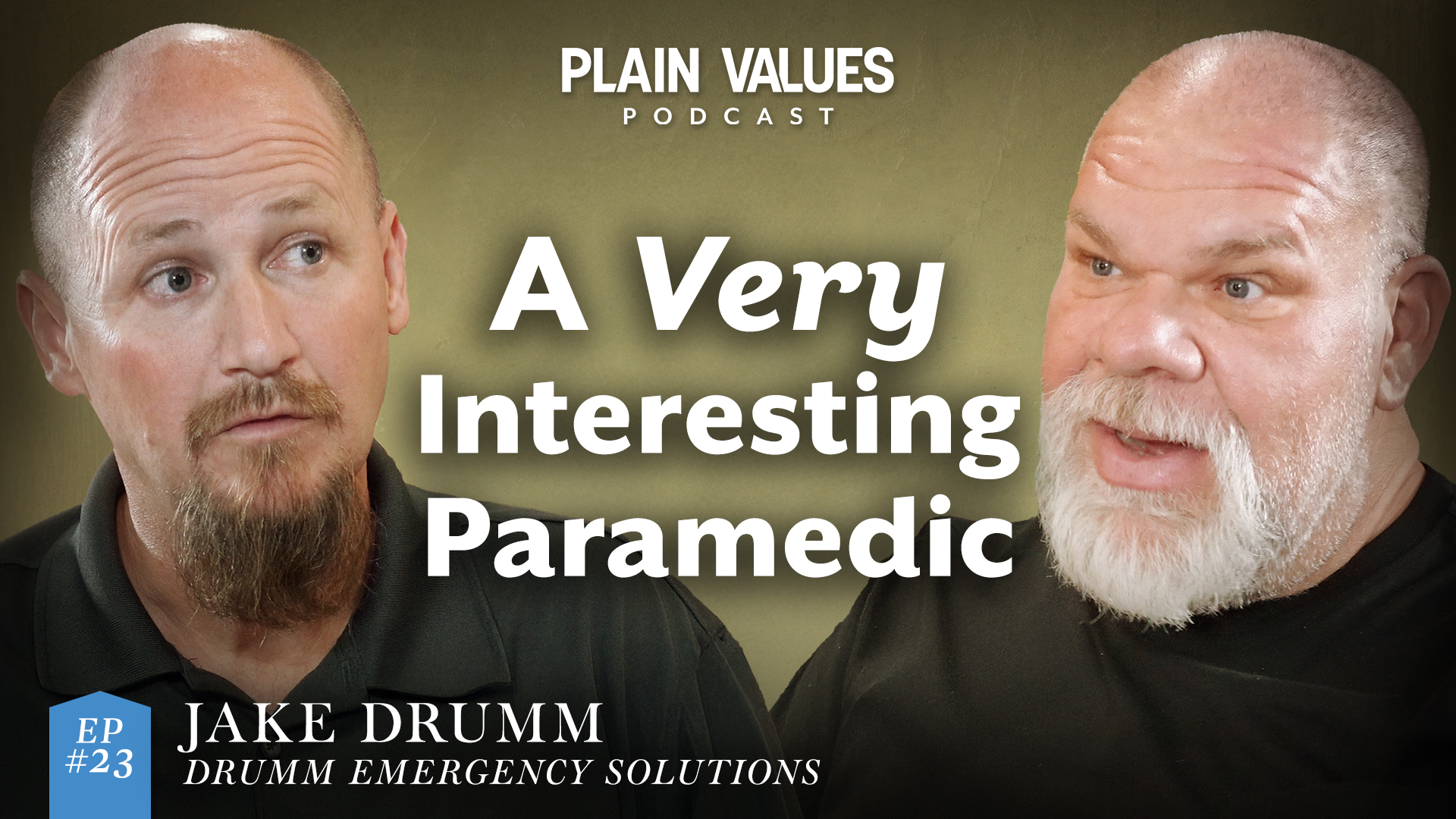
Jake Drumm, a longtime paramedic now running Drumm Emergency Solutions and managing Watauga Flats Farm in East Tennessee, sat down for a raw, beautiful conversation.
He shares stories from the ambulance that’ll make you hug your people tighter … about the ghosts that linger from years of witnessing grief, the burnout, and how true healing comes from community, not isolation.
And then there’s the farm … regenerative practices breathing life back into the land.
This episode is for every one of us walking this path, balancing family, land, and the call to care for others. Jake’s honesty about regrets, direction, and trusting God’s leading … it’s the encouragement we all need some days.
Learn more about Jake Drumm at https://www.drummemergencysolutions.com
Learn more about Plain Values at https://plainvalues.com.
Transcripts
0:00 – Intro
4:00 – Growing Up in Amish Country & Wanderlust
9:27 – Finding Soul Connections in Northern California
13:00 – Old School Politics, Patriotism & Environmentalism
28:50 – The Reality of Paramedic Work & Burnout
34:11 – Moving to Tennessee & Family Roots
40:23 – Old School Homesteading: “My Parents Were Hippies”
47:30 – Regenerating the Land: Dragonflies, Mushrooms & Life
1:01:53 – Drumm Emergency Solutions & The Psychology of Crisis
1:09:19 – Practical First Aid vs. Radical Prepping
1:21:36 – From Dead to Eating a Turkey Sandwich–
1:26:07 – The Ghosts That Haunt Us: Trauma & Memory
1:49:14 – How Can We Pray For You?
Jake Drumm:
You were 100% dead one hour ago, and now you are 100% eating a turkey sandwich. Like you can’t just go clear cut a forest and kill everything to build houses and be like, oh, it’s fine. No, it’s not freaking fine. It is not fine. I’ve seen dragonflies. We’ve had dragonfly hatches out there so thick that it looked like snow in the air when you look out across the pastures. Be careful what you dream for, right? You might just get it. You might just get it.
Marlin Miller:
Yesterday, I sat down with my friend Jake Drumm from Drums Emergency Solutions in Johnson City, Tennessee, and we had an almost two hour conversation. We talked about politics, we talked about the environment, we talked about his work as a paramedic and all … I mean, the man has done everything you can do from fixed wing to helo to ambulances, of course. He’s done it all. And today he’s transitioned away from the paramedic work and he’s managing a farm for a friend. And we just had a magnificent conversation about life and grief and some of the hardest things that he’s had to deal with and overcome. Some of the things that have haunted him over the years inside that paramedic work. And it was just a wonderful conversation with a dear friend of mine. If you’re dealing with regrets or things that haunt you from your past, this is a conversation that you will enjoy.
Thank you. This podcast is sponsored by my friends at Azure Standard. A while back, I had a chance to sit down with the founder, David Stelzer, right here at the table. And we had a great conversation. I love the Azure story. They started out as farmers back in the ’70s and I think in 1987, they began a nationwide food distribution company. And guys, they are non- GMO organic. They do it right. They do it so well. And you can get a truck to drop food right in your town. Check them out at Azurestandard.com and tell them Marlin and Plain Values sent you. Dude, thank you for coming. Thanks for making the trip.
Jake Drumm:
Thanks for having
Marlin Miller:
Me here. I’ve been looking forward to this for a long time. Did we meet the very first time at Rory’s or at the Homestead Festival in Virginia?
Jake Drumm:
I don’t know.
Marlin Miller:
I think it was the Homestead Festival at Rory’s, but I don’t remember. And I was thinking about that earlier and I was like …
Jake Drumm:
Yeah, arguably that’s probably accurate. And that was maybe the first one that HOA did with Rory, right?
Marlin Miller:
I think that’s right.
Jake Drumm:
Yeah. Was it in the winter? It wasn’t in the winter. So they had had one, and this was maybe the second one and it was spring and the wind was blown 800 miles an hour and it was dusty and hot and horrible.
Marlin Miller:
I remember. I remember. It was a brutal, nasty … Yeah, I
Jake Drumm:
Remember
Marlin Miller:
That.
Jake Drumm:
Not Rory’s fault. Just the weather was vindictive. Vindico.
Marlin Miller:
That’s a great way to put it.
Jake Drumm:
Yeah.
Marlin Miller:
So you and I, I believe we would’ve been there every year, which is, I think this would’ve been the third or fourth, the third. And somehow our booths have always been like-
Jake Drumm:
Every show we’ve been at, our booths are like touching.
Marlin Miller:
It’s pretty cool.
Jake Drumm:
Yeah.
Marlin Miller:
So yeah. Tell us about how you grew up. Where did you grow up?
Jake Drumm:
Indiana.
Marlin Miller:
What part of Indiana?
Jake Drumm:
Amish country. Elkhart County. Indiana. Yep. So I hate to call it all Amish country because it’s not true. But southern Elkhart County, but northern Indiana is heavy Amish country. Would argue having driven around your area, maybe heavier Amish country than here. So like the entire city of Napanee, for example, is basically an Amish town. And so we have all of those things, right? So Northern Indiana, it’s flat. We have corn, soybeans, and it was fine. I moved away when I was, I don’t know, 23-ish, something like that.
Marlin Miller:
Did you go to college after high school?
Jake Drumm:
No, no. I waited a long time to go to college till I had screaming kids and like two full-time jobs and bills to pay. I was like, you know.
Marlin Miller:
Let’s add some more.
Jake Drumm:
Let’s add some more. Why be easy?
Marlin Miller:
Did you serve in the military?
Jake Drumm:
I did not. So I looked at all of that stuff. I was one of those wanderlust people, which I blame my mom and dad for. So it’s probably the most interesting thing about me in my mind is that my mom and dad obviously got together, got married. My mom was probably pregnant with me when all of that happened. And so basically they got married the next day. My dad packed up their little Volkswagen and a little tiny trailer and they jumped in the car and drove to the Gulf Coast somewhere Central Florida Gulf Coast, which I don’t really know where. And they were down there for a few months. My mom got homesick. They turned around and came back right about the time I was born. And ever since then, I’ve just wanted to go everywhere all the time. All the time. All the time.
So blessing and a curse. So yeah, you ever heard of … A guy’s last name is Blanding. He was a writer and a poet and I’ll butcher the title of this poem, but there’s a poem out there, you can look it up. It’s like if only there were two of me or something like that, and it is like I’ve never read anything that more closely describes kind of that inner feeling of the … You hear people talk about this wonderlust thing, right? And so I think about all of the people we’re kind of friends with, familiar with, interact with, with homesteaders, and they’re looking for this permanent place. They’re going to settle down, stay there, have their kids, have their grandkids, have their great grandkids, be buried there for like 38 generations, right? Well, there’s this whole other population of people that are not that way.
And that poem kind of describes that, this idea that you have one of you that wants to be home and like establish that home and family and friends and community. And then this other, it’s the angel and the demon idea. Like you literally have this, depending on how you want to look at it, little demon or little angel on your shoulder being like, “Hey, what about here? And what about here? And what about
Marlin Miller:
Here?” Where’s that coming from? Where does that stem from? Is it the fear of missing out? Is it just this drive to see more?
Jake Drumm:
That’s a good question. And I’ve certainly spent a fair amount of time kind of researching that thought. For me, I grew up in Northern Indiana. All my family was there. I had traditional Northern Indiana, Midwestern childhood. My grandma lived on the river. I had tons of cousins. I had a brother. All the things. I mean, nothing exceptional.
So I had that kind of rooted childhood. But as mentioned, for some reason, I always wanted to go. And it’s not because I was trying to escape having a family or having like this rooted existence. Where we lived wasn’t the world’s best place. I mean, there wasn’t a lot there. If you want to work in a trailer factory and be laid off a third of the year, like for the rest of your life, it’s a great place to live, right? If you want to farm corn for Big Ag, it’s a great place to live. And I’m not throwing the place under the bus. There are great things there, but man, I just had to get out and go see things. So I don’t know why, but my first inclination was just to go as far away as possible to see what else was out there.
And so that’s what I did. And through my life, having done that many times now, I’ve not come to a conclusion of what drives that because I think a lot of people would think you’re running from something, and I’m not really running from anything. I always felt like I was running to something,
Which is much different.
And oddly, the first place that we moved, which was … I’d gone to paramedic school. There’s of course a whole three hour story about this, but the point is, I’ve gone to paramedic school, become a paramedic, had a firefighter paramedic job, was doing that thing. I found a job listed on the north coast of California, which geographically, arguably, is the farthest west that I could go. And I was like, “That’s the spot.” And so there’s a whole bunch to that story too, but that’s exactly what I did. And so that place that I went oddly became the place that nowadays I feel the most at home. So we just got back from there. I took kids out there a few weeks back. We go out every couple years and hang out at different trips and that’s where I feel homesick for now. And I mean, we’ve been in Tennessee for 20 years and Tennessee’s great, not throwing Tennessee under the bus.
Everybody wants to move to Tennessee, which believe me, they are doing. I
Marlin Miller:
Have heard.
Jake Drumm:
Yeah. It’s wild, man. But Northern California, to me, somehow, and believe me, the whole metaphysical thing escapes me, but for me, if there’s some metaphysical component, somehow my soul has some connection to extreme Northwest California.
Marlin Miller:
So that’s just south of Oregon.
Jake Drumm:
Literally just south.
Marlin Miller:
So what towns are close by there? Do you have a house out there?
Jake Drumm:
We never had a house. We just had rented, had townhouses. First town I lived in was Crescent City, which is, I mean, you can see Oregon from there, so that’s how close it is. Wow. Right on the ocean, very, very rural, rugged, like everything you would imagine like the wild Pacific Northwest to be. That’s what Crescent City is. Blue collar town, it’s done better over the years. We were just there. There’s a lot more money there than there used to be. When we lived there, there was not any money there, like fishing, logging,
And supporting kind of businesses. And then I’d worked there for a very short time, and then fate being what it is, somehow crossed paths with a guy who was working for the ambulance service, the next one down, which would have been the north end of Holmbolt County, had met him. He’s like, “Hey, we got a paramedic job down here. You should come down and check it out. ” And then that’s where we ended up. So I’d gone back to Indiana to get married. My wife then came out with me. She started in Crescent City very quickly. We moved down to Humboldt County. We lived in Arcada, which all of these little kind of pieces of story or a three hour story, like everything. But when I think about my childhood, growing up, we’re 90 miles east of Chicago. So it’s blue collar, it’s family values, like everything your magazine is about is where we came from.
And so we came from one of those interesting places in Northern, or not just Northern Indiana, but an interesting place in the Midwest, I guess, from a political standpoint where you had a very kind of deep Democrat voting body, very pro- union. And so I mean, I grew up a union kid. Most of my mom’s jobs that she had, she was a union employee. I mean, I was like running around a Teamster shirt, you know what I mean? The union was like the thing, but unlike today where you have this weird delineation, like if you’re going to have family values, you have to be part of this party. And if not, you’re part of this party. That was not the case. Deep, deep, deep conservative values, but like deep, deep, deep Democrat kind of voting.
Marlin Miller:
Like the old school Democrat.
Jake Drumm:
Old school Democrat, right? Yeah. So everything from social programs to like welfare, I guess a social program, but all of kind of the good things there that you consider, at least I consider them good, like helping your fellow man, those were like Democrat things then. Well, they’re not just Democrat things. There’s lots of people who are on the right who like that stuff too. Anyway, politics less crazy back then. But moved to Northern California and Arcata was about as wild and leftist and progressive and hippie and everything that you can imagine kind of in that genre to be. And then Arcada sits in a region or really the entire end of that state is deeply, deeply, deeply libertarian. And I mean, libertarian in the truest sense, like people out there, much like so much of my family’s from Appalachia. So being a kid, going to Appalachia and visiting, I remember these like deeply reserved, like private, serious, probably shouldn’t show up at their house at night and open the door kind of people because they’ll kill you and bury you in the graveyard with everybody else.
However, if you’re cold, if you’re hungry, if your car is broke down, we’ll drop what they are doing
Regardless of what it is and help you.
Marlin Miller:
And they’re there.
Jake Drumm:
And they’re there, period. And so Humboldt County is that. And it was obviously deeply Native American before settlers showed up and then heavy kind of Catholic, Portuguese, Spanish population, very familial populations. And even the Native American tribes out there are very familial. And then as it was settled by others, that kind of idea continued. And so you had massive influx of Vietnam vets kind of escaping. That madness went out there, hippie generation embraced it because it’s just the wild west. You could go out there and just be you. You could find a little square of property and like build yourself a little cabin and like let your kids run around naked in the woods and like grow your own food. Nobody screwed with you, right? Yeah. I mean, the way America is supposed to be.
Marlin Miller:
When did you move out there?
Jake Drumm:
That was 2001.
Marlin Miller:
01.
Jake Drumm:
Yeah. No, that’s wrong. Yes, that’s right. September. So I moved out there February of 2001. It was crazy. And then nine eleven happened and even there things changed for the better initially.
Marlin Miller:
Moving to the right, like as far as being conservative, patriotic?
Jake Drumm:
Patriotic. So I am not the guy who will call the progressive-minded people out there not patriotic because quite honestly, some of the most leftist people I know out there who I’m friends with are deeply, deeply patriotic. And that I think you and I both know we could sit here and like rail on the media for like the next three months. All that’s propaganda, right? You can be a crazy, like legit, crazy leftist and be deeply patriotic. And I have those people as friends,
Right? And you can be the other side and be deeply patriotic. But that patriotism kind of congealed, right? And everybody tells stories about the American flags. Well, out there, my most vivid memory of being out there was routinely seeing American flags being flown upside down. You have a lot of kind of anti-government sentiment out there. And so it never really mattered who the politicians were. It was always like, we are in peril. The US government is like wrong. And so we are going to make this statement. And so you saw a lot of upside down American flags. That being the kind of one time you can fly it and be like, “Hey, we’re in trouble over here. Things have gone wrong.” And that’s the sentiment out there and it continues to be the sentiment, of course.
Marlin Miller:
Still today?
Jake Drumm:
Oh, absolutely. Now those people are not less patriotic. Here is a great example. In Arcata, there is a baseball team, little semi-pro baseball team. It’s like AAA. I don’t even know if they have like 4A, but really it’s more like a 4A baseball team, but awesome, right? It’s Humboldt crabs. And so every time we’re out there, we go to a baseball game. Now, Arcada is still like, I mean, I can’t imagine honestly a much more kind of left place as a town center. These baseball games are packed, man. There’s a huge American flag flying over the baseball game. When they have a baseball game, everybody stands up and says a pledge of allegiance, right? And they sing the national anthem. Really? Like this happens there. And so you see on the news these places that’ll not do that. There is no national anthem and then fans in the stands are all pissed off and like they just sing it.
You see these videos of these places making that choice. That doesn’t happen there.
Marlin Miller:
While being on the left side of many, many most things. All things. Wow. All things. That
Jake Drumm:
Is wild. And so it’s a contradiction to what we are presented to be the truth of left and right.
Marlin Miller:
Yeah.
Jake Drumm:
And then like I said, that is like floating around like a little island in like an ocean of libertarianism, like for real. And the kind of community centric self-reliance that is Humboldt County is something to behold. So all of the
Marlin Miller:
Crazy, I mean, all of the wacky Gavin Newsom stuff, does it still impact the town and the county or have they kind of said, “No, no, we’re good. We’re not even going to really bring it in here.”
Jake Drumm:
I
Marlin Miller:
Mean, they’re part of California, right? I mean, it’s- Kind
Jake Drumm:
Of.
Marlin Miller:
Yeah.
Jake Drumm:
Kind of. They’re part. So for years there are other places. So Eastern Oregon, Eastern Washington has … A lot of those counties have had those ballot, whatever they call those things, a ballot proposal amendment. They’ve voted on seceding from those states to become part of Idaho.
Northern California has been talking that for a long time. So California, if you’re real rudimentary, you can divide it up into three kind of subsections, north, central, and south, but that’s not in any way true. So everything Mendocino County and North, which is the true Northern California, regardless of the fact that it says state of California, it is its own country. It’s not even its own state. And it is distinctly different than Oregon and distinctly different than the rest of California. And then the eastern side of that kind of geographical region of California is also its own place. Even though it’s still Northern California, it’s very conservative, deeply conservative. Look at the voting maps year over year over year, like you can’t find a blue vote. Then it’s high country, it’s ranchers, it’s farmers, it’s …
Marlin Miller:
That’s where I was going to go was I have heard and read about all the ranches in Northern California and I really have no idea where they are.
Jake Drumm:
And there are ranches all over the state, but when you see those kind of pockets of red on those California voting maps, generally those are ranch heavy areas. And it’s a complicated thing with California. I’m sure lots of people out there listen to Gavin talk to Sean Ryan.
Marlin Miller:
Yeah.
Jake Drumm:
It’s interesting. I align with this idea. I like the idea of Sean out there talking to everyone. Joe Rogan’s out there talking to everyone. We need to be hearing everyone’s point of view and it needs to be aired publicly. If for no other reason, there’s accountability. So you go on Joe Rogan and talk for four hours and like flap your gums and like make these statements about what you believe. Well, now it’s documented. And it’s not that you can’t change your mind, but the next day, if you go out and make some policy decision that is opposite of what you just said, you prove what many people believe.
That will happen with the interview with Gavin. And I don’t think Gavin’s a bad guy. I kind of like him personally, right? But I too look at policy decisions, look at laws, like I follow what’s going on in California closely. I love California. And I’m like, listen, what is happening is madness. They’ve destroyed much of everything. That’s correct. And here is where it gets real, real crazy. All of my crazy politics aside, I generally align, and I feel better about saying this because Joel is constantly talking about being kind of this radical environmentalist. I certainly have radical environmental views. And so if you want to put me on a political chart and be like, “He’s left, he’s right.” If I sat down and wrote out all the stuff I think environmentally, you’d be like, Jake is a crazy progressive. But there’s a reason for that that we are killing the entire place.
That’s what we’re doing. And we’ve been doing that for generations. So California decided because there’s not enough housing that they would completely shred their environmental protection laws. So for decades, California had the most stringent environmental protections in the … Their state environmental protections made the EPA look like a freaking joke.
Marlin Miller:
Like down to the little smelt in the harbors and all that.
Jake Drumm:
Yeah. They basically took those laws, which were initially passed by left leaning, progressive lawmakers, people who were like, “Look at what they did to the redwood forest.” The Sierra Club and- Right. Look at what we’ve done to the fisheries. Look at what we’ve done to the rivers. Look at what we’ve done to this quite literal Eden on earth. We turned it into almost a burning landfill, right? And they were like, “We should maybe not do this with the rest of it. And so we will pass these laws to prohibit the raping and pillaging of this land.” And Gavin and the current legislature in California, all obviously very left, basically took that law and stuck it in a shredder. Well,
Marlin Miller:
How have they done that? What have they actually done to turn that around?
Jake Drumm:
The biggest thing that they did is, and I’ve not read the complete new law compared to the complete old law, but the main part of that that they got rid of was they’re essentially are waived ecological damage assessments for building developments. So let’s just say that there is a healthy stand of redwoods or like a healthy population of owls or a healthy breeding ground for salamanders in kind of a suburban area and some developer wants to come in and build 600 homes. There is now no requirement whatsoever for anyone to get any kind of environmental impact. So regardless of what that does to the watershed, the animals, the trees, the air- Just go do it. Go do it. Wow. And so we’re picking on California, but like this should apply to every state You can’t just go clear cut a forest and kill everything to build houses and be like, “Oh, it’s fine.” No, it’s not freaking fine.
It is not fine, right?
Marlin Miller:
Have you ever seen the Lorax?
Jake Drumm:
Listen, man, I can’t tell you how many times I’ve seen it, like a lot, right? And I think about what we talk about like HOA and what kind of the homestead movement’s trying to do and what Joel Sellton has worked hard to reverse the whole thinking about agriculture and raising animals and like repairing damage done. California had done a great job at least stopping much of that damage for development. And I’m like, at some point we need to be rethinking how we’re approaching these problems. People need places to live, right? We need to address those issues. But I’m like, is cutting down another stand of like Sitka Spruce going to fix that problem? No, it is not. It is not. Is building another subdivision in the North Bay, in a current watershed, like one of the little tiny pieces left, filling in those wetlands like, “Really?
That’s what we’re doing?” I mean, really.
Marlin Miller:
So let’s go back to something that you said that I jotted a note down because I have to ask you about this. Are there any things in the paramedic, in the emergency world that you’ve not done, that’s part one. Then part two of the question is the fact that you are a wanderer looking for that next place, do you think that plays into the adrenaline junkie paramedic side of Jake Drum?
Jake Drumm:
So that’s an assumption. You know you’re not supposed to do that. I know, I’m sorry.
Marlin Miller:
That’s why I’m asking.
Jake Drumm:
Yeah. So at its heart, I’m not an adrenaline junkie and many of the people that I’ve worked with in the past that I kind of came up with as paramedics, I would argue that they are looking for that kind of adrenaline fix. So the traumas and the car crashes and all the things like that’s what they were into. I could have never gone to one car crash and been just fine. I’m perfectly fine with going to mamaw’s house
Marlin Miller:
Yeah.
Jake Drumm:
Every single day and taking care of her congestive heart failure. Those are generally the places that you make the difference. You help her, you help the family. You do good, tangible good. This idea that paramedics are out there saving lives every day is a little overplayed. Not that it doesn’t happen. So for me, as a paramedic, my dopamine hit from that was more from the altruistic action. So I am not an adrenaline junkie. I am all about calm, cool, and collected. With that said, I have the ability to perform, and I honestly perform better many times under stress when things are bad,
But I don’t prefer that. I prefer boring. Things that I’ve done, I have indeed dabbled in the vast majority of paramedic jobs out there. Fixed doing aircraft, rotor ring aircraft, obviously ambulances. I’ve done critical care transport. I’ve taken care of a lot of kids, a lot of pediatric stuff. My last real five years working was in trauma center and a pediatric ER, so not EMS, you’re providing bedside care. So I’ve kind of done all that stuff. All the wilderness medicine stuff. Lots of teaching, obviously, because that’s one of the things I do now. The wandering thing for me has always been about just trying to find home. I don’t think that has anything to do with my work as a paramedic. And quite honestly, and this is maybe kind of a selfish or self-centered statement, but it is true. The paramedic job, I sort of fell into that and it was for me, just a path of least resistance to do the things I wanted to do.
I was never like I was set on this earth to be a paramedic. I never thought that at all, ever.
Marlin Miller:
You wanted to travel and you saw that’s how I can travel.
Jake Drumm:
That’s exactly right. And that worked. Interesting. Yeah. And it’s translated into many other jobs. So I’ve done a lot of stuff. I taught at the medical school there in East Tennessee for 14 years. And I mean, that was a direct result
Of both working as a medic, having that very kind of diverse background in EMS and patient care. A lot of the kind of additional education that I sought out and got on the way, but then also the people I met. So the guy who turned me onto the job in East Tennessee was from Israel and did his paramedic training with me when he came to the United States in Humboldt County, California, and then got into a medical school in Appalachia that seriously accepts maybe, maybe one out of state person each year. And so we had moved away. My mom was sick in the Midwest. We got back closer. Life happens, all those things. So he had stayed in Humboldt, worked as a paramedic, went back to Humboldt State, did all this pre-med stuff and took the MCAT and then started applying to medical school. So of course he applies to medical schools all over the place.
He’s not American by birth. Israeli served in the Israeli army, was a medic in the Israeli army. Him and his whole family came to the United States. And the only school he got accepted to was Quillin, which is in East Tennessee. And seriously, like many years, they’d never take an out- of-state person. It’s a state medical school kind of in place for the kids in Tennessee to be physicians.
So where that story gets a little kind of weird and spooky is that for years, my wife … So there used to be this website called Find My Spot, and it may still be out there. There was like a dog on it. And so back in the day when the internet was still kind of rudimentary, websites were a little clunky, you’d get on there and you’d answer like 40 questions or something, and then it would give you a list of places that kind of fit. And we had done that for years. And routinely, Johnson City would be on that list. Now, this was before Johnson City was popular. This is before US News and World Report and Southern Living was like number one place in the … There was nothing in Johnson City when we moved there. There was no money. The downtown was garbage, like things falling down.
There wasn’t nothing going on. But nevertheless, it always came up in the recommendations. So that’s where Ari ended up in medical school. And shortly after he got there, he called me up. He was like, ” Hey, there’s a job open. You should check it out. “And it wasn’t even two months. I mean, maybe a month and a half, six, eight weeks, maybe we’re there like working, living, just bam, that quick. And so then the other weird things that we’ve learned about the area, so my great, I always get this wrong, should be my great, great grandfather had also, I don’t want to use the word immigrated, found his way to East Tennessee after the Civil War. And oddly, him and what would have been my great-great-grandmother had lived across the river from a place that we lived for a short time in Wisconsin. So my great-great-grandmother and what would be my great-aunt, I guess, are buried in a cemetery in Winona, Minnesota.
They died of freaking cholera.
Marlin Miller:
Oh, man.
Jake Drumm:
So now I didn’t know any of that when we lived in Wisconsin. And when we moved to Tennessee, I didn’t know about the Tennessee story. But this dude is buried on a mountain where his cattle ranch used to be, like 30 minutes from our house. I never knew that before we lived there or before we moved. And then there’s other family connection. There’s a lot of stuff. I knew about family connection, Southwest Virginia, coal mining country, Southern Appalachia. That’s the family I knew. That’s the family I visited. That was my understanding of our family history, and there’s so much more. And somehow through all of our crazy rigamarole- All the traveling. All the traveling were like … I can see that dude’s grave from my house, not really, but you know what I mean.
Marlin Miller:
Wow. I think those family stories like that are really, really … As you get older, number one, they mean a lot more, I think. I know they do for me. And number two, if you just start digging just a little bit, it hooks you and you’re just in. At least that’s the way it was for me. Back in May, my uncle sat here with a couple of my monks and my dad’s cousins, and we sat here and recorded for four hours. Two weeks later, we laid monk in the ground and he passed away. And when he was sitting here, he told us about my grandma’s great … No, it’d be my great grandpa, mommy’s grandpa. And I learned that Benjachan is buried not more than 10 minutes from here in Walnut Creek, and I had no idea. And he told me where the cemetery was and all of these things, and it just makes you think back to the 1800s and how they ended up here and the stories that go along with it.
How did you and Jennifer meet?
Jake Drumm:
The internet. Really? Yeah. So we had a blizzard. I always get the year wrong. It was either right around New Year’s of 1998 or 1999, I believe. Anyway, we had a blizzard. It does that. And just rudimentary internet, everybody’s holed up in their house, got your little 56K modem doing the thing. And we met that way. And then once the snow kind of melted, we’re able to get out, met, went to Barnes & Noble, coffee shop, something else, can’t remember. And the rest is history.
Marlin Miller:
Yeah. How
Jake Drumm:
Long have you been married? We have been married for our 25th wedding anniversary will be May 26th. No kidding.
Marlin Miller:
Yeah. Of 2026?
Jake Drumm:
Yes. And then we dated for two years before that.
Marlin Miller:
Nice. That’s cool. So
Jake Drumm:
Yeah, like 28 years. Wow. Which goes by fast. Yeah. So for the kids in the room. Yeah, I know. It goes by fast.
Marlin Miller:
Let’s talk about your parents. Are they still here? No.
Jake Drumm:
Been gone long time.
Marlin Miller:
Both gone.
Jake Drumm:
Yeah. Both
Marlin Miller:
Gone.
Jake Drumm:
Both died young for parents of grown children
Marlin Miller:
Anyway.
Jake Drumm:
Yeah. I mean, my mom was 54 when she died, so I’m like 51, so not old.
Marlin Miller:
Yeah. Yeah. Pop was 55 and yeah, I’m 48 and it’s like you get there and you’re like, oh, gone. That’s not old at all. I know. I know. So tell us about your work. Drums, which by the way, you also manage a farm, right?
Jake Drumm:
That’s right.
Marlin Miller:
So let’s go to drums, emergency solutions, and then let’s go to the farm.
Jake Drumm:
Yeah. So that probably kind of starts with my parents. So I said my mom was kind of union through and through over the years, just factory work, as you do in the Midwest, that is what there is to do. You can be a farmer, you can go work in a factory. So she did all of that. We didn’t have much money. My mom paid for me to go to paramedic school.That’s where that money came from. Most parents, especially parents who sort of start out as she did, she was born shortly after my grandparents moved from Virginia. So my grandpa was a coal miner.
She had siblings. They moved north to Indiana, got involved in the RV industry. My mom was born. Of course, they were poor. My mom was less poor. She wanted something better. So I’d looked at college. We kind of talked about that a little bit. So that seemed like a path. She paid that money. It was a career. I could go work at the fire department, be a medic. Well, that’s that side of it. My dad, the same. He basically worked in a factory and never got a lot of education. So everybody’s like, ” Hey, you should probably go do something better than this. “And then the other piece of that is that my parents were basically hippies and not basically, like my parents were hippies.
And so one of the things I always think is wildly comical with homesteaders and like all the books that are written and all the YouTube videos is every single time somebody figures out that you can put hay bales on a garden bed and make it more productive, they think that they’ve discovered some new race of people. And I’m like, ” Listen, I grew up 50 years ago watching my parents do … We fed ourselves doing this in the city. What everybody’s doing right now, not new. It might be new to all of this newer generation, but not new. “So we had the compost pile and me and my brother were out there with the pitchforks, like turning the compost pile. We heated our house with wood. And so if you wanted to be warm, then by golly, you get out there and split the oak and like stack it and season it and like put it in the stove so you don’t freeze the death.
Fish in the lakes, catching the fish, cleaning the fish, putting the fish in the freezer, like that’s how we fed ourselves. My mom had a massive garden. I won’t call it organic. My dad used nitrogen and those things, but we used a lot of compost. We used a lot of top mulching. So a lot of chips, a lot of grass, a lot of straws. So everything that I do now on the farm that I manage, like every bit of what I do to grow vegetables and be successful is stuff that from the time I was two years old,
I was taught this is the way. So everybody’s put their name on it. You got the lady who did the lasagna bed gardening and you got the guy who’s doing back to Eden from Oregon and all these things. I’m like, ” Yeah, it’s cool. I’m glad everybody’s made money off of that. “But again, seriously not new. And I do all of that stuff not because it’s been brought into this bright spotlight, but I was just like, that’s how you did it. And then my grandfather, my mom’s dad, massive garden, same thing. I mean, yes, they use nitrogen fertilizers and stuff like that, but if you went out in his garden, you didn’t find a bare patch of soil. Like that was not a thing. What you found was well cared for soil that was always top dressed with something and weeds were pulled and weeds were composted and like plants were treated almost like a child.
Marlin Miller:
So are you … Okay. When we talked this last time down there at the Homestead Festival, I got the impression that you were doing a lot of beef.
Jake Drumm:
Oh, we’re doing that too.
Marlin Miller:
Okay. That’s what I thought. How many acres is the farm?
Jake Drumm:
This farm is 25 acres and then across the river, there’s about 20 acres that we also run some cows on.
Marlin Miller:
Okay.
Jake Drumm:
Well, it’s all grass. All grass. Grass and more grass.
Marlin Miller:
And you’re doing all the vegetables?
Jake Drumm:
Yeah. I mean, I plant normal American vegetables. So we have a lot of peppers and tomatoes and cucumbers. I got cucumbers this year. Ridiculous.
Marlin Miller:
Yeah.
Jake Drumm:
But like all my pumpkins and watermelons and stuff rotted because we’ve had rain endlessly
From like mid-June and like the town was just flooded again since we’ve been gone. I mean, the rain has just been incredible. So for some crops like my sweet corn, epic, right? My pumpkins, like just a big pile of ooze out in the field. So no pumpkins from me. So how many … Is it just beef? You running some sheep or something? We got sheep. I think out there now, there’s about 24 sheep. Eight or 10 of those are segregated because they will be going to the freezer. But we have katad and sheep. From time to time, I do some breeding of pigs. So I have Tamworth hogs. I have a bore and two sows. So we’ve had a few litters of pigs. So from time to time, I raise up pork, obviously. Chickens, turkeys, rabbits, the cows, a couple dogs, a lot of deer, a lot of deer.
Marlin Miller:
Not necessarily raising those, are you? Apparently we are.
Jake Drumm:
I feed them pretty good, and then we shoot them and eat them.
Marlin Miller:
Yeah.
Jake Drumm:
Good. Yeah. I mean, they eat well, believe me.
Marlin Miller:
That’s cool.
Jake Drumm:
Yeah.
Marlin Miller:
How did the farming come in for you? Another
Jake Drumm:
Weird principle. It’s with a friend
Marlin Miller:
Of yours, right?
Jake Drumm:
Yeah. So my buddy Brent, who I’ve known since we moved to Tennessee, we met through the medical thing. I’d just taken the job at the medical school, and he was a rep for, I don’t know, somebody, Johnson & Johnson, but he was tagging along with another sales rep who I had been working with to get some surgical equipment training stuff for the surgical residency program. And so they’d come up to the office one day. I met Brent and then just through a series of weird events, we kind of stayed in touch, kept talking. And then his son, same age as my son, they’re playing baseball together, the normal thing. And so through that time, Brent’s from there, Ray’s back in the holler, normal country kid.
From medical sales, he got heavily involved in real estate, and so now basically does commercial real estate. So he is a like- minded person like us and is concerned about all the things, of course, but they try to eat pretty clean and he’s always wanted to have a farm. And of course he doesn’t have time to rent a farm. So I don’t know, it’s probably been close to five years ago now. Him and I were talking one day, he was like, “I think I’m going to buy a farm.” I was like, “That’s cool.” He’s like, “You want to run it? ” I was like, “I don’t know, maybe.” And so that was that. And we looked at farms and this farm that we have now, which to look at it, how it was when we got it, he sent me the pictures super excited and I was like, “I hate to be like Debbie Downer here, but that looks horrible.” But it was just how it was cared for, right?
It had been abused badly, but having been on it, been working on it, if you pay attention to any homestead social media thread or blog or anything about East Tennessee, you see a lot of people complaining about the soil. And that’s fine because in many places, in Tennessee in general, especially everything kind of east of Knoxville, the soil is garbage. I mean, it’s clay and rocks and it’s difficult. This place is not that way. So this place, somewhere along the line, was the bottom of the Watauga River. And now the Watauga River is far down below the farm. It runs across the back, but the vast majority of the top of the farm, which is kind of on a hill, but it’s called Watauga Flats. And so it is truly like a river flats area, but we’re just like a hundred feet above the river now.
There are places that the river till is six, eight, 20 feet deep.
Marlin Miller:
Wow.
Jake Drumm:
And so it’s primarily been a livestock farm, kind of traced sort of settler involvement back to probably the late 1700s. So going on maybe 300 years or so, it’s been a farm of some form or fashion, mostly livestock and luckily they just grazed cows and so it’s just been grass.
Marlin Miller:
So you don’t have any runoff, Roundup, I mean the nasty stuff that has
Jake Drumm:
Killed it. No, zero. Zero.
Marlin Miller:
That’s amazing.
Jake Drumm:
Yes. And then even the neighbors. So the neighbor leases the 40 acres, be to the south of us. He is slightly higher than us. He grows commercial straw, but it’s not sprayed. So he’s growing rye over the winter as a cover crop and then cutting that for straw. He does nothing to that. He plants it, lets it grow, cuts dry, bale. And then in the summertime he grows silage for his cows because they do about 200 head of cattle a year. So he’s doing silage from time to time, depending on the weather, like he’s known to use like a fungicide.
He definitely fertilizes with just 400 nitrogen, but there’s no Roundup, there’s no pesticides, there’s no herbicides, he’s not doing anything like that. And I’ve got, we kind of built in this probably 80 foot wide strip, sort of my bio filter between that field and where everything else is. And even now, like if you go on the fence line, there’s basically corn, which this year is like seriously no kidding, 14 feet tall. There’s the last row of corn and then all of the fencerow plants and then my flour and grass meadow and there’s nothing dead. And I like to tell people that in sort of the peak of the summer, which is now, during the day, especially after rain, you can go out there and grab handfuls of insects out of the air. That’s not an exaggeration.
Marlin Miller:
It’s that thick.
Jake Drumm:
I guess it’s wildlife, the life up there
On the flats is … I don’t even remember being around anything like that as a kid. And that’s back before we killed everything. It makes me speechless, obviously. I’ve seen dragonflies. We’ve had dragonfly hatches out there so thick that it looked like snow in the air when you look out across the pastures and it’s just like millions of dragonflies or millions of butterflies or millions of whatever it is decides to hatch today. And then the finches and the bluebirds and every bird you can possibly imagine living in like Eastern, Southeastern United States is there. And not one, I mean, I’ve counted 50 finches at one time in like one spot on sunflowers, like 50
Marlin Miller:
And
Jake Drumm:
They’re just like there all the time. And then of course we’ve got all the other things. We’ve got ospreys and eagles and like every kind of hawk imaginable and bats and owls and …
Marlin Miller:
Yeah. One thing that I’ve learned to love about the approach that Joel espouses is when you take care of the land, it not only takes care of you, but it brings all this other life along with it. It’s unbelievable.
Jake Drumm:
This stuff was not there when we moved, like when we took over this operation, it was not this way. There were things, mostly flies and mosquitoes.
And so this is my fourth summer kind of doing this. And in that short amount of time, it is astounding the way that the life has bounced back there. And it’s not just the things flying around in the air. So like the microbial life. So just focus on fungi. I’ve seen mushrooms out there that I look up and can’t even find. The fungal life kind of through the year, and I’m talking through the year, like in the middle of winter, I will have a mushroom bloom on something. It is unreal. We came out last year, it was maybe a week, week and a half this happened. Every single day you’d come out there and the ground, I mean, all of it was covered in parasol mushrooms. So those are those real kind of beautiful, fragile … And as soon as the sun comes up, they like welt and die.
It looked like we had planted them. Wow. Like just a billion of them. Wow. And it happened like that week and a half. I’ve never seen anything like that before, ever. And it’s just like one thing after another after another. And then forget about the vegetables. We don’t fertilize anything in the traditional sense. And I have banana peppers and hot pepper plants and I grow all kinds of peppers, but like a bushel of peppers on a plant, like a bushel. Wow.
Marlin Miller:
Are you doing like a CSA? Are you selling all the veggies? Are you keeping them, canning them?
Jake Drumm:
A little bit of all that. The whole kind of produce production and sales thing is a work in progress for us.
There’s a lot to do there. We have a farm store that I’m slowly but surely kind of renovating, that stuff will be available in there. I think next year we’ll probably at least do the one farmer’s market, have stuff out there. That is becoming a more and more saturated segment, I guess, in the area, because you got a lot of people doing this. So what we’re really planning to do, and this is one of the things we’re experimenting with this year, is value added products. And so, Tennessee has very friendly kind of cottage laws, right? So we can make a lot of stuff and put it out there for sale without really any kind of government of any level involvement. Nice. And I would say that that is maybe the greatest thing about Tennessee. People have all these reasons they want to move to Tennessee, and that’s all fine and good, whatever.
Government interference in my mind is probably the greatest strength of Tennessee. And I’m not saying they’re perfect because they are far from that. Just to bring up the environmental thing, some of the environmental stand of the state of Tennessee makes me want to run for office and go cause problems in Nashville because they do things that I’m just like, “You can’t be that stupid. It’s not possible.” You’re making decisions about the environment that is going to be detrimental to not just the area that you’re allowing this factory to be built. Do you guys know that water runs downhill? You have the entire Tennessee River watershed and then the Mississippi River and the freaking Gulf of Mexico. None of this helps, like none of it. Why are we doing it? And there are reasons. I mean, Tennessee’s in the black. Obviously I’m no expert. I don’t understand the intricacies.
Tennessee financially is in the black because there are huge industry that come there and pay a lot of money to be there and then they pay their people well, then all that money stays there. So there’s got to be a balance, but I get a little bit riled up about environmental issues.
Marlin Miller:
The last time that we were there, is it a big, huge battery plant that’s being built down in Spring Hill next to the Saturn plant?
Jake Drumm:
Could be. That’s far from us. Okay.
Marlin Miller:
That’s on the other side of the state. I’m sorry.
Jake Drumm:
Yeah. So Spring Hills, that’s a solid four and a half hour drive. It wouldn’t surprise me. There’s a big zinc mine, maybe an hour and a half, two hours from us. So there is mining that goes on there. There is a lot of automobile manufacturing that happens in Tennessee, a lot of different manufacturers. All that’s great. I’m pro industry. Like I said, I mean, I’m like one of the few hardcore right-wing guys that you would ever find wearing a Teamsters t-shirt. It’s all about what you’re wanting to fight about and fight for, right? And so just to expand on the union thing a little bit, what I watched with my mom, she died of cancer.
We were always kind of a union household. I mean, the whole freaking neighborhood, I mean, the whole town was that way, so you just sort of were born into it. But the only reason that my mom had anything after all of her years working when she got sick was because of steel workers. So working at her job Bob, she was a steel worker at the time. That contract that she was able to work under saved her benefits, saved her from being destitute, saved her from dying in a cardboard box on the street. And so after having watched generationally companies just abandoning all of their employees, just bye, pensions being stripped, all the things that happen. It’s only those union protections that allowed my mom to have something, suffer with her disease, have some quality of life, all those things. And so for me, I’m just like, we shouldn’t need union protections for that.
How’s come no one has been like, maybe businesses should just treat their employees correctly. Crazy idea.
Marlin Miller:
That’s a wild idea.
Jake Drumm:
Wild idea, right? But that’s not what we do. And there’s a million kind of political excuses for that, but I’m like, nope. All BS. We’re not doing it because we’re not doing it.
Marlin Miller:
So is that where your passion and your heart for your company started?
Jake Drumm:
Oh yeah. We got to talk about that, don’t we? Sorry. No, it isn’t. Here’s another crazy story.
Marlin Miller:
My wife loves Jill Winger’s old-fashioned on- purpose planner and this year’s is better than ever. It has all sorts of tabs from your gardens to your animals to your meals. Anything and everything that you can imagine that needs planning, Jill has built a spot for it in here. You can find this at homesteadliving.com orders today for 2026.
Jake Drumm:
When I was at the medical school, we of course had a physician who was part of our program. The guy that had hired me, he moved on, went away. So we interviewed people, looked for a new kind of medical director, physician to be part of that program. Brought on a guy. Tennessee guy had been a paramedic, had served in the Air Force, went on to become an emergency medicine doctor. Once he was working as an ER doc, he was still involved in all kinds of stuff, but kind of military affiliated emergency medicine things. At the time, that’s when shortly after the Newtown Connecticut school shooting and all of that stuff, so there’s this move, the stop the bleed movement, which is kind of what I got involved in initially. That’s what the business was launched under. And so there’s a lot of people doing a lot of things at the time.
And the whole idea was with Stop the Bleed is that we need to equip people in schools. Hopefully somebody, this group over here is going to figure out how to just stop school shootings, but until we fix that problem, we should at least equip teachers and administrators and students themselves to be kind of first care providers, right? So hold on. Hold on.
Marlin Miller:
Okay. The Stop the Bleed movement. I remember hearing about it.
Jake Drumm:
2015 is when that was launched.
Marlin Miller:
Were there kids in those shootings that actually bled out?
Jake Drumm:
Oh, certainly. Certainly. Absolutely. And so interestingly, if you want to be morbid and kind of ruin your day and all of those things, if you dig deep enough, a lot of those tragedies that have occurred, once that’s moved through the legal system, all of that documentation becomes public knowledge. And so that includes like pathology reports and coroner’s reports and all of the things.
Marlin Miller:
You can find them online.
Jake Drumm:
Oh, absolutely. Absolutely. So the people behind Stop the Bleed, obviously aware of that. The committee that was involved, it was the Hartford Consensus is the group that kind of came up with the recommendations for Stop the Bleed. They’re saying, “Hey, in any of these critical events, critical incidents,
Whatever you want to call them, there are people who can be saved at the point of injury if we have first care providers, bystanders trained up, knowledgeable, willing to engage in providing this lifesaving care.” And so then they were like, “Okay, we have all of these tools that have now been proven for all of these years from Afghanistan and Iraq. We know that these tools and treatments are safe, they’re effective. How can we marry these two things together?” And that’s what the Hartford Consensus and Stop the Bleed did. It said, “The least we can do is teach people how to manage a bleeding wound, put on a tourniquet, hold some pressure, open somebody’s airway, like very basic things.” So I’m sitting around, I’ve been a medic for all these years, done all these things. I’ve been working at the medical school for all these years, all the things I’ve learned working there.
I spent five years working in the trauma center, working in pediatrics. My wife does special ed pre-K. I’m thinking about all of these things. So Brock, who was the doc, he’s like, “You should do something. You should make a kit.” I’m like, “Okay, so we’re talking about all this stuff. There’s more to it, but that is the distilled version.” As I’ve pointed out many times before, I’m a very simple person, right? And so I’m like, “Okay, I know my wife. She’s got a classroom full of three-year-old special needs kids. Let’s just say she finds herself needing to do this God forbid.” Not what can she do? What is she smart enough to do? What’s available that in extremists she can reasonably be successful with? I took a very kind of pragmatic, methodical, almost engineering-like view of this problem.
Marlin Miller:
Totally stripped it down to, this is the guts of it, the heart of it. Here’s
Jake Drumm:
What
Marlin Miller:
You have.
Jake Drumm:
I’ve been working as a medic all these years, and so you show me the very best paramedic out there in the world, and I will show you a guy that I can trip up in three seconds, right? Give the right scenario, the right call, all the training, all the experience, right out the window. All of us, given the right circumstance, revert to about a three-year-old mentality.
And so you got to work in there, right? And you can’t expect that a teacher is going to be training weekly to deal with this scenario. They’re going to get one training, if they’re lucky, maybe every two years, a little refresher, and they’re going to have this kid of stuff. So I need it to be simple. I need it to be intuitive. I need someone who is petrified, worst day of their life, trying to save a life that they never thought they were going to have to save. I need that person to be able to take this thing and be successful. And that is where our first kits came from. And so from there, we built those kits, we put them out in the world, they were successful. A lot of people did that. We’re not new or novel. And from there, it just grew.
Different opportunities. “Hey, can you sell me this? Can you get me this? Can you teach this class?” And it was like 100% organic growth from there.
Marlin Miller:
How much training do you do in a year
Jake Drumm:
For people, for
Marlin Miller:
Companies?That
Jake Drumm:
Varies. We’ve been reasonably busy this year. The thing that initiated this entire trip was me being in Dubois, Pennsylvania, doing a training at the ambulance agency that covers kind of that whole region. And that originated from a Facebook advertisement that I put out, not for Pennsylvania, for Johnson City that somebody saw on Facebook. And in this part of Pennsylvania, there’s kind of a desert for sort of the tactical medical training that I went in and provided. And these guys, and this is a common problem across the country, even with Pittsburgh and Philly, there are places around them, they could find no one to get this course that they needed for their agency. So they got ahold of me. They’re like, “Hey, will you come up here and teach this class?” I was like, “Sure.” And so we scheduled it up and planned it out. And from there, we end up in Niagara Falls and Canada and Ohio and jungle gyms.
And that’s usually what we do, right?
Marlin Miller:
Okay. I’m thinking about the typical- Crazy. It’s all over the map. Well, I’m thinking about all of the typical homesteaders that I know that we know. Something that I’ve observed over the last couple of years is you tend to have a couple different groups or perspectives on certain things. And what I’ve seen is that there are some that tend to go almost into a prepping style mode where they’re looking at their homestead. And I’m not saying that’s bad. I’ve gone down those worm holes, but I wonder where the lines are between being able to do a solid job of taking care of an emergency, doing solid first aid and taking it … Don’t hear me saying it’s too far. That’s not what I mean.
Jake Drumm:
I know exactly what you mean. And I would expand your opinion or view. It’s my experience and just picking on kind of that, we’ll just call it the homestead community, not picking on, focusing on. What I’ve seen is that you have a range, think about a bell curve, you have, and I don’t have a better term to use than this, but you have one side that’s almost the inshallah side, like it’s God’s will, whatever that may be. And so why are we worried about it?
Marlin Miller:
And I’m not going to do anything.
Jake Drumm:
I’m going to do nothing. Right. Right. The other side of the bell curve is like, well, if it’s that bad, why should I worry about doing anything about it?
Marlin Miller:
Because we’re all dead.
Jake Drumm:
Because we’re all dead.
Marlin Miller:
Yeah.
Jake Drumm:
And I’m like, okay, everybody needs to reel it in a little bit. From both directions. From both directions. Yeah. And so there in the middle, you have kind of the regular people. So you’ve heard me talk to people, you know this. I go, I give these talks, I go out, I do trainings. I’m not worried about you preparing for the apocalypse because if you’re reasonably prepared for kind of reasonable emergencies, you’re going to be able to manage most things. So even if you’re that more aggressively prepared, prepper mindset, right, that doesn’t really change kind of the basics of what you need to know. And that’s what I’m trying to convey. It’s just as likely, and this is a personal story, right? It’s just as likely that your pregnant wife trips on the baby gate with a coffee mug in her hand, stumbles, falls, spears the artery in her thumb and wakes you up screaming bloody murder like she’s being murdered while painting the kitchen and blood and you encounter that problem, right?
I mean, that is an everyday emergency that can happen to any of us. And so when I dealt with that, when I had been awake for 36 hours and like had been asleep for five minutes and now I’m disoriented and I think someone’s murdering Jennifer, I can immediately see the problem just because of my muscle memory experience and be like, “Okay, it’s not a murder. There’s not a bad guy. This is the problem.” That’s a blessing for me. In three seconds, I solve that problem. Well, most people are not in that boat,
Right? So they’re tripping because their wife’s pregnant. Did she fall on her belly? Is she going to lose the baby? There’s blood all over the kitchen. What do I do about this arterial bleed? All the things. And so then it’s just a big panic session, right? And it can be anything like that. That’s the stuff that I’m trying to help people kind of manage. And if you have knowledge, a little bit of training, practice, a little bit of equipment, and you can catch like 75, 80% of that stuff, all the outlier stuff, you’ll figure it out, man. Anyone who thinks that every paramedic, an emergency medicine doctor and like trauma nurse somehow knows all of the answers, that’s the very farthest thing from the truth.
Marlin Miller:
What
Jake Drumm:
Those people have is a little toolbox, right? And so they see a problem, they’re like, “Okay, now we’re going to make it up until we work it out. ” That is what’s actually occurring. So they’re just a little further ahead because they have some experience, they have some knowledge, broader knowledge of causative nature of problems. How do I generally fix those problems? They have these little tools over here and anything that falls outside of the norm, well, they just figure it out. I mean, it is no different than being a good mechanic at all. And that’s what I try to teach. So people can get a little radical, right? And I guess I can’t say if you’ve ever been standing around, but more than once I’ve talked to people out of buying things when I’m out there at a show because they want to spend like $1,500 on this bag full of stuff pointless.
What are you going to do with it?
Marlin Miller:
If they don’t know the basics-
Jake Drumm:
Yeah. How about I sell you this book for $20 and you read this book and learn something and then go buy some stuff?
Marlin Miller:
Yeah.
Jake Drumm:
So I’m not even sure what question and answer we were trying to tackle there, but I get what you’re saying. There are wide range of viewpoints. I’ve written a couple articles for homesteaders and one will be in this coming issue that’s coming out the fall issue. And I think what you’ll find is that I’m trying to be like, “Listen, take a breath. It’s an emergency, but it’s probably manageable.” And the other thing I tell people is we had a guy up there where I live, knew better. I’m not going to give a lot of details because I don’t want anybody Googling him because of course, it’s not my story to tell. Anyhow, this guy’s buying me, did everything wrong working on the farm. His background, his job, he knows better, he knows better.
Ends up getting caught in the auger, loses an arm, right? No immediate way to call for help, no immediate way to take care of the problem. By the grace of God, this guy doesn’t die, which is amazing, right? But that’s not the normal version of that story. So a little bit of preparation goes a long way. Like I tell my son all the time, if he’s on the tractor, number one, I’m like, “Make sure, don’t ever let me catch you on a tractor without your seatbelt on because I’ll kill you and then we will know that your death was purposeful.” Number two, and this is contrary to what we tell our kids, but I’m like, “Make sure your cell phone is in a pocket that it’s not going anywhere.” So if the tractor flips, if something happens, right, like you have your phone, you can reach it, you can call for help.
I mean, this is painful, painful basic common sense. And even when I give the talks at homesteaders, I’m like, “Listen, get on the tractor, just put your seatbelt on, man.” Seriously, wear your seatbelt, put the rops bar up. I understand it’s a pain in the butt putting it up and down. I totally get it, but you know what? Getting crushed to death by a boiling hot tractor is bad. Yeah.
Marlin Miller:
I’ve got a friend who, I mean, my goodness, he has … Over the years, they were out cutting timber and a tree came down behind him and almost killed him. And then a couple years later, he was in a big tractor and I think he knew better. I know he did, but he took a load of hay down over a hill. It was too late in the day and the due was there and all that weight pushed him and it almost killed him there. And I think that guy is a walking miracle in pain I think all the time, but it’s amazing how quickly those things happen. And to share a personal story, just a few days ago, my mother-in-law was at our place and sent my wife down the road to get some groceries and run a few errands and I find her and she had fallen, hit the back of her head, and she ended up … She’s supposed to be coming home from the hospital today, the brain bleed.
I think it paused and it’s good and she’s okay, but any number of things can happen at the drop of a hat and you’re not expecting anything obviously you’re not expecting to have a moment where you black out and hit your head today.
Jake Drumm:
Right. Yeah. Just being alive is very dangerous, right? I mean, it is. And you think about if you work in any kind of homestead, farm, agriculture … Chainsaws. All the things. And I’m just like, how people don’t die of this every single day is beyond me. I mean, it’s just all luck.
And listen, I’ve had my share of close calls many times and sometimes I was doing the right thing and sometimes I was not doing the right thing and that just helps me remember to do the right thing. The seatbelt on the one tractor that we use all the time had gotten stuck and most people, which is what I did for like the first day, just like threw it over in the cup holder, it wouldn’t retract, right? Then I had to go over to the other farm to like give out hay. And I’m like thinking about driving this tractor on the road and all these morons that drive around us. And I’m like, “I need to just take five minutes and fix this seatbelt.” Not because anything bad happened that day, but that’s what I did. I went and found the WD-40 and I stood there and sprayed the thing and like jerked on this stupid seatbelt until it released and then I lubed it up and now it’s working fine.
I have seen my fair share of tractor things working as a medic and getting killed by a tractor is never a good time ever.
Marlin Miller:
Oh man. What’s your top story of your time as a medic? Something that you think back on and you go, “Only the Lord could have done that.
Jake Drumm:
” Well, from that perspective, so I told you that I’m not … It’s not that paramedics don’t save lives and EMTs. All of this is very kind of broad statements, right? When I think about my career, all the patients I’ve had, have I done some good? Absolutely. How many lives I’ve saved? I don’t know, if any. The only time, and I tell people this, all the time, half for years, the only time I know that when I showed up, the dude was dead and when I left him, he was eating a ham sandwich. It was actually a turkey sandwich, but was this one time I was working in Wisconsin, it was fairly early in the morning, 5:30, 6:00. And so where we worked in Wisconsin or we lived in Wisconsin, there’s a huge Hmong population. So the Hmong are one of the mountain people from kind of like that Vietnam, Thailand, Indonesia, all those countries.
And I don’t remember exactly where they’re from, but a lot of those people after the Vietnam War were relocated here because they were being persecuted and basically massacred by the communist government. Big population of those people. And you never really interacted with them. We didn’t run a lot of calls with them, weren’t seeing them all the time, taking care of them. They kind of do their own thing.
So we get called, and I remember what we got called to. But anyway, we go in this house, it was among family, and on this bed is this guy, not very old, in his 40s, maybe, and he looks dead. And so I go over and check him out, and lo and behold, he not breathing, no pulse at all. And so the Hung people are not very big. And so I grabbed this guy, just grab him, put him down on the floor, start doing chest compressions, the normal stuff, partners getting everything ready. And maybe a minute I’d done chest compressions and I could feel his heart start beating again. It felt like something from the inside of his chest, like a sledgehammer just hit my hand underneath his sternum.
Marlin Miller:
Wow.
Jake Drumm:
Yeah. Wow. That’s exactly what I thought. And so when all that happens, if you’re doing CPR right and you’re really trying to resuscitate somebody, you generally don’t stop just because you feel that feeling. So I keep going a little bit. This guy starts wiggling around. I’m like, sweet. So I check a pulse, he has a pulse, open his airway, dude basically starts breathing again. So anyway, get the gurney in there, get this guy loaded up. We were like, for real, across the street from the hospital. So it probably took us longer to get turned around than it did to actual drive over there. So we take the guy in, I tell him what happened. Of course, everybody’s looking at me like I’m a lunatic. And seriously, like when we left and I had his wife or whoever it was sign the paperwork, he was sitting on the bed eating a turkey sandwich and I’m like, “That dude was dead.” What had happened to him?
Who knows? Who knows? Who knows? Heart attack. I mean, something- Something. Something stopped. I’m like, “You were 100% dead one hour ago and now you were 100% eating a turkey sandwich.” That is amazing. Yeah. So that’s the one dude that I’m like … And he had kids and stuff.
I’m like, so bam, I saved a life. Hooray. And there’s lots of other things. And so many stories, obviously, many of which, and I think veterans, everybody were in this weird space where people are starting to want to tell stories, obviously, to maybe help themselves heal. And I think that’s great, but I think on a trend, and you see this historically, people don’t want to tell those stories, and it’s not because they don’t want to share the knowledge, it’s not because they don’t want anybody else to know. A lot of that stuff is imprinted on your brain. And so you and I have talked about storytelling. Obviously, storytelling as a concept is like a big deal. When you tell that story, you are then there. And so sometimes it’s good. Most of the time it is not good. And so for me, kind of my evolution out of that line of work, dealing with whatever trauma … I’m not the guy to say I had PTSD.
I don’t think I had PTSD. What I think was I had severe extreme burnout, and that’s just the nature of the job, the lack of sleep, like the financial stress, the family stress, like all those things, like you’re just freaking cooked
And that doesn’t address the physical changes. I worked a lot. And so even when I went to work at the medical school, pretty much from day one working there, I’m working Monday through Friday at the college, doing the job, and that job was roughly 8:00 to 4:30. And then at least I had a full-time job. So at a minimum, three days a week, I was working, I want to say it was 6:00 to 6:00, maybe 7:00 to 7:00. So 7:00 to 7:00 in the ER.
Marlin Miller:
On top of the 8:00 to 4:30? Oh,
Jake Drumm:
Yes. And I did- So
Marlin Miller:
You slept …
Jake Drumm:
Right. And zero. And the kids were little. And that was- Oh, goodness. While all of that was happening, that is when I actually went to college. So whole different thing.
Marlin Miller:
You are a nut.
Jake Drumm:
Yes. There was certainly something wrong with me. So for me, it’s easy, I think, and that’s not a unique case. And it was interesting because I would see other guys come in, other medics who were as burnt as I was when I left and then went to work at the college. And I would look at those guys and be like, ” Holy crap, that’s what I look like.
“But I was still doing it. I just switched things that were occupying my time. And so, I was basically the guy who was coming in the door who was a raving lunatic and really needed to step away from the job. And so sure, I wasn’t doing that job anymore, but I was still working how many ever hours that is a week. And it’s not even the hours worked. It’s the lack of sleep. And that’s kind of what finally just freaking broke me. But the thing with the storytelling, and I have all kinds of funny ER stories and all kinds of funny street stories, but it’s like, I don’t want to remember that stuff. I don’t want to see those people anymore. I don’t want to remember their names. I don’t want any of it. And it’s not because I don’t care, but you hear people talk about ghosts and being haunted by these things and all that.
And so I can’t speak for everybody’s experience from time to time will tell somebody that has haunted me. It’s not like I see somebody in the corner. That’s not what I’m talking about. What I’m talking about is it’s like a shadow of that person in my mind that is always there and I don’t want to remember that anymore.
And sometimes it’s not the most tragic, horrible things. Like one of the things that I think about very frequently, and this was a long time ago, me and my buddy Ryan, it’s like an early Sunday morning. It’s like a beautiful day in Northern California and it’s early and we get called these little old people’s house, these people probably been married freaking 60 years, dude’s dead. Well, he’s freaking old. So I don’t remember what he looked like, what his name was, like that part of that call It is just a blank spot for me. But I do remember his wife and I do remember that she had no immediate family close by and she wasn’t really close to the neighbors. And now she is alone, alone. For real alone. Alone like she has never been in her life. And so here’s Ryan and I, Ryan’s a huge dude, like taller, bigger than me.
We’re it. And believe me when I tell you, there’s no training for immediate grief counseling when you go to paramedic school and we’re waiting on the corner to come get her husband’s body and this woman has lost her entire world. And I have memory after memory after memory, but for whatever reason, that particular lady lives in my mind. And I don’t want to think about that. And I certainly don’t want to think about that in the sense of, is that going to be my wife? And maybe not. The kids are around and all the things, but when your whole life has been someone and then now that someone was here like five minutes ago and now they’re like literally not here anymore ever.
To me, and the same thing with kids. And that’s the problem is that a lot of people have stories to tell, but it’s like all of these ghosts live in your mind. And so the second that you decide to like open the little ghost door, well, they all want to come out. They all come pouring out. Yeah. That’s right. And that’s not something you can deal with. All you can do is come to terms with that. Another story that I have, and this is one that has kind of truly haunted me in a … I have changed the way that I behave in life because of this. Not because it’s weird. And you’re about to see. So it’s late. I’m working in the ER. God only knows how long I’ve been awake. I don’t really have a recollection of what year this happened.
This is like a snapshot in my mind. My mom had died. I had not dealt with that at all. She fought cancer for about nine years, sometimes successfully, obviously ultimately not successfully. But she was like a fighter and liked to fight. Even in life, she’s not the one. She was like crazy little hillbilly chick, like not the one. So I’m working in the ER and a woman, probably in the vicinity of my mom’s age, like very similar. I was not taking care of her as a patient. I didn’t even know she existed as a patient to the ER, but one of the nurses had asked me to take her down CT scan. So sure. So I go, I get this lady, we’re talking, I’m willing her down CT scan. She’s like, telling me what’s going on. Breast cancer. Right? It’s some recurrence. For whatever reason she was sick enough the middle of the night, that night that she felt she needed to come to the ER.
So she’s in there. The docs are taking care of her. I take her to CT scan. CT scan was busy and we were always busy. So it was a level one trauma center. It was rarely was there a time to be like, “Oh, I’ll sit down for five minutes.” That wasn’t a thing.
Marlin Miller:
Yeah.
Jake Drumm:
So I take this lady down, CT scan is backed up. So just sit her out there in the holding area and we’ll get her as soon as we can. So it’s the middle of the night in the hospital. It’s dark. There’s nobody around. And I park her out there and for a few minutes I did stay and talk to her. And for whatever reason, and this is the part that haunts me. Some part of my brain, I was like, “I need to go back to work. I need to go back to the ER and keep working.” Which most people would do that. I mean, you have other patients, like there’s other stuff going on. You can’t just be chilling down here for two hours sitting with this lady, but that’s what I should have done. And just, it’s similar to the story of the old lady.
I can’t imagine how alone that person felt because she had no one there. I don’t know who she was. I don’t know what was going on in her life. I don’t know if she had a husband, if she had kids, if there was anybody. She could have had the biggest Italian family ever. I have no idea.
But in the middle of the night, petrified about whatever was going on with this cancer, she’s like alone on a bed in the CT holding area. It’s that stuff, man. And I think that’s the stuff that breaks people.
And so if you let all of those things kind of add up, pretty soon they’re like kicking down the ghost closet door and now you can’t ever get a reprieve from the ghosts. But I really think between the physical damage that happens, just doing all the jobs, like not sleeping, and then just the helpless stories. Some of my buddies, been overseas, served. Some of the stories that bother them the most, it’s not the gunfights, it’s not people getting shot in the face. That’s not the stuff that keeps them up at night. It’s like the kids that they have to leave to die, that are just caught in the middle.
Marlin Miller:
Wrong place at the wrong time.
Jake Drumm:
Right. Complete helplessness. Freaking bomber blows himself up and just like kills women and children indiscriminately. And there’s like nothing you can do, nothing. You’re just there as a witness to whatever that madness and evil is.
Marlin Miller:
Do you think, because I’ve noticed the same thing, you’ve got the Sean Ryans and I’m so glad that he’s doing what he’s doing. It’s great. But I’ve wondered what is different between the greatest generation. My wife’s grandpa served under Patton, fought at the Battle of the Bulge. Lisa has, I don’t think she’s heard a single story and Grant that he’s been gone for a long time, but Tars did not talk about that stuff. I don’t think they’ve heard any stories. Why is it different? I mean, have we as the human race learn more about neuroplasticity and all of these things that are encouraging us to go there? And I agree with you, Jake. I think it is healthy. It’s how God built us to deal with some of the trauma. It’s, oh man, this is so interesting. So I’m sitting with our back farm neighbor over the weekend.
She came up to talk to Lisa about her mom and we’re sitting there drinking something cold, some tea. And Linda and I started talking about some of the crazy things that she had to work through as a judge and how she would be able to go do certain things to detach and unwind and not deal with those ghosts.
And she told me about, she said, “Marlon, have you ever heard of the whole, this spectrum of detachment disorders?”
Jake Drumm:
Yeah.
Marlin Miller:
I had never heard of those things. If the trauma is bad enough, we are built to be able to literally detach from ourselves. I didn’t know that was a thing. What’s the difference between the two generations?
Jake Drumm:
Well, I don’t think there’s any difference per se. My angle is this. Last two or three generations, you’ve had a steady improvement in life in the United States. And so you have this greatest generation. Those guys that went over and fought in World War II and then Korea, Korea was no fricking picnic. Every single one of those guys, their whole life was working to be alive. So if you have a life experience that is like every day is a battle, like you have to feed yourself. You have to produce the food. You have to not get sick. You are already a survivor. So everyone who survived to be old enough to go fight in World War II had survived all manner of starvation, plague, pestilence to just be alive and healthy enough to do that. So that changes you. You’re not the same human as what we are because we have not lived that life.
So despite the fact that, yes, we grew our own food, we heated our house with wood, like we were active participants in survival. We had doctors and medicine and hospitals and a warm place to sleep and air conditioning.
Marlin Miller:
They didn’t have any of those things.
Jake Drumm:
They didn’t have any of those things. Right. And so I think the change starts there. But the other part of that is when they came back from World War II, when you come back from Korea, there’s no time to sit around and worry about how broken you are. You just have to go back to work and that’s it. And that’s what society was. So it’s not like they came back to a society like ours where you can not work or you can stare at your phone. If you wanted to eat, you had to do something about that, right?
Marlin Miller:
Yeah.
Jake Drumm:
If you wanted a hot bath, you had to do something about that. You had to provide those things. And so that’s a different world than what we experience. I think there’s other things that play a part. There was more community then. That is an issue. Nowadays, my wife talked about that the entire drive down here, just like, I don’t know what has happened with the world. There was more community then. Veterans after World War II, like you had in not just neighborhoods, like you had entire freaking towns that were vets. And so-
Marlin Miller:
And they supported each other.
Jake Drumm:
They supported each other. So whether you’re like drinking beers out in the driveway or you’re cooking hot dogs or at the VFW or you’re like fixing cars, like there was a big family, big family.
And so now, even though you have kind of the veteran movement, there’s not a tremendous connection. These guys come back and they just go into a suburban environment, an urban environment. And so sure, thank you for your service. Everybody’s thankful or whatever, but you have to seek out the support. And a lot of times the support’s not there. I mean, this has been a giant pet peeve of mine. I mean, this is the issue with my wandering. This is the issue with me always looking for what I found in California. And it’s all the same. I showed up in California and found a group of people that acted like a family, accepted me as member of the family, and we took care of each other. And so I chose to leave that, but I have never found it again. And so you’re in the military, you have the camaraderie, you have the brotherhood, all the things.
And not all vets have that experience. Not all firemen have that experience. Not all paramedics have that experience, but generally speaking, you belong and then you leave and you’re alone. No different than the lady with cancer who I ditched in the freaking CT holding.
Marlin Miller:
Yeah. Yeah. And then when those vets go back home to the suburbia land and they’re staring at their phone and their brothers are either buried and gone or are doing their own thing also in solitude, typically.
Jake Drumm:
Yeah, yeah. And it’s hard to talk about that stuff. One of the things I struggle with, speaking of not understanding where people are, I had this friend Paul, worked with him at the hospital. He was from Wales, but I was a US citizen, was a nurse. Him and I had been friends from the moment we met. And so no matter where anybody was working, we stayed in touch, we’d get together and do stuff, all the things. And so he used to come up to the med school when he was around and he’d come up, hang out, do whatever. And the last time I saw him in the medical school before he made a choice to take his life was maybe, I don’t know, a month or six weeks.
He would have been the last person on earth, on earth that I would have been like, “Paul’s going to commit.” Never, ever, ever, ever, ever would I have imagined that. And what’s worse is nobody even knows why. Like he came home from his flight medic one day, he was a flight nurse. So he came home from his flight nurse job, from what I understand, basically walked in, put his stuff down, picked up a handgun, went outside and shot himself in the yard. Oh man. And like, why? Like what happened? Now I’ve been in some dark places, okay? I have. Yeah. But I’ve never been in a place so dark that I would have like on a sunny day, come home, got a gun out of the house, went out in the front yard and shot myself without saying a word to anyone. And so talk about things that haunt you, like that haunts me, haunts me badly because I had talked to him not all that long before that.
And I mean, I’m telling you, there was no warning sign. And believe me, at that point he was thinking about it.
Marlin Miller:
Yeah. That doesn’t just
Jake Drumm:
Creep up on you. That’s right. Yeah. That’s right. And you can’t like blame it on the COVID vaccine or any other craziness. None of that craziness was happening at the time. This was a normal, grown adult man who was well adjusted, had served in the British military, had been in EMS in the UK, had come here, been an RN, had worked as an RN, had what his dream job was, was to be a flight medic or not flight medic. I keep saying flight medic, a flight nurse. Yeah. None of that really matters. The point is like this dude was doing what he wanted to do and I mean, I don’t understand what happens, but I do think that part of that is just the isolation like things not being talked about, you feel like you’re alone despite the fact that 12 people you know might be dealing with the very same thing, like everybody thinks that they’re in that boat alone.
And so a lot of these podcasters who are out there trying to at least be like, “Hey, go talk to somebody.” Don’t be like, “What’s the deal?” It’s not like go talk to somebody, go talk to somebody.
And that’s the right thing, right? I mean, regardless of what’s going on, you have to get some of a doubt and you don’t have to go talk to somebody and get their opinion. Sometimes maybe just go talk about it. Yeah.
Marlin Miller:
And just find someone to listen. Right. I don’t think we have any idea so many times, we have no idea how that five minute listening ear, “Hey man, how’s it going? ” And mean it and genuinely mean it to the tune that they know that you mean it, we don’t know how that is going to impact.
Jake Drumm:
Well, you’re exactly right. And so I told you I kind of changed the way that I am, right? So my wife will sort of, not in like a serious or weird way, but no matter where we go, I would like to talk to people, much like you. Now I’m not as outgoing as you, but if someone comes up to me and starts conversation, I will like stop what I’m doing if possible and stand there and have a conversation with that person. Sometimes I initiate the conversation. So my wife will kind of make fun of me no matter where we go, I’ll be like standing in line having a conversation with like mama or like some weird dude or whatever, but it’s because of that lady Jake. Because you just never know. I mean, you do not know. And sometimes it’s hard. I am the last person to be like, “Oh, stand and talk to weird people who come up and start a conversation with you.
It’s easy.” No, it’s not easy. Sometimes you’re like, “For the love of God, stop talking.” Right? Like you just want to walk away, but maybe to a fault now, I’m like the other way, like I will
Stay engaged and like have the conversation. Maybe if Paul would’ve went and like randomly picked somebody in the freaking line at the airport and been like, “Hey, what’s up?” I mean, maybe Paul’s still alive.
Marlin Miller:
Yeah, man. Jake, last question.
Jake Drumm:
Hit me.
Marlin Miller:
How can we pray for you and Jen and your family?
Jake Drumm:
Man, direction, that’s an excellent question and direction would be it because you know small business, not maybe the easiest path, right? Yeah. So we have this weird thing with this business that’s training and products and I’m trying to manage this farm and it’s all finding good. And so from the outside, that probably seems like you got all these people working these jobs that they hate and they’re like, “Oh, that’s my dream.” Like, listen, be careful what you dream for. You might just get it. You might just get it. And so you know how it is.
It’s not that it’s never enough, but it’s like never enough. You don’t even know what enough is. Should we do this? Should we do that? Should we be publishing more stuff? Should we be … I mean, you don’t know. And it’s difficult. It’s just all difficult. Most days I don’t even know which direction to like face to get started. So like the direction thing, like what are we supposed to be doing here? And that’s really the struggle for us is that we’re doing things. We’re helping. My wife is at her job helping every single day, but even sometimes with that, it’s like, what am I supposed to be doing? And I have no doubt that you guys struggle with this sometimes. It’s like you’re doing, you’re helping, you’re engaged, you got these special kids, like there’s all this stuff going on, you got this business.
You’re like, okay, we’re doing obviously, but like are we doing what we’re supposed to be doing?
Marlin Miller:
Yeah.
Jake Drumm:
Should we be doing something different?
Marlin Miller:
Yeah. I have this goofy fear that I’ll get home and he says, “Hey, you did a decent job, but I really had a lot more for you to do. ” I know, right? Or to hear him say, “Man, you were hacking down the trees. You were just in the wrong
Woods.”
Oh, man. And those are the words that I don’t want to hear. I really want to hear you did what I put you there to do.
Jake Drumm:
I totally get that. And I mean, I guess that the blessing there is that that’s where the grace thing comes in. We’re all a bunch of bumbling idiots.That is not some surprise to God. It might be a surprise to us,
But God’s like, “Oh, what a bunch of morons, seriously.” But I think the only thing you can do, and this is what I try to do, people talk about this meditation thing, sitting quietly, all these things, that’s all fine and good. My tinnitus is so bad that I couldn’t sit quietly if my life depended on it, but I do try to just sit and be like, “Okay, which direction am I supposed to go? What am I supposed to do? ” And whatever kind of, whether it pops in my head or there’s a flashing sign or somebody like Marlon calls me and like is, “Hey, can you do this? ” I do that thing, that’s what I do. I mean, that’s how I got involved in the farm. It seemed like the right thing. Yeah, I love it. And so far it has been. And I mean, clearly what you’re doing, podcast studio, same thing.
That’s a lot of fun. Yeah.
Marlin Miller:
Jake, thank you. Thank you. This has been so good. This has been so good just to be able to hang out and just talk more and get to know what is all driving you. There’s a lot. I love it. There’s a lot of weirdness in there. I love it.
Jake Drumm:
Thanks,
Marlin Miller:
Man.
Jake Drumm:
Yeah, thank you. Appreciate it.
Marlin Miller:
We’ve been publishing Plain Values for almost 13 years now. And about a year ago, the team and I decided to put together a compendium, a best of, if you will, of our favorite stories, the most impactful stories of all those years. And invited is what we built out of those conversations. It is 194 and four pages, and it is absolutely a thing of beauty. We do a monthly gathering here where we just simply open our doors. It’s called Porch Time, and the story of how Porchtime came to be and how our family was invited into that, and how we are inviting you and every Tom, Dick, and Harry, anybody who wants to come can come and hang out at Porch Time here at the office in Weinsburg. So it was such a natural fit to use the home of the founder of Porch Time and to call it invited.
You can find it on plainvalues.com on the shop page, and you can now consider yourself invited.
In his book, Rembrandt is in the wind, Russ Ramsey says that the Bible is the story of the God of the universe telling his people to care for the sojourner, the poor, the orphan, and the widow, and it’s the story of his people struggling to find the humility to carry out that holy calling. Guys, that is what Plain Values is all about. If you got anything out of this podcast, you will probably love Plain Values in print. You can go to plainvalues.com to learn more and check it out. Please like, subscribe and leave us a review. Guys, love you all. Thanks so much.
Brought to you by …

🤝THIS EPISODE’S FEATURED SPONSOR: Azure Standard
Talk about a mission-oriented company; our friends at Azure Standard set the standard of excellence when it comes to sourcing nutritious food for your family.
They have a new program called “Around the Table” that nourishes by walking shoulder-to-shoulder with churches and church communities. It’s wonderful!
Learn more: https://www.azurearoundthetable.com/ from Plain Values’ mission to share the gospel amid infertility, adoption journeys, and special needs advocacy, this 194-page volume renews hope and affirms the beauty of simple, purposeful lives.

🤝THIS EPISODE’S FEATURED SPONSOR: The Old-Fashioned On Purpose Planner
Talk about a mission-oriented tool for homesteaders; my wife loves Jill Winger’s Old-Fashioned On Purpose Planner from Homestead Living … it sets the standard for organizing real life with wisdom and hard work.
The 2026 edition is better than ever, packed with tabs for gardens, animals, meals, food production trackers, habit builders, and goal-setting pages to tame the chaos and amplify your dreams.
Learn more: https://homesteadliving.com/the-old-fashioned-on-purpose-planner/
🤝THIS EPISODE’S FEATURED SPONSOR: Invited: Collection 001
If you’re craving stories that restore faith in hard times, Invited: Collection 001 is a handpicked “best of” from Plain Values magazine … uplifting accounts of triumph, simple joys, adoption beauty, homesteading wisdom, and gospel-centered living.
Born from Plain Values’ mission to share the gospel amid infertility, adoption journeys, and special needs advocacy, this 194-page volume renews hope and affirms the beauty of simple, purposeful lives.
Learn more: https://homesteadliving.com/invited-collection-001/




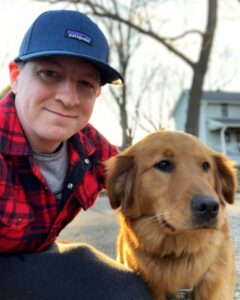

Leave a Reply