
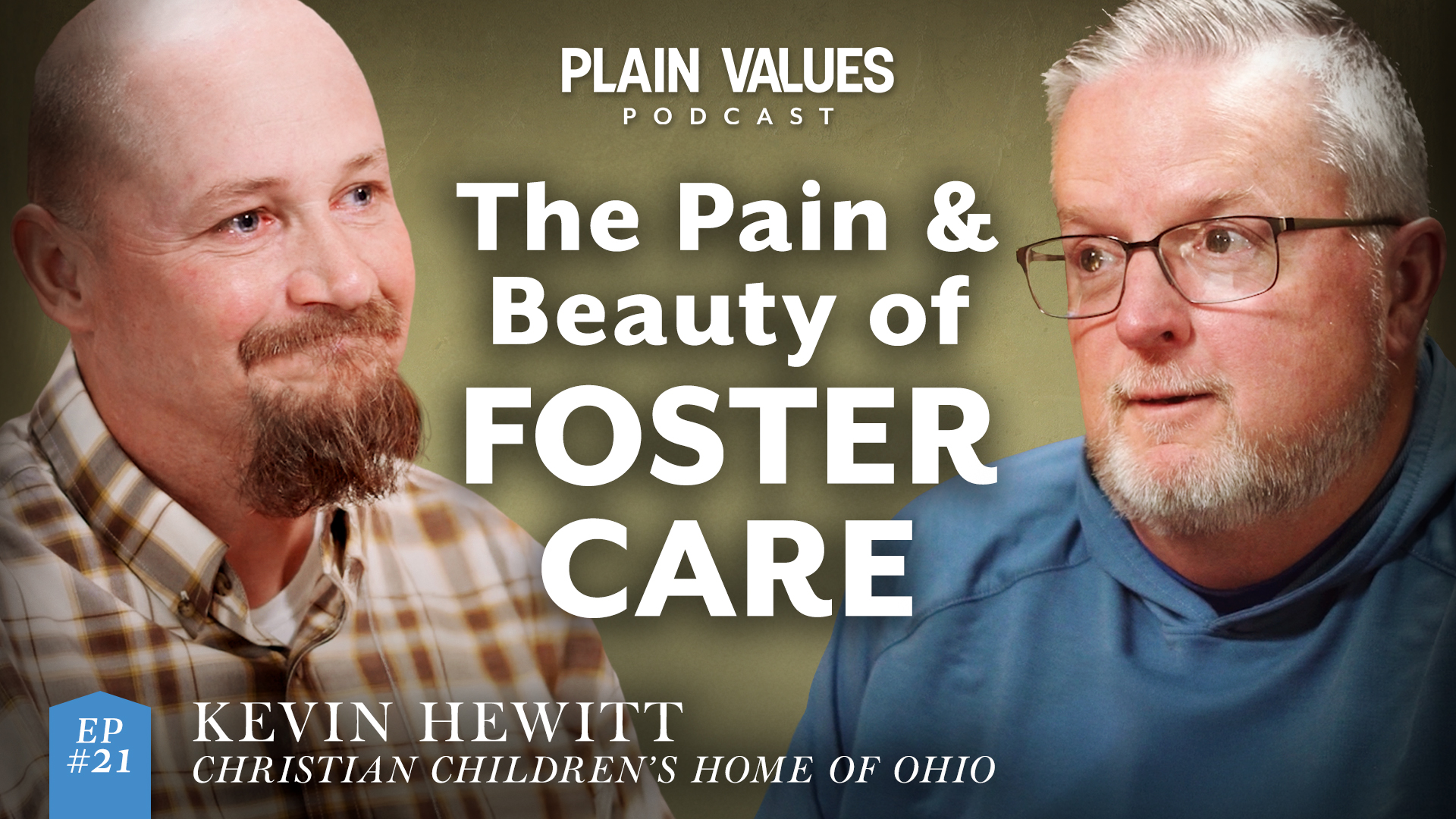
In a raw and moving episode of The Plain Values Podcast, Kevin Hewitt, CEO of Christian Children’s Home of Ohio, pulls back the curtain on a lifetime devoted to foster care, adoption, and healing traumatized children.
From his own faith awakening as a teen, sparked by his brother’s battle with cancer and a faithful basketball coach, to quitting law school because his heart couldn’t settle for money over people, Kevin’s journey is one of relentless surrender to God’s call.
What shines brightest is his unapologetic reverence for foster parents. “When I think of true heroes,” he says, voice cracking, “it’s foster parents.” These everyday missionaries open their homes, absorb emotional baggage, and love children who’ve known only brokenness … all without seeking applause.
Yet he doesn’t sugarcoat the pain. Fostering hurts. Love risks grief. The system isn’t perfect. But woven through every story is unshakable hope: every child bears eternal worth in Christ, and no story is over until God says so.
This episode will wreck you, then rebuild you with gratitude and courage. If you’ve ever wondered whether one life can make a difference, listen. Then pray about opening your own door.
Learn more about Plain Values at https://plainvalues.com.
Transcripts
0:00 – Intro
1:51 – Roots, Basketball & A Brother’s Tumor
3:49 – A Coach’s Faithful Witness
15:41 – The Carwash
17:44 – True Heroes: Foster Parents
27:25 – Marrying the Coach’s Niece
36:15 – The Myth of Control & Trusting God
48:16 – Redemption Stories Are Off The Charts
1:01:41 – Textbook Story
1:14:15 – CCHO
1:22:52 – What Makes a Good Foster Parent?
1:25:28 – Final Thoughts & Prayer
Kevin Hewitt:
When I think of true, true heroes, it’s foster parents. God, I’m going to get choked up here talking about that. The redemption stories that we get to hear are off the charts. I can still remember this was the wildest placement that I had.
Marlin Miller:
I sat down with my new friend, Kevin Hewitt, who was introduced to me by a mutual friend. And Kevin is the CEO of CCHO, the Christian Children’s Home of Ohio. And the journey that the Lord took him on to get there and the heart that he gave him in the process is one of just wonderment. I just loved it. Kevin and I are so beautifully aligned on so many things that I often found myself thinking this is like a brother from another mother. We talk about life in regards to the foster care system, to adoption, to equine therapy, and the effects of trauma. It was a wonderful conversation. Please meet my friend, Kevin Hewitt. My wife loves Jill Winger’s old-fashioned on- purpose planner, and this year’s is better than ever. It has all sorts of tabs from your gardens to your animals, to your meals.
Anything and everything that you can imagine that needs planning, Jill has built a spot for it in here. You can find this at homesteadliving.com. Order yours today for 2026. Tell us about where you grew up, your roots, all those things.
Kevin Hewitt:
Well, it’s really interesting you bring that up, Marlon, because my roots are real close to here. And actually, I’ve been at Weinsberg Restaurant my whole life growing up. So my grandpa and grandma had a little hobby, horse farm, seven acres between Beach City and Wilmont. That’s my maternal side. My paternal side grew up in Mount Eden. And so this is a lot of where I hung out at. And actually, I don’t know if there’s any old time Weinsberg people here, but my grandma’s best friend, I think we actually might have been related to him for a while. Evie Swan was a waitress at the Weinsburg restaurant for 30 years, 20, 30 years or whatever back in the day.
Marlin Miller:
We met a month ago, two months ago?
Kevin Hewitt:
Yeah. Yeah.
Marlin Miller:
How did that not
Kevin Hewitt:
Come up? You know what? For one thing, I don’t think I realized that you were in Weinsburg until I read the magazine and stuff. And then when I saw the address, I’m like, 2106 Main Street. I’m like, that is … Yeah. I spend a lot of time route 62. Yep. Yeah. Yeah. I
Marlin Miller:
Love it. So you grew up right up the road as a
Kevin Hewitt:
Kid? Yeah. Well, I grew up actually in Massillon. So my mom and dad, we lived in Massillon. I graduated from Tuslaw. But yeah, I spent a lot of time in this area. Yeah.
Marlin Miller:
That is so cool. I love it. Oh my goodness. Yeah. Man, what a small world. Yes, it is. Yeah. So you went to Tuslaw. Yeah. Tons of siblings, no siblings?
Kevin Hewitt:
Actually, one brother. Scott was two years later than me or older than me. And he’s really instrumental in my walk with Christ in my testimony. Yeah. So when I was a freshman, and there’s like these two things going on at the same time. One at Tussal, the basketball coach’s name there was Jim Kurgen, and he was in charge of the FCA. I wanted to play basketball, so I wanted to go to FCA. And so at that point, at FCA being fellowship Christian athletes,
And Coach Kursin was very, very faithful and asked me to go to church. As much as he was interested in me as a basketball player, he’s even more interested as where I was at spiritually. My first practice, I would have actually practiced with him as my coach. So my first practice as a freshman, because he was a high school coach. And that day, my brother had gone into emergency surgery because the Friday before he had gotten knocked out in the football game. And when they took him to the hospital, they actually just did a CAT scan and they found a tumor in his stomach. And the surgery started at 9:30 that morning, but my mom and dad didn’t pick me up from practice, which was totally like what’s going on. My neighbor picked me up and they said, Scott’s still in surgery. And so fast forward, he had actually been in surgery for like nine and a half hours, but Dr. Tilles, a surgeon at Madison Hospital, saved his life.
But it was the first time Marlon I can ever remember thinking about death. I almost guarantee that I had to have had a family funeral sometime before that, but I don’t think I ever thought about death. But when Scott was sick, it made me start thinking about where was I going to spend eternity. And Coach Kurzen was just such a faithful witness at that point and had shared the gospel with me many times. And I don’t know why this stands out, but I can still remember going into at Tussle in the locker room. There was a room beside it that was like our laundry room. And one of the glorious tasks of being a coach is doing the laundry and stuff like that. And so I remember going to Coach Kurz and I’m like, “All right, coach. So you’re telling me I could be the best person in the world.
I could do everything right, but if I don’t accept Jesus, I’m going to spend eternity separated from him.” He just looks at me, he goes, “Yep.” I’m like, “All right, I’ll get back with you, ” because I was expecting this long theological debate and he just said yes. And I went home at night and prayed and asked Jesus in my heart and it has- That very night. That very night, that very night. And yeah, so it’s been what, 40 some years since then and it’s been an amazing journey. I happened to marry his niece, so that wasn’t bad. That wasn’t bad too. And he’s still one of my best friends today. No
Marlin Miller:
Kidding.
Kevin Hewitt:
Yeah. And he was the FCA. He still, he actually is retired from teaching and still the FCA director or leading FCA at Tuslaw. 40 some years later, 100 kids will come at 6:30, 7:00 on Wednesday morning to hear the gospel. And I can’t imagine the number of kids that have been impacted by his faithful service at Tusla.
Marlin Miller:
Wow.
Kevin Hewitt:
Yeah.
Marlin Miller:
How old were you? How old was Scott when that whole thing happened?
Kevin Hewitt:
So I was 15, 14, 15, and Scott would have been 16 because we’re like 18 months apart. My birthday’s March, Scott’s in July, so it’s probably like 20 months apart. The interesting thing is it actually pushed Scott away from the faith, my brother, because I think he struggled with over the years, one of the aspects of his treatments was he got to go to National Institutes of Health because the cancer was so rare and kids that he would see one month weren’t there the following month. And so I think he struggled with the whole concept of why me of cancer in the first place, then why am I surviving and not? And so, and he is an amazing kid. I mean, he’s still, he’s a patent attorney. He lives out in Arizona, brilliant kid, the toughest person I ever met. He was in high school, he lost his hair from the chemo and radiation, had to wear a colostomy for a year.
And as a high school kid-
Marlin Miller:
Boy, that would be tough. Oh my
Kevin Hewitt:
Goodness. It was horrible, but he was just so strong. And like I said, and it was interesting because he wasn’t allowed to play football anymore, played baseball until last year. He literally had played all the way through high school because he had to take a year off because of the illness. So the one good thing is I got to play two years of baseball at Tulsa with him and at certain points he let off and I bet at second, so it was really cool. And so that was neat. But yeah, so that’s an amazing part of my spiritual journey, is my brother. And I still, at one point he went a couple times to Francis Chan’s church out in California. He lived in California for … And so at that point, I’m like, yeah. But he still, I think he knows the truth and God’s got it.
I mean, it’s God’s time. It’s not mine. But yeah, I love him to death. And he’s still, to this day, still struggling with some of the cancer stuff. And again, I am not a doctor at all. Don’t practice medicine, but it’s almost to me like he had so much stuff in his body to eradicate the first cancer, the chemo, the radiation. It’s almost like it’s coming out. You know what I mean? But he just hangs in there. And like I said, he still plays pickleball. I mean, he’s just one of the toughest guys you’ll ever meet. Unfortunately, he’s an Orioles fan, so I’m a Baltimore Oreos fan, so I don’t hold that against him, but so we have some spirited valvaries still.
Marlin Miller:
Yeah. I can understand that. I think of all the sports, the only one that I actually … I guess I shouldn’t say it this way, but the only one that I care about is baseball. Yeah. I totally
Kevin Hewitt:
Understand. I
Marlin Miller:
Totally understand.
Kevin Hewitt:
That’s about it.
Marlin Miller:
And I will confess, the Indians will always be the Indians. I’m not-
Kevin Hewitt:
It is hard to call it.
Marlin Miller:
It is tough for me to go there. So you get saved at 14 years old. You graduate high school. Did you go on to
Kevin Hewitt:
College? I did. I went to … Originally out of high school, I went to … Man, you’re telling me … All these questions going, they’re going to end up being these journeys, Marla, and I’m just telling you, these journeys. So I ended up wanting to play basketball and baseball in college, and went to Case Western Reserve right out of high school, was in way over my head with academics.
Marlin Miller:
That’s a tough school.
Kevin Hewitt:
That’s a tough school. That’s a tough school. That’s a tough school. I think I loved my guidance counselor, but I think they were more interested in having somebody from Tough Saw go to Case Western, whether than seeing it was really up my cup of tea. It’s interesting. I can still remember Marlon taking, it was a preview of modern physics as an elective. I’m like, “What was I thinking?” And it actually had this little P3 beside it, and I didn’t realize that meant third year physics. I’m taking it as a freshman-
Marlin Miller:
As first here.
Kevin Hewitt:
Yeah. Yeah, yeah. And so I can still … This shows you how much it traumatized me, Marlon. I can still remember the final exam question, and I still don’t have any idea what it was. It was like two spaces. This was back in what? 84, 83, 83, two spaceships, so many miles away from earth are taking a picture and they’re sending it to each other, and I’m supposed to figure out how long it’s going to take and all this stuff. And I remember looking at it like, “I don’t know. I don’t even know. ” There was one day we took a quiz in there and it was on the mechanics of a curve ball. And so the physics of a curve ball. So I was all pumped up and I started scribbling, writing it all out and I get it back and it’s 10 out of 10.
And this is somebody that got zero out of 100 in his first test. So I am so pumped up. I like 10 out of 10. I’m showing it to the guys around me, other baseball players. I’m like bragging and the professor starts going over the answer to the quiz. I’m like, not even close to what’s up there. I have no idea, but I start covering up my paper like that. And I’m like, yeah. So anyways, Case, and again, it wasn’t a great experience for me because it was over my head and stuff like that. So actually I transferred from there, came home for a semester and went to Kent State Stark, still wanting to play baseball was really my biggest desire was baseball and basketball and ended up transferring. But in all fairness, when I came back from Case, I was really struggling with who I was because here I was at Tuslaw, a somewhat big fish in a small pond.
And it was the first time like I had ever had to deal with failure and where I could just memorize stuff in high school and get good grades, I couldn’t do that in college. And so I was really dealing with my identity and I came back and Coach Kerson’s church accepted me and it wasn’t about my performance, it was about who I was as a person and who I was as God’s creation. And that was a really, really ended up being a really, really powerful time for me of setting me firmly in my foundations and my faith. And so when I ended up going out to a small school in Indiana called Manchester College to play baseball and basketball and ended up getting into a small group with a local optometrist out there called Dr. Bradley Camp and it was a great growth spurt and just really, really solid.
Then actually went to law school. Again, that’s going to show you all these failures of mine. I can’t believe I’m doing this on a podcast. I have rights to edit here at the Marlin. I’m just kidding. You do. I’m just kidding. But I went to law school and at that point God had, and this is a really, really wild thing and it probably won’t mean anything to the listeners at all, but we just had our first One Heart Chapel at CCHO for our staff.
And the gentleman, Jim Breckuler, is a discipleship minister from Discover Church, Christian Church in Dublin. And he shared from Isaiah 58 where it talks about that the fasting wasn’t pleasing to God. And what really is the fasting is take care of the widows, the orphans, and that’s really what God wants. That was the scripture that when I was in law school, I was really, really struggling with because when I got to law school, and I was a baby Christian at that time still. I mean, even though I was started at 14, I really hadn’t done a lot of growth until that college type of years where I really was on fire. So I really got discouraged because all I heard at law school was make as much money as you can and cover your rear end so you don’t lose that. And my really wanted to help people.
And so I quit and ended up starting to work at a car wash while I was trying to look for a job. Can I tell you, Marlon, that could have been the best thing that I’ve ever had happen. Go ahead.
Marlin Miller:
Just to clarify, was the going to law school the best part or starting to work at the car wash? Car wash. The car wash.
Kevin Hewitt:
Carwash. Why? Because I all of a sudden started meeting people with needs. Like the coworkers, they were like their lives … Actually, I can still remember one, this would have been back late 80s, back when the whole satanic panic type thing was on. And this guy really was like in a Satanist cult at that point. I mean, he bragged about it, I mean showed me these things. I had never experienced any of this stuff, never really had never been around like people that had these kind of hurts and it just broke my heart, just broke my heart. And so I was looking for a job and got a job with a foster care agency out of the blue. My degree from Manchester was a double degree in political science and sociology. And so I got hired by the Bear Foundation, fell in love with foster kids, foster parenting.
Really, I mean, Marlon, if you talk to me enough, you’ll know I’m a pretty one dimensional person. It’s sports and I’m pretty boring and all this stuff, but when I think of heroes, athletes are not heroes. They’re great performers, they’re great athletes, but we shouldn’t look up to any heroes. They’re people. When I think of heroes, I think of our first responders. Again, I have to say them first. I think of our armed service personnel, but when I think of true, true heroes, it’s foster parents. It’s our treatment specialists at CCHO. People that are willing to literally lay there, a lot of their wants and their desires aside and say, “I want to walk alongside you. I want to take along, take some of that emotional baggage that you have and I want to help you. ” Because I see … Our purpose at Christian Children’s Home Ohio is to help more people experience their worth in Christ, because we know we will never lock eyes with anyone that wasn’t worth enough for Jesus to die for.
And so when I see foster parents continually opening their homes up and becoming missionaries in their own home, missionaries in their own home, that still brings me to tears all these years, I mean, I’ve been in the field now 35 years and you know what? Our field’s not perfect. You’ve been around it enough to know the system a lot of ways is broken, but it’s still the best in the world. When you think about foster annech, I wholeheartedly believe, and this becomes editorial now, but I wholeheartedly believe why it is the best in the world is because of the Christians involved. And I think I just saw CAFOs, the Christian Alliance for Opens, their latest, and their studies say it’s like 66% of all foster families are Christians, because we see these kids as eternal value, not a temporal thing. One of the things that just fries me is when I hear, “Oh, foster parents are just in it for the money.” There isn’t enough money for us to pay.
Now, on the flip side of that, I also have worked with foster families, not in the Christian agencies I worked in, but foster families, they would name their kids by what they were going to buy, by what the kids’ placement. Now that is wrong, but I can tell you, those people don’t hang. They don’t last.
Marlin Miller:
It’s so fascinating. And I don’t think it takes but a split second to meet a family, a set of parents who are putting themself in the gap for the foster kids that they’re serving. You can tell really quickly, often I think you can tell really quickly how the motive-
Kevin Hewitt:
Correct. Yes.
Marlin Miller:
… looks, what it looks like, why they’re doing it. And I absolutely love to meet families who are fostering for the right reasons. Amen. Because they are a … Heroes. Yeah, they are. And to a point, I think to a point, it is almost a high calling.
Kevin Hewitt:
Yes. Yeah. And let me make sure I couch that correctly too. When I say they’re heroes, they’re not looking for the plaudits. They will actually deny it. They’re not in it for the applause. They’re in it because of the fact their hearts are so turned to how do I help these kids?
Marlin Miller:
So let me ask you about that. Do you think there is a correlation between a healthy understanding of what the gospel saves them from and then stepping into that gap, into that void? How do you think … Because there’s a part of me … And- Go ahead. I feel like I should just be very quiet. No. But there’s a part of me that senses that when someone really understands, sincerely understands, A, the need of the child or children, a sibling group or whatever it is, when they really understand the need, and then they also understand what Jesus has saved us from in our own selves, in our own sinful mess, that you start to get that family that goes, “You know what? It might be painful. It’s going to be painful, but it’s worth it.
Kevin Hewitt:
” Yeah. I am 100% with you because of the fact is we even talk about it with our foster families and our treatment specialists. It’s going to be the hardest job ever that you’ll love because one of the things I think in life that ends up hamstringing us or hampering us is the fact that we get to the point of we get fearful of taking risks that are going to hurt us and because reality is fostering is going to hurt. Love’s going to hurt, right? And actually, who did I just hear … My wife is going to crack up when she hears this, because I always start saying that we’re getting to the age of now, who said this? You look like somebody. I remember. You know what I mean? It’s hilarious. We start joking and it’s like, “Oh, we’re at that age.” I
Marlin Miller:
Love it.
Kevin Hewitt:
Oh, it was Kurt Thomason is who it was, TBRI guy, stuff with that. He taught his new books on grief, and part of why grief hurts so much is because we can love so much.
If we didn’t have the ability to love, we would never have the ability to grieve. And I think that that is part of it. And almost we protect ourselves by not risking. And so I firmly believe there’s a relationship, but I’m also a firm believer in what you just mentioned, Marlon, that gratitude of understanding what we’re saved from plus what we’re saved to it should be the marker of a Christian’s life and it’s gratitude. Dave’s heard me say this before, and I say a lot. I think one of the biggest challenges as believers when we grow to old, and actually, I could probably say it’s not even believers, is not to be cynical, is to be grateful and understand that what … I love that concept of what we’ve been saved from, and to understand what Jesus did on the cross, and by defeating death.
I mean, we should be every day just thanking God for that.
Marlin Miller:
How do you think a person maybe gets moved from a more of a shallower understanding? Shallow is not the right word. That’s not what I mean, but how do you go … How does the Lord do that?
Kevin Hewitt:
Man, that’s probably way beneath my deepness. But I think one of it is, is just a willingness to be open, the willingness to risk.
Marlin Miller:
And it goes back to being willing to get hurt.
Kevin Hewitt:
Yeah. And I don’t necessarily know if I would be first in line. I mean, it’s easy for me to say that sitting here on your basement, Marlon, and this awesome podcast, but then I start thinking back on the times of my life that I did and how God showed up, and then I start thinking, “Why don’t I do this more?” We see God time and time again, and it’s interesting of how many worship songs are about God’s faithfulness. Do it again by elevation. I hear that song makes the hair on my arms rise because it is just a recognition that God, you have been so faithful over the years. Why aren’t I remembering that? The Israelites, the Old Testament. I mean, how many examples of God’s faithfulness, and yet they go running after other idols, right, and stuff like that. And that’s us. And yet, again, Jesus says, “I love you.
I forgive you. Come to me.
Marlin Miller:
” Boy, there’s a million ways to take that, or I should say directions to go two things. Have you ever heard of a songwriter named Andy Gullahorn? No. No? No. I think he’s down in Nashville area somewhere, and his songs are just incredibly powerful. And I’m actually blanking on the one, but he has one that almost verbatim talks about that it’s in loving someone, that you’re going to have pain.That’s what’s happening, but it’s better to love and then get hurt than to not love at all.
Kevin Hewitt:
To seal yourself off and not love.
Marlin Miller:
And how many people do we know that just like you said, they’re afraid of the risk because of what it could bring, and then they miss out on all these wonderful things. Painful, yes, maybe. Yes, probably yes. But that’s where the rubber meets the road, and that’s when … Yeah. I didn’t mean to guess. Oh my goodness. That’s wonderful. So you said you married your coach’s niece.
Kevin Hewitt:
Yeah. Yeah. My wife, Lori, has been … So we’ve been married 35 years. She is absolutely amazing. I have drug her to so many foster parent trainings and conferences, the churches we speak at for CCHO. And realistically, she probably does a better job of representing CCHO and us. We were just at a church in Sandusky on Sunday and we went out to lunch with the mission group and they love her more than they meet because she just connects, but her heart is also for our kids that we work with. I mean, it breaks. She’s just an amazing lady. Yeah. Her love for others is off the charts. We have two unbelievable kids and two unbelievable … We have a daughter and a son, and then we have two unbelievable son-in-law, unbelievable son-in-law, unbelievable daughter-in-law, and three granddaughters, six and four are with our daughter and son-in-law.
And then we just have our son and daughterlaw just had their first in June. And it is absolutely amazing. I mean, all the stories about being a grandparent is the coolest thing in the world is true. I just want to tell everybody it’s true. But I do have a theory about that, Marlon. A real quick second, if you were like me when you were a parent, right? When you were a first parent, you literally worried about every little thing. And I was even a one, if they were quiet for too long, even sleeping, I would go in and make sure their chest was rising and falling and like, “Are they breathing? Are they breathing?” That kind of stuff. As a grandparent, you’re so past all that because you know all the mistakes you made and your kids still made it. You know what I mean?
And so you don’t have the anxiety, you don’t have the worry. And I actually believe that I marvel more at my grandchildren than my kids because I was so anxious about trying to make them perfect and knowing … And so I don’t have that with my grandparents or my grandkids. I just enjoy them. I just enjoy them.
Marlin Miller:
Boy. Yeah, that’s fantastic. I hope … Yeah.
Kevin Hewitt:
And not that I didn’t enjoy my kids, but there was this added layer of anxiousness That I felt they had to represent me some way. You know what I mean? And it’s like, that was so faulty.
Marlin Miller:
Let me ask you a bit of a question out of left field here. Pardon the baseball pun. I’m okay with
Kevin Hewitt:
That.
Marlin Miller:
When people talk about that the family name is something to defend and show up for and represent well. Is that a biblical thing? Is that a good thing to put that on your children?
Kevin Hewitt:
Man, that’s a great question, Marlon. Expectations are always a challenging thing because I did hear one time before, no expectations, you’ll get exactly what you expect. Two eye of expectations, you get anxious, neurotic people. So I think that there is a nuanced answer to that. And the answer I would probably fall on, which is always not a real exciting answer to say, but maybe. And the fact is, if there’s an understanding of why you want to make the family proud, I think that that can be a good thing. But I think that we always have to check ourselves, especially when it’s our kids, is am I making that expectation for them or am I making it so they make me look good? You know what I mean? And I think it was Andy Stanley that he was talking about parenting and he said the rule that Sandra and him or the concept, they will feel that they’ve succeeded at parenting.
If their kids, when they get older and can leave and go out on their own and actually want to come back and spend time with them on their own. Not that there’s a birthday party or something, but they just want to come.
And I think that that is a really good, like a practical way to look at that. If your kids want to spend time with you, because I can tell you with my kids, one of the most exciting things I think about growing older, I already said was the most difficult thing. One of the most exciting is watching our kids grow up. I mean, they’re better parents than I ever was. I’m not even a kid. Our daughter and son-in-law are more organized and better parents. And of course, our son-in-law works at CCHO and knows T.B., But our granddaughter, I mean, they’re amazing. Our son and daughter-in-law, I’m like, man, they are so much better. And that is exciting to me. And so to watch them grow up and have their own walks with Christ, their own passion for Jesus, God, I’m going to get choked up here talking about that.
I can tell you the moments that I’ve felt like the closest to God, and worship music is one of my spiritual pathways. So just any sacred music, but worship music particular is when I’m at a concert, a worship concert, and my whole family’s together in worshiping. I’m like-
Marlin Miller:
There’s nothing better.
Kevin Hewitt:
Nothing. There’s nothing better.
Marlin Miller:
Nothing better.
Kevin Hewitt:
Nothing better. So I don’t know if I answered your question there, Marlon. And I think, and the interesting thing, one of the things we do at CCHO is the five voices, and that is a giant leadership. So giant leadership’s motto is fighting for the highest possible good of those you serve are those you lead, right? Fighting for the highest possible good. And the five voices are a way of what’s it like to be led by me. And so I think it does take some work, but there are kids that are motivated by super high expectations. There are other kids that are demotivated by high expectations. So I think the work comes as a parent or as a family member is, do I know my kids well enough to know what will motivate them? So am I willing to take and learn? And it’s positive motivations, not negative, but am I willing to learn my kids well enough to know what motivates them?
Marlin Miller:
And on top of that, it would also come back to our own motive. Correct. Correct. And I mean, just like everything, I’m only 48, but the older that I get, the more I realize that there are two million different aspects to almost every issue. There are so many different things and most of the time I think I have a handle on things until I realize that, you know what, I barely have a foggy clue.
Kevin Hewitt:
Yeah.
Marlin Miller:
And I think it’s so hard, especially when you’re dealing with a child who has trauma or special needs or any one of those things. I mean, for crying out loud, a biological son or daughter has their own sets of challenges. And so yeah, that’s an incredibly complex thing.
Kevin Hewitt:
Yeah. And I think if we unpacked all of what we’ve talked about so far, I think it comes down to why there’s so many times in scripture and even in church history that it comes down to, am I willing to surrender? Yeah. To die to yourself. To die to yourself, take up your cross and follow Jesus. Because I think one of the biggest myths ever is if you tell yourself you’re not a control freak because we’re all control freaks.
Marlin Miller:
That is fantastically ironic and beautifully true.
Kevin Hewitt:
Because we try to control everything. We really do. And so I think that’s part of why even we talked about earlier about taking risk. Part of the reason we don’t take risk is I’m not in control. I’m not in control. The first time we’re getting ready to go, one of our affiliated ministries, our partners is Esperanza Deanna down in Choca Peru. It’s a children’s home and they are changing a culture. It is absolutely amazing what they’re doing now. They’re actually bringing families together. You’re talking about the scripture of turning the hearts of the parents to the children, children of the parents, they’re doing it. It’s a culture that’s totally okay for males to have three or four baby mamas and not be responsible for any. They’re literally building … So going around having children with other-
Marlin Miller:
That’s what I thought you
Kevin Hewitt:
Meant. Yeah. So they’re actually building the families back up. The parents are building marriages strong. They’re building the kids, going back to the parents. It is crazy cool. But I can tell you, the first time I was walking the streets of Choco, 3,600 miles away from here and realizing I had no control over anything. Didn’t speak the language, didn’t … I was just like, I was petrified and excited at the same time, because that’s when I knew, God, you’re in control. So my vision of God went from this to this. I mean, it’s still not as big as it needs to be because God’s so in describing Isaiah and his ways are way above my ways, but that’s where I want to be. And I tell people, I want to live in that space of terrified and excited at all times because I’m going to see God move.
Marlin Miller:
Most people would not have the guts to ever say that. I probably have the guts to say it. I don’t even know if I have the guts to do it. How’s that, Marlon? Man. Oh, Kevin, that’s so fascinating though, because that is where he shows up. Because he has to. Yeah.
Kevin Hewitt:
He
Marlin Miller:
Has to. Because I’m not in good stuff. Because we aren’t in control. And it’s almost like you hand the reins over to him and say, “Here, take over.” Cleatus take the reel or something. Yeah.
Kevin Hewitt:
And I’m the type … When I was a youth pastor, I hated going to the hospital. There’s certain pastors that have that pastoral gift of they can sit with the families forever. I hated it because I was in control and I wanted to help. You know what I mean? So I was like, “Let me see that chart. Let me see if we can just add something here and get you going a little fast.” And I knew it was all about me. I was, again, going back to I was in control. I wanted to make this child healthier, better when I’m out of the hospital and it’s like, I need to surrender all that to God.
Marlin Miller:
Boy, that’s fascinating. So you went from a car wash. By the way, where was the car wash that you
Kevin Hewitt:
Worked at? Actually, Click Clean on Exchange in Summit Mall areas because I was actually going to law school at Akron. I was actually a room with my brother who was in grad school at Akron at that point. And yeah, so Click Clean Carwash, not there anymore. There was another car wash there because I think it was literally at that time right in front of Summit Mall and it was worth … That property was pretty … Yeah. Yeah. It was worth a lot.
Marlin Miller:
So after the car wash, you got the job at the Bear Foundation. Right.
Kevin Hewitt:
Yeah. Right. I was the first Ohio case manager. So the Bear Foundation was founded in Pennsylvania, Bill Bear and his wife in a great book, If you’re a foster parent, interested in foster care, Love is an Open Door by Bill Bear is the description of how the Bear Foundation started. And at 20, I was a case manager, covered all of Northeast Ohio. Used to drive 6,000 miles a month.
Marlin Miller:
Oh my goodness.
Kevin Hewitt:
Yeah. Foster homes all over Ohio and just fell in love with foster kids, foster parents. Yeah. Yeah. It was …
Marlin Miller:
How old were you when you and Lori got married?
Kevin Hewitt:
I was 25. She was 20. So
Marlin Miller:
Yeah. Did you guys have your kids?
Kevin Hewitt:
So let’s see. Both of our pregnancies were really difficult. We actually had a miscarriage first and then Lori, it was a challenge. So miscarriage first, I think I would have been … Let’s see, how old I’m … I must have been 28. So it must have been three years after we had been married that we had Haley because she’s 32. So relatively quickly.
Marlin Miller:
Are you following the big fertility movement with all of the IVF issues, the surrogacy issues?
Kevin Hewitt:
Yeah. I probably know enough to be dangerous, so I’ve not been 100% on that.
Marlin Miller:
Kevin, I don’t know how. I can’t overstate. I don’t think it’s possible to overstate the train wrecks that are coming our way in 15, 20 years, maybe sooner. When you have a child that is born to a surrogate and then hands that baby off to not mom and dad, not biological mom and dad. Our oldest son, we are his fourth family and he has asked me, “Dad, why did God let all this happen to me? ” And I can say, and I have to say, “I don’t know. I have no idea, but I am here. Let’s talk about it. ” And I will confess upfront and down the other, I didn’t do near enough of that. He’s now 22. I didn’t do near enough of that, but I can’t imagine the situation and the effects, the impacts of that child who’s now 18 and starting to say, “Where did I come from?
Why am I here? What’s going on? ” And he or she’s asking that question and gets told, “You should just be glad you’re here.”
Kevin Hewitt:
Yeah. Man, I wish I had some great answer for you there, Marlon. And a lot of it is. A lot of it is just being
Marlin Miller:
There. I think we’re very, very blindly walking off a huge cliff, and I think it’s the kids that are going to pay the price.
Kevin Hewitt:
Or their kids. Right. I mean, when we see the trauma we see a lot of times, it’s such … I don’t have a lot of grace for abusers unless I can take a step back and say, “What in the world happened to this person that would make them abuse?” And the majority of the time, something happened to them. And being in this field for a long time, I unfortunately learned never to say, “I’ve heard it all when a referral comes,”
Because of the depth of depravity that some of the people have gone to what they do to kids. So it’s only an understanding of, man, people don’t … I mean, we know we’re all sinners. We all have original sin, but we also know the feeling as a parent, right? When you see your kid and stuff like that. So what has happened that has made a disconnect there that you would … We had a girl in residential, dad got drunk, tied her to a back of a car and drug her through a bowling alley parking lot.
You’re a dad. Yeah. I mean, what could have ever been inside you that would ever, that that would click, that that would be appropriate, that would be the right thing to do? You know what I mean? And I have to come back to what in the world happened to that dad that would ever think that that was appropriate? So I don’t know if that’s where we’re heading, that this conscience is … I don’t know. That’s a great question because we all do struggle with our identity. Where do we come from? What’s that look like? And that’s hard. That’s a hard question. That’s where … And you phrase it very, very well, Marlon. I wasn’t there enough to just let him say this or ask those questions or just sit with him through the pain. And that’s what a lot of the times is needed. But again, going back to, if we’re a fixer, right?
We feel totally incapable at that point because when our kids come to us … Actually, I even feel this at CCHO. When staff members come to us, I feel like I have to have the answer and there’s sometimes I don’t, and that is hard. That is hard. But I do know that we also serve a God that doesn’t have the same timeframes that we do.
You know what I mean by that? Yeah. Where it might look hopeless now.
Marlin Miller:
Right.
Kevin Hewitt:
Actually, it’s our theme for this year’s CCHO T-shirts. I have to bring one down for you, Marlon, but the story’s not over. It’s what’s on our t-shirts. Romans 8:28, the story’s not over. And that’s the cool thing that a lot of our hope comes from, is that the story’s not over. We know the final story’s over, but the story of the people in our lives are not over until the God’s.
Marlin Miller:
How do you hold it together? Hearing all of the stories and seeing … I mean, my goodness, Kevin, you got a front row seat to … Depravity.
Kevin Hewitt:
To all of it. It is literally what I just told you, the story. The story’s not over. And the story of redemptions, or the redemption stories that we get to hear are off the charts. And it’s interesting. I always tell people, “God, I don’t mean to get so choked up.” I love baptisms, love any baptism. I mean, I love them. I mean, they’re just like the angels singing in heaven, but there’s something about when our kids get baptized that it’s a different level because I know where they’ve come from. I know what they’ve persevered through, and so it’s just different levels. So those stories of redemption that are unbelievable is what gets me through it. Working with humans, there’s hundreds of techniques. And so what I learned when I was a case manager, and again, I don’t do this well at all, but God has … My point was to, I’m going to do everything I can and then leave it in God’s hands and go to sleep.
Now it is interesting. God’s always blessed me with being able to go to sleep, but I can tell you, I can tell my level of stress by when I wake up. You know what I mean? So I’ll go to sleep, but if I wake up at three, it’s usually, all right, something’s going on that I’m ruminating about, stressing about. And if it’s at two or one, it’s- It’s
Marlin Miller:
Intense.
Kevin Hewitt:
Yes, it’s intense. But I think it really is. One, I am not that good that God needs my help. He allows me to help him, and I want to always remember that, and I’m going to do it, like I said, I’m going to work as hard as I can and go to sleep and leave in God’s hands. Man,
Marlin Miller:
I mean, a healthy dose of humility goes a mile and a half. Oh my goodness.
Kevin Hewitt:
Yeah. Wow. I am like, this isn’t false. I would not have survived in this field without that. I actually don’t know how … There’s two fields that I don’t know people work in that are not Christians, ours and hospice. I don’t know how, if you were not a believer how you could see death all the time like that and that weight, you know what I mean? If you didn’t have a hope of eternity.
Marlin Miller:
So let’s go back a little bit to, you were in law school, you worked at the … I almost said gas station. Car wash. The car wash. How do you think those things prepared you to do this work and to lead in this field?
Kevin Hewitt:
I think that’s a good question and how to … I have a lot of answers running through my head real fast. One is I do feel like I was one of those people in the ivory tower of, in school, everything was about sports, was in the classes that college preparatory classes. For me, it wasn’t where you’re going to college, it was where you’re going. It was just the next step to the point of I really didn’t appreciate college. I mean, when I look back, I didn’t appreciate it. It was just the next step. So working at the car wash was really the first time I spent a lot of time with people whose lives were a mess. Because even though I went to our church at that point, there wasn’t a whole lot of people, lives were a mess. We weren’t really reaching out at that point.
I mean, thank God that it’s changed and very missional type. So I think that that was the first time I really ever realized people, lives were … And they didn’t grow up like me. I was in Akron. I grew up, as we said earlier, outside of Massillon, spent most of my time between Massillon, Beach City and Mount Eton.
Just great place to grow up. I mean, we played ball all the time. And in our little neighborhood, we had five kids and we had a swimming pool and ball fields and we were good. And so that like opened my eyes to a whole new culture of herding. It is interesting. I tell a story because it was just another … I’ve had a lot of God winks in my life that’s like, okay, God,
As I look back, I’m like, you were trying to tell me. And I was … So at Manchester, my sociology professor was Dr. Fern Baldwin. She was about maybe four eight. I mean, doesn’t very tall at all, had been on the mission field for like 35 years and she was my sociology. And when I told her I was going to go to law school, and talking to her, I’m like, ” I’m going to go to law school and make a lot of money, but I’m going to help others. “You know what I mean? I’m going to help others. But when I told her I was going to law school, she goes, right before I graduate, she goes,” Kevin, I just want you to know I don’t see you being an attorney. “I was offended. I’m like, ” Wait a second, I’m just graduating. I’m like, I got to look at my grade and all this stuff.
“And she goes,” I see you leading a large Christian organization. I’m not kidding. “Get out of here. I am not kidding you. She called it. Yeah. She knew. Yeah. When I was 21, 22, whatever that … And I look back now, because I laughed. I’m like, ” Yeah, I don’t see myself … “Because she saw something with the compassion in me that I didn’t, you know what I mean? She saw me that I cared for people that I really didn’t see at that time. I mean, I had definitely had the Christian … Again, it was a growth time, it was understanding, but she saw a depth that I didn’t. So I can’t wait to get to heaven and tell her that she was right. So I don’t know where that came. I can tell you, I don’t know if the Bear Foundation was really super smart because they put me in leadership at like 26, 27.
But that point, again, another thank God moment is that was from my administrative assistant, Diana Williams. She was absolutely perfect. I would write … It was back in the days you would write and hand them to your … And say,” Type this up. “And she’d come back and go, ” Kevin, you sure you want to say this like this?
“”I guess not. How should I say it? ” And she probably saved me so many times, so many times. And her godly wisdom, Diana, to this day, I still thank God for her. And she was amazing and she loved Jesus. She loved Jesus and had the gift of administration and how to … So I learned so much from her and yeah, so I’ve always been in leadership and in this field, it is hard because a lot of times, even as Christians, the social work field, the social services field tends to be anti, more liberal in some of these things. And I probably could lose my license by saying this, but there’s a lot of the social work ethics that I don’t necessarily agree with. The whole concept of self-determination is a really challenge for me because there are certain limits to that too. And I understand that at the beginning it was about having a voice and stuff like that, but it just doesn’t mean I get to choose whatever I want to be because no matter how hard I try, I’m not going to dunk a basketball, you know what I mean?
And stuff like that.
Marlin Miller:
Right. I totally get that.
Kevin Hewitt:
Yeah. So you know where I’m heading with that type stuff.
Marlin Miller:
How do you feel about the whole concept of reunification? We’ve been publishing Plain Values for almost 13 years now, and about a year ago, the team and I decided to put together a compendium, a best of, if you will, of our favorite stories, the most impactful stories of all those years. And invited is what we built out of those conversations. It is 194 and four pages, and it is absolutely a thing of beauty. We do a monthly gathering here where we just simply open our doors. It’s called Porch Time. And the story of how Porchtime came to be and how our family was invited into that and how we are inviting you and every Tom, Dick, and Harry, anybody who wants to come can come and hang out at Porch Time here at the office in Weinsburg. So it was such a natural fit to use the home of the founder of Porch Time and to call it invited.
You can find it on plainvalues.com on the shop page, and you can now consider yourself invited.
Kevin Hewitt:
I’ve seen it be absolutely beautiful, and I’ve seen it be a struggle. I think it is the most challenging aspect of our field, because one of the things I’ve seen over and over again is no matter how great our foster families and even sometimes adoptive families do with their kids, there’s still something inside those kids yearning for their birth families and the acceptance of their birth family. And so when they … A lot of times when they become young adults, a huge concept is, where is my place and my birth family? And what I saw a lot with younger kids, what I see a lot with younger kids is they create this idealized picture of their birth family that is so far off, but it helps them. I can still remember this was the wildest placement that I had taking two kids to a foster home at two o’clock in the morning, two young boys, they’re seven, nine-ish, somewhere in that area, and everybody’s tired.
They had been removed in the middle of the night. We’re all tired. We had an amazing foster mom that said she would take them at that point. I mean, again, just miraculous. These people are miraculous and I’m driving, I think it was from Portage County down to New Philly to the foster home, and out of the backseat, I hear this, “Are you going to be my
Marlin Miller:
Dad?” To you?
Kevin Hewitt:
To me, to me. Are you going to be my new dad? My heart crushed. I mean, just I had a rough time keeping on the road. I had not met them for longer than an hour and they’re asking who my new dad. And so that crushed me. But then he started talking about his dad and he painted his picture that his dad was a truck driver. He was going to have this … He’s working on this mansion to take him and his brother back to and all this stuff. But that to me was an example of no matter how difficult their lives are, they’re still going to have to answer that question or somehow with that void. So if I looked at the greatest picture, it’s when we can actually work with the birth families too. And the reunification is … I can tell you a story that is a true story from our encouraged foster care that should be in every textbook of every … This is foster family, first placement.
Child comes into care. I think he’s eight at this time, right around that area.
Good kid, behind in school because of truancy, because mom unfortunately is hooked on drugs and just isn’t being able to provide the care. Mom loves the son, just can’t kick the drugs. Foster family, like I said, it’s first placement, great solid couple. Professionals. Again, not that that’s a big deal with foster parents, but they’re professionals. And so they’re fostering and the foster child’s doing better. Starts having weekly phone calls with birth mom. And the foster parents did a great parenting technique because I would just say Brian’s his name. So the foster child, Brian, is like any other eight year old boy, what’s he want to do? He wants more time to play video games, right? He wants to play more video games. So the foster parents do a great parenting technique. “Hey, if you memorize scripture with us, let me underline that concept with us.
We’ll let you have another half hour or so of video games. “And so they follow through. Well, Brian’s on the phone with his mom and mom asked what are you doing? He says,” I’m memorizing verses. “And you can know as a foster parent that she’s listening to the conversation, not monitoring, not listening on the other end. So her first thought’s like, ” Oh, how’s this going to go? “But Brian doesn’t react like mom reacts bad. He actually starts sharing the verse that he’s memorizing with mom. And this becomes a habit of every phone call, every weekly phone call. They start talking about the verses that Brian is memorizing. Foster parents start inviting mom to family gatherings. And so Brian was playing baseball. They invited mom to come see and watch Brian play baseball.
They invite mom to church. She starts coming 45 minutes away, one way to come to church with the family. This goes on for a while. Brian gets baptized at the church. They invite mom, mom’s relatives. The whole family at the church has a fellowship hall. They have a meal together. Again, this is a textbook. I mean, this is … If you could paint the portrait of what out of home care should be, this would be it. So I realize this is a textbook. So Brian’s going to get to go home in a couple of weeks. Mom has been doing fantastic. She’s been following the case plan. It’s just a great story. They’re sitting at church and the church one day, they do the invitation. Mom looks over. Foster mom says,” I want to go forward and be baptized. “Foster mom baptizes the birth mom. Wow.
Two weeks later, Brian goes home. That was five years ago. Brian’s still home. They still have a relationship. Oh, I forgot to mention. The next year, the foster family went on vacation. Guess who went with them? No kidding. Birth mom and Brian went together on vacation. That’s how the story. If I could paint a picture for out of home care, that’s how. And we know that doesn’t happen all the time, but that gives us hope that it could happen. And I have to admit in my career, we’ve probably done some crazy things that were probably outside the book. We actually had a birth mom move in with a foster family one time, four kids. Birth mom, it was another instance of substance abuse. Just that story didn’t end as well as the one I just shared. But here’s the flip side of it. Didn’t end as well for the mom, but for the kids.
Birth mom moved in. And this, again, this sounds so stereotypical and I hate saying it, but it’s the truth. Carnival comes into town, she meets somebody, leaves over. And she had been making tremendous progress. She really did. She leaves. But can I tell you, that was the fastest permanent custody hearing I’ve ever heard because we went to the point of moving the birth mom in. You know what I mean? So the adoption was finalized in like six months. And the kids themselves, some of those questions we just talked about, they were able to answer some of those questions because they literally lived with them and they recognized that we tried everything we could to get that family back together. You know what I mean? So on the flip side, it ended up being a good … But it was very hard. But those are the kind of things.
And we’ve had foster parents mentor, birth moms, those are good times. And there are other ones. The system is a challenge when you think about it, because the same people that take the kids out of the home, the children’s services workers, which is the … I can’t imagine how difficult that part of that job is, are also the ones that are supposed to work with that family to get the kids back. I mean, you’re talking about having to … Yeah. I mean, you feel like you’re torn. And so it is a challenge on that. And so I think reunification is fantastic at times.
Marlin Miller:
How’s that for a
Kevin Hewitt:
Qualified answer?
Marlin Miller:
I think that’s a great answer. I have wrestled with it for a long time. You hear those horrific stories.
Kevin Hewitt:
Correct.
Marlin Miller:
I know there was one not that far from here where a cousin of mine was fostering a little guy and he went back and I don’t think it was a year and he passed away and it was not of natural causes. You get my drift there. And it just rips my guts out. But I understand it. I do because as a birth parent, it is this massive draw and you would want that to happen, of course.
Kevin Hewitt:
Yeah. And I think that that is, again, part of that trying to figure out when bad things happen, how can we control this? And unfortunately, I don’t know if we can … I think Ted Decker wrote the book once, and it was about they had removed all emotions and people had said you couldn’t … And so everything was bland. Emotions and color, except there was one drop of blood and it was a drop of the Jesus character in it. There was a fear that that would get out and it would get in everybody else’s blood because of the fact is there is risk in being human. There’s just risk in being human. And I can almost guarantee, not that I’m into guarantees, but I can almost guarantee even in that situation when that judge said for the child to go back home, his plan wasn’t for that child to have that happen.
You know what I mean? And unfortunately, there are times the judges’ hands are even … I’ve seen judges and magistrates in tears saying this child has to go back home.
Marlin Miller:
Are you
Kevin Hewitt:
Kidding? Yeah, because there is sometimes it’s a mistake on paperwork. Yeah. And they know their hands are literally tied. And that, believe me, you’re talking about challenges again that you’re like, oh, so that becomes, we got to make it so we don’t make mistakes. So yeah, it is … I know it sounds bad, but it is not a perfect system, but it’s the best in the world when you look at childcare across. But the challenge is how do we get people to understand who they are? Because I don’t know about you, but I think one of the biggest things is when you can tell somebody and go, “That’s not who you are. ” When you see somebody acting that you know, acting in another way that’s contradictory to everything I’m … When you can tell somebody that’s not who you are, that is one of the most comforting things to somebody.
You know what I mean? Yeah. And when we can tell that to ourselves, that’s even more because if I made an argument about … Because we know that there’s leadership issues in America, right? And I would make an argument, self-awareness is part of the reason why we have leadership issues, is that we’re not willing to look at ourselves and say, “That’s not who I am. When I act like that, that’s not who I am.” And I would love to have the opportunity to say that to a lot of our birth families, “That’s not who you are. ” And then show them their true identity, which is a child of crowd, that the creator of the universe loved them enough to die for them.
Marlin Miller:
It is an incredible thing to think about the real world repercussions of a decision. Forget about, “Well, I was going to this college and then I … ” Those big ones, that’s the obvious one, right? Those are the ones that make those headlines, but it’s those little decisions in the moment that don’t seem like it’s a big deal and they can-
Kevin Hewitt:
They build on each other.
Marlin Miller:
Yeah, they do. Yeah. They do? Boy, boy, that’s good. How big is the need right now? How many kids are in the foster system? Because I remember, Kevin, I remember a back farm neighbor of ours, a good friend of ours is now a retired judge from Tuscarawas County. And I remember calling her and saying, “Hey, can you tell me how many kids are in Tuscarawas County right now that need a home?” And this is years ago, and I think she told me who to call and I think the answer was like 76 or 77 or something like that in Tuscars County. Do you have a bit of a window into that? In the
Kevin Hewitt:
State of Ohio, unfortunately some of the statistics lag. The statistics is 17 to 22,000 kids a year and out of home care and- At any one- Any one time. Point in time. Any one point in time. So if we’re talking about … Actually, I think I may know who you were talking about, that Tuscarawas County judge. She was fantastic. Another strong believer too. Yeah. Yeah. And actually it’s interesting. There’s a lot of juvenile court judges that are strong believers, which is a huge … And again, it also makes that decision we talked about just prior, even harder, because again, they do look at their families as eternal value and eternal police.
Marlin Miller:
Sorry.
Kevin Hewitt:
Go ahead. She’s going to be sitting here in a couple weeks. Oh, wow. Wow, that’s awesome. But yeah, 17 to 22,000, I can tell you that we turned down in our residential program, excuse me, in our foster care program around 100 referrals a month.
Marlin Miller:
Do you really?
Kevin Hewitt:
In the majority of the time, particularly in residential, it is the aggressiveness of the kids. And as much as I would love to help, it’s just having our staff …
You can’t come to work in fear. I mean, that is just one of the biggest challenges. So we try to try to balance that and try to bring in kids. And foster care a lot are the older kids. It’s a lot of the older kids. It’s just teens are a challenge, I think, to a lot of the foster parents. And it’s not that the kids don’t go somewhere. I mean, they usually end up finding a place for them. I just know the quality of our residential program and the quality of our Christian foster parents and encourage, and I want them to come with us. Again, because what we talked about earlier, the value we place on those kids. And again, there’s other great agencies out there too. There’s other that are not so great. And so, yeah, so it breaks my
Marlin Miller:
Heart.You have encouraged foster care. But you also have other things.
Kevin Hewitt:
Yeah. Yeah. What all do you guys do? So we have our CCHO, which is our residential program, North of Worcester. We have five cottages, four that we are currently have residents in. We use our fifth cottage as kind of a holding cottage while we renovate. So we just redid some bathrooms or redid a kitchen. So we move that cottage into our holding cottage and then that. Also on campus, we have One Heart Stables, which is our equine therapy. So again, another amazing thing that God does is gives animals the ability to understand human emotions that they’re working with kids. I mean, the number of times that our horses have understood, like when kids are unregulated compared to regulated, it’s eerie. So again, gift from God. And then, and actually our One Heart Stables Equine Therapy is under our Encompass Christian counseling. So we have locations spread across Northeast down to Central Ohio now that we provide Christian counseling to individuals, families.
Actually, our Encompass Christian counseling is for birth to grave. So it’s not just kids. We do families, we do individual counseling. Our biggest office is in Green, and actually it’s in front of River Tree Christian Church in Masson, Ohio. If you will go by there right now, it’s a building that is going up. So we are in the middle of our Building Hope campaign. When I arrived at CCHO in 2005, we had one therapist and one receptionist in that office, and now we have 30 clinicians working out of that office.
Marlin Miller:
You have 30.
Kevin Hewitt:
And in that office. Now they’re not all located there because there’s not enough room because it was a house that was built in 1957. Actually, it was the original River Tree Christian Church started in the basement there. And they blessed us with an unbelievable $1 a year lease for multiple years. And as we grew that program, we did everything we could to a house built in 1957. We converted the garage, the sunroom. It still was just a house built in 1957. Yeah, there’s only so
Much you
Can do. And we were blessed with a starting donation to build a new building. And so we’re in that process. So it’s almost under roof right now. We’re going to have encourage and encompass there, but our encompass goes from Circleville, which is by far, farthest south. Sebring, we just hired a therapist for Macedonia, Avon Lake, Ontario, over to Ontario, and then in Dover First Christian, we have an Encompass office and inside that parameter. So yeah, we have 11. And realistically, the growth of Encompass is limited by the number of Christian therapists we can recruit. There is such a need, Marlon is such a need. Well, you don’t read too far or listen too long before you hear the concerns about mental health in today’s society. And there is definitely a need for clinicians trained with the Christian background and Christian perspective.
Marlin Miller:
Do you know Brian Post?
Kevin Hewitt:
That name sounds really familiar.
Marlin Miller:
Brian is … I’m not sure where he’s
Kevin Hewitt:
Out. Oh, I think I have. I think I … Yes.
Marlin Miller:
Yep. Is he African American?
Kevin Hewitt:
Is he African, not African American? He is African American. Yeah. Okay. Yep, yep, yep.
Marlin Miller:
He’s a great
Kevin Hewitt:
Guy. Yeah. He was a social worker.
Marlin Miller:
He was a soccer …
Kevin Hewitt:
Yeah, yeah.
Marlin Miller:
And adopted.
Kevin Hewitt:
Yes, yes, yes, that’s right. Yes
Marlin Miller:
Now. His sister passed away. I could sit and listen to that man. Oh my goodness, for a long, long, long time.
Kevin Hewitt:
And that’s the stories that need to get out. I always … This is a quiz and I know you love baseball, not necessarily basketball, but if the stories of foster kids’ success never gets out. There’s all kinds of stories if, again, they’d commit a crime or something, the first thing you see is foster child commits crime, right? Or they do this. One of the fifth … If you remember, again, you might not because you’re not a basketball fan like me. And like I said, all my sports are all my stories. So Cleveland hosted the All-Star game. Man, I don’t even remember what it was now, but they named the 50 top all- time NBA players to that point in the All-Star game.
Well, one of them was a foster child that gave all the credit in the world to his foster mom. You never hear that. It was Alonzo Morning who was a center for the- I remember Alonzo Morton. Yeah. He was a foster child. You never heard that. If Alonzo had driven to a gas station, robbed a gas station, happened to shoot the attendant, that’s all you would hear. Yeah. But when it’s success stories, you don’t hear that. So one of the goals is we need to promote, again, not in a bad way, but understand there is hope, there is a possibility because realistically, overcome our stories are what we all love. We love the story of the underdog. And I just have to share this because I share this a lot. So there’s all these stories about kids or all these studies about kids that have overcome severe trauma, overcome poverty, overcome all these detrimental attributes.
And the amazing thing is, doesn’t matter if the study is done by a Christian college, Christian researcher, non-Christian, the attribute that is consistently present is somebody cared about them. Somebody in the midst of all that stuff, it could have been a teacher, it could have been us coach, it could have been an aunt, uncle. It always comes back to somebody spoke into their life. And how many kids do we know, even in your own circle, people listen to this, how many kids in our own circles do need a word spoken into their life and us being able to take that part so the kids can be overcomers. So we don’t have to sit down and complain about these kids that are causing trouble and stuff. Let’s do something about it. Let’s go out and just say, “I care.”
Marlin Miller:
Yeah.
Kevin Hewitt:
You never know what
Marlin Miller:
That’s going to … Oh, man. Kevin, I know that we have to kind of land the plane here, but how many times do you hear this automatic negativity when it’s around a foster kid or an adopted kid? And in fact, Lisa would kick my butt here because she always reminds me to use people first, a kid who’s adopted, a kid who’s in foster care, that sort of thing. And it’s so good, but how other than … And I mean, I’m sitting here thinking, how can we help bring more of those stories to the forefront? But other than that, how do you guys aim to change that narrative and to get people to think in terms of can do instead of the can’t side?
Kevin Hewitt:
Well, one, we want you to come work for us. We need treatment specialists at our residential program, Worcester, man, if you have any inkling that God has moving you, we’d love to talk to you. Again, it’s not easy. And part of it is, I think sometimes people think that they’re coming to work for a camp, like a Christian camp. And I understand Christian camps, a lot of Christian camps do a great job with kids that come from hard places, but this is a different level when it comes to that with the acuity of needs our kids have. The other is being a foster parent. We are always looking for new foster parents that love Jesus. Actually, it’s funny, I’ve been asked over and over again, what makes a good foster parent? And I really think there’s only a couple attributes. One is you love Jesus.
Two is you believe you don’t know it all, that you’re going to learn, you’re going to learn, and three is you have to be able to laugh at yourself and have a sense of humor. If you don’t do those three things, it’s going to be hard to be a foster parent because you are going to get to those points of thinking, “I’ve tried everything. I’ve tried everything. I’ve tried everything and you get frustrated.” So those are two points. The other points are see the person in front of you.
Be cognizant of people and be willing to ask questions because you care. We live in a crazy time and the fact that we’re the most unconnected, connected people in the world, right? And we have computers in our pockets. Computers that used to be in six story buildings are now in our pockets, right? We don’t have phones anymore. They’re computers with phones, right? The phone app. I mean, so we have the ability to connect way beyond what we ever do. And why are we so depressed? Why are we so lonely? Why are we have so many mental health? It’s because we don’t take the time.This is an amazing thing to think about Marlon. Even think about dating compared to the old days, your dating field was like your church, your school, and it was part of why camp romances was so … Because you had a new pool, right?
I mean, it was like, “I’m in a week. I’m totally in love.” Think about now kids’ options. I mean, you scroll, right? It’s like the whole world. No wonder we have so much pressure on kids these days. And so anyways, so part of it is see the person in front of you just say, “Hey, we’re in this together.” And those people that scare you are probably the ones you need to talk the most to and be willing to be courageous. Be courageous because we serve a courageous God that stepped out of time because of his love for me and you.
Marlin Miller:
Wow. How can we pray for you, your family, for CCHO, for everything?
Kevin Hewitt:
Well, what I just shared, I mean, workforce development is- That’s an ongoing- That is an ongoing thing. Yeah, it’s an ongoing thing. It’s an ongoing thing. The other huge one for us, I’m not getting any younger. Our executive team, a lot of our executive team are not getting in, so we need that next generation coming up. And we have great staff. I do, again, try and not … I do think we’re going to have more and more challenges to the Christian faith in social work. I mean, I think a lot of where we’re at culture wise came from some of this stuff. So I think the next generation might even feel more of that pressure. One of the things that I am so excited about is 1969, 56 years ago, CCHO was founded to be a place where kids and God can meet, and we’re still a place that kids and God can meet.
A lot of institutions like ours, a lot of facilities like our start as Christian organizations and now … Yeah, definitely. We are unashamingly Christian.
We know more than just teaching people to behave in public, we want people to know where true healing’s found. And so pray that God would give us the strength and the courage to stay on that. For my family, I would just pray … I’m humbled that you would even ask that. I would pray that we continue to make an impact of where we’re at. And I would pray the exact same thing I just told you, that I would see people in front of me, because there are times that I start thinking about so many things like vision and what things could look like. I don’t think I see people in front of me. One of probably … Oh man, this was a Diana Williams, that administrative assistant impressed on me how important it was to know the people’s names. And I tried to do that.
I try to use people’s names and our employees, I want to know … We’re now at 230. I want to know every one of their names and I don’t like it when I don’t know.
Marlin Miller:
Do you know it is so utterly fascinating and sad at the exact same time because I agree with you. There are not many things that can be more impactful than when you remember someone’s name. And how many times do we meet a new face or a new name and you get that person’s name and they get your name and they follow it with, “I’m not very good with names.” And I want to shake them and say, “Well, you stop saying that. That’s why you’re bad with names. Quit it. ” If you tell yourself that you can remember … If you tell yourself you can remember their name, you have a much better shot of remembering their name. And I love the fact that you highlight that because it’s so critical and to the people that you’re leading, it … Oh my goodness, it shows so
Kevin Hewitt:
Much. I hope they know that I care.That’s what I want to share.
Marlin Miller:
Oh man, I love it. This has been a wonderful time. Let me just … I’m going to throw this out there right now. I would love nothing more than to have you guys back. And then we just simply sit and talk about some of the best stories, some of the overcoming stories, and we just get it out there.
Kevin Hewitt:
Oh, I would love to.
Marlin Miller:
So many families, I think, need to see that their sacrifices mean something and that it can do what they’re hoping and praying that it-
Kevin Hewitt:
And I would love to tell you some of those God winks who got to show me on kids that I thought we had failed.
Marlin Miller:
Really?
Kevin Hewitt:
Like decades down,
Marlin Miller:
Out of the blue. Okay.
Kevin Hewitt:
Out of the blue. Yeah.
Marlin Miller:
Well, that’s a date. We will get that on the calendar and we’ll get it done. I’m all in.
Kevin Hewitt:
I think
Marlin Miller:
It’s
Kevin Hewitt:
Fantastic. I appreciate what you’re doing. Beautiful place. What plane value ALU stands for wherever they’re with you, man. Thank you. Thank you. This is great. Thank you, brother.
Marlin Miller:
Thanks,
Kevin Hewitt:
Kevin. You’re welcome.
Marlin Miller:
This podcast is sponsored by my friends at Azure Standard. A while back, I had a chance to sit down with the founder, David Stelzer, right here at the table, and we had a great conversation. I love the Azure story. They started out as farmers back in the ’70s, and I think in 1987, they began a nationwide food distribution company. And guys, they are non- GMO organic. They do it right. They do it so well. And you can get a truck to drop food right in your town. Check them out at Azurestandard.com and tell them Marlin and Plain Values sent you.
In his book, Rembrandt is in the wind, Russ Ramsey says that the Bible is the story of the God of the universe telling his people to care for the sojourner, the poor, the orphan, and the widow. And it’s the story of his people struggling to find the humility to carry out that holy calling. Guys, that is what Plain Values is all about. If you got anything out of this podcast, you will probably love Plain Values in print. You can go to plainvalues.com to learn more and check it out. Please like, subscribe and leave us a review. Guys, love you all. Thanks so much.
Brought to you by …

🤝THIS EPISODE’S FEATURED SPONSOR: The Old-Fashioned On Purpose Planner
Talk about a mission-oriented tool for homesteaders; my wife loves Jill Winger’s Old-Fashioned On Purpose Planner from Homestead Living … it sets the standard for organizing real life with wisdom and hard work.
The 2026 edition is better than ever, packed with tabs for gardens, animals, meals, food production trackers, habit builders, and goal-setting pages to tame the chaos and amplify your dreams.
Learn more: https://homesteadliving.com/the-old-fashioned-on-purpose-planner/

🤝THIS EPISODE’S FEATURED SPONSOR: Invited: Collection 001
If you’re craving stories that restore faith in hard times, Invited: Collection 001 is a handpicked “best of” from Plain Values magazine … uplifting accounts of triumph, simple joys, adoption beauty, homesteading wisdom, and gospel-centered living.
Born from Plain Values’ mission to share the gospel amid infertility, adoption journeys, and special needs advocacy, this 194-page volume renews hope and affirms the beauty of simple, purposeful lives.
Learn more: https://homesteadliving.com/invited-collection-001/

🤝THIS EPISODE’S FEATURED SPONSOR: Azure Standard
Talk about a mission-oriented company; our friends at Azure Standard set the standard of excellence when it comes to sourcing nutritious food for your family.
They have a new program called “Around the Table” that nourishes by walking shoulder-to-shoulder with churches and church communities. It’s wonderful!
Learn more: https://www.azurearoundthetable.com/ from Plain Values’ mission to share the gospel amid infertility, adoption journeys, and special needs advocacy, this 194-page volume renews hope and affirms the beauty of simple, purposeful lives.






Leave a Reply