
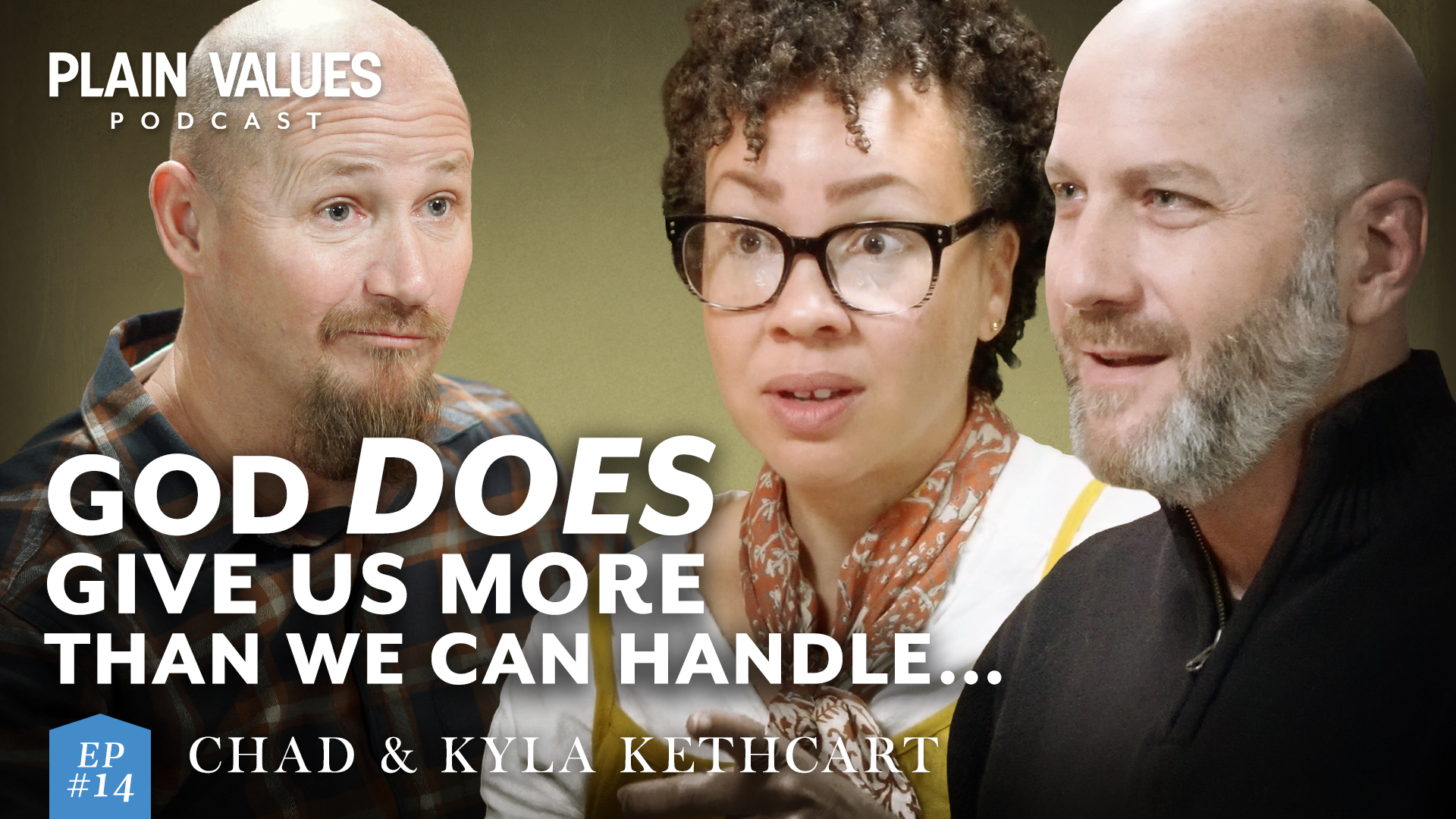
Chad and Kyla Kethcart’s journey began in the creative pulse of Chicago … he a musician, she an artist … bound by both love and struggle.
When life’s storms hit in 2020, they were forced to confront what truly mattered. Out of hardship came a radical shift: rebuilding not just their marriage, but their foundation as a family.
Over the past five years, they’ve chosen a quieter, richer path … homesteading in Northeast Ohio with their four children. Here, amid soil and song, God’s grace has written a new story of healing and restoration.
The Kethcarts’ days are now marked by creation in its purest forms: art, music, gardens, and the slow work of renewal.Welcome to the Plain Values Podcast, please meet our friends Chad and Kyla Kethcart …
Transcripts
00:00 – Introduction
02:21 – Family history
05:44 – How did you meet?
07:05 – The beginning of Chad’s faith journey: Stopping a bully
16:50 – Kyla’s faith story: Growing up going to church
17:54 – Being a biracial child in a white church and being treated differently
20:53 – Reading the dusty Bible from an aunt and Jesus capturing Kyla’s heart
23:52 – Pursuing art and music
26:06 – Is there an inherent inborn desire for truth and beauty in all of us?
33:31 – Led Zeppelin album changes Chad’s life
42:00 – Experiencing racism and relating to one another
51:31 – The moment they realized they needed to leave Chicago (witnessing a shooting)
56:52 – Child diagnosed with failure to thrive and hearing from God: “Broth”
1:02:10 – Healing and the Gut and Psychology (GAPS) diet results
1:16:02 – The despair of finding mold and lead in the home
1:21:58 – Coping and addiction
1:35:30 – One signature away from divorce when COVID hit
1:46:17 – Healing and restoration and how God uses pain
2:04:04 – Conclusion: How their journey impacted their daughters and praying for the future
Kyla Kethcart:
Some people say that phrase like, God doesn’t give you more than you can handle. Well, I don’t agree.
Chad Kethcart:
I was so brought to the end of myself that I was looking for something to hang onto and to get me through. And unfortunately, I turned to very unhealthy, very unhealthy coping mechanisms. And if the pandemic, if COVID hadn’t happened precisely and almost within hours how it was announced, it’s bizarre, wouldn’t be there. We might be sitting here, but or very likely would not be.
Marlin Miller:
I first met Chad and Kyla Kakar a few years ago at a local event, and we very quickly became friends and they popped into porch time a couple weeks ago. We had a chance to sit and talk and just get to know each other. And out of that time comes this podcast and it is a beautiful story of redemption. It is a story of keeping a family together and just, I think at the heart of it, it is a story of God’s faithfulness in a young family. Guys, please meet my new friends, Chad and Kyla Cathcart. This podcast is sponsored by my friends at Azure Standard. A while back I had a chance to sit down with the founder, David Stelzer, right here at the table, and we had a great conversation. I love the Azure story. They started out as farmers back in the seventies, and I think in 1987 they began a nationwide food distribution company. And guys, they are non GMO organic. They do it right, they do it so well, and you can get a truck to drop food right in your town. Check ’em ou*@***********rd.com and tell ’em Marlon and Plain values sent you. So hold my, where did you guys grow up?
Chad Kethcart:
South side of Chicago, suburb just outside of Chicago. I grew up in Orland Park, Illinois, and yeah, basically just a sort of ordinary middle class upbringing. Parents were together, family was together. I have three siblings and yeah, I think three for you.
Kyla Kethcart:
Yeah, I grew up in a neighboring suburb. I think for most people who don’t live in Chicago, we just say Chicago because Chicago is so big,
Chad Kethcart:
So sprawling,
Kyla Kethcart:
And there are all these little suburbs around it that just, I mean, it’s like a big massive blob. So we say Chicago land, but really technically we lived in the southwest suburbs, so I lived in a neighboring suburb to where Chad, Chad grew up. I did live in Chicago proper for a few years in my younger childhood, but yeah, that’s where we both grew up and our families are all still in that area.
Marlin Miller:
How many siblings do you guys have?
Chad Kethcart:
I have three siblings and older sister and two younger brothers, and my next youngest brother had passed away a handful of years ago.
Marlin Miller:
Really?
Chad Kethcart:
Yeah. I’m
Marlin Miller:
Sorry.
Chad Kethcart:
Yeah, thanks. Yeah, and that was from addiction, from his battle with addiction, and that was difficult. My mother passed away a year before he had, so not all my family is around.
Marlin Miller:
So your dad is still in Chicago?
Chad Kethcart:
He is. Or in the burbs, right? He’s in that area. Okay.
Marlin Miller:
How old were you when your brother passed?
Chad Kethcart:
How old was I? Well, that was 2020, so I’m trying to do math. I’m 49 right now, so
Marlin Miller:
44? Yeah.
Chad Kethcart:
Okay. Yeah.
Marlin Miller:
Wow.
Chad Kethcart:
Yeah, that was an intense time. My mother had passed away from quite a long battle with cancer, and so there were at least seven, eight years of decline. Then my brother passed away a year after she passed.
Marlin Miller:
How about you?
Kyla Kethcart:
I have two younger sisters. I’m the oldest of three of my mom’s children. I’ve got a complicated family. I have an older half-sister. We have the same father, different mothers, and she would come and stay with us in the summers to visit. But in my mother’s house, I’m the oldest of three girls, and then found out later that I also have other half siblings I’ve never met before because my parents split when I was pretty little and father went off and had other family experiences, I guess. So yeah, I haven’t met some of them and I honestly don’t know how many there are, but the ones that I do know, all sisters? Yep.
Marlin Miller:
All sisters?
Kyla Kethcart:
Yes.
Marlin Miller:
No brothers. Wow.
Kyla Kethcart:
Well, the ones that I am aware of. Yes. Right.
Marlin Miller:
Yeah. So how did you guys meet?
Chad Kethcart:
I was working at a family owned record store, and I worked there with one of her best friends and she and I met Kyla through her. Kyla had come into the store at least a couple of times, and I was playing drums in a band and there was a gig downtown that she came with her friend to. And we started hanging out with one of my best friends at the time, and the four of us basically started a bible study together. I was just recently become a Christian, and so did my friend Ryan, her friend had, she had come from a Christian home and upbringing and Kyla more. And so the four of us started a Bible study together, and that lasted a couple of months throughout that. Throughout the summer. Yeah.
Marlin Miller:
So how did you get saved?
Chad Kethcart:
Yeah, I guess in a nutshell, by the time I hit high school, I thought that all religion was brainwashing. I kind of grew up in a non-practicing Catholic environment, and so we went to church two or three times a year, sometimes maybe more, but went to Catholic school as a child and then went into the public school system and public high school. And when I started band, I actually started playing drums right before I went into high school. And a guy that I became really close friends with was a percussionist. And when I started band in sophomore year of high school, that was the first experience I’d ever had. I did not play drums in grade school or anything like that, or percussion or being band or anything like that.
The guy that I became really good friends with, he took me under his wing. He taught me how to read music. He taught me a lot about technique. And we became really close friends, and he was picked on a lot in high school, and I was on the football team at the time, and I had put a stop to some bullying that was going on from someone in particular. And so that just kind of cemented our friendship. And he told me at one point that he was a Christian, and I thought to myself, oh no, he is one of those. He, and I think it was probably about two years of hanging out with him and having late night conversations with him and his mom and just talking about things where I just remember thinking all the time. Very often I would just think I didn’t know these things.
I had never heard them before. I didn’t know that the Bible was like that. I didn’t know that Jesus was like this. I’d never heard that. I’d never heard the gospel, really. I just never heard it plainly presented to me in a way that really affected me, that stuck. And even through all of my meanderings and the things that I was trying to figure out, those things started cementing themselves. And I remember defending Christianity in diners and late night conversations with friends and then being like, wait, why did I just do that? What am I doing? I don’t know if I believe this. Yeah.
Marlin Miller:
So you stuck up for your friend.
Chad Kethcart:
Yeah.
Marlin Miller:
And man, that is so cool. How do you think it changed him to see you stick up for him? He doesn’t know that I did that. He doesn’t know? No.
Kyla Kethcart:
Well, he knows now.
Marlin Miller:
Yeah, he might. So you did, was it perhaps someone on the team?
Chad Kethcart:
No, it was actually just somebody in the locker room before gym class that was kind of relentlessly picking on him.
Marlin Miller:
Were they picking on him because he was a Christian?
Chad Kethcart:
No, no, just that he was kind of a geeky kid. He was not
Marlin Miller:
Just in that crowd,
Chad Kethcart:
Just not in that crowd. And he was not friends with any of them. And he was an easy target for some people, unfortunately, as these things go. And so since I had a connection to this kid through football and through athletics or whatever to some degree.
Marlin Miller:
So he had no idea?
Chad Kethcart:
No, I think, yeah, I never told him that either. That’s interesting. Was like that stopped and yeah, it was something that he never really knew about, but we became really, really close friends. I just remember defending him because I valued his friendship.
Marlin Miller:
That’s cool. So then what actually led you to make a change?
Chad Kethcart:
To follow Christ?
Marlin Miller:
To follow Christ, to go there. That was a horrible way to ask a question.
Chad Kethcart:
Yeah. Because I think as we talk further, it’s interesting that I do believe that I gave my life to Christ when I was about 20 years old and I was at Northern Illinois University with him, and he was studying percussion and composition, same kid, same kid. Ended up going to music school and I was visiting, and I feel like at a certain point, I didn’t need any more information. I had felt like I had looked into, and I am just this way. I ask a lot of questions. I had read a lot of dystopian fiction. I had a lot of feelings about society and about culture and religion and philosophy, and these were things that I was also beginning to study in school and out. I was taking world religions classes and Philosophy 1 0 1, and I started really interacting with these thoughts and going to use bookstores and getting books to philosophers.
And I was really interested in these pursuits. And I finally realized that I had this really jaded sense that I didn’t like people, that I had a lot of criticism and cynicism and about society as a whole. And Jesus offers the solutions. They really are the deep rooted heart solutions. And that is what really reached me and got to my heart because I saw that there were problems and I wanted to push them away and say, well, it’s people. It’s people. Well, it is because we’re all fallen short, and that he offers a way to restore and redeem. And that was what was really powerful for me. And David walked me, he walked me through so many analogies and through scripture, and I just felt at a certain point that I didn’t need any more information. I felt in my heart that he was who he said he was, that he shed blood on the cross, his resurrection. It does stand out more than any other philosophy, any other belief system or worldview. And
Marlin Miller:
So you, boy, this is interesting. Okay. When we first met Chad, I’ll never forget it, you said something that I’ve never heard anybody else say that Brave New World is the most influential book that you’ve ever read, other than the Bible, obviously, but Huxley, and that shocked me because, well, I think we talked about it a bit, but you had been reading all of these other things, dystopian Orwell and Huxley and probably Asimov and I mean a whole bunch. Do you think that, like you said, it jaded you. Do you think that’s what it was that jaded you towards people?
Chad Kethcart:
I think so. I think that there was a component of that for sure, because there was such harsh criticism, and especially a book like Brave in a World ends very dismally and with despair, and fatalism really is sort of the
Marlin Miller:
Result. I mean, they just take off into the unknown and hope it goes well. I mean, it’s kind of like, what, okay, what are you going to do? You’re going to die. And then that’s it. It seems like
Chad Kethcart:
It, anyway, I don’t know. Or that you’re destined to just give yourself over to the machine, to the whims and to your failings.
Marlin Miller:
What did they call the drug? Som? So Soma. Yeah, that’s right.
Chad Kethcart:
Soma. Yeah.
Marlin Miller:
So you had been studying all these other faiths, all these other philosophies, nothing fit like Jesus,
Chad Kethcart:
And I didn’t want it to, I was really just thinking to myself, well, this is what I was programmed to believe to a degree, since I was a kid, since I was young.
Marlin Miller:
All the other things,
Chad Kethcart:
No, just kind of coming up through Catholicism and my experience with Catholicism, and I just thought, well, I’m supposed to believe this. And this was just at the time, my mindset, because I just thought, well, it’s what I grew up with, so I’m supposed to believe this, so I’m, there’s a temptation to just reject it. I got it. I’m sorry to just
Marlin Miller:
Right.
Chad Kethcart:
Rebel against that
Marlin Miller:
And rebelling against what you grew up with.
Chad Kethcart:
I got
Marlin Miller:
It. Takes me a little bit. Sometimes I get it now.
Chad Kethcart:
No, yeah, I wasn’t explaining that. Yeah.
Marlin Miller:
Okay. That makes much more sense. Wow, you, Kyla, how did, so you guys met in college,
Kyla Kethcart:
Right?
Marlin Miller:
Yes.
Kyla Kethcart:
In
Marlin Miller:
College. Did you date for a long time, college age? College Asian?
Kyla Kethcart:
Yeah. We dated for about four years before we got married. We crossed paths a lot because of where he worked, and I liked music and he was at the register. And it’s funny to think I didn’t go into that store and buy that CD that day thinking this is my future husband. It didn’t register at all. So we kind of crossed paths a few different times, and then more formally when my friend worked there and we were all wanting to study the Bible together. So my friend and I both grew up in Christian homes, so I grew up going to church. I was in the church from the time I was a baby, and my grandparents went to that church, and it was really just a vital part of our family life. And so I grew up memorizing the verses and singing the songs and a little bit about my family and me personally. My mom met my dad in high school, and it was during a time when interracial relationships were not really acceptable socially. And so she was kind of like the black sheep of the family and the church. And so she has me. And so I’m the product of this relationship. And because my mom was the black sheep of the church, I was sort of like the black sheep’s kid. So I
Marlin Miller:
Never, the black lamb
Kyla Kethcart:
Exactly. I never, or really like the black and white lamb, the spotted lamb. I never really felt like I fit in. We weren’t in the same demographic as a lot of the people we went to church with. So I grew up singing the songs, memorizing the verses, and feeling a disconnect with the way we were being treated by people.
Marlin Miller:
Can I pause you?
Kyla Kethcart:
Yeah, sure.
Marlin Miller:
Were you a black child in a white church or a white child in a black church?
Kyla Kethcart:
I was a biracial child in a white church.
Marlin Miller:
Okay.
Kyla Kethcart:
Sorry.
Marlin Miller:
That’s what I meant, obviously. Yes. Okay. So you were in a white church. I got
Kyla Kethcart:
It as a biracial child, but I also lived in a black neighborhood. So I’ve had this unique experience of not ever feeling like I fit in anywhere,
Marlin Miller:
And you’re crossing all these boundaries,
Kyla Kethcart:
If
Marlin Miller:
You will. Okay.
Kyla Kethcart:
Yeah. So I have this vivid memory. I was probably five. I was really little in church, and the old part of our church had these stained glass windows. It was like a non-denominational church, so it wasn’t imagery and it was just panes of colored glass. And I remember all the kids are playing, and I’m kind of off by myself playing in these windows. And I would step here and the yellow pane would shine. I would look at my skin and be like, I’m yellow. And then I would step over here. I’d be like, I’m blue, and I end up becoming a painter in life. And so color has always been special to me, but not in, I mean, it’s more of a feeling. It’s certain we were talking about that word. What does it mean? It’s at that it thing that you can’t quite explain.
But color was like a language to me, but it wasn’t because of race. So I just had this different experience. And now as an adult looking back, I think God has used that to help me to see myself as God’s child. I grew up in this broken home situation, dad’s not around. And while that is difficult, it created a lot of difficulty and dysfunction and trauma. Even in my growing up years, God used it. God used it as a way to pursue me and to help me understand that I’m seeking something that is not on this earthly plane. I’m seeking something that’s eternal. And so God provided father figures in my life who fed into my spiritual understanding and my spiritual walk still grew up going to church. But around the time I met Chad, I was also questioning, do I believe this because this was how I was raised, or this is what my family believes, or is it truly mine?
And when I graduated high school, my aunt had given me her Bible as a graduation present, and I went away to college, and I brought that Bible with me. It got packed in my stuff, but it was under the bed, under the bed. But every year I would pack it, bring it back and forth. It traveled with me. And then finally, when I was probably about 20, so sophomore, junior year of college, I would say, and I’m studying art. I remember one day thinking, I can talk to people all day long about painting, painters, art, history, technique, all this stuff. If somebody came up to me and they asked me a question about Jesus, I didn’t know if I could answer it. So that was the beginning for me. Like, well, how do I answer that question? I crawled under the bed, pull out this dusty bible.
Literally I had to brush the dust off of it. And I started reading. I started reading the New Testament, and I didn’t stop. I read it all the way through, and then I started over in the Old Testament, and because I wanted to answer a question, but in the process, Jesus captured my heart and really showed me his love, his faithfulness, and I was hungry for, I just wanted to know him. And I think all my whole life, I’ve always sought God and truth and beauty and the things that are good always had a heart towards God. But it took a little while, and really, I made a profession of faith as a little child. I asked Jesus in my heart, I was probably five. And I’ve had a series of events in my life where it was almost like a check-in, like, do I still want to walk with you, Lord?
Yes. Okay. Do I still want to walk with you? I’m not so sure. I might want to check out these other things. And he let me, time goes on. And again, do you still want to walk with me? Yes. And I meant like 100%, yes. Christ alone, where I’m at in my life right now. And as we’ll share some of our story and how I got there. But Chad and I met during that time where we were all, even though our faith upbringing was different, we were all kind of asking the same questions and all just very hungry to know Christ in a real way and not just a formulaic way. So we started studying the Bible together and totally friends, friends getting together. There wasn’t romantic interest or anything like that. That took some time. And then one day we just realized, oh, we kind of spent a lot of time together. Maybe we will date. And it was right before I went off to finish my senior year of college that we officially started dating. And I was on a track to go to grad school. And so right after graduating, so our dating years, four years, we were apart most of that time.
Chad Kethcart:
Really? Yeah. It was long distance for almost all that time. So you did go to grad
Kyla Kethcart:
School? I did. You did.
Marlin Miller:
Got your master’s.
Kyla Kethcart:
Yep.
Marlin Miller:
PhD.
Kyla Kethcart:
No,
Marlin Miller:
No,
Kyla Kethcart:
Nope. I got my Master’s of fine Arts from Indiana University. And then as soon as I finished that program, my goal was to teach at the college level. That’s what I wanted to do with my degree. And we got married that summer that after I finished, and then Chad began his graduate program at the same university. So he kind of joined me. That was in Bloomington, Indiana. He joined me there. And then he had three years of his music program, and we kind of had this, this is what we’re doing, this is the path we’re on. We’re going to do art, we’re going to do music, we’re going to do this thing. And then life throws you a curve ball
Marlin Miller:
And you end up in Millersburg, Ohio
Kyla Kethcart:
Eventually.
Marlin Miller:
The hub. The hub, exactly. Of much art and music.
Kyla Kethcart:
There’s much some things, but it’s different. Yes, yes.
Chad Kethcart:
Yeah. It took some time for us to get here. We actually moved to Columbus for about almost 10 years after we left Bloomington, after we left graduate school. So yeah, we spent about nine years, almost 10 years in Columbus, and we actually made a decision to move there primarily for a church community. And so to the chagrin of our instructors, professors, that all thought we were LA or New York? No. Or Chicago. Or Chicago maybe, but you should be. Those are the three big markets. Three big ones. Yeah. Those are the three big
Kyla Kethcart:
Markets. I think the phrase was, you guys are choosing to move to a cultural wasteland.
Chad Kethcart:
Yeah. Literally, somebody actually said actually that to
Marlin Miller:
Us now, in defense of Columbus, it’s not an utter wasteland.
Chad Kethcart:
It’s a wonderful city.
Marlin Miller:
It’s a great city. I don’t know it that well, but it’s a great city.
Chad Kethcart:
Yeah, I think this just sort of is indication of the kind of perspectives that you would get sometimes from
Marlin Miller:
It’s
Chad Kethcart:
Voices. It’s
Marlin Miller:
Not in New York. So let’s go back to something. Okay, sure. Kyla, you said that you were always seeking truth and beauty and art. You guys both live in that world just in every way. I think. I mean, from what I know of you guys do, is there an inherent inborn desire in all of us?
Kyla Kethcart:
I love that question. I love that question because as a teacher, as a professor at times and just interacting with people when they find out, oh, you’re an artist. Oh, well, I’m not creative at all. And I love that because I mean, the Bible starts out with creation, and we are created in God’s image. God is creative, so therefore we are creative. I think there is an inherent automatically thing in us. It’s just expressed in different ways. And I remember talking to a family friend who is a math professor, and man, that woman, she loves math. When she would talk about math, and I was like, you’re an artist. I mean, my brain doesn’t work that way, but I saw that’s how her creativity was expressed in numbers.
Marlin Miller:
So our oldest son, he has a lot of trauma. He is diagnosed. He was diagnosed at 15 or 16 being on the spectrum, and I’ve asked Bryson many times, how do you see the world? He has an ability to memorize things that the serrations on a T-Rex is 13th tooth or something. I am probably exaggerating, but I’m probably not. And here’s how he defines it. He says, I basically see the world in photos, in pictures, and I don’t really know what that means other than I think he sees everything around him in a very different way than what I do, which is great. That’s fine.
Chad Kethcart:
Yeah.
Marlin Miller:
But math, do you know John Lennox? John Lennox is a polymath from Oxford. He’s actually, I fear he’s close to going home. Lennox is a brilliant everything. He’s just amazing. But he talks about math in that way where the beauty and the simplicity of math proves intelligent design and things like that. Did you have to nurture that in yourself, or did that just come out as you were growing up, did the art, and I am not that artistic, obviously. How does that work?
Kyla Kethcart:
Well, I think people have certain inclinations. I’ll say that even a young child, they organize their toys or they do these little things, and you might see creative patterns in what they do, or we have some of our seem to be musically inclined. They have an ear, maybe more so than an eye. And so I think it’s kind of one of Chad’s favorite phrases, which I’m sure he’ll use at some point, is it’s a both. And there isn’t an either or there are. So you can apply that both and phrase to so many aspects of life. I think that it’s in there and it does need to be nurtured. I studied, I learned, I grew up in a creative household. My mom is also an artist, a self-taught artist, but she didn’t, I mean, she was also a single mom working, so she wasn’t like, let me take you under my wing and I’ll show you everything.
I didn’t formally learn art until I went to college. That was the first time I had taken a painting class, like an oil painting class. There’s a lot of discipline, learning technique, practicing, practicing. I mean, you really do devote a lot of your time and attention to honing a craft or a skill. So I think it’s both. Do I think you need that in order to be considered an artistic person? No. My degree is kind of just like a piece of paper, really. But it came with a lot of experiences and teachers that I found helpful.
Marlin Miller:
So for you, being creative was a totally different direction, and yet not in a way, I mean your artistic, this is a bad question. Where did your music take you?
Chad Kethcart:
Yeah, no, I think that’s a great question. And I think it’s always taking me places. And as Kyle was talking, I remember from some of my earliest memories are actually melodies, whether it was the song something by the Beatles or the song Windy, and I can’t remember who did that, but there were melodies that my ear gravitated toward when I was a little kid, and I remember making drum beats and clicking my teeth in my mouth. A lot of drummers I found out actually are do this. They would make drum beats with kind of clicking their tongue on the roof of their mouth and clicking their teeth together for different drum sounds. And I used to do that on the bus to school
Marlin Miller:
As a little kid.
Chad Kethcart:
As a little kid, yeah. I just loved music. My dad was listening to the radio in the car or had records at home, and I remember putting on these huge foam over the ear headphones that I still have actually these Nova Pro headphones. And so yeah, music, it reached me. I’ve found a lot of fulfillment in music, and I can’t explain why, really. And so I think me, as far as my experience, music was always sort of carrying me along or driving me. I mean, it was a constant common thread throughout my entire life, and I really didn’t know that I wanted to play drums. I never until a certain point, I remember a vague memory of being at an uncle’s house and there was a drum set set up. I think I was very young. And I remember sitting behind there and thinking in my head, that, man, that was awesome.
I must have sounded great. I wish I could have seen a video and could see a video of what that actually sounded like. I’m sure it was hysterical. But no, that had an impact on me. And it was one fateful evening, and I think I was sixth grade. We had moved, my family had moved, and my dad had brought out his records. He put ’em in my room. I had gotten a little stereo all in one system with a turntable. And I remember at one point putting on this record that had no name on it, didn’t know who the band was, I put it on and it changed my life, and it ended up being led Zeppelin four really. So
That album really changed my life, how it hit me in a way where the music on the whole, I never really, I mean, my dad would listen to classic rock radio, but for some reason, those songs, if I ever heard them, didn’t register. It was something about the circumstance of putting the record on and listening to that from start to finish and just, yeah, that was the day that I know that I wanted to play drums. So John Bonham changed my life just as he did. For many drummers, there’s a number of them, whether there’s Ringo or Buddy Rich or John Bonham or Neil Pier to Neil Pier would be from Rush would be the next huge influence. And so for me, music, it was a deep love from the time as far back as I can remember, and
Marlin Miller:
There’s something, so, okay. Okay.
Chad Kethcart:
And your question was, where
Marlin Miller:
Is it taking me? Yeah, let’s go there in a second, but I feel like I need to ask this first. When you’re talking about the Led Zeppelin guy’s style, compared to the guy from Rush, forgive me, I don’t know the names.
Chad Kethcart:
No. Neil Pur. Yeah.
Marlin Miller:
How are their styles that different? Because in my mind, I mean obviously Led Zeppelin is Led Zeppelin, but Rush, I don’t see them as vastly different. How does that come together in your mind? That they’re That awfully?
Chad Kethcart:
Yeah. Yeah. I think Led Zeppelin very much like a blues based band, and there are similarities in Russia’s earlier stages of their career. But yeah, John Bonham’s drumming very soulful in a lot of ways. I mean, a lot of nuance. And even though he’s perceived as sometimes like a bashier and that led up and was just hard rocking band, there was a lot of subtlety. There was just a lot of nuance in the music, and especially from what I was hearing in John Bonham’s drumming, and of course his sound, a very warm fat sound, but very forceful. And then compared to Rush, where they’re definitely taking aspects of rock and roll, but they’re really mixing in and would be more considered a progressive rock band because there are more elements of classical and jazz on top of rock and folk and more complex arrangements and odd time signatures and things like that that you wouldn’t necessarily hear in a band like Led Zeppelin.
And they really, rush was the band that really sort of catapulted me into jazz and more progressive rock and more exploratory and experimental types of music. I would attribute them as a major catalyst in my experience of branching out into listening to all different kinds of music and really appreciating everything from, and where that’s taken me is I love music. I love literally every type of music. And it’s not a lot of people say I love everything, but I really do. I can listen to somebody that does 74 minutes of drone music or solo acoustic guitar or singer songwriter music to Avantgarde jazz and classical. I love Drum and Beagle Corps. There is a lot of great rap music. There’s a lot of great country. There’s a lot of great music everywhere you look. And what I always appreciated was honesty and a sincerity where you really hear somebody’s heart. I think if I’ve ever had criticism about music, it’s that maybe that the music wasn’t made from the most sincerest of place is it was just to make money or it was just to cookie cutter. Let’s just push this out.
Marlin Miller:
So I’ve been studying Rick Rubin a bit. He’s a man who loves music. I’m fascinated. I am absolutely just fascinated. Why do you think it is that some songwriters, and I think many songwriters can say things in a verse song that they maybe don’t know how to get out otherwise?
Chad Kethcart:
Yeah. Well, I think it’s interesting. So Rick Rubin, he’s someone who has said, I’m not a trained musician. I can’t read music, but I hear these things and I know how to, is it a feeling how to get things out of people? I think so. I think whether it’s an instinct or a feeling or in a case like that, I really love the word curation. Somebody who is a master curator, somebody who can hear sounds, assess talent and possibility and look at the resources in front of him and out of all the options to choose from, he’s able to really curate sounds or words or arrangements and music. And that is masterful.
Marlin Miller:
It’s incredible to me that he helped launch the Beasties and then he later resurrects Johnny Cash. That doesn’t make any sense to me.
Chad Kethcart:
Loves music. I just a love for music and being able have those sensibilities to be able to be that versatile in working with so many different types of modes of expression.
Marlin Miller:
Do you guys think that music and art are simply a way for the Lord to show us aspects of his infinity, of there is no end to the creativity? And if I can go back to something that you said over the years back, all the way back when George Floyd died, I mean all those things and everybody starts beating on the white race and the black race and all the others. Rather frustrating to me because I don’t understand how people attribute a color on the outside of our skin to us being a completely different race. I think we’re one, one race, and I think different shades of melanin on our skin, I think mean it reflects his creativity. It’s not, oh, you’re different. We are different than someone that’s black because they’re darker skin than we are. We’re the same. It’s the same. I know that I think there’s aspects to it that are very different, but underneath we’re the same.
Kyla Kethcart:
I think it’s another both, and I think it’s a both. And its a very, I mean, you could spend a lifetime exploring those ideas and people, I think you have to be careful. It’s a topic that you have to approach with care, and not everyone does. It’s hard. It’s hard to talk about that because you can’t dismiss someone’s lived experience just because you think, well, the color of your skin shouldn’t matter, or things like that. I have experienced racism in lots of different situations my whole life. And so I can only speak from my own personal experience. And I think what it did for me was through my relationship with Christ and understanding there’s a level playing field here. It’s like we see things, we see the finite things in front of our eyes, but we also see a reality that is beyond sight. And I think about how really we’re living in a body house in a way.
It’s like, I just happen to be in this body house. Its not, yeah, it’s not going to last forever. And so I don’t really attach a lot. This is just me personally. I’m not speaking as a spokesperson for an entire race of people. I don’t think that would be right to do. But for me personally, I have not drawn my identity from what I am in any kind of way. I happen to be a woman. I happen to be biracial. I have a white mother, I have a black father. I happen to be married to a white man. We have daughters. We grew up in a city, we live in a rural place now. It’s like these are all just sort of details of our lives, but there is something that is beyond the limits of this frame that I’m sitting in, that I feel like that’s where we are able to connect. I can look at you and call you brother from the minute we met and started talking. It was like, Marlon is my brother. And I genuinely believe that and feel that.
Marlin Miller:
So is the brokenness that is that as far as the bickering and the fighting because of a skin color, I mean, can it be that simple that it’s just simply and an effect of our sinful natures?
Kyla Kethcart:
I think it’s a part of it. I can’t say it’s simple. I think it’s very complex. But yeah, I think that especially, I mean, we live on this world, and so we’re in a physical place. We’re in this timeframe, this timeline. We only have our experiences, and I think really at the heart, people want to be seen. People want to be loved. People want to know. It’s like we all have the same basic human needs for belonging, acceptance, all of these things. And
People have different experiences of that. And I think we tend to just focus on what we can see in front of our face and not really look beyond that. And so I feel like Christ offers an opportunity to learn how to look beyond the finite. And so Chad and I, as you were talking, this is a little off topic as you were sharing your experience of music, it dawned on me all of a sudden I remembered how did we transition from being friends, studying the Bible together, to dating, to knowing this is my person. And I all of a sudden remembered that you were trying to see what I saw, and I was trying to hear what he heard. He’s explaining time signature sequences to me, and I’m not a numbers person. And so I’m trying to follow along. He’s clicking his tongue through the roof of his mouth. He’s moving and tapping, and I’m like, I think I get it. I don’t know. I’m trying to explain to him colors. I see he’s colorblind. I’m colorblind. Oh, no, you’re not. He is.
Chad Kethcart:
It’s like severe red green colorblindness.
Kyla Kethcart:
Oh, we were hiking, and I see this, I think it was a leaf or something that was like, look at that. And he’s like, what? He couldn’t see it because he didn’t see the color contrast the way that I did. And so we had this experience of really, I was genuinely trying to understand and hear what he heard, and he was genuinely trying to see what I saw. And I think that’s almost like a little glimpse of the finite or the infinite beyond the finite. We were aware of our limitations, but we were still trying to connect in this other way. And I feel like that was the moment that I think this is my person.
Chad Kethcart:
Gosh, we’ve all been through so much I think in the last handful of years, and we could spend a lot of time talking about these aspects. And I think my feeling has been just feeling heartbreak in so many ways because my heart in this has been that there is so much truth in life experience and the unfairness of things and injustices, and people are looking for those things like peace and justice and identity. These are words that are really being tossed out and that people are aligning themselves with causes. And I think what I just at a point remark to myself, I was like, what am I not hearing about very much? And it’s love,
Frankly, whether it’s a politician at a podium or the media or whatever, in the information sphere and everywhere, people are getting pummeled with messaging. And I feel like as a musician, I mean, I’ve shared the stage with people of all different races and walks of life. And when there are common purposes and common goals that are much larger than yourself, and I’ve seen this and I’ve seen this in areas of recovery. I’ve seen this in collaborative areas of artistic endeavor, whether it’s music or different artistic expressions. People really can be one and work together and find common ground and half peace and have a sense of love and community. And that has I, I’ve always just always innately felt that with music, even just seeing like this is music often created by groups of people.
Marlin Miller:
You don’t care.
Chad Kethcart:
You
Marlin Miller:
Don’t care. You don’t care. When you’re focused on one thing. Now is that what happens when Jesus enters the picture? Is that what happens? Because all of a sudden we realize, Hey, guess what? We’re all broken.
Chad Kethcart:
Absolutely.
Marlin Miller:
We’re all broken. And that’s okay. He loves us anyway. And you turn your attention off of you’re white and all these other colors, and it fades into the distance when you’re looking at him. I mean,
Chad Kethcart:
If we’re told that we are new creations, if we’re new creations in Christ and our identity isn’t him because of what he has done, what he’s accomplished, that those old ways pass away. The identity that you’ve drawn from your flesh is a completely different mindset. It’s a completely different spiritual position. And that’s what Christ offers us. A totally new economy, a totally new context of relating to one another and now having connection with him in the spirit. And that isn’t the offer of an entirely different experience of fight and the clamor and clamoring over the top of one another to claim what’s rightfully yours. And there is an appropriate place for justice, and God asks us to allow him to deliver that.
Marlin Miller:
I was going to say, all that we just said does not negate the validity and the importance of our past. Absolutely. And of our story and of our family traditions. 100%. Absolutely. I’m not saying that I think we should just ignore and just wash it all down the river. Nope, it’s not at all. It’s the both and right.
Chad Kethcart:
It’s not
Marlin Miller:
Just Chad. It is both. And it’s fascinating. It’s absolutely fascinating. Okay. Let’s shift gears a little bit. Okay. You guys have how many children? Four. Four.
Chad Kethcart:
How many? Four daughters. Four
Marlin Miller:
Daughters. And how old are they?
Kyla Kethcart:
They’re 16, 12, 9 and four.
Marlin Miller:
Okay. So can you tell me the story of the moment that you guys realized that you needed to leave Chicago or big inhale? Is there a lot of context that should be shared first? Yeah, there’s some context before.
Chad Kethcart:
Yeah, there is some. I think the very moment, and this was after we lived in Columbus for almost those 10 years, we actually went back and lived in the Chicago area for about five years. And the reasons for that are I think an important part of our story and journey that has brought us here. But the specific, I think moment when we decided that at that point, and this was shortly after COVID, after the George Floyd rioting and things like that, and some of the unraveling that was beginning, I was sitting at an intersection, the first car to make a left hand turn at an intersection not far from our house. And two cars went screaming through an intersection just shooting at one another. And were
Marlin Miller:
They side by side?
Chad Kethcart:
No, they were one in front of the other came flying through in succession, through the intersection right in front of us perpendicular. And they were just shooting at one another. And I think that that was the moment for us that we just decided, I think it was time. It was time to leave that area. You
Marlin Miller:
Guys were both in the
Kyla Kethcart:
No,
Chad Kethcart:
No,
Kyla Kethcart:
No. Chad
Chad Kethcart:
Was with our, no, I was with two of our daughters,
Kyla Kethcart:
Our oldest two. I had just had our youngest. So I was at home with the baby and our little middle, and he was with our oldest daughter and our bigger middle, older middle. And I had no idea this had happened. They come in pretty shaken. And we had already decided before that point that we wanted to leave. But that was the moment where we left with no regrets. Where it was like, okay. Yeah,
Chad Kethcart:
It was tough. I mean, with family and friends there. It
Kyla Kethcart:
Was not an easy decision,
Chad Kethcart:
Not an easy decision. And part of what was factoring into that decision as well was wanting to get back to Ohio, close to friends that were here and that we’re actually living themselves more of a home studying lifestyle. That
Kyla Kethcart:
And in community
Chad Kethcart:
And in community there, homeschool co-op things going on there. There were a number of friends in the area that we would be able to reconnect with. And that’s part of a long arch of really our oldest daughter and things that had been going on with her health-wise, really since birth. We found out around six months old, that led into us deciding to move more toward Homestead lifestyle. Mentioned this came up in conversation before with you that Kyla, after we had visited the friends that we decided to move close to, they were doing homesteading farming type things. And we left after visiting with them. And Kyla asked me, what do you think? And I just said, I appreciate what they’re doing. It’s really awesome. Don’t ever ask me to do any of this. Don’t ever ask me to be a farmer. I don’t really ever want to do anything like this. We had always lived close to cities, and I was often playing in a lot of bands. And I had just actually been able to play professionally drumming for a Broadway theater production in downtown Chicago. And COVID had shut that down completely. So yeah, we were in a position to make big changes at the time.
Marlin Miller:
So what’s the backstory on you starting to do the research that you did that drove you to think outside of the box?
Kyla Kethcart:
It’s funny because it’s like, how do you end up on this track going to school for art, going to be a college professor, do all these things to being a homesteader in rural? There’s got to be some, and I often think about the fact that my art background helped me to think outside of the box. I don’t think that I would have done a lot of the things that I had done had I not been skilled in thinking outside of the box. So I don’t feel like they’re totally separate. You had asked something a little bit ago about, or made a comment about how art and music is just a part of our lives, and it is. We may not be in those big cities doing the thing that we thought we were going to set out doing, but it is woven into how we live.
I am an artist. My art expression is in our life, in our family life, and in being able to make some decisions about health that I wasn’t brought up with, I had to ask a lot of questions and be willing to take some risks even to find different solutions. So when Chad and I, early in our marriage, we had a conversation about family, having a family, and he thought, you know what, I think, what would you think about you being home with your kids, with our kids? And I said, yeah, that sounds good. And I’m thinking, idealistically, but I could still be an artist and a mom and I could still do all of these things. And he decided, I want to make sure that we get good health insurance and all these things. So he pursued a corporate job. So he’s doing his corporate job and I’m home with our kids. And our very first child, our entrance into parenthood was with a child that had very complex medical conditions, like multiple complex allergic type conditions, and she was diagnosed failure to thrive. We didn’t know that she could eat food. We were actually told she’s allergic to all food.
Marlin Miller:
You didn’t know that she could eat food.
Kyla Kethcart:
That’s what we were told. We’re not sure she was an infant. She was still breastfeeding at the time. So we’re introducing solid food. It was when we saw something as seriously wrong here,
Chad Kethcart:
Suspect and having serious reactions to
Kyla Kethcart:
Suspect food suspect that was, I suspected things even before feeding her. But once we fed her solid food, it was like boom, everything turned completely upside down for our family. And we were told she might not be able to eat food at all. So that’s a lot. You’re thinking, well, how is she going to live if she can’t eat? So we were encouraged to put her on a medical formula that would be basically her nutrition indefinitely. It would be like, this is how she will survive. And at the time when you have an infant, you don’t really think too much about that. You’re like, okay, well we’ll give her the formula. I wasn’t thinking she’ll be a 20-year-old on this formula. We weren’t at that point yet. So anyway, we put her on the formula, and that was a point where we really saw God provide for us in a big way because it was very expensive. It’s not one you could just buy at the store. It had to be through a prescription. And it would’ve been like at the time, $800 a month just to feed her just
Marlin Miller:
Her 16 years ago.
Kyla Kethcart:
16 years ago. 16 years ago. Oh
Marlin Miller:
My goodness.
Kyla Kethcart:
Oh yeah,
Marlin Miller:
That’s a couple grand today. I mean,
Kyla Kethcart:
I don’t even know what it would be today. I mean, I’m sure it’s increased in price. And we were like, what are we going to do? We don’t even spend that much money on us. This was a lot. And God provided complete coverage for that medical formula through the state of Ohio. So we’re like, wow, so grateful. And she was doing okay, and we’re managing all of her allergies. And I thought I was going to be the mom. That was the free spirit, artsy mom. Kids just get dirty. Let’s have fun. And I had to turn into the neurotic, afraid of a crumb mom and micromanaging everything. Every situation and every situation involves food. When you realize food is sort of a threat, and then you notice, well, food is freaking everywhere. You can’t avoid it. So it was really difficult. And then we end up having our second child, and I was thinking, how are we going to feed our family?
What if the second baby has the same allergies? Or what if she doesn’t? It just didn’t feel sustainable. And I had a lot of questions about just practically how to do that. And so when our oldest daughter was about four years old, our second was about six months old, and our oldest daughter had a food reaction where she almost died. And I mean, it was a horrible experience. A lot going on, and I’ve had a lot of years to heal and process it and everything. She was stabilized, but she wasn’t the same after that. Thankfully, we were in the hospital when it happened. So there was care for her there. But after we got home, she was just declining and not doing well at all. And I cried out to God. I was just like, God, help me my child. I don’t know what to do.
And I felt this impression, it’s hearing from God, but it was like this impression on my heart broth, and it was loud, and I’m like, broth. And I was familiar with the Western, a price nourishing traditions type way of eating. We had a friend years ago who had mentioned, just put this little bug in our ear that you can heal with real food. And we had never heard that before. So these things were at least on my radar somewhere in the archives. And I knew it had to be real food broth. And so I was like, okay, broth. She needs broth. It has to be homemade broth, and I can’t go to the store and get it. Why? So I Googled it. That was the next, was like, go to God. And then I went to Google and I was like, broth. And this was before people really knew about, it’s a little bit more like in the mainstream awareness now, which is awesome.
But I looked it up and I saw Broth has all these healing properties for your digestive system, the collagen, the amino acids, all these things. And I’m reading about it. And I was like, huh. And it seemed like a viable option compared to this formula that she was on. And I kept seeing this gaps Diet mentioned also, and links to this gaps, GAPS diet along with information about broth. And I found, so I’m curious. I’m a curious person. I click on this link takes me to what the Gaps Diet is. It’s a healing protocol that repairs, it basically gives the body all of the tools that it needs to repair your gut flora, which in turn will affect the whole system, your immune system, your hormones, your allergies, eczema, autism, all these things. The common denominator is an imbalance in your gut flora and leaky gut, all these things. And I was like, leaky gut, that’s allergies. It’s the same description of her condition that we had heard for years, but just didn’t connect the dots until that moment. So I was literally standing in our kitchen with a can of formula in one hand, in a frozen chicken in the other hand. And I’m looking at the two, and I’m like, they offer the same thing, but this is a real food and this was made in a lab and
Chad Kethcart:
You don’t know what’s in there.
Kyla Kethcart:
Well, I could look at the ingredients and they’re not great.
Chad Kethcart:
We didn’t really pay attention to it at first, but we actually found out that some of the things in there we’re actually contributing to some difficulty that we were having with her as well.
Marlin Miller:
So we went that way. You’re holding a chicken and a can of formula.
Kyla Kethcart:
Yes. Yep. Amino acids, minerals, all of these in calcium, all these things that we need for building and repair a real stuff, a real food. And it made sense to me. And so I think I mentioned it to you. It wasn’t like I made the decision alone, but we were kind of in a do or die situation here. So it wasn’t like we had a lot of conversations about it. I was like, this is it. And also when I looked up gaps, it stands for gut and psychology syndrome, and it is a book written by Dr. Natasha Campbell McBride. And it is a protocol for repairing gut health. Hold on. Yes.
Marlin Miller:
Gut and psychology.
Kyla Kethcart:
Yes. Yes. Because your gut is connected to your brain. So for some people, they have gut distress and it’s going to express through neurological or behavioral or mental avenues. Some people, it’s expressed through their skin. It’s different for everybody.
Marlin Miller:
So your daughter was four years old, had all these symptoms that you were reading about. All this stuff was manifesting itself, and you go through and you see gaps and you’re like, check, check, check, check, check. You
Kyla Kethcart:
Just, well, the thing that really checked it for me was that number one, it was food. It wasn’t like crazy supplements or hire all these professionals or whatever. It was a clear, I mean, she wrote that book for families. She actually had, her son was autistic, and she was able to reverse her son’s autism with diet and nutrition, specific foods, healing foods. And so what really clicked for me was that that book, there was only a yellow book at that time, gut and Psychology. There was a chapter devoted to nursing mothers and weaning infants. And so there was my answer for baby number two who was at weaning age. And I thought, okay, this is going to help me figure out how to take care of our family.
Marlin Miller:
Had you had diagnosis work done on daughter number two?
Kyla Kethcart:
Just minimal. Yeah. She didn’t have the same issues, but she did have signs that her gut was imbalance. She had a lot of eczema and constipation and things just weren’t working right in her little body, but different than her sister. Wow. Yeah.
Marlin Miller:
So you used the chicken.
Kyla Kethcart:
Yeah,
Marlin Miller:
I’m assuming.
Kyla Kethcart:
I sure did.
Marlin Miller:
What happened?
Kyla Kethcart:
Well, there’s a protocol laid out, and I followed this protocol. It was one of the most challenging things I had to do, because there are no shortcuts to healing. You have to really commit to it. I did have some support online through other parents who were also going through this. The story that I read, this woman’s son had the same diagnosis as my oldest daughter. He was on the same medical formula. She had started the Gaps Protocol a few months prior to me reading her story. And she was seeing remarkable healing in her son. And I was like, well, if this mom can do it, I think I can do it. So I Did it, and we saw, I mean, just amazing recovery in her body in a very short time. But we committed to about three years of being very strict. That protocol and all of her issues went away.
Marlin Miller:
Everyone, she can eat food.
Kyla Kethcart:
She can eat
Chad Kethcart:
Food. She can eat food. Yeah. Yeah.
Kyla Kethcart:
Yep, she
Chad Kethcart:
Can. It took time, and it wasn’t like it was immediate or that things just dropped off, and so it took time.
Marlin Miller:
Did you have to, as you were introducing the broth, as you’re introducing the protocol, did you then start to drop the formula down?
Kyla Kethcart:
I actually stopped it completely because at that point she was four. I think it would be a different situation if you’re dealing with an infant. So she was four and she had a number of safe foods that she could eat. We had to try one food at a time. I mean, it’s like four years to build. What is that? Is it in Napoleon Dynamite where there’s a phrase that he’s going to build a cake? It felt like I have to build a meal. I had to build with one ingredient at a time. So by that time, she had some safe foods. It wasn’t like the formula was the only thing that she was eating. And so for us personally, we just made the decision to give her the broth because she was declining after that episode in the hospital and really wasn’t even taking her formula at all. I had to spoonfeed her. So I had to spoonfeed her something. I started spoonfeeding her the broth and she recovered. Yeah, but I mean,
Chad Kethcart:
We made radical changes. We did. And we changed all the food that was in our house. I mean, she was making every meal, three meals a day from scratch. And we up, we began buying all of our food from farms. We were going to farmer’s markets. We actually already had a sort of category for this. And it’s funny because it goes back to when we were in grad school and we were in Bloomington, and that was the first time I’d ever been to a farmer’s market in my life. And I was like, oh wow, this is interesting. Wow, this is different. And it was a great farmer’s market down there where
Kyla Kethcart:
It
Chad Kethcart:
Was, it was lively there, musicians music, it was great. And a lot of local produce and stuff like that. And so that stuck with us. And we’d had a friend that at the time had told us that he had experienced healing in his own life through alternative health therapies that he sought out. And so that stuck with us. And when she felt that God had given her this word, we did make many massive changes. And I would come home to two sink folds and the entire counter filled with the griest dishes imaginable, almost every dish in the house dirty. And it would be an hour, hour and a half of me washing dishes and at night, because she was taking care of, she was ka push. Yeah,
Kyla Kethcart:
She
Chad Kethcart:
Was white. She was wiped out.
Kyla Kethcart:
I was sling ladles of broth and meat. And I mean, there were so many things. It’s not just broth. There were a lot of there specific foods, but it was a full time job. And really when we found out about her issues, that was when I stepped away from pursuing art as a career because it really became a full-time job to manage her health even before that point with the doctor’s visits and tests. And it was a lot. So I remember thinking, okay, well my studio is the kitchen and I’m kind of doing it’s art and science and health and all these things rolled into one and three years. Seems like a long time. But it went by. It did go by fast. And I mean, the benefits are just, I mean, I wouldn’t wish to go through it again. It’s not like, oh, this was great.
It was hard, but would I do it again? Yes. Because I saw the outcome and it was worth it. So yeah, it really did change the trajectory of our life and was the beginning of thinking about homesteading really. I mean, we weren’t anywhere near here yet, but you start to see broken systems and you’re like, well, there has to be some other way than this broken system, the food system, the pharmaceutical system, all these systems were just not serving us well. And I remember thinking I would’ve paid a million dollars for somebody to tell me there was hope for my child. And in those systems, no one ever did. No one ever did.
Marlin Miller:
So I have to ask, so my wife and I are going through a couple things, not to throw her under any bus in any sense, but I have one ticked off wife right now because she’s learned things that she cannot believe that nobody ever told her before. And she’s just simply angry. And it’s good. I am not saying that it’s bad. Oh, my wife needs to, it’s great. I love it. I don’t love the fact that she’s upset, But
You get the point. We are learning things that we should have known 20 years ago and nobody said a word. How did that whole process for you just, I don’t even know what to ask because I’ve been in those situations where you’re like, okay, I know that we need help here. It’s
Kyla Kethcart:
Very disorienting when you learn a different way and you’re like, oh,
Marlin Miller:
And you don’t know where
Chad Kethcart:
To go. It was really bewildering. And I can relate to how she feels because I was angry as this went along, as we parted ways with other kinds of traditional treatment just to speak honestly. I mean, I was angry. You start finding out certain things about the way certain industries work. And again, there is a both hand here. I’m not throwing all babies out with bath water. And you find out that there are certain components that maybe are not working toward with best intentions in mind. And for me, it was bewildering because all of a sudden the entire rug got pulled out too. This was an amazing thing that was happening with the intention of healing our daughter. And everything changed very radically. Food is a big thing.
I mean, even just looking at sociologically what is and how it functions and how we gather and all these aspects about food and taste and things that you’re used to and things that you like and things that you prefer. And I, I mean, I felt anger at the world and systems and industries and finding all these people going through the revolving doors and the big machine and stuff like that. And then at the same time, building new relationships with people that were contributing. We were getting food, obtaining food from different resources from farmers and getting to know them and visiting them, and even learning about what’s in the food and what’s not in the food. Because we actually found most of the time it’s not actually the food in the food and the standard American blank just fill in the blank. And you just think that it’s supposed to be okay, this is the way it’s done. This is what we’re used to. This is okay for you. It’s safe. And I think even at the time too, and maybe this is appropriate to bring up, I was having difficulty in my coping with what was going on around me just with the regular pressures of life and
Kyla Kethcart:
A traumatic event, a traumatic
Chad Kethcart:
Event that threw us again, further into a tailspin. It was very sort of destabilizing concurrently. We also, we found out that there was lead in our home from lead paint. We had a 1928 build house and old paint that we were told, it’s fine. All the houses in this area have lead paint and stuff like, well, it wasn’t okay. Our second daughter actually was testing for high levels of lead. Really? We had discovered mold in our house that we started trying to figure out what we were dealing with. And then we had massive flooding in our house and in that house, oh, the sewage flooding the sewage. We had sewage flooding, and that exacerbated the mold situation to a degree where we had to leave our home and it was a very toxic variety of mold. And so this is all going out at the same time.
Marlin Miller:
Oh my goodness, Chad, this was in the middle of her doing the healing on your oldest. Oh my goodness. All of it truly is. It was a tailspin,
Chad Kethcart:
It was a vortex of,
Kyla Kethcart:
That’s one way to describe it.
Chad Kethcart:
Yeah.
Kyla Kethcart:
Yeah.
Chad Kethcart:
Wow. Yeah,
Kyla Kethcart:
It was. Some people say that phrase like God doesn’t give you more than you can handle. Well, I don’t agree. Amen.
Marlin Miller:
I don’t either. Bull. Sorry.
Kyla Kethcart:
Baloney. Right. It was far more than we could handle and we didn’t always handle it well, is what you’re getting at.
Marlin Miller:
Yeah.
Kyla Kethcart:
None of these things are things that we would ever say, oh, we’ve done the right thing, or Look, go us. We really did it. I mean, God. And we have been brought to utter despair, utter brokenness, utter. I am so 100% aware of my limitations. And God, if you’re real, if you’re real, we need your help. And he’s done it.
Marlin Miller:
He shows
Kyla Kethcart:
Up. Yeah, he’s shown up. I want to speak to, you mentioned your wife being angry. I wanted to share something with you about how I process some of my anger. I was angry too here. I’ve made decisions taking care of my family and the decisions I made weren’t always the best ones. Then in the case of the formula even I was like, God, you provided that. I’m confused. I know you did. And it wasn’t what was best for her. This is what’s best. I had so much guilt. I was just carrying the guilt of a mother. I could have made different decisions had I known better, but I didn’t. And how do you work through that? And God spoke to me very quickly. It’s funny, you ask the simple question and you get a quick response at times. And he answered me and said, I did provide that formula for her because you weren’t ready for this next thing. And immediately I was able to lay down all of that guilt and shame and confusion and move forward and do what I needed to do. But it was hard. It was hard. And I’ve had to revisit that a lot. Like, God, there are so many things we’re not ready for. And you look around at your life, why is this happening? Why is this? Because maybe we weren’t ready. This is our school. This is our training ground and preparing us for this next thing.
Marlin Miller:
I really appreciate that we’re in the middle of our thing right now, and that means a lot. And that’s really encouraging because we have dealt with the anger and the guilt and a lot of things. Obviously, we’re as broken as they come. And so you do the best you can, but you are going to not always make the right call. And half of the time, it’s our kids that end up paying a price and you want to flog yourself or something. It’s like, okay, this I should have known. But anyway, thank.
Chad Kethcart:
Yeah.
Marlin Miller:
Yeah, I really appreciate that. So can you talk to the traumatic event that maybe sent you down that rabbit hole? This episode of the Plain Values Podcast is being brought to you by my friends at Kentucky Lumber. Derek and I were talking this morning and he shared a story about how they like to do business and they like to do business with people that are like them and they like to be treated in a way that they treat their own customers. He told me about a customer of theirs that he had to fire, and this was not going the way that it typically does. And this guy was not being happy with anything that they did and nothing was good enough. And finally Derek said, you know what? You’ve disrespected my team enough and I think we’re done. And so you can go find your lumber someplace else. And the attitude and the heart behind the way that Derrick sees the world is exactly the way that I see the world. And I have a hunch, you might as well, if you call Kentucky Lumber, just know that they might fire you if you treat them poorly.
I’m kidding, of course. But they will treat you with the utmost respect because it’s how they want to be treated. And I think there’s a golden rule thing in there somewhere. But if you need anything at all to do with any lumber, wood flooring, wood siding, any type of wood product that has character just baked into it and a great team to match, call my friends at Kentucky Lumber. You can find th**@***********rs.com.
Chad Kethcart:
Yeah. So I mean, for me, and I think as far as the aspect of how I did not cope well with things that were going on, the sort of seeds of addiction run deep, I can look back at my life from the time I was a kid and through experiences that I had had where a hook was set with being able to escape into or feel like I could show up or I inhibitions were lowered in being able to enjoy things more with how alcohol would allow for those things. And there is this idea of that your coping mechanisms serve a purpose for a certain time to a certain degree until your coping mechanisms become a problem and become the problem. And then what do you do? Well, I think when things were really going on with our oldest daughter and there were challenges with our home with mold and lead, and we had to be out of our home.
The house had flooded, we didn’t know how we were going to fix any one of these issues. And I can look back at that time and I can say that I was so brought to the end of myself that I was looking for something to hang on to and to get me through. And unfortunately, I turned to very unhealthy, very unhealthy coping mechanisms. And this is where things had already been sort of building in that regard with my struggles with addiction, I was allowing more in. And even I can say that I even used some of those aspects to justify and to make an excuse that I need this. And even in talking about this, I do just want to say, talk about guilt and shame and you should know better. I should have and I should have known better. And I carry and deal with the guilt and the shame and the remorse, and I feel as though for whatever reason, and it’s not a justification of any of it that God has used, God has used those aspects in my life to show me things about him that though I wish I had never given myself over to those things, God has used them and made beauty for mashes in a way that I can say we’re here today because of him.
It’s not because of any putting my nose to the grindstone, it’s not because of justifying or any desire to want to share war stories or anything like that. It’s nothing like that. I began to go off the rails and I really brought my family through years of addiction. That is, they talk about it being insanity. There is no rationalization. There’s no justification for any of it. And I didn’t know how to deal with, I didn’t know how to deal with things. And so our leaving Columbus really had a lot to do with my addiction. I had carried my job through in the corporate world, and eventually I threw in the towel when things got really bad. And so I ended up going to a rehab facility in Florida for some time. And in that time, Kyle and the girls,
Kyla Kethcart:
I needed help.
Chad Kethcart:
They had already sort of left things. Things were very difficult. And after treatment, we began a process of transitioning back to the Chicago area closer to family.
Kyla Kethcart:
I was there with the girls already. So when he went, I left Ohio and went back to be close to family. I just needed support.
Marlin Miller:
How many kids did you guys have at the time? Three at that time. And how long were you in Florida?
Chad Kethcart:
It was a 45 day program, so not very long. And it was meaningful. It was significant in my story of recovery. And when I got back to the Chicagoland area, I wish I could say that I was a person where relapse doesn’t have to be a part of your story, and I so wanted that to be my story. That relapse and going back to it would never happen. And honestly, it was close to four more years of on and off. And I mean, looking back, I am sad because of how much it takes, what was robbed and how I chose that more than, and what’s interesting about this is as many people in these situations can describe, it was for no lack of help and tools and skills and love and support and support. And I had been connected with somebody who was very, and is still very instrumental in my life and part of my recovery journey. And I had been also connected with a therapist and that really shared from a Christ-centered perspective how to understand and navigate through my thought life and how to understand thoughts, emotions, and behavior and put those things in their appropriate context and understand how to organize my behavior around my commitments and values and to understand my thought life and navigating that. Not every thought that comes into my head is me, that I can learn to pause and detach, and these are all really important things that are still with me to this day, but it wasn’t.
What’s crazy is that, so I basically had been working a job where it was pretty grueling when we moved back to Chicago. And I was thankful for the opportunity and it was not what I really wanted to be doing. And at a certain point I just thought, oh my gosh, I can’t do this anymore. And I got a phone call to play drums for a major theater production in downtown Chicago that I had mentioned before. And I auditioned and I got that gig and it was an incredible experience. And talk about being able to basically use every skill that I’ve ever an instinct, every technical ability and instinct, and be able to respond improvisationally in situations. It was an incredible experience. And February 18th, 2020, I was coming home from one of those shows and was in a horrible car wreck. I was by myself, I was driving home. I was in a horrible car wreck. And there were circumstances on the heels of that that really exposed what kind of condition I really was in, how bad things really were, and how I was able to somehow very high functioning, be able to hide, be able to hide what was going on to degrees
Even from me, even from my own wife, even from Kyla and other people, and basically be around the clock drinker from the time I woke up until,
Kyla Kethcart:
I mean, it sounds crazy to say that. How could you not know? And I wrestled with that. How did I not know? I knew something wasn’t right and it was increasingly not right.
Marlin Miller:
And I’m assuming that when you say around the clock drinking, you’re not talking about a beer.
Chad Kethcart:
No, no. I mean, it was sort of anything I could really get my hands on. Unfortunately,
Marlin Miller:
February the 18th of 2020, you were in the wreck. You had come back from Florida before that, right?
Chad Kethcart:
Yes.
Marlin Miller:
So you had come back, you’d gone through rehab. How long after rehab was the accident?
Chad Kethcart:
That was almost four years.
Marlin Miller:
So that was four years.
Chad Kethcart:
Yeah.
Marlin Miller:
And had you been struggling with the all day for four years?
Chad Kethcart:
On and off for four years, and that was on top of the years leading up to even going to
Marlin Miller:
In Columbus,
Chad Kethcart:
Right? And Columbus. Yeah.
Marlin Miller:
How did your marriage survive?
Kyla Kethcart:
Well, it got to a point where I had compassion for Chad for many years. I didn’t know because he was very high functioning. We socially would drink. I never saw him drink in excess when we were together. Every once in a while he would say things like, yeah, I think I’m just going to stop drinking for a while. And I was like, okay. And then he would, but I didn’t understand that’s what he meant. So it was really under the radar for quite some time until I learned how bad it was. And I think I was even the one who was like, you need to go get help. I left Columbus with our kids, went back to Chicago, he went into this program, comes back, and it was like he’d be doing okay for a while and then not, and I’m giving him the benefit of the doubt, but it’s like living with Jekyll and Hyde, there were behaviors that I did not appreciate.
And Chad, he’s just, it’s hard to figure out how to say this. He wasn’t the abusive, the caricature of an alcoholic that you would think in your mind towards the wife or the kids or anything like that. No. It’s like he was in that torture all to himself. And sometimes we would see the spilling over of that. So just short temper or erratic behavior, things like that. But it got to a point where I realized I can’t change him. And I mean, he has a loving family, but that’s not going to make him choose. He had to choose his life. He had to choose that his life was worth living and I had to make decisions for myself. And I got to a point where I decided that our life was no longer compatible. And I started the process for divorce. And it was, I mean, we didn’t set out to get married to get divorced.
That’s not what our intentions were. And we start out Bible study and love and Jesus and all these things, and it’s like, how do you end up here where life is so messy and I know who he is inside and he’s also struggling with this thing that is insanity. I can tell you that yes, it was like a different person when I would see him in these moments. And so I made the decision that, you know what? I need some boundaries, but the boundaries have to be for myself and my kids. And so I made that hard decision to pursue the process of divorce. And I told him that being kind of afraid of what his response would be, and it was the opposite of what I feared. He wanted to go to marriage counseling and give it another shot. And I was very clear, no, you’ve had so many chances. I mean, from rehab until that point, that was sort of the chance the four years prior.
Chad Kethcart:
And there were numerous times where things were brought to chaos again.
Kyla Kethcart:
So we’re pursuing the legal route there. And he moved out and I was one signature away from our divorce being finalized when COVID hit. We get a letter in the mail that the courthouses were shut down for COVID. So
Chad Kethcart:
This is what really, this is really crazy.
Kyla Kethcart:
This is where everything comes to a head. It feels like
Chad Kethcart:
This is mid late February. And I remember I reached over to open up the last drink that I had in the house, and I remember looking over at it and saying, this isn’t fun anymore.
Out loud, out loud, I just said, this isn’t fun anymore. And I walked over and I popped it open and I poured it down the toilet. And that was the last time I ever drank. So that’s the last drink I’ve had. And thankfully that I have not, and I’m committed not to. And the theater was still going on. There were rumblings of a pandemic happening, and I would hear on the radio on the way to the shows that this seemed to be mounting. And there was something sort of serious happening here. And then things really were seriously starting to happen. She had already filed for divorce. I was staying with a friend and riding out the rest of my responsibilities and holding things together. And that show shut down. It was the last show in Chicago to shut down on March 15th. And I had had a moment where I cried out to God because I had sobered up to the point where the full crushing weight of really, really the gravity of the situation really hit.
And I was actually before, right before I had left our home, I had fallen down on my knees, cried out to God and was so undone. And I look up at the bookshelf next to me, and this was, I look at the bookshelf next to me and there’s this devotional streams in the desert, I’ll be coming. And this was Kyla’s devotional and something told me to take it down and open it up to that day and just read. And I was on my way to go out the door to get some support. And I opened it up and it was February 26th and there were no bookmarks in this book. There weren’t any bookmarks, nothing except for one. And I kid you not, it’s this, it’s a little cutout piece of paper that says, ask of him, draw close to him. I love you.
On the day that I opened this up, and I had written that to Kyla when we were dating, when we were in Bloomington, Indiana, she was at class one day. I had gone down and I was visiting, she was at class and I cut up a little piece of stationery that she had and I wrote little notes and I put ’em throughout her apartment, and I still so many layers of that. And I thought, oh my goodness. It’s like God was writing that to me. He wrote it to me, threw me. I wrote it to Kyla and I was just undone. And then at that day’s entry starts with Second Corinthians 12, nine verse, my grace is sufficient for you, for my power is made perfect in your weakness.
I’ve heard that verse so many times. That’s a famous one that’s often referenced. And to say that I heard that in a different way, that day is a total understatement. I still to this day hear that and feel that in my heart in such a deeper way and understood and a verse that has really stuck with me throughout all of this, even though even just like all the tools that have been laid out before me, with all the support and help, I just had to pick them up. I just had to pick them up. And Psalm 51, 6 has been an undercurrent where he says, you desire truth in the innermost being and in the hidden part, I will make you no wisdom. And I thought there is such a difference between knowledge and wisdom. People can tell I heard things, people told me things. They were all incredibly valuable.
And I didn’t know the difference between knowledge and wisdom. And I think that their wisdom is something is completely different. And whether it’s the fear of the Lord, the reverence for the Lord, or the experience that you’re brought through that you choose to go through and that God uses to make one, no wisdom. And so that was, I feel like a way that God spoke to me and met me in a way where I somehow had the boldness to ask Kyla as everything was shutting down after I was out of the home. And I’m hearing all kinds of strangeness about things going on. And I had gone to the grocery store around that time right after March 15th or so, and tried to get some things that were needed, like toilet paper and to see what was the strangeness that was going on. And Kyla had told me I have to honor my own boundaries to the point now where I can’t betray my own conscience, I have to be honest with myself and honor my boundaries. I had bagged, I had pleaded. I tried to see if we could do things a different way. I was willing to do anything I needed to do. And I think it was her boundaries. It was the pain, it was God’s grace and the full weight of really what I had done.
Marlin Miller:
You didn’t let him come home? Not at first. Not at first.
Chad Kethcart:
I asked, we had been talking on the phone. We were still in communication with one another because of our children and because of what was starting to take shape. I said, after I had been for a few weeks out of the home, would you consider me coming back home to, I didn’t know what was going to happen. I wasn’t sure what happening with the pandemic, but I said, would you be okay with me coming back home because I don’t know if you’re going to need some level of protection or if I can help in any way. Those are the two things. I said that, and Kyla basically said, you are the last person I would ask for help or protection from.
Marlin Miller:
Oh man.
Chad Kethcart:
And she prayed and considered what I asked. I mean, I can’t even say it was the most reasonable request, honestly.
Kyla Kethcart:
It was an insane request really.
Marlin Miller:
When did you tell her of this?
Chad Kethcart:
It was a while. It was a while after.
Kyla Kethcart:
I mean, as this was happening, it was the very, very beginning of the pandemic. So we’re talking shelter in place, wearing gloves, you can’t even see your extended family members. It was like that portion of that time period. I think as time went on, people started making different decisions, so we weren’t sure what was happening. And there was a lot increasing violence in the Chicago area that was spilling into the suburbs. So there were a lot of things, factors to consider.
Marlin Miller:
So his request you’re thinking was not out of line?
Kyla Kethcart:
No, not necessarily. And really, I mean he is even in the midst of, I would say betrayal of our marriage, he was devoted to his children and really I know that he wanted the best for all of us. And again, the both end and it was a mess. And so I did eventually say, okay, we will see how this goes.
Marlin Miller:
How did that change in you?
Kyla Kethcart:
Well, I still honored my boundaries and I was not in a place where I was thinking, oh, this is, we’re going to get back together. So we lived separately in our house. We set up a separate space for him, he had his room and I had my room and we took care of our kids and whatever he was committed to his sobriety at that point you had mentioned he was attending online meetings because no one was getting together. I was focusing on healing in my own way emotionally. And so we were just sort of like, let’s just ride this out. And then I’m thinking in my mind, things lift and we, I’ll just sign and we’re on our mery way, sign
Chad Kethcart:
The paper
Kyla Kethcart:
And the irony of it, and it is not, I mean I don’t use that word like, oh, how funny. At that time during that time period, as people were in their homes, there was an increase in divorce, there was an increase in addiction. People dying from addiction during that time period in the complete opposite happened for us where he’s coming out of addiction and God did allow for healing in our marriage, eventually took place. As I saw, he really is a changed man. He’s taking steps. And I will say we do have very clear boundaries still in place to this day. We have things that we’ve discussed, and I have lines that cannot be crossed, and that’s just part of how we live now. But God brought our marriage together and it’s truly a miracle that that happened because I was set. I’m going this way.
Chad Kethcart:
What’s really another aspect of this is that if the pandemic, if COVID hadn’t happened precisely and almost within hours how it was announced, it’s bizarre, wouldn’t be here. We might be sitting here or very likely would not be.
I can’t say looking back if we actually had gotten divorced, if we would’ve had ever gotten back together, if I would’ve made the same decisions. And though I have made decisions based on my marriage and family, I know that Jesus allowed circumstances and used pain in my life to a degree in a way that allowed me to make and make decisions and choose those things for myself in a way that I couldn’t, he did for me things that I could not have done for myself. I don’t know if we would be sitting here if that particular circumstance hadn’t happened. Exactly When it did. Exactly when it did. So I have to look back at that time where, I mean, I don’t even say this lightly, that whole event is still resounding. It will. I mean the effects that have been had on people, and I did see personally firsthand in the community, people that I was seeking support from and sobriety and recovery treatment with a lot of people fell off that went back out as they say, and maybe never came back. And God used that in my life, that situation. It wasn’t just that there were the ways that God engineered a path for me to be able to begin healing and then see restoration in my marriage and family. And we have a fourth daughter that
Kyla Kethcart:
Is a gift from the Lord.
Chad Kethcart:
It is such a gift that say the child shouldn’t have been, but I mean that’s not, she’s here and we’re here. So I can look back at that, the whole aspect of my life, and I do struggle with feeling horrible about, I mean, I couldn’t apologize enough. I couldn’t feel worse than I do, and I have to walk in newness of life that he promises and that I can follow him. He has been my strength and my ability to honor my commitments. And so I am super, super thankful for our family. And yeah, it’s hard to know what to say. I mean, to have gone through that and to have seen God provide and be the things that I could not be for myself and do the things that I could not do for myself,
That is really powerful. And I think just the whole concept of weakness, and I mean, we’re told that the meek shall inherit the earth. That meekness and weakness, not even necessarily the same things, that meekness is a quiet reserve, a restraint, a courage to not just act out and lash out. And I’ve taken that to heart in my recovery that it’s not just freedom isn’t just to do whatever you want to do, even if it means you think you’re doing something good to respond to a situation, the best of your ability or to cover something up or just be able to get through, but to not react with the first thing that pops into my head and to Paul, even in Philippians, talks about boasting and weakness so that Christ might be glorified and there is no boasting, but the boasting that in my heart I know is that he did this and that he is who he said he is.
Kyla Kethcart:
So years ago, kind of around when I first found out Chad was struggling, and I mean this is going way back, I remember laying on the bed, I think you had gone to work. We only had our oldest at the time. I had had a miscarriage between our first and second and it was around the anniversary or the day that that baby would be born. So I’m just emotionally a mess and I’m laying across the bed and I find out he’s struggling with stuff. And I remember just being like, how in the world can I even get up off of this bed and play toys with my kid? How do you do that? How do you just do normal life? I felt just completely, it was like the flavor left my mouth. The flavor of life was just gone. And God spoke two words to me, healing and restoration. And I laid there and I was like, what?
Whenever God speaks to me, it’s not like all the time, it’s usually short word and I have to grapple with it. It’s not something that I’m like, oh, thank you. It’s like, wait, what? Or I have to Google that, what I really have to wrestle with it. And so these words came to me again, it’s on my heart healing and restoration. Like, okay, well you’re going to have to show me what that means. And I had no idea the extent in our life, in our story, in our marriage, in our family, for our kids, this was before even the gaps protocol that God would make that true as a lived experience. And he just showed me last night, he was like, do you remember writing this healing and restoration? God always keeps his promises. I think I put that on paper when those words were spoken. And that was the other thing. Was it stuck in here? Did you
Chad Kethcart:
Find it somewhere else? No, I actually had it in my Bible for many, many years. I think she had it on a window ledge in our house. And I think I remember what it was when we had to be out of our house because of the mold situation. We were out of our house for months. They were in Chicago. And I was cooped up in a hotel in downtown Columbus by myself for three months. And that’s where things actually kind of really got bad for me, just left to my own devices, making poor decisions and not being able to hide out by myself. And that was not a good situation for me. But I had to pack up our entire house, our entire house to get everything out of our house, to be mold remediated. And I took that little piece of paper off the window ledge and it in your Bible and stuck it in my Bible,
Kyla Kethcart:
Haven’t. Last night was the first time I’ve seen this, and it’s my handwriting. It’s my little colorful thing and
Marlin Miller:
I’ve hung onto it.
Kyla Kethcart:
Yeah.
Marlin Miller:
Were you staying in Columbus for those three months to sell the house and
Chad Kethcart:
No, this was before. This was a period about a year before we left Columbus. Yeah, this was about a year or so before we left
Kyla Kethcart:
Columbus, basically trying to fix our house so we could live in it. But then after it’s like so many things happened that we were
Marlin Miller:
Had to go, I can’t believe I get a chance to say this in real context, was that pre flood post
Chad Kethcart:
That was post flood, that that was part of the mold explosion because of flooding. And then I was able to actually sort of secure some mold remediation for our house at the same time with some lead abatement that was happening, dovetailing one another. God was even able, I saw him providing in ways that were actually supernatural because we didn’t even qualify for any mold remediation assistance or anything like that. There was a way that it was completely covered a hundred percent. And I mean that whole house was gone over with a fine tooth comb inside and out behind walls. And I mean, I couldn’t believe what was actually happening. And wow. Yeah. So that was a situation where I had taken that piece of paper with me and it wasn’t even necessarily about me and just like that little note that I had written to her that got read back to me in the spirit. And
Kyla Kethcart:
God keeps his promises when he speaks a promise, like he keeps it. We don’t keep our promises. We try sometimes, but we don’t do a very good job of it.
Chad Kethcart:
I always, I love Kyla. She’s such a gift, such a wise woman. The things that I have seen her do, the ways that she’s spoken truth into my life, the way that the relationship that we have is special. And even despite all the choices that I made, to the contrary, I never maliciously wanted to be away from her to be out of our situation. I didn’t know things just about life and about how to respond and how to cope and how to really go to the Lord to really know how to go to him. He uses pain. He uses pain. That’s what the cross is. That is something that should not have happened. It should not have happened. And by all rights it means that iss not justice, that’s God incarnate. And he used that for the redemption of humankind, for all of humankind, for all time. And I am so thankful that we’re here today and I really do see it as a way that God healed and restored and is continually reconciling us to him.
Marlin Miller:
And so I have two questions. I have a bunch of questions, but I have two right now. Did you tell me that your dad was not in your life when you were young?
Kyla Kethcart:
That was me.
Marlin Miller:
That was you. I’m sorry. I’m sorry your dad was around.
Kyla Kethcart:
Yeah.
Marlin Miller:
How has all this worked itself out in your relationship with your dad today?
Chad Kethcart:
That’s a tough one. I don’t have a relationship with my father as of this time. And for reasons not really associated and connected, I never really had a close relationship with my dad. He was always there. He was a very good provider, hard worker, hard worker, and was a very capable man and worked on a lot of things, built a lot rehabbed. And I never spent time with him really. He never asked me to do projects with him. I didn’t really have a very close relationship with him, even though he was there and my dad has his own story and he was in Vietnam, there were a lot of ways that admittedly he didn’t know how to be emotionally available. And I love my father. I understand I category four, having grace and being like, yeah, I can understand. I am not going to condemn or judge or accuse.
And unfortunately just as time has gone on, my relationship with my father has sort of dissolved for other reasons. He actually was one of a few people who was around for me at the time when I was at my lowest and really at rock bottom that he was there for me in a way that I didn’t expect. And I take that to heart too. And in ensuing years, there have been some circumstances that have contributed to us not having a relationship at this time. And my father wasn’t one who struggled with that particular struggle and as I did. And I think that those are tough dynamics.
Marlin Miller:
So this isn’t the second question, but I have a good friend who could relate better than I could to having a dad that was a little unavailable as a way to say it. And I remember talking to him sitting in a car after midnight one night, we were on a trip together and my dad passed away about 14 years ago at 55. And I remember just encouraging him and saying, you know what? It’s never too late. Just don’t give up. And in the last two years there has been a rekindling of that father son relationship.
And so I don’t ever want to, should anybody, I don’t want to tell you what you should or shouldn’t do, but at the same time, if you don’t mind, I’m going to add you and your dad to my little prayer list. And thank you. I’m just going to, I appreciate that. Thank you. Until he’s gone. There’s always hope. And I feel a little sheepish saying that to you guys after you telling me this story because I know you know that. But I just want to remind you that your dad is still here and that the Lord can do some amazing things. Here’s my second to last question. How have you seen your journey impact your daughters?
Chad Kethcart:
Yeah. Our two oldest daughters particularly have memory of difficulty and of wanting their dad and me not being there. And so there are resounding effects and I feel like I’ve been blessed with daughters that have always wanted to be with me. And it’s not lost on me that it could not have been that way. And that I very gratefully have a good relationship with all of my girls. I love them dearly. And as things have decisions that Kyla and I have made on the heels and as part of, even as my recovery journey has resulted in me making different decisions, I had said I would never be a farmer. And before you mentioned, and now you’re in Millersburg. And so we are here in Millersburg sort of unexpectedly how we came here. I saw the place that we’re living in right now posted on Facebook marketplace, and it is a staggeringly beautiful place and we have the opportunity to do things that she has maybe always dreamt of doing. And I just more recently have found myself dreaming of doing, having,
Kyla Kethcart:
I never asked him to be a farmer. I will say that.
Chad Kethcart:
Yeah. She never asked, never asked. She just asked what I thought and I would never thought that we would be doing what we’re doing. And I think the effect that that’s had on our family is as we’ve seen and been on this path of healing and restoration, that we have an appreciation for God’s design and for stepping into things that are common here, but very foreign to us in a lot of ways. We are raising chickens to a degree from egg layers for meat chickens. And having learned how to process them ourselves, raise them and process them to now I’m caring for four Herefords. And even a friend of mine texted me, he’s like Chad Kart, like, who is this? And I am not playing music the way that I used to. This is the first time in my life I’m not gigging the way that I, Kyla had laid aside her visual artistic pursuits much sooner to make that kind of sacrifice for her family. And I it’s think of it as living a mend. I’m going to do these things as a sec. I can’t believe I actually am excited to do these things.
I mean
Marlin Miller:
Are genuinely fired up to be a bee farmer
Chad Kethcart:
To learn how to do this, learn how and going to the Food independence summit every year, as soon as we moved out here, that started up, that’s where we met you, that’s where we met you. And hearing Joel Saladin and every one of from the keynote speakers to the workshops, to all of the presentations and
Kyla Kethcart:
Really having opportunities to, I mean, you have to work as a family when you live that way. And so the last handful of years since we’ve been here, we have had opportunity to work together as a family to get things done. And there’s a lot of healing of relationships when you do that working side by side, seeing a project from start to finish, having a vision of something or having a challenge and you have to learn something, you have to learn it together. And I think that that has been, it’s played a huge role in and just being able to mend broken relationships with our kids and with each other. And I think that that’s part of the fruit that you see. I can sit here and say he’s a changed man. And I can also relate to that feeling of being like a foolish woman. Why would I choose to trust him? You know what I mean? It’s hard when you live in that situation where there’s addiction and whatnot and both. And he’s really helped me grasp that. I get it. These things that we do in our life have given plenty of opportunity for him to demonstrate that he’s a changed man. And I think that that’s key for me and for our kids. We can see the work that the work and the humility of him leaning on the Lord to be able to continue honoring his commitments.
Marlin Miller:
I feel like I read something in the end of the book about Show me your faith by my works. I’ll show you all that. I think I butchered the verse, but I think you get the point. Yeah. My goodness. Last question. How can we pray for you guys?
Chad Kethcart:
There are a lot of things that are new to us having moved out here. We love it here. Seeing being in this place and the community of people that we live amongst, and I think that we would love to be even more involved in our community. We have a desire to, as we see the way the world is going and rumblings of things about focus going on online and VR and AI and laboratory and synthetic and digital and all those things. I think for us, we really do have a value for community and we have a hope and an aspiration of if it’s possible to use where we are to use our story, to use things that have been helpful and beneficial. And if there are ways that we can offer whatever it is that God would see fit to offer through us, honestly that is something that we would really ask for prayer about.
We have thought about what kinds of really meaningful things could be ahead and what are some ways that we could step into things that we haven’t even thought of that we haven’t even imagined. We at one point had prayed and really asked for where we are right now and even the place that we’re living in, and we actually saw God provide that in a way that was exceedingly abundant, where we are shocked, astounded, and I would absolutely ask for prayer for real purpose and growth and to see things in our lives that may be greater, that would be greater than how they are now. And all the areas that we even talked about with the Marlin, I mean, could always, I mean, I need prayer in my commitments in my day to day and my learning and my just all of the areas where I just want to be a godly man and a husband and father and have integrity with what I do, what’s in front of me, and make those continual choices. So for me personally and for our family to grow and thrive,
Kyla Kethcart:
You put this book in my hands when we came and visited you last, and there’s a section in there that talks about community and the value of not seeing your hardships, your shortcomings, your struggles as unique to you, but it is something that contributes meaning and beauty and value to those around you when you share in them. And we don’t know what little roles we have to play in someone else’s story. And one thing that I would ask prayer for me personally and for our family over the last 12 years or so of learning how food can be medicine, I have felt it put on my heart to share these skills with others and around me and my community, specifically families, because a lot of kids are struggling with their health and it’s affecting their life and the whole family’s life, really. And so two years ago I had an opportunity to start teaching workshops, kitchen workshops, and specifically these skills that support gut health. And it’s just a small way to share so that these skills aren’t lost. They’re like old skills and they will be lost if people don’t share them. And so I started doing that and connecting with people and it’s been beautiful. That’s actually how you and I met at the Food Independence Summit. They gave me a table.
Marlin Miller:
You were a speaker?
Kyla Kethcart:
No, it was kind of random. They found out I had an Instagram account that I was local, that I teach workshops and they asked me to be at this meet and greet that they did a year ago, I think. And you just walked up and we started talking. That’s how we met.
Marlin Miller:
I remember now. You were behind the table.
Kyla Kethcart:
I was behind the table, but I wasn’t a speaker or presenter. I’m like, okay, this is interesting. And I don’t consider myself an influencer by any means. That’s a whole other conversation. So I’ve been doing that and then also recently decided to pursue certification to be a coach for the GAPS protocol to help people because it is challenging and especially if you’re coming at this new to the understanding that food can be medicine and some food can actually hurt you. They just need people to be willing to come alongside people and help. So I’m in the process of being certified for that and just looking for opportunities to serve the community in that way, to keep these skills alive. We feel like that would be meaningful work. And there’s something in this book about just seeing that there is beauty in those hardships and skills and valuable things to learn and share.
And one of my favorite passages of scripture that has carried me through all of this, aside from God speaking that word of healing and restoration is that God, God causes all things to work together for good to those who are called according to his purposes. All things, not the great decisions you made, not the high road you took or the highlight reel of your life that you show other people only, but those hidden and hurt things too. He takes it all and he makes it all good and good. We have to be open to his definition of good. It’s not always going to look the way we think, but that is a promise. And I mean, we are living that promise and we will continue. So we just, what does that look like for our family? I have no idea, but we’re open to really let God lead there. We’ve spent a good handful of years really pouring into rebuilding our family and we are ready and willing to see God. What do you have for us now?
Marlin Miller:
Yeah,
I have a good friend who buried their daughter about five, six years ago. She was nine. And he has told me that through the grieving process, they always knew that someday God would redeem it. They didn’t know how. And I think they still don’t know how, but I think it’s starting to become a little bit clearer for them how he’s going to do it. And I think it’s in sharing their story, and I’m not saying that’s what’s going to happen for you, but I was sitting here thinking, this is an amazing story of redemption in so many different ways. Just it is how he redeems us. And like you said, he takes every part the parts that you like and that you don’t like
Kyla Kethcart:
Sometimes, especially the parts we don’t like.
Marlin Miller:
Yeah. Thank you. Thank you for being here, for sharing.
Chad Kethcart:
Thank you so much for inviting us, Marlon. Thank you. Thank you so much. I’m blown away.
Marlin Miller:
This episode is brought to you by Homestead Living Magazine. Homestead Living is a monthly print magazine that interviews all the big names in the homesteading world and they focus and educate in a wonderful way. You can learn more and su*******@*************ng.com. In his book, Rembrandt Is In the Wind, Russ Ramsey says that the Bible is the story of the God of the universe telling his people to care for the sojourner, the poor, the orphan, and the widow, and it’s the story of his people struggling to find the humility to carry out that holy calling guys. That is what plain values is all about. If you got anything out of this podcast, you will probably love plain values in print. You can go to plain values.com to learn more and check it out. Please like, subscribe and leave us a review. Guys, love you all. Thanks so much.
Brought to you by …

🤝THIS EPISODE’S FEATURED SPONSOR: Azure Standard
Talk about a mission-oriented company, our friends at Azure Standard set the standard of excellence when it comes to sourcing nutritious food for your family.
They have a new program called “Around the Table” that nourishes by walking shoulder-to-shoulder with churches and church communities. It’s wonderful!
Learn more: https://www.azurearoundthetable.com/

🤝THIS EPISODE’S FEATURED SPONSOR: Kentucky Lumber
Our friend Derek Guyer at Kentucky Lumber is the type of guy that you want to support. He is a highly-skilled tradesman who exemplifies excellence in everything he does. Kentucky Lumber is an independent lumber yard that truly does world class work!
We would humbly ask you to support them with your lumber needs: http://www.drywallhaters.com
“WELCOME TO THE HOME OF WOOD, PEOPLE, AND SERVICE WITH CHARACTER.”




Leave a Reply