
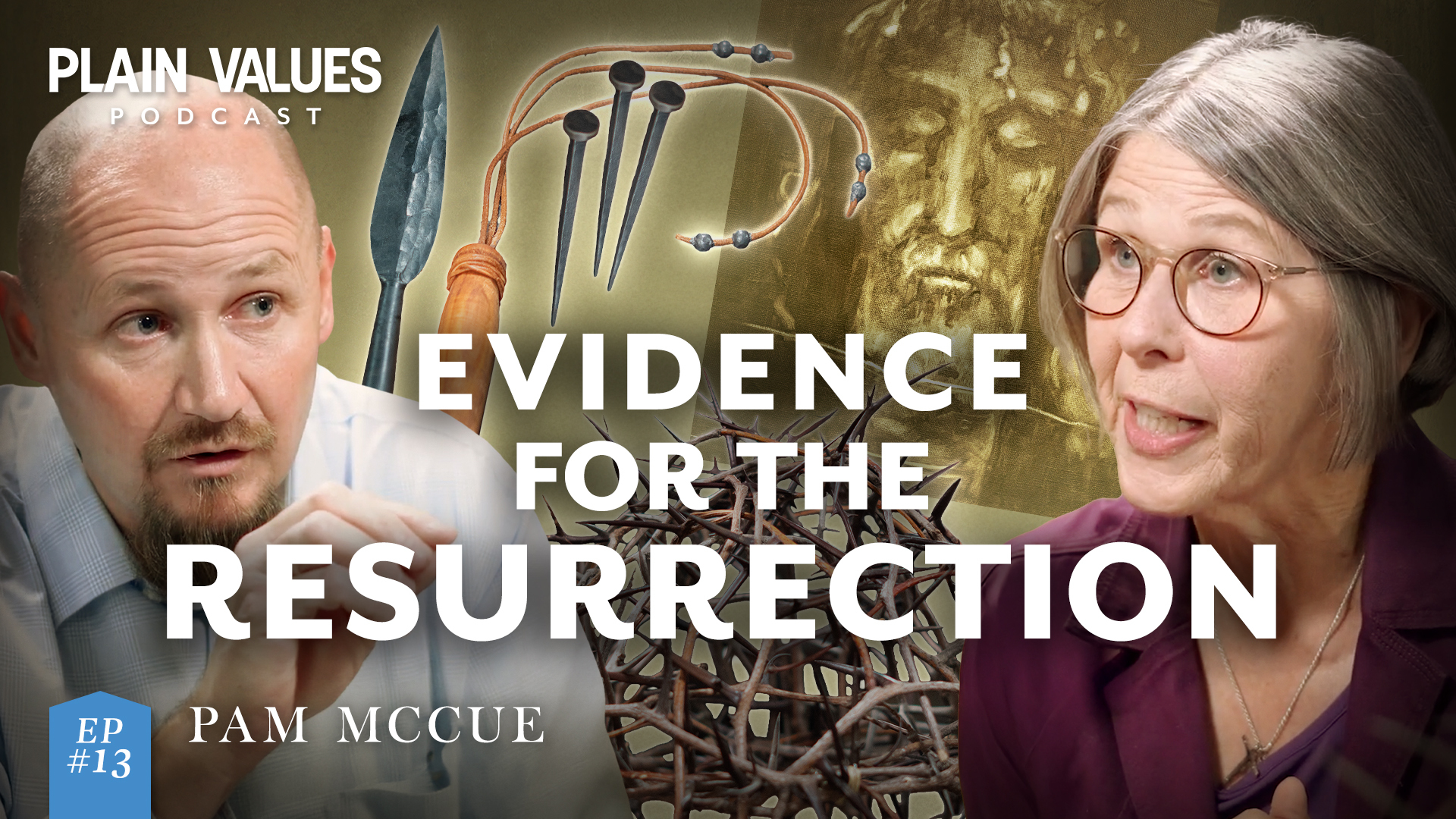
After a distinguished 30-year career as a senior executive in the U.S. Department of Defense, Pam McCue could have easily settled into a quiet retirement. Instead, she turned her lifelong curiosity toward one of the most studied (and most mysterious) artifacts in human history: the Shroud of Turin.
With both Bachelor’s and Master’s degrees in electrical engineering and decades of experience in defense science, Pam brings a deeply analytical mind to a subject often surrounded by both reverence and skepticism.
The Shroud, believed by many to be the burial cloth of Jesus, is not only a religious relic, it’s a scientific puzzle that continues to intrigue researchers worldwide. For Pam, that intersection of faith and science is where the conversation gets truly meaningful.
She’s found that the extensive scientific study of the Shroud provides a powerful bridge between belief and reason … especially for those who think the two are incompatible. “Presenting the science of the Shroud gives people permission to reconsider their doubts,” she explains. “It opens hearts through evidence.”
What began as small presentations to interested groups has grown into a traveling display that has captivated audiences at churches and schools across the country.
Today, Pam shares a stunning exhibit developed by Othonia International, combining her technical precision with a heartfelt mission: to help others encounter Jesus through His shroud.
Pam also supports the National Shroud of Turin Exhibit and is a dedicated volunteer with Othonia, working toward the goal of establishing a permanent Shroud display in Washington, D.C., a place where faith and inquiry can stand side by side.Welcome to the Plain Values Podcast, please meet our friend, Pam McCue …
<For more information about Pam’s work, check out https://othonia.org.
Transcripts
0:00 – The Shroud of Turin: history’s greatest mystery
6:50 – What is the Shroud?
9:14 – Who found it and who owns it now
11:07 – The brutality of crucifixion
15:58 – The crown of thorns and the wounds
20:52 – Traces of dirt from Jerusalem
25:23 – Could it possibly be faked?
29:31 – How crucifixion really kills
35:10 – The Shroud points to resurrection
39:12 – How did the image appear on the cloth?
49:47 – The carbon dating controversy—They hid data
52:00 – Doubt, faith, and the power of belief
54:38 – How can we pray for you?
Pam McCue:
So now I’m talking to the stuff that everybody just has to shake their head and walk away from, and I did too when I first heard it.
Marlin Miller:
Can you tell me what the shroud
Pam McCue:
Actually is? Millions. At least believe that it’s the burial cloth of Jesus. Is there any way that this could be faked? I have friends who doubted, maybe they still do, and they look at it. It makes them doubt their doubts.
Marlin Miller:
Guys, I have been fascinated with this image of Jesus for a long time, and it just so happened that a week ago I met a lady at an exhibit not far from here, and Pam and I very quickly became friends and it just worked out so beautifully. She was able to come to the office here that evening, the last evening of her being in the area, and we were able to spend a little time together. If you have ever wondered anything about the shroud, anything about Jesus’ death and resurrection, this is a wonderfully fascinating conversation. Please meet my new friend, Pam McHugh. This episode of the Plain Values Podcast is being sponsored by my friends at Azure Standard. My friend Spencer just told me about a new program that they have launched, it’s called Around the Table. And around the table is this beautiful synergy between Azure and their food and their trucking and the local church. Here’s how it works. You set up a drop, you choose a coordinator, you order your food and you pick it up and the church gets a small percentage back to put into any ministry that they want. It is a fantastic opportunity to encourage and help the churches get to know the people in their own backyards. I love it. It’s wonderful. You can call Spencer at nine seven one two hundred eight three five three nine seven one two zero zero eight three five three, or you can shoot him an email at the ta***@***********rd.com and tell em Marlon sent you.
Well, I’m going to start at the very beginning. I am a complete and utter layman when it comes to these things. I know a little bit about a little bit of what the shroud is, but I really want to start with you if I may. How did you come to do this?
Pam McCue:
So I am an engineer, and in the 1980s, it seems forever ago now, I heard about the shroud, and then almost immediately I heard that dating, testing, radiocarbon carbon 14 dating testing proved that it wasn’t authentic because the linen itself was made in between 1260 and 1390. So I just thought that the shroud wasn’t worth looking into. Then about 10 years ago, I saw a museum exhibit on the shroud, and the information that I saw there was just so compelling, and I realized that there was much more to the story. So I started studying the shroud and I spent probably two years reading every book I couldn’t find in convincing myself that it was the real deal. I could feel in my heart that it was the real deal, but I had to convince my head that it went along with it. And then I started sharing it, and as I started sharing it, I got to the point where I thought I need some visuals for people to see. And so last year I acquired this exhibit that I have now that has 24 panels that tell all about the different aspects of the shroud, and it has a beautiful replica that’s the 14 foot long cloth and a statue, even a statue, a life-sized statue of the man who was wrapped in the shroud, who I believe is Jesus.
Marlin Miller:
Boy. I’m sorry. I have so many questions. Can you tell me a little bit about yourself? Are you married all of those little
Pam McCue:
Perce? Yes. So I’m married. I have no children, which is probably part of the equation that makes it feasible for me to put an exhibit in a vehicle and drive it around the country. But my husband and I, he helps from the home base.
Marlin Miller:
So you started doing this in the 1980s,
Pam McCue:
So No, in the 1980s, I just heard about the shroud. So I started this in 2015. So about 10 years ago.
Marlin Miller:
How did you come to the shroud, to the replica that you have with you? How did you find it?
Pam McCue:
I have friends. Once I started studying the shroud, I made contact with other people who were studying the shroud. So the replica that I’ve got came from a man named Barry Schwartz, who is very well known in the shroud community. He was the American photographer that studied the shroud in the 1970s, and he took high resolution scientific photos. And so he had all the photo database and he also provided the service of doing high quality printouts of them on whatever medium we wanted so that we could also have a high quality photo.
Marlin Miller:
Wow. So as I said, I’m a total utter neophyte when it comes to this. Can you tell me what the shroud actually is?
Pam McCue:
So millions of people, millions at least believe that it’s the burial cloth of Jesus. So it’s a long linen cloth. It has the image of a man on the inside of the cloth, two images on one side, the back image and the front image, and the man was laid on one end and the cloth was pulled over him. It’s very confident by most people who research it, that shroud really held a crucified man, and it held a man that was crucified in the way that Jesus was crucified.
Marlin Miller:
How can they tell
Pam McCue:
That? The other thing about the shroud is it’s the most studied object in the world. In
Marlin Miller:
The world,
Pam McCue:
In the world. People have been studying it super intensely since the turn of the 20th century. About 1898 actually, the first photograph was taken of the shroud.
And when that photograph was taken, there was a thing that is the most mysterious thing about the shroud became obvious. And that is that when you look at the shroud as a photographic negative, in other words, everything that’s dark is light, and everything that’s light is dark. An image pops out that has so much detail. It is like looking at a very detailed high resolution, a photograph of a person only it shows up in the photographic negative, which is usually very vague and not specific. So that mysterious characteristic of the shroud captured everyone’s attention, and then they started studying it in super great detail.
Marlin Miller:
So the photo is taken in 1898. Let’s go all the way back. If Jesus Christ was buried in this, who found it?
Pam McCue:
Yes.
Marlin Miller:
How did they find it?
Pam McCue:
That is one of the debated points. So we know where it’s been since 1355. So it emerged into the public eye in the historical record in 1355. Since 1355, we have known where it was. It was with a family. It’s always usually been housed in a church, but a family owned it. They actually sold it to Italian royalty, and it was the possession of Italian royalty for hundreds of years. And then when the last Italian King, king Berto II, I think died, he willed it to the living Pope. So now the leader of the Catholic church owns it, but it’s kind of had that history. And we’ve known where it was since 1355, so since I think it’s 1578 has been in St. John, the Baptist Cathedral in tour in Italy. So before that. So you will hear people say, well, but there’s no, we’ve never saw it before 1355. It just showed up. But if you look back in history, there are indicators, there’s evidence of it all the way back to the tomb in Jerusalem. Of course, the gospels record it. So from their own, there are points in history where we see it emerge.
Marlin Miller:
How brutal was the crucifixion according to the data that is found on the shroud and in the shroud? What would Jesus’s crucifixion have been like? I mean, from a very real and a very human sense. I mean, I am looking at these things and I just, I don’t have any words.
Pam McCue:
Yes. And I think when you, that’s the most powerful thing about the shroud, I believe it’s authentic. Even if you don’t believe it’s authentic, it is a look into the crucifixion that you can’t really turn away from. So the first thing of course that happened that was especially brutal was the urging. So you mentioned the scourge. So we have this replica of a scourge, a Roman scourge also called a flagrum or a flag. And that particular design that has three strands and then two metal balls on each strand matches the wounds that are visible on the shroud. And there are a tremendous number of wounds. One of the forensic teams that looked at the shroud and analyzed, it, counted 372 wounds from those balls. And we only see the top and the back on the shroud, you don’t see the sides. So there probably would’ve been more than 600 wounds. Medical people who have examined it and looked can tell that the wounds, they are very specific. They match those balls. So they’re uniform in that sense, but they have an individual character. When you examine the shroud and look at it with ultraviolet light and they can see that it’s clotted blood that is there, and it’s not just scratches, it is deep wounds.
Marlin Miller:
This seems like it would, these are heavy and it would just simply slice you open, wouldn’t it
Pam McCue:
Tear the flesh? And doctors who have looked at it, a lot of doctors are fascinated and medical people are fascinated with the shroud because you can see the effects of the wounds on the body and you can see the blood. The blood’s been tested and it tested to be human blood when they tested it in the seventies, ab blood type. And they look at those scourge wounds and say that Jesus, the man of the shroud, Jesus would be in hemorrhagic shock from losing at least 20% of his blood. So it was a brutal beating.
Marlin Miller:
Wow. What takes me back or aback when I hold this is how short this is. I have always, when I read the crucifixion story, and then I think it says that pilot had him flogged. I’ve always imagined a horse whip like a big horse whip, one that’s 6, 8, 10 feet long, and the guys are standing back. This was up close. This is up close and personal. I don’t know exactly what to do with that other than how could those guys have, I’ve done that. I don’t understand it.
Pam McCue:
So the people who have examined the shroud and looked at the forensics have even come up with the postulate that there were two people who did the surging. They were a little bit behind and to the side, and that they can see how they alternated the patterns. One of the men was taller than the other one. So they can do a very good forensic recreation of how those wounds were made.
Marlin Miller:
Wow. So what else do you have here?
Pam McCue:
So of course, in the sequence of Jesus’ passion, the surging was first and it was brutal. So the next thing in the line was the crown of thorns. We often see in art the circlet style crown that went around the head. We can see from the wounds on the shroud that it looks as if there are wounds on the very top of the head also. And there are about 50 wounds total on the head. And they actually, you can see some of the more distinct running blood patterns from the wounds on the head, which probably came from when they took the crown off and blood, even though he may have been dead, then the blood leaked and looked fresher. So that’s why the cat style crown of thorns, and that’s why very sturdy thorns, because you can see the wounds that they made, and it actually matches somewhat because eastern crowns, a Jewish king would have a cap style crown. So that is typical of Eastern crowns.
Marlin Miller:
That thing is absolutely terrifying.
Pam McCue:
The medical community say that those wounds probably wouldn’t be as medically significant, but they would’ve been extremely painful. A lot of nerves in the head and the humiliation, that’s another thing that you realize as you look at the shroud and contemplate the wounds and the sequence of activities, the humiliation was tremendous.
Marlin Miller:
Wow. That is just hard to fathom. So Pilot brings him out with this on, he puts a robe on him, a robe of purple, I think a long time ago I read somewhere that when they would’ve taken that robe off, it would’ve probably have clotted and kind of gotten stuck to his body. So they take it off, and then it would’ve probably opened up everything again in what was next in the process.
Pam McCue:
So the next and the major things that we see would be, we see wounds from his carrying the cross, so on the back of the shoulders. So they’re often the imagery as we see him carrying the whole cross. People have written about crucifixion, plu tar wrote about crucifixion in the first century and indicated that the vertical piece would be in place already and that the condemned would carry the crossbar with their arms loosely tied to the crossbar. So not able to use their arms carrying a crossbar that would weigh somewhere in the neighborhood of somewhere between 60 and 120 pounds.
Marlin Miller:
So he was tied to it. All that weight would’ve been on his back or on his shoulder,
Pam McCue:
And he was already very crucially injured from the urging.
Marlin Miller:
Would he have died from this alone?
Pam McCue:
I don’t know. I don’t know. I would think maybe not.
Marlin Miller:
Okay, maybe, maybe not. So he’s carrying this and then he falls.
Pam McCue:
Yes.
Marlin Miller:
And then siren,
Pam McCue:
The Bible doesn’t say he falls, but it says that Simon of Cyrene was ordered to help him. And one of the fascinating things on the shroud is that in addition to seeing all the wounds on the shroud, they recovered foreign particles that were caught on the shroud. And this was in work that they did in the 1970s. So those foreign particles, there were two key things. One of them was pollen, and the pollen came from various places, but the majority of it came from Jerusalem and pollen’s microscopic. So you don’t even know it’s there until you search for it and take it off. And then when they examined it, Jerusalem was tied to the shroud in the pollen. The second thing that is the most pertinent here is there were traces of dirt and dirt doesn’t have a fingerprint, but this particular dirt was a relatively rare type of travertine, orite limestone, and that’s the building material in Jerusalem. And the dirt was recovered from his feet, which makes sense, but also from his knees, which were skint. And you could tell from looking at the shroud and from the nose area and the dirt from the nose area just covered it, he planted his face in the dirt.
Marlin Miller:
So that very specific type of dirt that’s found in Jerusalem, I’m trying to get this right. So he falls, he gets the dirt on his knees and his nose. He dies. They lay the shroud
Pam McCue:
On him.
Marlin Miller:
On him. And would they have laid out this 14 foot piece of cloth, laid him on the one half, and then covered him up with the other?
Pam McCue:
Yes.
Marlin Miller:
Right,
Pam McCue:
Exactly.
Marlin Miller:
So the top half is put down over his head and his entire body.
Pam McCue:
Exactly.
Marlin Miller:
And the dirt transferred from his nose and his knees into the shroud. Sh
Pam McCue:
Yes.
Marlin Miller:
And you’ve got evidence of that? We have evidence of that,
Pam McCue:
Yes.
Marlin Miller:
Very thing today.
Pam McCue:
Yes. Yes.
Marlin Miller:
Okay. So Pam, I have to jump ahead and ask. We haven’t even gotten to the best part yet, I don’t think. No. This episode of the Plain Values Podcast is sponsored by my friends at Kentucky Lumber. When Derek from Kentucky Lumber and I first talked, one of the first things that we talked about was his story of their family and their business and how that all came to be. And what I found really quickly was massive similarities in their family stories and Lisa and I, our family story, from the adoptions to the business side of things, it really comes down to Derek and his wife and Lisa and I basically saying the exact same thing where we basically said, Lord, if you want us to adopt and foster children, you’re going to have to bring us a bigger house and a bigger income. And that’s exactly what happened in Derek’s case.
Two weeks later, a guy approached him about buying his business and his home. In our case, it was a little different a couple years later, but he provided everything that both of our families needed to live out the calling that he had put on our families to care for the children that he was going to bring us. And I adore that, having the faith to step out and say, if you want us to do this, you got to provide the way. There’s something so great where you give. Not that we don’t give the Lord the opportunity to do something, but I think it’s especially wonderful when you have the attitude that you have to do this in a way that I can’t take any of the credit. It is literally so cool and so absurd in a way that only you can get the glory. And I just love that. I love Derek and his family. They are the kind of people that I want to do business with. And I have a feeling you’re going to find the same thing. You can find th**@***********rs.com. Is there any way that this could be
Pam McCue:
Faked? Oh, I think not. But there are people who say, if someone was really clever, they might think of doing that. I think that the forensic work would be a very long shot, given that we’ve known where it was since 1355, to be so sophisticated that you could falsify this forensic trail, I really can’t see. How
Marlin Miller:
Would you not have to? Very improbable, right? You’d have to kill a man to do
Pam McCue:
It. So some people might have the opinion not, but yes, definitely the consensus is that wrapped a real man crucified.
Marlin Miller:
Wow. Okay. So Jesus falls with, what’s that cross piece called the
Pam McCue:
Patibulum?
Marlin Miller:
Yes, thank you. So he falls with a patibulum. Simon helps them, they get to the place of the skull. And is that when and where they would’ve nailed him into the cross?
Pam McCue:
So the process was usually the holes would already be at least started in the wood, and then the hands would’ve been nailed on the crossbar, and then he would’ve been lifted up to set that crossbar on the vertical piece, and then the nail would’ve been put in the feet.
Marlin Miller:
Where did they actually put the nails? Was it up here in the wrist or was it through the palm?
Pam McCue:
We know it came out the back of the wrist. So we know it was in this vicinity. The wound that we see is in this vicinity. So we think that it would have gone in either in this meaty part of the palm or through the wrist, and either one of those would’ve been sufficient to hold the body, of course, art. And our common perception is through the middle of the palm, but the middle of the palm would not hold the weight. And there have been some tests that showed that,
Marlin Miller:
Right? Because there’s not enough. I mean, it wouldn’t have had bone that’s just tendon and ligament and it would’ve probably just ripped
Pam McCue:
Pulled through.
Marlin Miller:
So what about the feet?
Pam McCue:
The feet have been a subject of a lot of discussion. I think most people who have really dived into it believe that it was one nail through both feet and that one of the feet would’ve been nailed pretty straight through kind of the middle of the foot, and that the other foot would somehow have been twisted or turned a bit and nailed. One of the theories is kind of through the side of the heel, but there is a little bit of distortion around the foot area, probably because the feet were so damaged because the crucified person would push themselves up with their feet to breathe. So there’s a lot of action there around that nail that’s holding them in place. So the feet you can tell have a lot of damage as you look at them at the imprint of them on the shroud. But
Some people say two nails. Most people, I think, one
Marlin Miller:
That’s How does crucifixion actually kill a person?
Pam McCue:
So often people die from asphyxiation. And in fact, that’s almost certainly what happened to the two thieves that were crucified with Jesus because the Bible story tells us that their legs were broken to hasten their death to get ready for the Passover. And so Jesus died earlier. So he died before they died, and he was already dead when the soldiers came to break their legs, which matches that prophecy of no bones being broken, his legs were not broken. So people speculate. There’s no way of telling, but people from looking at the shroud. But people speculate that because the Bible says he spoke his last words and then he died, that he may have died from a heart event. And it’s not unreasonable to think, given the brutality of the surging,
Marlin Miller:
He would’ve lost an unbelievable amount of blood.
Pam McCue:
Yes,
Marlin Miller:
He would’ve been struggling in more ways than I can imagine. So the spear this comes in, at that point, the two thieves are still there, and I mean the Sanhedrin and everybody is in a hurry to get them down because of the Sabbath coming. When did the Sabbath actually start? Do you know? Good question. I don’t know if I know that sundown. I
Pam McCue:
Don’t remember. It was sundown, so I don’t remember if it was, we think he died at three. We have the timeline of it probably took 45 minutes to get permission from poncho’s pilot to bury him, and then they would’ve been taking him to the tomb and preparing him. So between five and six is a reasonable time to think they were shooting for that would be the reasonable time for the Sabbath to begin.
Marlin Miller:
So the guys take a spear
Pam McCue:
To make sure he’s dead. So they thought he was dead, but they weren’t going to take any chances because they would be in big trouble if they let him live. And
So they pierced his side with the spear, as they say. And that has had a lot of study because you can see the wound from the pierce side and the right side of the body. And John, the chapter in John 19, I think describes blood and flowing from the wound. And that’s exactly what you see on the shroud. You see blood and you see a watery liquid that runs under the blood and around to the back on the portion of the shroud where the man was laying on the back.
Marlin Miller:
So the lion’s share of that would’ve poured out at the event, but when they laid him down, it would’ve still been slowly oozing maybe.
Pam McCue:
So doctors say that it definitely shows that that was after death, just like John said, it was. It’s postmortem. It’s postmortem because if it were not, you would not see the watery liquid. And what caused the watery liquid, the water was that the spear would appear, and doctors used cadavers and tested this. So the spear would pierced the pleura around the lungs, the pericardium around the heart and into the heart’s right atrium.
Marlin Miller:
So
Pam McCue:
Between the fifth and sixth rib,
Marlin Miller:
Fifth and sixth. So that would’ve gone in right in there, right in here, and it would’ve gone through the lungs and through the heart,
Pam McCue:
Through the lungs and into the heart,
Marlin Miller:
Into the heart.
Pam McCue:
And they measured that thrust of the spear into a cadaver to show that that was what you would expect to happen. So that’s why they say that happened. And interestingly, some people question why the spear would’ve gone through the right side when the heart is actually on the left side. Wouldn’t it be easier? And Julius Caesar wrote a book on the Gaelic War, and he talks about how Romans engage their enemy with a spear. And that’s exactly how they engage. They engage on the right side, they’re all fighting, and that’s the way to keep themselves best protected. So they were piercing his side just as they were trained to fight.
Marlin Miller:
Wow.
Pam McCue:
Yeah.
Marlin Miller:
Whew. My goodness. Okay, so Jesus is now dead and they lay him in the tomb. He’s there for three days. And then what happens?
Pam McCue:
So the timeline, let me tell you the timeline. So the timeline, one of the things that I think is another one of the gifts to us to have us interested in the shroud is we have been able to recreate the position of the body as it was wrapped in the shroud. So do the analysis to see what the body was positioned. So for one, we have some physical characteristics. So we know that Jesus was five 11, about 170 to 180 pounds. You can see the features on the face of the shroud and see that he looked like a first century Jewish man. He had long hair and it was caught behind almost in a ponytail in the back. So we know his knees were bent and his head and shoulders were up stiff, which is odd. You would think he would be laying flat on the shroud, but he, he had that posture. And that’s because the body was still in rigor mortis. So while the arms had been repositioned, the body held that position still from rigor mortis, and that helps set the timeline.
Marlin Miller:
Are you implying that’s how he would’ve been positioned on the cross?
Pam McCue:
I am saying that’s how the body stiffened. Yes. Based on his position on the cross.
Marlin Miller:
How quickly does rigor mortis actually sit in?
Pam McCue:
So an hour to two hours, it varies with, so there’s a little bit of potential variability here because of being such an extreme death, But
It is not untypical to say an hour to two hours.
Marlin Miller:
And what that basically means is that everything tenses up and locks into place.
Pam McCue:
So it locks gradually. So it starts out kind of almost a soft rigor mortis, and you can still do more repositioning, and then as time goes on, it locks harder.
Marlin Miller:
And
Pam McCue:
That’s when
Marlin Miller:
You really would struggle to
Pam McCue:
Move. That’s when you would really have to probably break bones or joints to reposition. So he was in that position for those couple days? Well, for at least. So the resurrection timeline from three o’clock on Friday to sunrise on Sunday morning would be 36 to 39 hours depending on how you count it. So 36 to 39 hours is the resurrection timeline and 40 hours or more is what they usually use as an average for rigor mortis before it relaxes.
Marlin Miller:
So
Pam McCue:
Rigor mortis, stiffens, but then at some point it relaxes
Marlin Miller:
And then he would’ve been laying perfectly flat,
Pam McCue:
But it didn’t get to that point.
Marlin Miller:
So
Pam McCue:
Though the reason I bring that timeline in is because that little rigor mortis posture of the body matches that he was gone from the resurrection before the rigor mortis relaxed.
Marlin Miller:
So he’s lying there. How does that image get onto the shroud? And if I can just mention, and I’m sure you’re going to talk about this, but please talk about this. It is two microns thick. Am I on track?
Pam McCue:
So I like to use the thing that people will remember, it’s about half the size of a human hair is how big the fibers are. So about 100 to 200 fibers are twisted into a thread that is then weaved into the cloth.
Marlin Miller:
Hold on. You’re talking about the linen itself. So when Joseph Avera Mathia, not a poor man, he bought a burial cloth for himself
Pam McCue:
Or Yeah, for
Marlin Miller:
Family. He acquired a
Pam McCue:
Burial cloth. Yes.
Marlin Miller:
Okay. So he got a really, really fine, very high quality piece. One continuous sew or stitch. What is linen made of?
Pam McCue:
Linen is made of flax
Marlin Miller:
Fibers, flax fibers, and it’s those fibers that are half of our hair or the few that I have left.
Pam McCue:
And that’s what 200 of them are twisted into a thread. So you’ve got 200 fibers, but the image is only in the top one or two fibers, and it doesn’t even go all the way through the fiber. So that’s how superficial it’s, so you could take a razor and you could scrape off all the image and you would still have a linen cloth, but the image would be gone. It’s that superficial.
Marlin Miller:
Okay. So tell me what happened when Jesus comes back to life.
Pam McCue:
So I’m going to, let me do the thing back. So let me tell you the character of the color in that flax fiber. What helps tell us how you get that photographic negative. So you’ve got just coloration in the top one or two fibers at a 200. And those fibers have a consistent yellow brown color. And chemists have looked at those and said that the color probably comes from the main plant cell. So it comes from the plant itself. It’s not different colors, it’s one color is the color that the fiber turns probably from being dehydrated. So that’s the nature of that fiber color. And we have recreated marks on linen that give you that yellow brown color by using lasers that generate light energy. It is for a very short period of time, lots of energy for a very short period of time, or you’ll burn up the linen
And we can make marks that give you those yellow brown color marks. So that’s why sometimes you will see people say it was a flash of light that made the image. So now let me get to how it relates to Jesus. So if you look at that image, and especially that photographic negative that we have, you can see some things about it. You can see for one thing, the image is darker, where the body feature was close to the shroud. So the nose was touching the shroud and it’s dark. The eyeballs were not touching the shroud. They still have image, but they’re light. And so you can even map. That was one of the neat things that happened early in the study. They can do a 3D map where they plot everything that’s dark high and everything that’s low, and you get a really well resolved human body. And that has not happened with anything else ever.
Marlin Miller:
Wait. So that 3D mapping thing, they could take a photo of me or you, and we wouldn’t be 3D. So then how is it 3D three dimensional with this?
Pam McCue:
It’s the way the image was made. So now I’m talking to the stuff that everybody just has to shake their head and walk away from. And I did too when I first heard it. So what the other thing that the scientists found when they really examined it, and there was just recently an article about this from a dental surgeon, there are even features of the body that are not on the surface that you can see. So things within a half an inch or so from the shroud, but not necessarily touching it contributed to the image. So this dentist that wrote the article recently, he reports that you can actually see a little bit of the teeth structure in the image and the concept. I’ll sum up the, so the concept is Jesus is in the shroud at whatever point, I think the resurrection, he has changed to what is described in the Bible as his glorious body. And we know that it was different. We know he went through walls, he appeared and he disappeared. So he’s not matter anymore, he’s energy. The shroud falls through is marked by the energy, if you will, from the body. And that’s what gives you that strange mark on the linen that looks like Jesus and that has that photographic negative effect, like nothing that exists in the world anywhere else.
Marlin Miller:
We have lasers and we have a whole bunch of power. Can we even come close to doing anything like
Pam McCue:
This? No, because we can’t control it to know how to make those lasers make them in. And frankly, I think most of the laser work, it just kind was blotchy and it affected it, but it wasn’t finally controllable. So it’s that fine control that it was enough energy to make all of those fiber, all of those disparate fibers be colored in all the right places to give you that high resolution image in the photographic negative.
Marlin Miller:
What do you think of Pam, when you step back from all of this research and all this time that you spend probably visiting, meeting, talking to many, many people about this, what have you, if I were to just simply ask you as of today, what does all this mean to you for you?
Pam McCue:
So obviously it’s really significant for me. I have acquired this exhibit and I carry it around and share it with people because I think the story is for us today, so that the shroud, I think it’s been significant through its history in many ways that we’ll never know at this point in time. But I think it is super clear that photographic negative picture, which is such a mystery, it is for certainly the 20th, the 21st century and beyond, because it couldn’t be seen before then. So that is a picture of Jesus for us to realize we can’t reproduce and it’s there for us to ponder.
Marlin Miller:
So which of the commandments says, you shall not make a grave, make a
Pam McCue:
Grave image. So I don’t consider this a graven image. So in the Old Testament images of Jesus, I don’t consider a graven image. Graven images were things that were not God that you worship. So Jesus was both man and God. So especially since I think he left that photo for us, I think he wants us to see it.
Marlin Miller:
And I mean, a graven image is something that we made
Pam McCue:
To worship other than God. Yes.
Marlin Miller:
In this case, we
Pam McCue:
Did not make, we didn’t make this. It wasn’t made by our hands. Right.
Marlin Miller:
Wow.
Pam McCue:
Right. My
Marlin Miller:
Goodness.
Pam McCue:
Yeah.
Marlin Miller:
What other ways has the shroud been tested?
Pam McCue:
Oh my goodness. There’s been so much chemical work, so much blood analysis, so much medical analysis. I’m sure I’m going to leave something out here. Of course, all the forensics on the pollen and the dirt and the medical effects, like the rigor mortis, and I’m trying to think,
Marlin Miller:
Did they do the carbon dating?
Pam McCue:
The carbon dating years passed was such a big impediment, and that is really what kept me from even being interested in it for many years. In the last few years, the carbon dating has been shown to be invalid really. And the reason being, well, the reason being, we now know the statistics associated with it. The original testers actually, the did something that is really bad in the scientific community and they hid data. And a French lawyer did freedom of information suits and got access to it and showed that the statistics of the test showed that you weren’t testing an object that you could age. You were testing multiple things because the statistics weren’t consistent with a single object. So the raw data showed there was some kind of contamination that affected the carbon dating. So since carbon dating, there have been at least five other tests that aren’t as precise as carbon dating. They don’t give you a hundred year window. They might give you a 500 year window, and they test things like how strong the fibers are and what the components that are in the linen, how much they have decayed. And all five of those tests show that it’s consistent with first century. So I think it is pretty confident right now that the linen looks pretty good at first century.
Marlin Miller:
Wow. Does any of this actually surprise
Pam McCue:
You? So what surprises me, what surprises me still as I studied this stuff is the layer after layer after layer of detail that’s in there
To satisfy our intellectual curiosity. It’s not like it’s so obvious that, oh yeah, this is a mystery. You’ll never understand it, so just go away. No, it’s there for us to study and to dive into and to keep refining. So I think it’s a gift for us to understand it and to get closer to God as we do it. So I think that is a gift to us. I think that it is the most powerful thing about it is that when faithful people come and look at it and get that sense of it, and I told you I didn’t immediately accept it. I took my time and looked into it. And a lot of people do that. They come in, they look at it, they’re drawn to it, but they don’t immediately fall in and accept it, but they follow that spirit in that lead. And so you see people who do that, that really end up with a much encouraged faith with just a real boost to their faith because it’s just peace after peace that can fall into place for us. And I think that’s the power of the shroud. I think it’s conversion of mind, heart, and spirit is the power of the shroud. And I think that with people who doubt, and I have friends who doubted, maybe they still do, and they look at it, it makes them doubt their doubts, really.
So it at least plants that seed and maybe it’ll really give them a boost at the right time. So I think just like you look at the crucifixion as Jesus loved pouring out for us, I look at the shroud as Jesus pouring his love out for us and showing us. Yeah.
Marlin Miller:
Wow.
Pam McCue:
That’s me. Thanks for the chance to say that.
Marlin Miller:
Oh my goodness. Pam, how can we pray for you?
Pam McCue:
Oh, so I told my husband when I started this effort that it looks like right now I’m hands and feet and he said, and wheels. So I’ve hands and feet and wheels and I’m driving lots of miles. So yeah, keep prayers from me and my travels and
Marlin Miller:
The
Pam McCue:
Energy to keep going and sharing this thing.
Marlin Miller:
I meant to ask this way from the very, very start. Why were you in New Philadelphia, Ohio this weekend?
Pam McCue:
They called me. How did
Marlin Miller:
They hear of you?
Pam McCue:
How did they find you? So I started this last year and it’s kind of gone word of mouth and not just locally around the country. So my first exhibit in Ohio was in Sunbury, Ohio, around Columbus. And then I think that was how the new Philadelphia guys heard about me. So then I go anywhere I’m called as long as I can work it on the schedule.
Marlin Miller:
Yeah. I’m so glad that you’re here. I’m so glad. Where are you off to next?
Pam McCue:
I’m home for a couple of weeks, and then I’m off to Maine, Connecticut, Massachusetts, and then Louisiana.
Marlin Miller:
How can people find you? I mean, if anybody were to listen to this and say, Hey, I want to reach out.
Pam McCue:
That’s funny. I don’t have a website but aia, which that I would encourage people to look at the AIA website. So AIA is a Greek word for linen, one of the Greek words for linen, and AIA is an organization based in Rome that does research and education on the shroud. And I’m a volunteer for Atonia, and they’re the ones that produce that beautiful exhibit. So Atonia can find me,
Marlin Miller:
We’ll make sure to put that in the notes so that everybody has a link to that. How do you spell it? I’ve got it. You
Pam McCue:
Have it?
Marlin Miller:
Yeah, I’ve got it. Yeah. Pam, thank you. This is so good.
Pam McCue:
Thanks.
Marlin Miller:
Thank you very much.
Pam McCue:
This was fun.
Marlin Miller:
You were right. Goodness.
Pam McCue:
Very comfortable
Marlin Miller:
Seeing that 14 foot thing. It completely blew my mind.
Pam McCue:
Yeah, good.
Marlin Miller:
I don’t know exactly. It did its job. Yeah, it’s awesome. It’s pretty incredible. So I’m so glad. Thank you very much, and thanks for being willing to come here and do this. My goodness. Seth, are we good? Did we miss anything big that you want me to ask or?
Seth:
It’s funny, I was wondering, I was curious, when did you become a believer and this whole thing with the shroud and stuff, like you were talking about doubts and how it helps boost faith and encourage faith. Did you struggle with doubts and what has your journey been like, your journey of faith?
Pam McCue:
So I have since I was young, loved Jesus, so I don’t struggle with faith in God. So the shroud, when I first saw it, I didn’t know the background. I hadn’t seen that photographic negative and understood what it was. So when I heard science said it was medieval, I just thought, well, okay, science spoke. And then when I actually had the chance to look at it step by step and go through, at that point, the carbon 14 date was still held as being legitimate, but at that point I saw there was a lot more to that and I was questioning the science at that point instead of questioning the shroud. But it still took me probably at least a year and a half of getting those science-based books and making sure that it was solid and not something superficial or kind of a trick of mirrors or whatever
Seth:
Before you start going around the country exhibiting it.
Pam McCue:
Oh yeah. So the first step was just talking and I probably drove my friends crazy, although they were all very interested, but I just started talking about it and then yeah, it took me a little more leap of faith to decide I would drive around the country.
Marlin Miller:
Does your church, does your local church help you with all these things or is this you and your hubby?
Pam McCue:
I think they are happy that I do it, but no, not especially. I’ve got a few friends who help along the way, but no, I’m pretty independent with it, which is really, why would you think at my age that I would be loading things into a car and driving across the country with them? I’ve got a statue of Jesus that weighs a hundred pounds and I’ve got all these things that I load into the car and go with.
Marlin Miller:
Wow. It is incredible to us. We talk about this a lot. I mean, we get to do stories and meet some just pretty incredible people like yourself. There’s so many. It is so great to see how he calls everybody in so many different ways, and it’s not a one size fits all. I’ve picked you for a unique thing
Pam McCue:
And
Marlin Miller:
I just love it. It’s so great.
Pam McCue:
What has been the most gratifying to me out of this is I have no doubt that I am doing what I should be doing. And it’s really nice to know that
We don’t always know that we try our best, but we don’t always know if we’re exactly in the right place. But I feel like with this, I know I’m exactly in the right place.
Marlin Miller:
Totally rock
Pam McCue:
Solid. Totally rock solid.
Marlin Miller:
I’m so glad for you because it is a real treat when you get to know that you are right in the middle of his will for you at that moment. So Pam, that’s so good. I’m so glad for you, Seth, anything else? What else did we miss? We’re going to leave here tonight with a hundred more questions that we should have asked, but
Seth:
I mean, we could just start a whole new podcast about what it was like for you in your growing up years.
Pam McCue:
Oh, that would be good. That would be boring actually,
Marlin Miller:
Man. Well, thank you. I thought great conversation. Yeah, I think so too.
Pam McCue:
Good deal.
Marlin Miller:
Thank you very much.
Pam McCue:
You have
Marlin Miller:
No idea how
Pam McCue:
Honored
Marlin Miller:
And excited I am.
Pam McCue:
Just have this conversation. That was another one of those timing things.
Marlin Miller:
Oh my goodness, I got to tell you. So I get out to the truck after we exchange numbers and all that, and I remember sitting there going, wait, you’re here right now? And I said, Lord, why wouldn’t I just see, just do it. Let’s just see if she’s available
Because I was afraid that you were going to take off, jump a plane or anything like that. So I hoofed it right back in there, so I’m so glad it worked out. That’s awesome. This episode is brought to you by Homestead Living Magazine. Homestead Living is a monthly print magazine that interviews all the big names in the homesteading world and they focus and educate in a wonderful way. You can learn more and su*******@*************ng.com. In his book, Rembrandt Is In the Wind, Russ Ramsey says that the Bible is the story of the God of the universe telling his people to care for the sojourner, the poor, the orphan, and the widow, and it’s the story of his people struggling to find the humility to carry out that holy calling guys. That is what plain values is all about. If you got anything out of this podcast, you will probably love plain values in print. You can go to plain values.com to learn more and check it out. Please like, subscribe and leave us a review. Guys, love you all. Thanks so much.
Brought to you by …

🤝THIS EPISODE’S FEATURED SPONSOR: Azure Standard
Talk about a mission-oriented company, our friends at Azure Standard set the standard of excellence when it comes to sourcing nutritious food for your family.
They have a new program called “Around the Table” that nourishes by walking shoulder-to-shoulder with churches and church communities. It’s wonderful!
Learn more: https://www.azurearoundthetable.com/

🤝THIS EPISODE’S FEATURED SPONSOR: Kentucky Lumber
Our friend Derek Guyer at Kentucky Lumber is the type of guy that you want to support. He is a highly-skilled tradesman who exemplifies excellence in everything he does. Kentucky Lumber is an independent lumber yard that truly does world class work!
We would humbly ask you to support them with your lumber needs: http://www.drywallhaters.com
“WELCOME TO THE HOME OF WOOD, PEOPLE, AND SERVICE WITH CHARACTER.”







Leave a Reply