
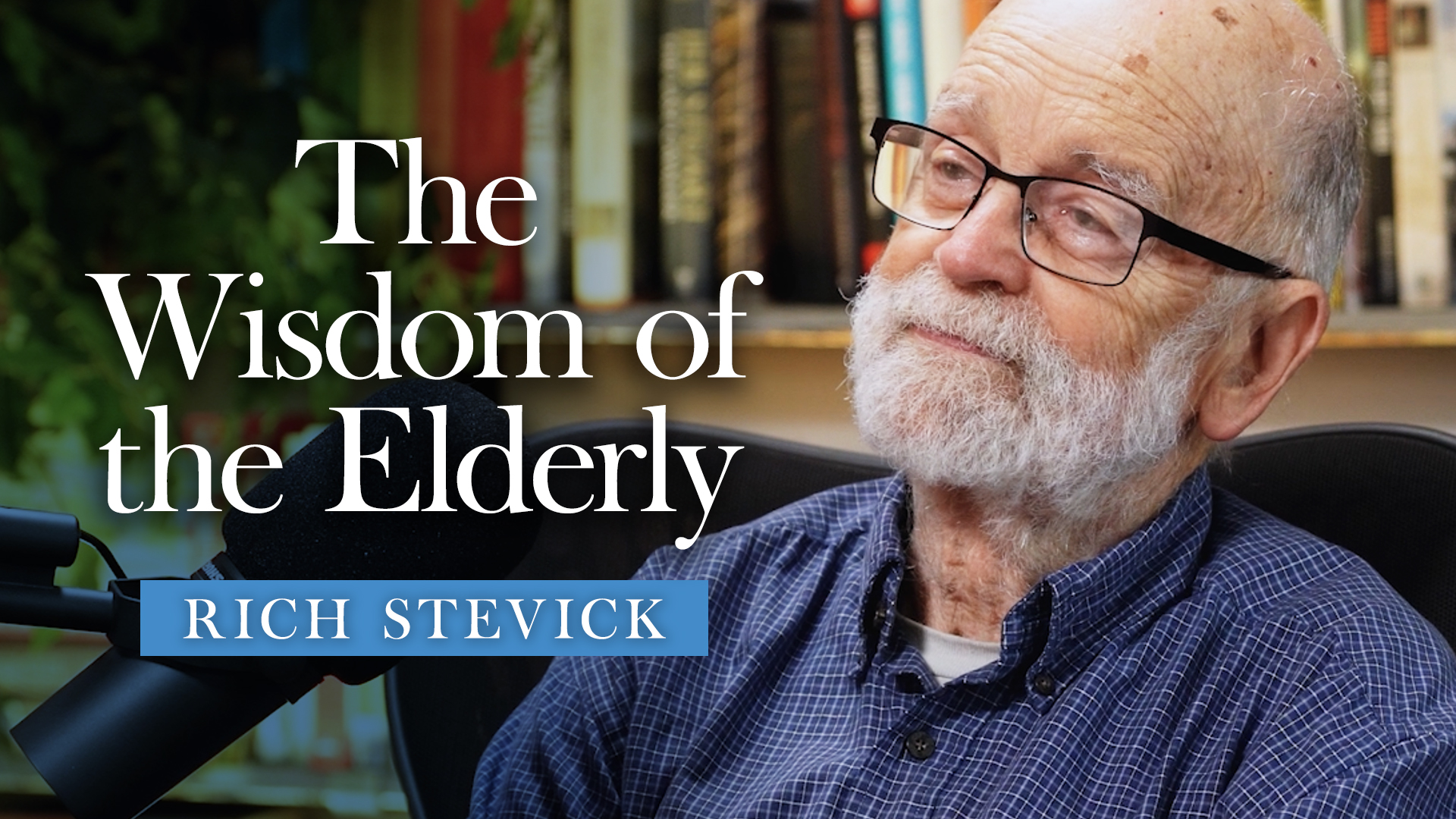
In this bonus episode of the Plain Values Podcast, Rich Stevick joins Marlin in the studio to reflect on the brevity of life, the value and wisdom of the older generation, and the priceless relationships of friends and family.
To begin, Marlin and Rich reflect on modern culture’s underappreciation of the older generation’s wisdom. They talk about the shortness of life, with Marlin sharing about his Dad’s early passing and how that made him realize the transience of life.
Looking back, Rich talks about the brightest and darkest parts of his life, while showing how those times shaped him for good. He shares about the painful guilt of sin that pressed on him while growing up, and the wonderful peace and freedom he was able to find in the Anabaptist church.
In addition, sprinkled throughout their conversation, Marlin and Rich both share personally about the friends and family that have impacted them. Rich tells of the close relationships with his siblings, while Marlin talks about the hours he was able to spend with his grandma in deep conversation before heading to Colorado. To close, Rich shares about his many friends at Walnut Hills and his admiration for the wisdom and talent that each of them has.
From beginning to end, this bonus podcast is a warm encouragement to value relationships with the older generation and remember the preciousness of the friends and family that we have.
Learn more about Plain Values at https://plainvalues.com
Transcript
Let’s talk about why you walked in here a couple weeks ago. Mm-hmm. You came in and shared that you had a burden on your heart. Mm-hmm. What, what do you think has caused this, this seeming underappreciation or, I’m not even sure if that’s the, you know, the best word for it, but the folks my age and younger, I’m 48- Mm-hmm … younger than I, seem to very quickly Dismiss? They, they, they dismiss and they gloss over- Their heritage … all the wisdom- Mm-hmm … that the older generations have. Mm-hmm. Wh- where do you think it’s coming from? I do not know. I mean, our, our, our, our culture, I think, I think Amish culture values elderly way better than any other culture I know. Mm-hmm. But in general, w- we do not value old… I almost said old farts. I won’t say that. I mean, what, what good are we? We, you know, we drive too slow, if we drive at all, and we smell bad if we’re not g- somebody’s not taking care of us and, you know, we’re just sort of detriments. Uh- High maintenance, high maintenance. You know- … I, I don’t remember where this is in the Bible- Mm-hmm … but I think it’s Paul talking to the church, where he’s talking about the young men and the young women and the old men and the old- Mm-hmm … he, you know, the older- Okay. Mm-hmm … ladies, and they are told to pass down, they’re told to teach the younger. Mm-hmm. And I think the, I think… It’s, it just makes me sad. Mm-hmm. It makes me sad. Mm-hmm. Um, and, and it’s probably in part because of the fact that I lost my dad at 55. You know, he was gone- He, he was 55 when he died? He was gone at 55. Oh, dear Lord. Dear Lord. And I remember, I think it, it, I think it, it took a couple months of hearing, “Marlin, I’m sorry that’s so young”- Mm-hmm … until I actually realized that, oh my goodness, that is really, really young. In fact, I remember I asked a, a friend what he was doing on a weekend and he said, “I’m going to, I think to Boston to be with my dad for his 90th birthday.” Mm-hmm. And that’s when it hit me. I was 35, I think 34, 35 when Pop passed. Mm-hmm. And th- that’s when it hit me that I would have had another lifetime with my dad- Mm … had he lived- Mm-hmm … to be 90. Yeah. And ever since, I think I have a, I think I have a better understanding, or at least a little bit of a deeper understanding of how short this life really is. Mm-hmm. Mm-hmm. Mm-hmm. It’s like a wisp. It is. A wisp. It just goes so fast. Mm-hmm. And I realize that I don’t even know what I’m talking about, but- You will … but it is, it is really, really quick. Mm-hmm. Um, what, when you look back on your life, Rich- Mm … what do you, what gives you the biggest smile? Mm-hmm. I have, I, I think I have a lot of smiles. I don’t know what the biggest one is. Getting free from the fundamentalism that I grew up with. I, I may have told you this already. If, stop me if I did, but when I was six, I told my parents that I wish I’d been born Chinese. Did I tell you that? No. Okay, you can’t stop there. My dad said, “Richard, why?” A- and I said, “Well, the preacher said that they won’t be held as responsible as we h- are because they haven’t heard the gospel, and I’ve heard it.” And I was such a sensitive kid, such sensitive. When we, we had altar calls at, at the church, there was no doubt that one person at least would be at the altar. I am, I was the boy, and just way, way too sensitive, way too sensitive for the kind of preaching, the hell fire preaching, the damning, the damning preaching that I heard. Mm-hmm. I, you know, at, at one level I knew God loved us, but it, it didn’t, it didn’t weigh in nearly as much as the fact that we’re gonna burn in hell. Mm-hmm. I’ll, I’ll be burning in hell because I’m dis- disobedient and I’m whatever. So it was a very, it was a very heavy time. My childhood was not a happy childhood. Wow. Mm-hmm. How many siblings did you have? Oh, we have, I have a brother and a sister. Mm-hmm. Have you talked with them about that? Oh, yeah. Oh, yeah. I think we’ve probably talked about everything that we can think of. Mm-hmm. Mm-hmm. Are they still here? Uh, yeah. My, well, my sister lives at the bottom of the hill f- in Walnut Hills. Okay. So she’s, she’s my mentor and shepherd and restrainer. My brother David is the smartest, smartest in the family by far. He’s brilliant. He’d, he’d invented, invented a telescope that is still being used. He had interest in stars and that kind of stuff. Okay. And, uh, but he, he spent his whole life working, stacking bags in a Pillsbury factory in Wellsburg, West Virginia. He, he, I mean, he never aspired to education. Uh, the teacher we both had in school, you know, he followed me by five years I think it was, she said, she told someone, “David is- See, by far the smartest kid in the family and he really was. But he was, he was, he was hurt really badly by that fundamentalism. Really? Mm-hmm. Yeah. Can I go back to the telescope- Yeah … that he invented? Mm-hmm. I can’t remember the name of it. It’s fairly compact, it has a wooden case, and it’s for looking at nebula and aurora borealis and the moons around Saturn and all that stuff. He was a… He invented that. I mean, brilliant guy. How many mirrors did- I don’t know that. Okay. I don’t know that. Okay. But w- in Wellsburg, West Virginia, we’d go out at night and l- see the rings on Saturn, for Pete’s sake, and- Mm-hmm … stars and Jupiter and all that kind of stuff. Mm-hmm. I may have my planets mixed up a bit. Yeah. Um, but yeah, he r- he w- is amazing. He’s still living. Uh, his wife’s suffering from dementia. Uh, he has two daughters, and they’re, you know, they’re living lives that are survivable, but they’re not joy-filled lives. Mm-hmm. Let’s go back to, to the biggest smile. When, when I ask you what brings you the biggest smile, I think you, you answered with, you know, getting out of the pain of the- Mm-hmm … fundamentalism. Mm-hmm. Mm-hmm. Um, what are your biggest, what are your biggest painful memories? Like, the things that, that you, you know… Oh, the painful memories are the guilt, the guilt and the sin that I felt as a child, and that I was under God’s wrath, and that I would… I could never live up, never live up to what I was expected to live up to. So, so how did it change? It changed when I encountered the Brethren in Christ, the Anabaptist Church in Lancaster, Pennsylvania, when we moved to Lancaster. We found… I, I said, “Pauline, I saw an article in Christianity Today by a, a man,” and he signed it s- and he signed it Br- the Brethren in Ch- Christ Church in Lancaster. And she said, “Well, why, why would you wanna go there?” Well, I, I knew Anabaptism enough to know that there was something different. We were going to a Nazarene church maybe 20 miles distance, and it w- it, it was Nazarene this and Nazarene that. I, the whole emphasis is on Nazarene. So we drove to Lancaster. Was convinced to let’s go check it out. We drove there, stopped the policeman, said, “Do you know where the Brethren in Christ Church is?” “Well, what street it’s on?” I, I, I’m not sure I had… Chuck Lenkert was the guy that wrote the letter. I, I wasn’t sure of the address, and he looked s- looked up his stuff and said, “Oh, yeah, we’re not far from that.” And we came up to this little brick building. It looked like a, a s- probably a former schoolhouse, and went into it, and here were people with… women had coverings on. The guys were dressed fairly plain, and they greeted us warmly. And, um, pastor’s, pastor’s wife asked who we were, and we told her, and we said, “We’re new here,” and she said, “We’re new here, too. This is our first Sunday here.” “Oh, how about that?” And when we went up to the service, and women with their coverings and men with their plain suits and stuff, we just found, we found food, we found peace, we found joy, and it was the beginning, the, the beginning of the beginning. That was our liberation. Mm-hmm. It was our liberation. What, what part of the theology in the Brethren Church- Brethren in Christ … actually, you know, actually brought that to the front for you and Pauline? I’m trying to think if it was theology or example. Okay. These were peop- these were people that were at peace. They were at peace with each other. They were, they were able to navigate in the world. They had purpose. They had, they had foundations. Mm-hmm. And their example, I think, was probably more than the theology, was the thing that drew us in. Mm-hmm. I think that was it. Did you, did you ever talk to your mom or your dad about- Oh, harsh. Yeah. Yeah. Did that ever come up? Yeah, I’m sure, I’m sure we did when, when I was an adult. You know, it’s… I remember being a kid and, and having those thoughts of, “This isn’t fair.” Mm-hmm. “Dad doesn’t know what he’s doing. This isn’t fair.” Mm-hmm. And I remember when I was 20 t- you know, 21- Oh, s- Of course, Dad was- Dad got all smart? Yeah. You know, Dad was an idiot. You know, he, he didn’t know anything. Mm-hmm. And then I think it was around 22, doggone. You know, he got really smart really quickly. Oh, man. And I, I just remember th- thinking, being a good parent is probably- … exponentially harder than I can even imagine. Mm-hmm. Mm. And it is. How do… Yeah, how do we train for being a good parent? Well, it helps a lot if, you know, if our parents are good parents, that helps a lot. Uh, my parents were. They loved us. Mm-hmm. Never abused us and so forth, but they didn’t have the warmth of the Spirit, the, the, the warm relationships that would’ve- Yeah … would’ve helped us a lot. Yeah. Mm-hmm. You know, it’s that… Can I share a dumb story? Yeah, sure. So, so- My grandpa died in ’87. I was 10. I was born in ’77. Mm-hmm. And then Mommy, my, you know, my grandma- Mm … my dad’s mom, um, let’s see. My brother graduated high school in ’97, I think, and right after he graduated, he, he and I took off for Colorado- Mm … and, and we worked- Wow … and lived on the mountains, and we snowboarded our, you know, our guts out for- Wow … you know, for five months. Wow. But before we did, I took probably about two or three months before we left, and every week I would go down to the home farm, and I would spend a couple hours with, you know, with Mommy. Mm-hmm. And I got to talk with her about things that I had never- Mm-hmm … never talked about- Mm-hmm … before. And I got to know her. And the week before we left, I told myself, “I am gonna give my grandma a hug before I go.” Mm-hmm. I had never, I had never gotten a hug from any of my grandparents, ever. Mm-hmm. And, and I, I just remember n- number one, I did give her a hug before I left. Mm-hmm. And I told her goodbye and, and, you know, kinda told her what we were gonna do, and I was so glad that I did. We get out to Colorado. I think we left right after Christmas or right after the new year maybe, and it was in, it was in a few weeks that she passed. Mm-hmm. And we had no money. We had no way to get back home, and so I missed her funeral- Mm-hmm … which I still regret. But I was so glad that I had spent that time with her before. Mm-hmm. And I was so glad that I had given her a hug. Yeah. Yeah. I am, I am so glad that that happened, too. Yeah. You would probably have had regrets to this day if that hadn’t happened. Yeah. Mm-hmm. It, it, it was, it was a, it was a real treat. Mm-hmm. It was a real treat. I, I look back on it now, and I, I’m just really thankful. Mm-hmm. Um, so, so tell me a little bit about some of the folks that you live with that you think have stories that need to be shared. At Walnut Hills? Yeah. Yeah. I think unless you’re in the, uh, the special place for people who have totally lost their faculties, it is loaded with talented people, loaded with talented people. Um, people who remember their years spending overseas, um, building houses in settlements for people that were homeless. That was their life commitment. Uh, people, our pianist, who is… She could’ve been a concert pianist. She plays in any key any song you’ve ever heard. She’s just spectacularly talented, and she, she plays for us. We… I was in charge of this, this past Saturday. I was in charge of the morning a- the morning activities. They, they took a chance and asked me if I would- … if I would do it. “Are you sure?” “Yeah.” “Okay. Uh, we’ll do it.” And, um, part of that was name that tune, and, and I had a list of tunes f- uh, everything from, uh, you know, The Old Rugged Cross to From the Halls of Montezuma. And the people were just they were just deeply engaged in it. Yeah. It was just a won- I’m getting goosebumps telling you. Yeah. It was such a wonderful experience. Yeah. Did the lady play the tunes on the piano for you? Mm-hmm. Yep. Yeah, yeah. She was marvelous. She, she’s, um… Well, she, she didn’t play professionally. She grew up playing, and she became a pianist, I would say a world-class pianist, and she’s there. Yeah. And pretty much, unless they’ve lost most of their mental faculties, almost everyone there has a wonderful story to tell. Yeah. Yeah. I know a few of them. I don’t know many. Mm-hmm. Mm-hmm. But, uh, yeah, we’ll have to, we’ll have to do some of those. Mm-hmm. Uh, last question. Mm-hmm. How can we pray for you and Pauline? Mm. Well, of course, pray that we be faithful. That we be faithful, that we continue to love each other, that we try to follow the rules to keep us there where we are, that we don’t get, that I don’t get too exuberant and carried away. So Walnut Hills has rules? If you- I would say so. I would say so. In fact, you know, my, my kids and, and Ruthie are concerned that I don’t get expelled from there, that I have to go live somewhere else if I don’t comply. Yeah. And I really truly am … You’re trying … I’m trying to comply. As, as they would say, “Yes, Rich, you’re trying. Very trying.” That’s funny. Yeah. Rich, thank you. My pleasure. I thought this would be r- very tense and hard, and it was not at all. I hope not. Not at all. Thanks, Marlin.







Leave a Reply