
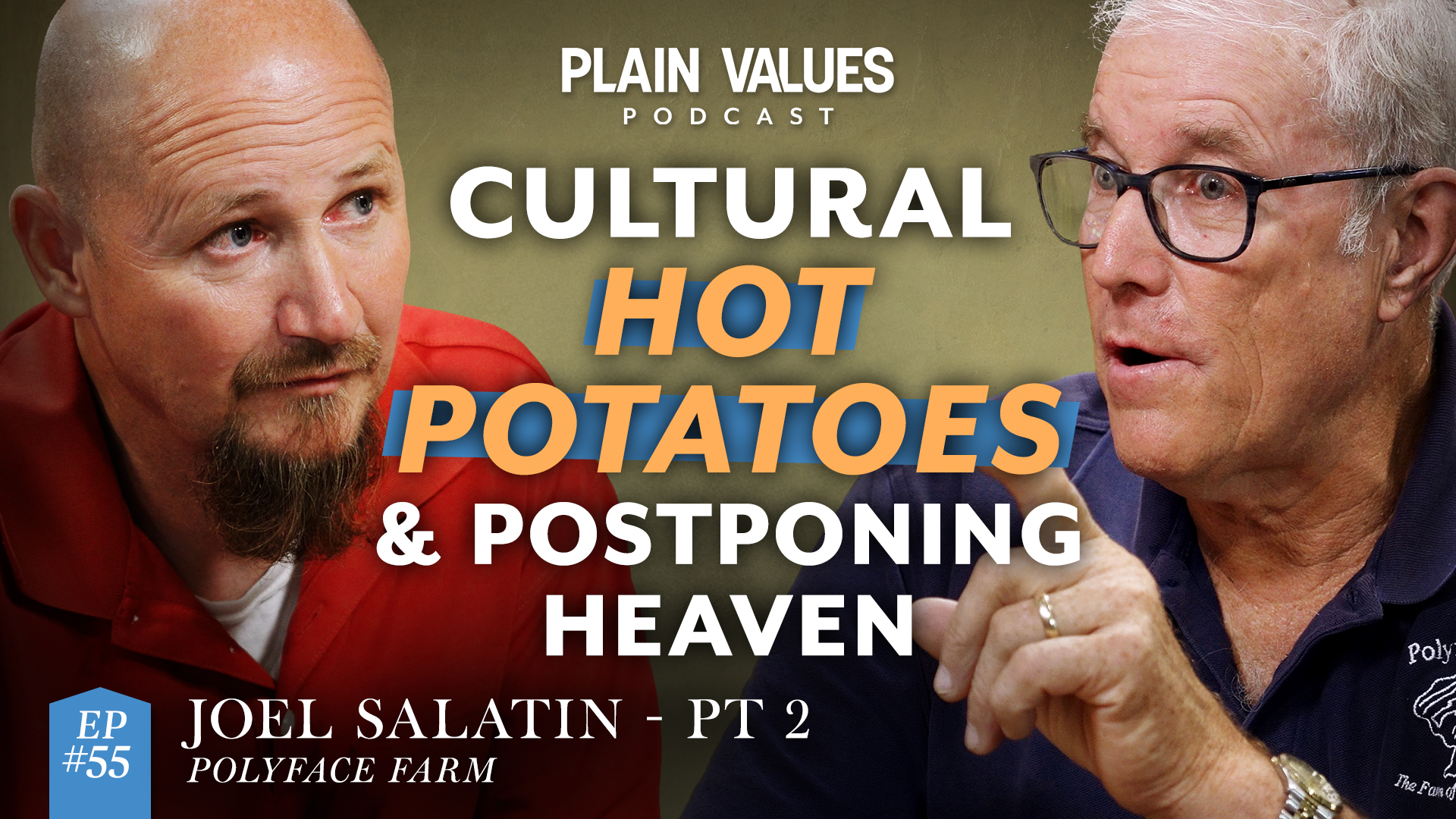
In this episode of the Plain Values Podcast, Marlin sits down a second time with Joel Salatin to discuss several cultural hot potatoes like Big Pharma, Big Ag, Big tech, and how Christians should think about these things. They also discuss several Christian mandates around business, animal care, the elderly, and how we should view death.
They begin by discussing what Joel considers to be the biggest crisis in America–our tendency to accept without question the narratives that are fed to us. Joel shares his belief in the Christian mandate to question the given narrative and discover for ourselves the truth behind the lies.
Continuing on, they also discuss the rise and danger of communism in America, how Joel thinks about money, and his philosophies for growing his business.
Does God care about the happiness of farm animals? If you’re a Christian, the answer is, of course, “Yes!” Joel poses the question, “If God cares about the chicken, how should this affect the way we raise them?” Christians are the salt of the world and are meant to stand out. From the way we raise our animals, to how we run our businesses, and all the relationships in between, we should look different from the world.
In issue #145 of Plain Values magazine, Joel wrote an article called “Postponing Heaven.” Marlin and Joel discuss this article and all the ways we ignore the realities of death in our culture. They close out the episode discussing life and death, and what Joel would like to do with his remaining time on earth.
Timestamps
00:00 – Intro
00:53 – Joel’s Biggest Cultural Concern
07:41 – Servant Leadership Amid Cultural Decline
17:04 – Communism, Technology, and how the Church Should Respond
24:35 – Postponing Heaven: Healing, Death, and Hope
33:43 – Joel’s Mom’s Final Days
37:30 – A Special and Final Goodbye
39:00 – The Burial + Funny Stories Celebrating Joel’s Mom’s Life
42:27 – Reflecting on Death, Imperfect Lives, and Grace
46:38 – Transhumanism
49:05 – Reflections on Heaven
50:42 – How Can We Pray for You?
Pure religion and undefiled is to visit the fatherless and widows and what’s the second part of that verse? To keep himself unstained from the world. It doesn’t mean that you don’t touch the world. It means it doesn’t stick to you. Exactly. Pray for pray for brother Joe. He’s 92, going into some pneumonia. Pray that he’d be healed. It sounds sacrilegious, but but, you know, to even say it, but I don’t think that should be the prayer. When you look across our culture, what’s at the top of your concern? My biggest concern is that we have a culture that’s been acclimated to accept the the government narrative, whatever it is. Joel, again, it is a joy just to just to be here with you. We were talking on the way over here a little bit about some of the topics that you and I hear a lot of feedback on, and it tends to be the topics that are considered hot potatoes. Why don’t we jump into some of those and just, you know Mhmm. Explore that a little bit? Let’s yeah. Let’s toss some hot potatoes back and forth. Okay. When you look across our culture, just, you know, the state of where we are as as a people from the, you know, the the LGBTQ transgender, you know, ideology, from the things that are going on in agriculture to big pharma and all you know, even down to big fertility and things like that. What’s at the top of your concern? You know, if if if you made a list, what’s at the top of your list? The top so in in the culture, I mean, my biggest concern is that we have a culture that’s been acclimated to accept the the government narrative, whatever it is. Whatever the government says, you know, the official the official line, and we have a media that is too lazy or negligent or or prejudiced to to to check into it. So they just take it hook, line, and sinker? Take it hook, line, and sinker and run with it. And then actually promote it out. Promote it out. Yeah. I was I had an hour long interview with senator Ron Johnson not long ago in Wisconsin And and he he finished his initial, you know, stuff and then I was to kind of, you know, I was to do to him what you’re doing to me right now. And and so my first question was and and his his whole initial part was about how awful the COVID jab was, how evil Fauci was, how they knew, you know, all this and was covered up blah blah blah blah blah. And and how it was killing people, you know, the the COVID jab. Mhmm. And I said so when I all got done, it came to be my turn. I said, so so when’s Trump going to apologize for warp speed? That was the COVID jab. And he said, it’s a blind spot. He says he doesn’t see it. Now, you could argue, well, Trump doesn’t apologize for anything. But I mean, that’s an example of where the stuff that Johnson and his committee have uncovered just don’t even see the light of day. I mean, it’s not on anything. So Del Bigtree says that the new religion in The United States is big pharma, that that’s the new religion. And you dare not question it or you’re a heretic And that’s kind of where we are. So my biggest, I’m looking for people and trying to encourage people will question who are willing to question the narrative. And and I think that’s the Christian’s mandate from day one. Mhmm. And so, yeah, that that that’s my it’s this it’s this idea it’s this idea that that safety only comes when the government says it’s safe, that, you know, you can only apply to your soil what the government says you should apply, you can only eat what the government says you should be able to eat, you should only be able to be educated at a place the government says you should be educated in, you should only invest in things that the government thinks you should invest in. And we just have this this overinterventive, you know, government in our society. And that’s why that’s why people like me, their most common phrases, I just want to disentangle. I I want I want I want to be able to make my own decisions, my own choices, and not be coerced or extorted into into whatever the, you know, the mainstream conventional narrative is. Yeah. Do do you think Do you think we are headed for 1984, or do you think we’re headed for a brave new world? Well, learned long ago I’m not a prophet. I I you know, prophets are supposed to be right all the time. If you’re not right all the time, you know, you’re you’re not really a a prophet or at least a godly prophet. And I did some some forecasting back earlier in my life and and was wrong. And, so I’ve backed up and and and don’t do any, prophesying anymore, forecasting. So I I actually I don’t let people lure me into forecasting what is gonna happen. I’m I’m I’m Hebrews. You know, today is the day. Harden not your heart. Today is the day that you you do. And and and each of us has to make that decision daily for ourselves. What is your what’s your obligation? What’s your responsibility, you know, to the Lord, to your family, to your marriage, to your business? What’s that obligation today? And if you will do that every day, then in ten years, the cumulative effect will be you’ll be where you’re supposed to be in ten years. When you think back to the communist manifesto Right. And the 10 things that Marx laid out Oh, yeah. We’re there. Lisa loves rustic strength soap. Lisa is my wife, and she wrote a few words about each of the of her favorites. This is the the ultra concentrated castile soap. This is a staple in our home. It is so versatile. A little goes a long way to make your own cleaning spray for nearly everything. It makes the best bathroom cleaner. Add a few drops of your favorite essential oil, and it leaves your rooms and surfaces smelling great. You can be confident in knowing your home is clean without harsh chemicals. Guys, go to rusticstrength.com to order your first batch. Use p v 15 for a nice little discount. Thanks a ton. We’re there. Well, I that’s where I was going. We’re there. Yeah. Yeah. We are there. Oh, yeah. We are we are absolutely there. And so yeah. I mean, and when you look at, you know, the the New York mayor, Mondani, and and and you see the the everything from the anti Semitic, anti Jewish rise in the on the campus to to the entitlement woke culture, victimhood, and and it’s it’s pretty rampant. They’re it is very very unusual right now to find somebody 20. I mean, they’re there. And when we certainly we certainly find them, they’re there. I don’t wanna be completely negative. It’s very typical, but but it’s it’s very difficult to find somebody, you know, 20, 25 who has what I would call a true servant’s heart that that, you know, my brother-in-law has a business and he’s trying to retire and and and ease out of it. And he’s got a couple of guys he’s, you know, mentoring and training in, but they just want money. They just want to get rich and get money. And they don’t understand that, no, you give stuff away, you build relationships, that’s where you start. A lot of people, our business has been wildly successful, I would say, but we’ve never had a business plan, we’ve never had a sales target, I mean, nothing. All we’ve done is can we do the best we can and make friends out of our customers and it’s been blessed. It it seems like there’s a Bible verse in there somewhere. I don’t know. Do something and, you know, as do do do things half, you know, rough shod, you know, as unto the Lord, I think is how it goes. Actually, not. Do when you’re talking when you’re talking with those younger folks who don’t quite understand maybe what a servant’s, you know, heart, what the attitude is all about. How do you try to instill that? Is it is it just simply time? Do they need to spend time with someone who gets it? Can it just be verbalized and then they see it all of a sudden? Two things, I would say. One is how you message vision. How do you message vision? So, you know, I’m a farmer. We’re in livestock. Most livestock farmers see themselves as whatever, growing eggs or bacon or pork chops or t bone steak or, you know, that that’s that’s what they see themselves doing. The way we talk to our young people on staff is we’re not just that’s a secondary thing that we’re doing. The first thing we’re doing is we are stewarding and caressing creation’s object lesson of divine spiritual sustenance of people. And and and that draws it into a a great majestic sacred place. And I think I think businesses typically are so focused on the dollar or or whatever or or numbers or more customers or whatever it is that that they they skip the chance to actually elevate the con the messaging, you know, the conversation around an elevated an elevated sacred, noble, righteous vision. Is it is it because they are focused on the wrong thing that they actually are not thinking big enough in a way? Oh, no. They’re they’re thinking big enough. I mean, want to take over the world. Yeah. Okay. I mean I mean, I don’t know a business that doesn’t wanna be, you know, if they’re making a billion, they wanna make 2,000,000,000, if they’re making 2, they wanna make 3. I think there I think it’s I don’t think it’s a matter of thinking big, I think it’s a matter of thinking righteously, thinking, I don’t know if it’s a word sacredly, I don’t think that’s a word, but you know what I’m saying, thinking sacredly and bring bringing a bring a moral dimension Right. To the to the practical day to day decisions of life. Mhmm. Into the economic world and the yeah. Yeah. Right. All of that. We tend to tend to think that, well, this is just, you know, this is just God doesn’t care about this. And, you know, I the question that I find catches the faith community flat footed, for example, regarding should we should we raise chickens in a in a 20,000 bird chicken house, for example. And the question that I ask that that I find touches people of faith quickest quicker than anything is to ask simply ask the question, does God care? Does does God care if a pig is happy? Yeah. Does God care if a chicken is happy? And if you’re a person of faith at all, you have to say yes. Well, then as soon as you say, yes, God cares, then the next question is, well, then how would he do it? Would he be interested in in a happy pig? Mhmm. And rather than just how do we grow them faster, fatter, bigger, cheaper, you know, that’s that’s the that’s the goal of the industry. And so, I mean, of course God cares. God God numbers the hairs of our head. He knows when the sparrow falls, you know, he says the lilies of the valley are more beautiful than Solomon in all his glory and Solomon in his glory was a pretty glorious dude, let me tell you, you know, ivory, you know, gold overlaid throne and everything. So the only answer to that question is, yes, God does care. And if he does, then how? Right. How would he do it? Right. And so that’s that’s that’s one element. So so one is one is what I just call the elevation of our messaging of our vision. That’s that’s one. And the second way to create a servant’s heart is to actually is to actually have authority where you suffer the consequences of your decisions. I’m sorry to laugh. Well, everybody gets a trophy. Yeah. Yeah. Yeah. Yeah. Okay. There there is no quicker way to make a culture to ensure that a culture makes poor decisions than to than to protect people from their bad decisions. And so, you know, we’ve got we’ve got soybean farmers, you know, they’re we’re we’re raising way too many soybeans with the got a glut of soybeans, so the soy you know, so the soybean price plummets. And so they demand a bailout. So Trump president Trump gives them a $12,000,000,000 bailout to grow soybeans. Well, in business, normally, when you overproduce something, you either produce less of it or you shift to something else, you know, that that they’re in supply. And take a bath. Yeah. And and take a bath. Okay? But but instead, you know, the soybean farmers are, no. I’m a soybean farmer. I must be I must be protected. Yeah. And they don’t even view themselves as part of the as part of the food system. They view themselves as soybean farmers. I mean, think about it. If if there was if there was a big construction project going on out here and and the project manager said we need 20 we need 20 electricians on on this project. Can you imagine a a soybean farmer saying, no. I think electricians are really important, so I know you only need 20, but I think you should have 30. And the government should make sure there’s 30 electricians here because electricians are important. No soybean farmer is gonna say that, but that’s what they’re asking for. They’re flooding the world with soybeans unnecessarily. The price plummets, they say, but I’m a soybean farmer. I demand, you know, to be compensated for my soybeans. And and so so what happens is the safety net, the cultural safety net, and of course we see this in families too, helicopter parents, no, no, don’t climb a tree, you might break your arm. So what happens is we grow up with this, with anemic discernment muscles. Because they’re never used. Because they’re never used. Yep. They’re never used. So, you to the you buy the food the government says it’s okay to buy, you go to the education the government says it’s okay to educate, you invest where the government says you can educate, You, you know, you you drive a car that the government says it’s okay to drive. Okay. You you go through all this and pretty soon, you know, you’re not really the only decisions you’re making are, well, do we watch Netflix or TikTok? I mean, that’s what it comes down to. We actually have, you know, unfortunately, we have fewer and fewer freedoms to be able to make those decisions. And and as you as you pare down the the the the number of decisions that a person makes or you make them, whatever, less important Right. Then what you get is what I call anemic you you get very anemic discernment muscles. So so two thoughts. Number one, is that not if you go back to communist manifesto, to Marx, they are playing an incredibly long game. Yes. Because when did they start? In the in the nineteen hundreds? Yeah. Yeah. Yeah. Yeah. Yeah. Yeah. Right. And and they were bringing in, you know, the professors. They’re playing a long game. Yeah. Yeah. How how Joel, how can we get our churches or the church, I should say, the church universal, to take a longer game view? I don’t and I’m not even sure if I’m asking a good question because I I don’t understand most of this. I really don’t. But that’s a big deal that the enemy has looked at and said, wait a second, we don’t care if it takes 150 Right, right. They don’t care. They’re in it. What does mean, true religion, pure religion and undefiled is to visit the fatherless and widows and in their what’s the second part of that verse? To keep himself unspotted from the world. Sorry. Yeah. That’s fine. Unstained, unspotted, yeah, yeah. The same thing. Same thing, okay. So what does that mean? Now, you know, we can’t go out and it’s unstained from the world. It doesn’t mean that you don’t touch the world. It doesn’t mean that you don’t interact with the world. It means it doesn’t stick to Exactly, exactly. Doesn’t stain you, it doesn’t block your clothes, it doesn’t block you. And so this is where I think I think the, you know, the faith community has has dropped the ball in that we are I mean, you can use the same thing from the the broad way and the narrow way. Okay? We’ve we’ve not embraced we’ve embraced a broad way. I mean, it’s it’s it’s a it’s a blight on the Christian community that our divorce rate’s the same, our sickness rate’s the same, Are bankruptcy rates the same? All these things are the same as the the the non faith community. The the only there there are a couple of things where the faith community has tended to to to shine. One of them is in suicide. That’s one that pretty much every study has shown that there’s something about being involved in a faith community that reduces suicide. So that’s good. That’s good. But in almost every other metric, we’re almost identical. And so where’s the salt? Where’s the salt that’s supposed to be the salt that salts the the, you know, the culture Yeah. Or or the light that’s supposed to shine. We are we are, you know, when when I when I, you know, when I go to church and I see all these kids on screens and I’m watching this and it just yeah. It’s not helpful. Do you ever, like for your grandkids, how how do you guys how do you see that? Do do your grandkids have screens of any sort? Well, they didn’t no. They didn’t until they were teenagers. I mean, so, I mean, average now, what is it? The average three year old spends four hours a day on screens, the average eight year old spends eight hours a day on screens. That’s a full time job. That is. It’s a full time job. Eight hours a day. Eight year So it’s not like let’s be clear. I don’t think screens are sinful. All right. Let’s just agree. Now, I don’t have a smartphone. So, you know, I’m still on flip phone. I I’ve I’ve never I’ve never apt. I’ve never messaged. I’ve never texted. You know, so when people say the dinosaurs are gone, say, oh, no. They’re not. I’m still here. So so at this point now in my life, it’s almost it’s almost a bit of a whatever, a kind of a brand badge of honor, you know, to how long can I hold out? You know, it’s just kind of hold out thing. And so so then, you know, send your then you’re just branded a well, you’re just a contrarian, you know. You’re just you’re just you’re just being contrarian because you wanna be contrarian. Luddite. Yeah. Yeah. Yeah. Yeah. Yeah. Yeah. And and I, you know, I get that. Fortunately, I I have a staff that does have smartphones and so so I get it, you know. I I oh, I wish I could do it, but my job demands I get it, you know. So I don’t I don’t think it’s sinful, but what what I what I do is I have a I have a a flip phone that has a built in, you know, hotspot. And so with my laptop, I can anytime I want to, I can pull up the in in four clicks, I can be I’ll have the hotspot on, flip open the the laptop and I can get on and I can do anything that anybody does on on a smartphone pretty much, but it’s it’s one step removed. It’s just one step. It’s not in my pocket. It’s not on. And Marlon, you know, I don’t want to live with something in my pocket that listens to everything I say, puts it in some AI data bank somewhere even when it’s off. Yeah. You know, so you have a conversation about puppies and the next day your smartphone is full of ads for puppy chow. That’s creepy. It is. It’s just creepy. Yeah. It is creepy. But rather than, you know, and what I see in Christian community is rather than wrestling with this, again, I’m not trying to say nobody should have a smartphone. I’m not saying it’s, I’m just saying that in the Christian community, rather than wrestling with it, we just don’t talk about it. Yep. We just, every, every, it’s back to judge it. Everybody’s doing what’s right in his own eyes. And as a result, you end up in the judge’s cycle. That’s what happened. Yeah. When everybody just did what was right in their own eyes. Yeah. So let’s talk about one of your last articles that you wrote for Plain Values Mhmm. On postponing heaven. Can okay. If if you’re a listener and you’re hearing this podcast and you’ve never read Plain Values and you don’t know the kind of story that that Joel Salton writes, you know, for us, give them a thirty second, you know, 50,000 foot view of what you said in that article. So I started it out with we’re at we’re at prayer and praise time and somebody says, for pray for brother Joe, you know, he’s 92 and he’s having he’s he’s he’s going into some pneumonia and pray that he’d be healed. And and and I, it sounds sacrilegious, but but, you know, just even say it, but I don’t think that should be the prayer. This episode is brought to you by our friends at Azure Standard. Lisa and I just recently signed up, finally, and we are loving it. Non GMO, organic, it is all that you can ask for. Go to azurestandard.com and tell them Plain Values sent you. If Joe is a good old saint and everybody knows he’s, you know, maybe he’s been a pillar of the church or whatever, he’s 92, he’s getting pneumonia, you you don’t pray for healing, you pray that he go gently and wonderfully and you can pray for not as much pain, but pray that he enter heaven soon and without turmoil and pain. And, you know, we we in the Christian community, in the church, you know, we talk about heavens, this is great great place to go, but then I see us doing everything possible in including medical intervention, including, you know, guy’s got, you know, stage four cancer. He’s 85 and and and he’s in, you know, third round of chemo and radiation and we’re no. Just let it go. Let it go. What’s wrong with saying, Lord, take them and thank you for their ministry? Why do we fight that? Why why why do why is it the innate thing of, okay, Lord, let’s oh, hey. We gotta pray for healing. Mhmm. Because there there I don’t remember how old I was. I don’t remember who it was, but I remember the feeling that that I had to work through of working up the courage to ask a family member of this person who was slowly dying. What when is it okay to start praying that they can go quickly Yeah. Or that they can go that they can pass into the next life? And I and I remember thinking, can is this okay? Can I ask this? Right. Right. Well, the fact is that that with our with our medical technology now, we have been able to prolong artificially, prolong life to force to force issues, to force decisions that I don’t think we were supposed to make. I had a I had a in the article, I wrote about a friend. He’s actually a missionary. His dad was a pastor and kindest man in the world all his life and he’s he’s whatever, 85, 86, you know, and he has a massive heart attack and are able to save him. Yeah. And he became he’d been in World War two. He was he was a mess hall. He was a mess hall sergeant in World War two. And when he came out of that heart attack and came back, he was a different person. He he swore, he cussed, he was mean, he he was he was angry, and he lived another, whatever, seven months, eight months. Yeah. For what? For what? Yeah. I mean, I’ve told my family, you know, I’m almost 70. I know I don’t look it, but but I’ve told them, if I had a heart attack tomorrow, don’t don’t it’s okay. Yeah. It’s okay. I’m I’m perfectly ready and happy to go. You know, there was a there was a was a tribe in a primitive tribe in the Amazon Rainforest that had a girl with a a congenital defect. Missionaries went in there. They had they had a airplane and the tribe was desperate for a clean water system. I think I wrote this in the article too. And and this and but with the but with the advent of now access to an airplane, they could fly this girl out and have surgery and save her. Yes. She was like three, a little, you know, child. And so the elders village elders got together and they said, do we they had they had they had a pool of money. They can either spend it to save this little girl’s life or to get clean water for the village. And they voted for clean water and little girl died. I’m not gonna judge that. Yeah. I’m not gonna judge that, but but but but as Christians, we tend to. We could almost we we almost get into this sanctity sanctity of life cult, and I know I’m skating on eggshells here. Okay? But we we we we can get into this this this thing, life at any cost. It’s almost like the abortion are the the abortion issue has shoved the Christian community into almost an overcompensation on the other side Mhmm. That every single ounce of of of money, technology, faith capacity, prayer needs to be done to preserve life on this side of eternity. Yeah. And there’s no appreciation or gratitude for the release of life on this side of eternity to gain the freedom and true healing on the other side. Have you ever wondered why the Lord put a fear of death in us innately? This is just me and my goofy ideas. Yeah. Yeah. That’s fine. Joel, if we believed that heaven was as unbelievable and wonderful Mhmm. As we say we believe Yeah. Yeah. If I I’ve I’ve wondered at times, if he didn’t put that fear of death I in think I would probably just commit suicide because I wanna go there. Yeah. Yeah. Yeah. I wanna go home. Sure. The older I get I I love life. It’s it’s not that I I wanna die tomorrow. Right. Right. Mhmm. But but if I really believe what he says about heaven Mhmm. The things that are going on there and the places that he’s building, why not just end it? Well And by the way, I’m not saying that I’m Yeah. Yeah. Yeah. Yeah. Yeah. Well, I think I think it comes down, how do you how do you discern his timing? I mean, you know, it it says that the days our days are numbered. Our days are numbered. Okay. Each one of us, our days are numbered. So so to assume that though that that we that our whatever creativity and technical prowess is is always the right way to respond to his timing is I think fairly presumptive actually. Yeah. It’s fairly presumptive. And obviously I’m talking primarily of old saints. I’m not talking about, you know, the family that gets hit in a car wreck and you’ve got, you know, three kids that are banged up. Of course. Okay? You Right. These are thorny things. I mean, mean, and I don’t have all the answers. But but boy, when you get up there into the seventies, eighties, nineties and you’ve got this old saying so, you know, I mean, it’s interesting that I wrote that article while we were taking care of mom, my mom, who was 102 at the time and she’s been, she was pretty much, you know, she wasn’t herself pretty much since about four years. I mean, dementia, physical, but she gradually just got worse and worse and worse and took more and more care. And we did not institutionalize her. We we and my wife every single mother in the world would want a daughter-in-law like my wife. I was gonna say Okay. Yeah. Theresa’s She’s an amazing lady. She she’s just a saint. She just took care of I mean, she bathed her, she cleaned up her messes, she I mean, all this stuff. And anyway, we began praying about two years ago, just take her. She was in pain. I mean, you could hear her bones crack her joints, and she wasn’t living her fullness. And and we don’t apologize. Just she’s ready. She I mean, and she would ask us, I don’t know why the Lord has me here. I’m ready to go. I don’t know what He’s got. Because she had gotten to where she couldn’t, She wasn’t needed for anything. I mean, even up till she was almost 100, we could at least she would we we would let her like lick envelope. We did a mailing, you know, and she could lick envelopes, put stamps on, you know, up. Yep. You you jobs and and you you get them, you know, easier and easier and easier, you know, what you do is you start going to jobs that you could give a three year old child. Okay. You know, you’re two ends of the spectrum there. But there’s still some purpose. There’s still purpose. But once once she got to where she couldn’t read and she couldn’t really carry on a conversation, she couldn’t remember anything and she was in pain, It was not a prayer to heal, it was a prayer to relieve. So please tell me that she was able to go home. Yes. Yes. She actually passed Wednesday, a week ago. I Joel, I didn’t know. Oh, okay. I am so glad for her. Yeah. Yeah. Yeah. I’m sorry for you guys, but I’m so glad for her. It was it and and you know what? It’s it’s been great. She so so Thursday a week ago, we think she had a stroke. Suddenly, her her legs wouldn’t work, left arm wouldn’t work very well, slurred speech, and and she just came with a sack of potatoes. And I flew back early from a speaking engagement I had to to to be with Theresa and help. And we did a we did two days and I looked at her and I and and she she by then, she’d almost become unresponsive. And I said, so and we had called hospice in a month before, started with hospice. Hospice came to just give us some relief. Right. To bathe her, nurse would come and check her vitals and things. And I looked at Theresa, I said, do we can we we just feel like this is the end, you know? Can we do Teresa said, I can’t go another day. She just she was just worn out. Years? Years of yes. Yeah. Yeah. She’d know, basically four years of of care. And and so we we called hospice. Hospice had a a special house. They have this kind of relief house that that you can use. And so they came on Sunday afternoon, picked her up, and and she was she was unresponsive. I got in her wheelchair. We got her out got her on a gurney, got her into the, you know, to the van, and she’s on the gurney. They they put her in, they strap her down, and and I’m in the I’m in the back. And, before they closed the doors, she kinda came to in a moment of lucidity and, kinda raised up, looked at me, smiled, raised her right arm, that was the one she could use, and she waved and said, bye bye. She knew. And then she went back she went back down. You think she knew? I think so. Yeah. I think so. To me, that was that was her saying, see you on the other side. Oh, man. You know, it was just special. She went unresponsive, and that was that was the last she communicated until two and a half day Wednesday morning, so it was Sunday afternoon. Wednesday morning, 04:15, she passed. So it was two and a half days. So we we almost came to the end, but we we we don’t apologize for using hospice. Hospice people were just unbelievable. Then we we didn’t embalm, we didn’t do any of that. We had visitation at the funeral home on Sunday night, so she died Wednesday morning. Sunday night, did visitation at the funeral home. Then Monday, we had a burial at our house, at the farm. Dad, were buried there on the hill. And so they brought the casket out and put on a hay wagon, and everybody brought shovels and everybody climbed on the hay wagon around the casket. I drove the tractor up over the hill to the grave site and we parked, carried the casket down to the hole. And and then, you know, we had just a little short service. And then and then I asked for, you know, anybody that wanted to share memories or, you know, whatever. And numerous people shared shared. And and and the one that stole the show was my grandson, Andrew, he’s 20. So that’s mom’s great grandson. Okay? And and he he said, well, I just want everybody to know it was really neat growing up with being and being able to say to all my friends, my great grandma is cooler than your grandma. My great grandma is cooler than your grandma. I mean, because she was she was 82 when he born. He was she was 82 when he was born, and then she took those kids to, you know, to the wings of freedom when the, you know, World War two planes flew in and climbed up in the cockpit with them, you know, at 90. And and they finally started getting scared riding with her when she was about 95. We we took her driver’s license away at 97, and and we decided it was time in the spring of nineties in the in the spring of twenty twenty, our joke in the family is COVID happened because we took mom’s keys away. That was the cosmic that was a cosmic reaction to us taking mom off the road. But but what happened was in December, you’re gonna get Christmas cards and, you know, it’s fun to get, like, thank you like, from businesses, thank you for your patronage, know, you’ve been a good customer, blah blah blah. Well, there’s one patronage card you don’t wanna get from a business that you patronize the lot. K. The local auto body shop. She And she did? She did. She had three three little fender dents in a year, you know, parking lot, you know, know, the the and and we said, you know, mom, you know, if you if you get a loyalty card from the auto body shop, probably it’s time to hang Yeah. Up the It’s probably time to hang up the keys. And so we took her keys away and began her gentle well, was declining then, mean, obviously her reaction time, but she didn’t really get into the dementia thing until she was about 100. And then when she got a 100, she was in that. So it’s been a wonderful visitation at the funeral home. We thought, oh boy, this is going to be but we, everybody was happy. It was just It was a celebration? It was a celebration. It was absolutely we didn’t cry, we didn’t do, I mean, joked, it was just great, great. So, yeah, a life well lived and a true saint, there takes the the pain of death away. It was it was really wonderful. So Yeah. And by the way, by the way, that verse I think is so oftenly is that a word? It’s it’s misquoted so many times because when he Paul doesn’t say that that the sting of death is gone. Mhmm. It’s when. It’s later. It’s not now. It’s Right. At the end. Right. Right. Mhmm. So anyway, another thought, and this is a bit of this shows you how how bright I am. Pop died. My dad died at 55 years old, about fifteen years ago. I went through Young. Yeah. I went through all of the stuff, you know, the viewing, the funeral, And I went I’m the oldest of of our family, and I was, you know, focused on taking care of mom and and all that. And I didn’t fully grasp how young that was until I I think it was like six months later, I was talking to a friend and I said, hey, man. What are you doing this weekend? And he said something about taking his dad or or he he was gonna go to Boston that weekend to celebrate his dad’s ninetieth birthday. I remember thinking, good land. Yeah. That’s another lifetime He’s thirty five years with my dad that I missed out on. Yeah. Yeah. Yeah. And that’s when it really hit me Right. Of, okay. Wait a second. Fifth and by the way, I’m 49. I’m five, six years there. I’m there. Well, dad passed at 66 and that seems really young to me now because I’m way over that. Teresa’s mom passed at 53. Really? And, of course, that’s really, really young. And and so so, yeah, we have the joke in the family. You know, her her mom passed at 53 and my dad passed at 66. So if she has her mom’s and I have my dad’s genes, assuming the gene theory all that Right. We’re already on borrowed time. Right. And and if I have moms who died a hundred and two and her dad was 90, you know, we’re probably good for a while, but we we joke about that. But, yeah, I mean, yeah, for mom it’s been you know what? I got to say this, just no parent’s perfect. I mean, you want to find fault, you can find fault. Yeah. Your kids can find fault with you. You can find fault with your parents. And and as as we came up on this, we we could see the the the decline. I mean, we we just just knew it it couldn’t go on too long. And and I I I found myself wondering how am I gonna feel? It’s not all roses. There were some warts and And splinters, you know what? The grace of God has just covered me in this week. I don’t remember any of the bad stuff. I told Teresa the other night, I said, I don’t get it. I don’t understand. I said, you know, while she was living, you know, I could recount some of the I said, I haven’t even thought of any of the bad stuff. Wow. It’s just all wonderful. Most wonderful It’s woman in the just like God just erased that out of my out of my mind and it it and it’s just been wonderful, Marlon. It’s been really really wonderful. What was your mom’s name? Naomi Lucille Salatin. Naomi Lucille, yeah. There’s something about saying their name And I I don’t even think I understand it. Mhmm. But but I I don’t think I knew your mom’s name. Mhmm. And I I just I just had to ask. Yeah. Yeah. Well, her name was Naomi Lucille, and Teresa’s grandmother’s name was Ruth Lucille. Both okay. That’s cool. I mean, Wow. You know, completely and both of them went by Lucille, their middle name. That’s uncanny. It is uncanny. Yeah. Wow. Therese, we were meant to be. That’s cool. I have two more questions. Yeah. One more, actually. Boy, excuse me. What talking about all of this, talking about, you know, living a long life and then dying too early and all of these things, I am sure that you have read and heard and seen the the momentum that the transhumanist movement Mhmm. Is slowly building. Mhmm. Yeah. You know, you’ve you’ve got people that are spending a million dollars a For month cryovacking. Right. And and, like, the one guy has has pulled parts of his son’s blood, and and they’ll do all kinds of crazy things. Why why do you think how do you think they look at it in in order to say, I wanna live forever? We’ve been publishing Plain Values for almost thirteen years now. And about a year ago, the team and I decided to put together a compendium, a best of, if you will, of our favorite stories, the most impactful stories of all those years. And invited is what we built out of those conversations. It is a hundred and ninety four and four pages, and it is absolutely a thing of beauty. You know, we do a monthly gathering here where we just simply open our doors. It’s called Porch Time. And the story of how Porch Time came to be and how our family was invited into that and how we are inviting you and every Tom, Dick, and Harry, anybody who wants to come can come and hang out at Porch Time here at the office in Winesburg. So it was such a natural fit to use the home of the founder of Porchtime and to call it invited. You can find it on plainvalues.com on the shop page, and you can now consider yourself invited. Like, they are literally trying to get rid of that pesky little thing of death. Yeah. Yeah. Yeah. That’s what they’re saying. Yeah. Yeah. They’re not hiding it. Yeah. Yeah. Yeah. Well, I mean, they they they have no hope. So they have to hang on to everything they can. They they have they have to hang on they have to hang on to what they know, which is this, you know, which is this physical life. The meat suit. Yeah. Yeah. Yeah. Yeah. Because they can’t they can’t fathom anything else. I mean, some some don’t think there is a heaven. Some don’t think there’s, you know, there’s there’s everything from annihilation to Reincarnation. Reincarnation. You. Reincarnation. That’s what I was looking for. Reincarnation. Yep. You know, all sorts of things to to even, you know, transcendent aliens, you know, beings or whatever. But it’s always, I mean, we we are we are whatever geared to to want what’s routine to us, what we know. Everything that we don’t know is a little bit it’s a little bit dicey. I mean, even as believers reading about the New Jerusalem and different things, it’s still just a little bit, you know, I mean, to me, the most amazing thing that God is going to be able to do is make an eternity in which we don’t get bored. Think how easy it is for us to get bored. I mean, we got to be doing stuff, right? And so for me to think that there’s going to be eternity, I’m not going to be bored. I mean, that’s got to be the most creative thing in the that’s more creative than flowers. It’s more creative than bumblebees that supposedly can’t fly. So yeah, it’s pretty neat to think about that, but meanwhile we occupy. We occupy. The the here and the not yet. Yeah. Yeah. Yeah. Last question. Mhmm. How can we pray for you now? Well, the the main way to to pray for me now is just to be faithful. So I’ve I’ve been blessed now at this stage of my life with some spheres of influence, Stephen Covey would say, that I’ve never had with with everything from, you know, politically to, you know, to the homestead movement, homeschooling movement. I’m I mean, I’m my my speaking schedule is just crazy. I mean, I’m just You got a motor on your back end there, you think? Yeah. Yeah. Yeah. I I, you know, and and I try to not even I try to just dismiss how long can I do this because then that that gets you into a defeatism, you know? So we just we just keep keep carrying forward. But but I I just want to be clearly, I’ve been I’ve been placed in a place of of influence both within the homeschool, home steadying movement, the agriculture movement. I mean, when you get introduced to the most famous farmer in the world, you know, that’s a It’s kind of a big deal. That’s a big deal, you know. It’s it’s a yeah. And and and so I I just wanna be faithful. I wanna be I don’t wanna I don’t wanna squander and I don’t wanna besmirch. I don’t wanna besmirch the influence that that I think God has just, you know, blessed me with and given me with. So, you know, I wanna I wanna stay totally just grateful, not proud, but just grateful, and here we are. And and if I do get to stand before kings, that that I will be that I will be a a a a spokesperson for God’s agenda. Yeah. That that I speak that with clarity and courage and precision in whatever those spheres of influence might be. Well, Joel, thank you. I I it is it is an honor to call you a friend. And, yeah, I I hope you know how much we love you and we pray for you guys. Thank you. Yeah. I look forward to to more. Thank you. Thank you very much. Thanks for the platform that Plain Values offers. It’s allowed me to write about things that I’ve wrestled with all my life and never had a voice or a forum to express it. And so I deeply appreciate the platform and the freedom. I mean, you guys just say, bring it on, you know, just go ahead and bring it on. So I’m bringing on, you know, the wrestling that I see within the Christian community and in my own heart, you know, the wrestling that I see. Yeah. I think it’s needed. So thank you.
Brought to you by …
🤝THIS EPISODE’S PREMIERE SPONSOR: Rustic Strength
Rustic Strength is the real deal. This hardworking family-owned company in Missouri makes high-quality, non-toxic laundry, home, and body care products in small batches… completely free from harsh chemicals, dyes, and synthetic junk you don’t want around your family.
Learn more: https://rusticstrength.com/
🤝THIS EPISODE’S FEATURED SPONSOR: Azure Standard
Our friends at Azure Standard have been quietly setting the standard for clean, wholesome food since the 1970s. Family-owned and values-driven, they make it simple to fill your pantry with organic, non-GMO groceries, bulk staples, and household essentials delivered straight to your door or a convenient local drop point.
Learn more: https://www.azurestandard.com
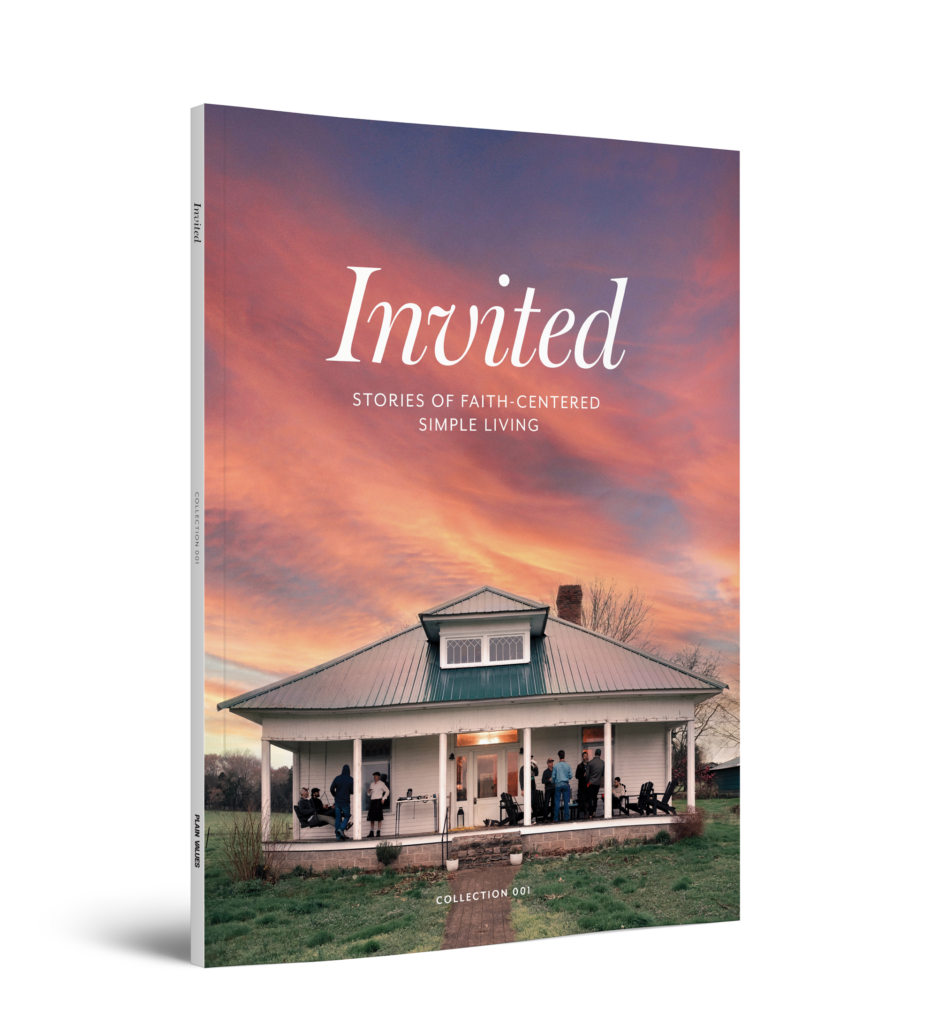
🤝THIS EPISODE’S FEATURED SPONSOR: Invited: Collection 001
If you’re craving stories that restore faith in hard times, Invited: Collection 001 is a handpicked “best of” from Plain Values magazine… uplifting accounts of triumph, simple joys, adoption beauty, homesteading wisdom, and gospel-centered living.
Learn more: https://plainvalues.com/invited







Leave a Reply