
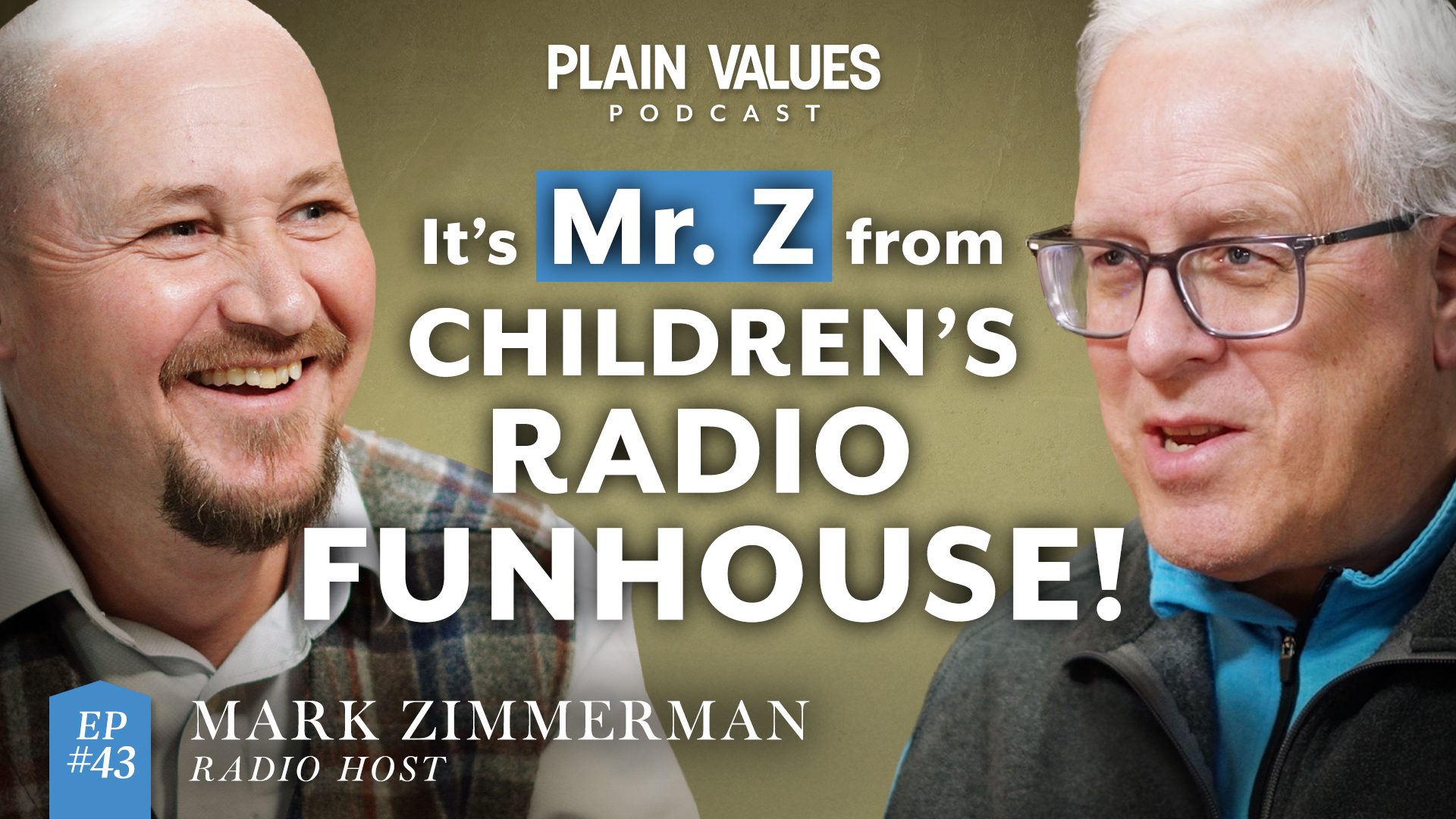
In this episode of the Plain Values Podcast, Marlin Miller sits down with longtime broadcaster Mark Zimmerman to explore his journey from growing up in Northeast Ohio to a rich career in radio and storytelling.
Mark spent his early years in Cleveland Heights before moving at age six to Geauga County in Amish country. At Bowling Green State University, he became the university mascot Freddie Falcon his junior year, an experience that taught him perseverance, work ethic, and leadership. He co-created the popular “Insomniac Half Hour” radio show, which grew into a live hour-long production, helping launch his broadcasting path.
Mark spent many years hosting the beloved Children’s Radio Funhouse on WCRF, bringing joy, music, and encouragement to families every Saturday morning. He also worked in advertising and did play-by-play for baseball and hockey. He shares how mentors shaped him and reflects on the lessons learned from both successes and challenges.
Now transitioning from daily morning drive radio, Mark looks forward to more time with his wife Wendy, their daughters, and grandchildren. He has already published a novel titled Eli, a story set during the 1946 baseball season, and is working on his next book, Fifth String.
Throughout the conversation, Mark’s warmth, humor, and gratitude for God’s faithfulness shine through. His life reminds us that our gifts, whether on the air or in everyday service, can be used in beautiful ways when placed in God’s hands.
Learn more about Plain Values at https://plainvalues.com
Transcripts
0:00 – Introduction
2:48 – Freddy Falcon
4:30 – The Mentorship of Mark Kelly
15:25 – Family Background
21:48 – Early Broadcasting
33:01 – Views on Local Radio
43:12 – Customer Service Lessons From the Ballpark
49:27 – Children’s Radio Funhouse
57:06 – Writing Novels
01:11:56 – Transitioning to a New Season
01:16:52 – How to Pray for Mark
Mark Zimmerman:
It’s going to be extremely important for the people who work at these local radio stations to immerse themselves into the local culture.
Marlin Miller:
Lisa grew up listening to you on the radio with the children’s radio Fun House.
Mark Zimmerman:
Fun House, yes.
Marlin Miller:
Tell us about the Fun House. So let’s talk about this right here. Well, Mark, it is a real joy to do this again. There’s a backstory there, but I’m not going to go into it now, but let’s go all the way back. Can you tell us about your childhood?
Mark Zimmerman:
Oh, I grew up basically in Cleveland Heights till I was about five years old. I think one of my first memories was actually walking to my school as a kindergartner in the city of Cleveland Heights. I can’t imagine that happening today. We moved when I was six out to Giaga County and Chesterland. That’s Amish
Marlin Miller:
Country.
Mark Zimmerman:
Well, Chester Township. No, actually that’s kind of funny because the Amish people I came to know in Giaga County, they found out where I was from. They said, “Oh, you’re a city boy.” And when I talked to people from Mayfield and Beachwood and places like that in Cuyahoga County and I’d say I was from Chesterland, they’d say, “Oh, you’re a country boy.” So there was really no way to win on that one. Nowhere to go. No, Amish country in Giauga County would be from Burton South.
Marlin Miller:
Middlefield.
Mark Zimmerman:
Middlefield. Yes. Parkman and places like that. Yeah.
Marlin Miller:
Yeah. I didn’t know that you were there in Geuga County.
Mark Zimmerman:
That’s cool. Yeah. Grew up there and my years from six years old to high school graduation were all there.
Marlin Miller:
So after high school, did you go to college?
Mark Zimmerman:
Bowling Green State University.
Marlin Miller:
BGSU.
Mark Zimmerman:
There’s no way I could repay those people at Bowling Green because that’s where all the doors came open for me as far as broadcasting was concerned socially. I mean, I was just really changed by that experience, not in the way Jesus changes you, unfortunately at that point. But the doors just flew open for me there and I owe that place a lot.
Marlin Miller:
Wow.
Mark Zimmerman:
Yeah.
Marlin Miller:
What is on memory from your college days that makes you smile?
Mark Zimmerman:
I was the mascot Freddie Falcon my junior year and the best part of the job is that your identity is kept a secret. As best you can keep it on a campus of 16,000 students and at the final basketball game at halftime your head comes off and you get to reveal your identity to the student body. But that whole year was just great because yeah, I went out and represented the university at a lot of sporting events and things like that, but I learned so much about myself during that year. Perseverance, work ethic, you name it. And I picked that up and I applied it to every other part of my life.
Marlin Miller:
Did you keep it a secret?
Mark Zimmerman:
Well, I had my roommate knew and two of my friends knew who were living actually next door in the dorm to me and they did the best job they could, but I was a rather vocal member of the marching band and when I didn’t show up and I had an excuse that I hurt my knee or that was a pretty lame excuse, people started to figure things out pretty quick. So I actually went into the band director’s office, guy who basically was my second father, Mark Kelly. And I just said to him, “Chief, there are people in the band who are talking and I need you to shut them down quickly.” And he also kind of figured out what my situation was. He kind of knew what was going on and so he passed the word and it was silence after that. It was great.
Marlin Miller:
How does the mascot get chosen?
Mark Zimmerman:
There’s a tryout and it has become a very big thing. It wasn’t a super big thing when I tried out, actually I didn’t even go to the tryouts. The guy who was the Freddie Falcon the year before, he and I kind of knew each other because we were both in broadcasting classes and he came to me in the trial process and he said, “We don’t have anybody who’s very much any good right now. Could you come and just do one session of tryouts and just kind of fire everybody up and get everybody excited for the process.” So I did it and by the time I was done and I was getting out of that suit, I knew I absolutely positively wanted to do it. I told my friend, I said, “Hey, I’m in. If I can go to the next round, I want to go to the next round.” And they took me.
Yeah, it was a lot of fun. That’s
Marlin Miller:
Cool. Because you really have to be fire upable.
Mark Zimmerman:
It’s a persona. I
Marlin Miller:
Mean,
Mark Zimmerman:
It is. Yeah, it’s a persona. You can’t just be boring
Marlin Miller:
And
Mark Zimmerman:
Try to do
Marlin Miller:
The job.
Mark Zimmerman:
No, you can’t. And I was fortunate to be there doing that the year that the hockey team went to the final four and that was there were like 20 home games and that was just party time. Every Friday and Saturday night there was a home series in BG. The place was packed. They said there were 3000 wink wink in the ice arena and the fire marshal obviously looked the other way because there were people standing three and four deep along the boards at each end of the rink and the stands were just full to the brim.
Marlin Miller:
Hold on.
Mark Zimmerman:
Yeah.
Marlin Miller:
Were you Freddie Falcon for all the sports?
Mark Zimmerman:
I did, yeah baseball. Well, I did football, basketball, hockey, and then the non-revenue sports, I tried to hit all of them at least once, maybe twice. And just some days walking through the student union with the suit on, swiping French fries off of people’s plates or coming up to a class that sounded like it was very serious, just walking through one of the academic buildings and just plastering my head up against the window and the door and kids in the class go, “Freddie.” And the professor was like, “Okay, come on in. ” So yeah, just doing stuff around campus just to get people fired up. Did
Marlin Miller:
You ever talk?
Mark Zimmerman:
No.
Marlin Miller:
You cannot talk.
Mark Zimmerman:
Cannot talk. No. Because
Marlin Miller:
If you would’ve talked, especially, I mean, someone like you that has such a-
Mark Zimmerman:
I was on the air at that time.
Marlin Miller:
They would’ve nailed you so fast?
Mark Zimmerman:
Yeah, I was on the air. Okay.
Marlin Miller:
All right. Let’s go back. You said that Mark Kelly was like a second dad.
Mark Zimmerman:
Yeah. He was the director of bands at Bowling Green at the time and he was there from 1966 to 1993. I was not even a music major, but I went there and I tried out for the College of Musical Arts as a senior in high school. I was terrible. What
Marlin Miller:
Did you play?
Mark Zimmerman:
Or try to play? Saxophone. Yeah, right. And I just didn’t have a good audition, I didn’t make the College of Musical Arts. Then I went a couple months later to try out for what they called an assistant drum major position with the marching band, because I’d been the drum major in high school and they decided not to go with it and that’s fine, but that’s also a place where he saw me and I was on his radar and when I got to Fundamentals Week in September of 1975, he knew who I was when I walked down the field and he would get on me if I was not displaying what he thought were leadership qualities, like in other words, being a real screw up and going for laughs all the time, but he became somebody in my life that he gave me the life lessons in leadership that I kind of led by the seat of my pants and he made sure I understood that people didn’t want to hear you proclaim what kind of leader you were.
They wanted to see you do it. And once I had that in my head, that changed everything for me. It kind of
Marlin Miller:
Clicked.
Mark Zimmerman:
Yeah. And it clicked in a lot of other ways as well. What a great man. And so we actually, I graduated in 1979 and by the mid ’80s I was married and I was getting ready to have kids and so we kind of drifted apart. But in 2007, I just called up his daughter and said, “Hey, is it okay if I come over and visit Chief and sit and talk with him for a while?” And she said he’d love it. And I went over and I was greeted like, he had three daughters just like I did. I was greeted like the son he never had and he went to get me something to drink. I’ll never forget this.
Marlin Miller:
This episode is brought to you by our friends at Azure Standard. Lisa and I just recently signed up finally and we are loving it. Non GMO organic. It is all that you can ask for. Go to azurestandard.com and tell them plain values sent you. You can use the code HL15 for a healthy little discount. Thanks guys.
Mark Zimmerman:
So he goes up into the kitchen from the little sun porch in his house and I look next to the door and there’s two photographs. The only two things in the room that indicate that he was a band director for his entire adult life. One was the picture of the marching band marching to the stadium on game day and his daughter explained to me later he loved, that was his favorite moment of the week because the show was just about to hit. The fans were filling the stands, the band was on the way anticipation. And the other picture was of me and him on the practice field, a candid that was taken probably about 1978. Wow. I pretty much lost it when I sat there and saw that picture because I never knew that I meant that
Marlin Miller:
Much.That was what I was going to ask you
Mark Zimmerman:
Was,
Marlin Miller:
Did you have any idea?
Mark Zimmerman:
Never.
Marlin Miller:
Never.
Mark Zimmerman:
Not a clue. Well, I knew he liked me. I mean, he liked a lot of people, but I wasn’t a music major. There was nothing that special about me and I didn’t think, but we kept seeing each other a couple times a year when I’d drive out there and when he passed away, his daughters asked me to represent the students at the memorial concert. They gathered rather than a funeral or a memorial service, they had a hundred musicians from his career as a high school and college band director
Gather on the stage at the auditorium at Bowling Green and then they played his favorite pieces. He picked them out and I spoke last and everybody who spoke before me had doctor in front of their name. They were all big time professors and I was just the student, the kid who got the bachelor’s degree, not even in music. And Marlon, I have been in front of audiences doing comedy and sketches and emceeing and broadcasting all my life, probably since I was 12 years old. That was the most scared I ever was before I stood up to talk because I wanted to be what I wrote and the way I said it. I wanted it to be the very best for him. Sitting there next to the university of president on one side of me and all these distinguished musician and band leaders from all over the country and just little old me sitting there and I just, by the time I got back to my seat, my legs were shaking.That’s one of those memories that, and I still haven’t listened to it.
Somebody made me a copy of it, but I haven’t listened to it to this day. I don’t think I could listen to it without losing it. Yeah.
Marlin Miller:
How many siblings do you have?
Mark Zimmerman:
Two sisters, both younger, very tolerant.
Marlin Miller:
You’re the firstborn.
Mark Zimmerman:
Yes, I am.
Marlin Miller:
Tell us about your folks.
Mark Zimmerman:
Well, my mom and dad, those people in the Cleveland area will kind of know the geography. My mom grew up in the neighborhood where she went to John Adams High School Southeast Side of Cleveland, Mount Pleasant was the name of the neighborhood. And my dad grew up in Collinwood on the northeast side, the Slovenian section of town. And so he went to Collinwood High School and she went to John Adams. He was drafted to go to Korea where he served for a couple of years and my mom and dad met probably not too long after he returned from Korea. I think they got married about 1955 and I came along in 57 and my sister’s in 60 and 62. My mom was my biggest fan and the biggest fan of my sisters, the biggest fan of my wife Wendy and my daughters. And she unfortunately passed away before she got to meet any of her great grandchildren, but she would be their biggest fan too.
And she taught me the system of scorekeeping for a baseball game, keeping a scorecard.
Marlin Miller:
Your mom taught you that?
Mark Zimmerman:
My mom taught me that and I still use that system with a few of my own modifications to this day and she was a hero because my dad left home the weekend after I graduated from high school and so it was very hard for my mom and she recreated herself at that point. So yeah, I call her a hero because that’s exactly what she is. She finished raising my two sisters and then she was able to sell the house that we all grew up in, moved to a condo and it was very interesting because she passed away the day after her last payment on that condo went in the mail.
Marlin Miller:
No kidding.
Mark Zimmerman:
So we just wanted to make sure that she did it.
Marlin Miller:
Wow.
Mark Zimmerman:
She did that. She paid for that whole thing. She got two kids through college. Yeah, amazing woman.
Marlin Miller:
What did she do as a job to be able
Mark Zimmerman:
To pay all that? Well, she worked for a company that produced natural gas and oxygen for medical applications. Burdett Oxygen was the name of the company originally. They’ve had two or three name changes since then, but she was there for a long, long time and she just kept working her way up, being dependable. And I have a feeling I picked up a little of my dependability factor in getting to work no matter what from her.
Marlin Miller:
What happened with your dad?
Mark Zimmerman:
He eventually remarried and it’s interesting. I was able to make it quite clear to him during the last few years of his life, because he passed away at 63 back in 1993. But Wendy and I went to Parkside Church, Alastair Bags Church at that time and we would invite him to the Christmas concert. We had him come to our baptisms in the swimming pool at Solan High School. We made sure that he was in position, whether it’s through others speaking or me and Wendy speaking, or me and Wendy living our faith. I made sure that he knew what he need to know. So I will hopefully see him again, but I don’t know how that’s going to be, where he will be headed when that happens. I’m not sure.
Marlin Miller:
I’m sorry. Goodness. How do you think it impacted you?
Mark Zimmerman:
Oh, when I met Wendy and I met her in 1983, before we got married in 1985, I had just committed myself to God that what happened to my mom and dad was not going to happen to me and Wendy. I could not, because I know what my sisters went through and I know what I went through too, but I was 18 at the time. I probably took it a little better than my sisters did. Still hurt, obviously, but I promised before God that I was never going to betray Wendy’s trust. And I have a feeling my dad might have betrayed that trust more than a couple times before he actually left home. There is circumstantial evidence.
Marlin Miller:
Boy, those are hard things.
Mark Zimmerman:
Yeah, they are.
Marlin Miller:
So let’s go back to Mark Kelly and how did you get into radio? How did that whole process come around?
Mark Zimmerman:
Well, I was always involved with plays and musicals in high school and broadcasting just always seemed like the fun part of it because it didn’t involve costumes, makeup or any of that other stuff. All you had to do in radio was create the theater of the mind. I’d been a big fan of old time radio from the 30s and 40s since I was a little kid.
Marlin Miller:
Like the radio dramas.
Mark Zimmerman:
Oh yeah. Yeah. Jack Benny Show, Phiber McGee and Molly and all of those old school radio shows. I started loving the way those sketches were written and how if you got the person’s personality correct, like in Jack Benny’s case, the audience would laugh without anything happening. Somebody would just say a line like the very famous one with Jack Benny is where the crook says to him on the radio show, “Your money or your life.” Well, Jack Benny was a skin flint. He didn’t say a word and the audience just roared for 30 seconds and Jack Benny just let it go. And so The Crook was played by Mel Blank, who was the voice of Bugs Bonnie- All of those
Marlin Miller:
Characters. Oh my goodness.
Mark Zimmerman:
I said, “Your money or your life.” And Jack Benny said, “I’m thinking it over.” So I just love that kind of timing.
Marlin Miller:
They knew what was coming.
Mark Zimmerman:
Yeah, they knew. Yeah. And so I love that. And so basically at the end of my freshman year I was doing a theater production for kids, not now I was doing a theater production for kids with this other guy from the Cleveland area. His name was Joe Gunderman and we came up with this idea during the summer of 1976 for a radio show, a half hour weekly show called The Insomniac Half Hour and we basically would write some sketches that we would do in the studio and we would play clips from comedy records and we would kind of group them around a theme sometimes, otherwise it was just our favorite stuff, what we wanted to do. And by the time we got to year three of that show, we decided to take it live in front of studio audiences at locations all across campus once a month and do an hour long show.
And this was in the original age of Saturday Night Live. So all we were doing was basically doing a college version ripping off Saturday Night Live. And so I was the writer for probably 75% of the sketches and Joe wrote the other 25%. My roommate, Bill Cohagen, came along and did voices and we had a few bit part players who kind of rotated in and out of the sketches. We had a band, a local band that would come and play like Saturday Night Live, play one or two songs during the show and we put out a record album. I mean, it was a lot of fun and we wound up winning a national award, a runner up with the National Association of Broadcasters for the Insomniac Hour, which it eventually became. And all three of us, I mean I wound up at WCRF and Heartfelt Radio.
Joe Gunderman has had a long career. Now he’s with WCLV, WKSU IdeaStream as their production manager. And Bill, my roommate, was the director of the news at 10 o’clock on Channel 19. So we all wound up making broadcasting our careers in various ways and we were all thrown together at Bowling Green at that time and people have said, “Oh, I’ve heard about broadcasting school at Bowling Green, going there for broadcasting.” And I said, “Well, now they have nice equipment, but the equipment back when I went there was terrible. It wasn’t the equipment, it was the people. ” We just found like- minded, talented people and we put ourselves together as a team and kept to the discipline of making sure we had a workable show once a week when it was a half hour, once a month when it was an hour and the logistics of producing it in a live setting.
Marlin Miller:
I’m going to pause you for a second.
Mark Zimmerman:
Yeah.
Marlin Miller:
Was the insomniac hour you out front acting? That’s what
Mark Zimmerman:
I thought. I did all my own sketches that I … Some of them I wrote for other people, but for the most part, I always put myself into them as one of the voices somewhere. Wow. And then I was a DJ also at student radio station. I also did baseball and hockey play by play from time to time. I tried to do as many things as I could to make myself as valuable as I could when I graduated.
Marlin Miller:
Let’s talk about doing play by play.
Mark Zimmerman:
Yeah.
Marlin Miller:
A friend of mine just told me that the local football team, the guy that was doing it couldn’t do it for one game Friday night and they pulled Jimmy in and he’s an auctioneer, but he said, “That is a whole other ball of wax.” He said, “I could barely keep it all together between the play by play, coming to him, the stats and all of the people, the names of the kids.” And then you had an ad here and an ad shout out there and he said, “It was insanely intense.” It was the first time for him. I’m not sure if he’s going to keep doing it, but it was a hoot for
Mark Zimmerman:
Me. Well, baseball and hockey are completely different. Baseball, you have to be a good storyteller and at least try to know as many stories as you can about the teams, the players and things like that. Hockey is so fast, you don’t have time for that.
Marlin Miller:
He
Mark Zimmerman:
Passes
Marlin Miller:
To this guy, he passes to that
Mark Zimmerman:
Guy. You’re riveted and you’re moving. Numbers, who’s what number and what line is coming on, what line’s going off. Yeah. So that was a lot of fun to be able to do that. And some of it came into play, certainly learning how to prep for Morning Drive and prepping to do play by play, very similar in a lot of ways.
Marlin Miller:
Wow.
Mark Zimmerman:
Yeah.
Marlin Miller:
Talk about the concept of broadcasting. It goes all the way back to doing the old broadcast seeder thing, right? Where you’re broadcasting seed out into a field.
Mark Zimmerman:
That’s original use of the word. Yeah. And that’s how the word actually came to be used by the electronic media we call broadcasting. But yeah, that was basically that would be the method of throwing the seed, just grabbing it out of the sack, not even Using a machine, but going back to the days of throwing- By
Marlin Miller:
Hand.
Mark Zimmerman:
Exactly. Throwing it out there. Just tossing it.
But broadcasting originated at the end of the 19th century with one of the many applications of electricity and it became workable really, probably just after 1920 when the first radio stations really signed on the air. And then it went through that era where it became the main source of entertainment during the Depression in the 30s, the war years in the 40s. And it basically grew game shows, soap operas, variety shows, news programs, live remotes. And as television came, all of that migrated to television. And so by the 50s, radio then was left with music, which made it the perfect conduit for the rock and roll era. And the local talk type thing, the town crier kind of thing. Also sports events. Here in Ohio, of course, Ohio State football is a big deal. If your station had that contract, you were going to do well in the fall.
Marlin Miller:
Which would then bring all the advertising dollars
Mark Zimmerman:
And everything else would flock to it. You get a nice cut of that. The Cleveland Indians back in that day would provide you 154 and then 162 days and nights of programming every year that you wouldn’t have to worry about because there’d be a game on.
Marlin Miller:
Was it a struggle for stations to get programming? I mean, they had to
Mark Zimmerman:
Create it. They would put anything on the air. Just about anything. It’s actually interesting. One of the stories that Tom Hamilton told when he was inducted into the Baseball Hall of Fame this past summer, he told a story where one of the first things he got to do in broadcasting, I think he was 16, 17 years old, he broadcast a livestock auction.
Marlin Miller:
Wow.
Mark Zimmerman:
Exactly.
Marlin Miller:
Not what I was expecting you
Mark Zimmerman:
To say. A
Marlin Miller:
Livestock auction on the radio.
Mark Zimmerman:
Yes. The Hall of Fame baseball broadcaster of the Cleveland Indians and Guardians started out by broadcasting things like livestock auctions. And Tom said at the time, he said, “Well, here comes another steer.” And ladies and gentlemen, there’s been a little bit of a mess on the platform. We’re going to have to take a little time out for a commercial. And that’s what local radio became. And now we get to like the 1980s when President Reagan deregulated the broadcast industry and everybody was scared to death that the broadcast industry was going to go from 777, which is what it was back then. You could own seven TV stations, 70 AM and 7FM radio stations. Well, people were all upset because they thought people are going to buy 30 radio stations then. I mean, that’s going to be terrible. Well, of course now we’re in the age where iHeart owns 1100 stations, Salem owns six or 700.
And of course that’s something the Reagan administration never envisioned. Nobody envisioned anybody having that much money to be able to buy up all of those broadcast properties. And so where we find ourselves today, which is kind of interesting, here we are at the end of 2025. If I had told you 11 months ago that the two main Christian radio stations in Northeast Ohio would effectively be gone, you would have gone, no, no, no, no. But the fish, all the fish properties that Salem owned got sold off to Kalov. And then WCRF, well, Moody Radio just cut the cord with all of their owned and operated stations. Everybody who worked there got let go. Probably about 60 people lost their jobs and Moody originates all their programming now from Chicago. And so the station I worked for, Heartfelt Radio, is the only local Christian radio voice left.
And nobody would have imagined that 10 months ago, but there was a lot of debt service with Salem Communications and they sold off the fish properties and rumor has it there was a lot of debt at Moody and that’s why the owned and operated stations, they made sure all the employees were let go. So that’s where radio now is as we get to the quarter pole of the 21st century, we now have an industry that is based with mega corporations controlling most stations from a central location and somebody says, “Oh, who lives in here in Northeast Ohio?” They’ll say, “What about the river?” Well, no. The river say they’re from Worcester, but their signal comes from Columbus. Yeah. They’re not a local Northeast Ohio station. And so those local stations are becoming more and more few and definitely fewer and farther between in many different ways.
And so the industry is now reaching a really interesting point where yeah, you can keep listening to the radio and listening to the same formula playing out in cities all over the country where iHeart owns oldies stations or you can listen to one of the local stations that will give you local news like our station being a Christian station, pastors from our 10 county listening area. We’ve had well over 50 of them on the air in the first five years, Christian ministries, local businesses. We become kind of a place where in reality, radio is kind of now at the truly local level, it’s regressing back about 60 or 70 years to the early years of television where now the local radio station becomes kind of the town herald and the numbers show the latest polls and the latest numbers taken by pollsters show the demise of radio is greatly overblown.
Still over 90% of Americans tune into their local radio station every week.
Marlin Miller:
At some point.
Mark Zimmerman:
At some point,
Marlin Miller:
Yeah. 90%
Mark Zimmerman:
Still.
Marlin Miller:
That’s
Mark Zimmerman:
Incredible. Yeah. And that’s the thing. Now you have all of these corporations that own these stations that are replicating over and over these formats in various music and we really don’t need them because all you got to do is go to Spotify and then you can program your station the way you want it. You can have all the music you want and desire on your Spotify channel just the way you want it.
Marlin Miller:
Can I confess something?
Mark Zimmerman:
Yeah.
Marlin Miller:
Don’t lose your thought, but it was not more than a couple months ago that I realized that Spotify has an algorithm.
Mark Zimmerman:
Oh, they do. I
Marlin Miller:
Didn’t know that. I didn’t notice it. I never thought about it. Now let me pull back the curtain a little further. Marshall McClewan, the medium is the message.
Mark Zimmerman:
Right.
Marlin Miller:
Okay?
Mark Zimmerman:
Right.
Marlin Miller:
Talk about what you’ve seen happen as radio goes from the 30s, 40s, 50s, where that was it. That’s all they had to all the way through to today where you now see this resurgence in the value in everybody because I think there’s a lot of those things that we are tired of the screens, we’re tired of the digital and I think a lot of people are saying, “I want to go back to analog.” Vinyl is making a massive comeback.
Mark Zimmerman:
Yes, it is. That’s interesting because the one thing I would say from the corporate viewpoint is that the number of jobs in radio now has shrunk precipitously. Most programmers now are going to want to give you an announcer who’s doing a playlist and they’re sending it out to hundreds of stations around the country.
Marlin Miller:
One guy- One guy.
Mark Zimmerman:
… for all
Marlin Miller:
Those hundreds of stations.
Mark Zimmerman:
Exactly.
Marlin Miller:
Yep.
Mark Zimmerman:
The only place where you’re going to see a local staff anymore is the truly local station. And I think we’re going to enter a period now, I think we may already be entering it, where it’s going to be extremely important for the people who work at these local radio stations to immerse themselves into the local culture and the local high school and school system and the businesses in downtown where the people shop and I think it’s going to become radio is going to become part of a symbiotic kind of relationship between the town where they are, the village or the city or the villages plural that surround them within the range of their broadcast signal and the businesses in that area. I think they’re going to have to survive together in some way. I think it will happen because there’s mutual interest there. Everybody has a mutual interest in a relationship like that.
The days where radio stations would just soak up advertising dollars like crazy, those are pretty much over. Those ads are all coming from national clients now and they better come from national clients or that money spigot is going to be shut off very quickly.
Marlin Miller:
It’s so interesting to see and I don’t just mean to be cliche here, but that circle really does come back around.
Mark Zimmerman:
Yeah.
Marlin Miller:
So if I remember right, Mark, okay, two things. Number one, you were with the Cleveland Indians for a while, right? You did a lot of stuff
Mark Zimmerman:
With them. Well, yeah.
Marlin Miller:
This episode is being brought to you by my friends at Kentucky Lumber. Recently, I had a chance to sit down with Derek and his wife Lisa and their whole family and let me tell you, they are wonderful. They have stepped into some of the hardest situations with fostering and adoption. If you care about the least of these and the kids that are coming out of really hard places and you want to buy from a family who gets it and cares about those kids, they are living on the front lines of some of the most unimaginable situations that I’ve come across in years from siding to trim to flooring, they have it all. You can find them at drywallhaters.com.
Mark Zimmerman:
When Moody Radio did the first cut back in 2015 that took me and Gary Bittner away, that happened all over the country. A lot of guys I knew lost their jobs in that first cut. I began a period of basically four years away from radio and during that time I was a gallery guard at the Cleveland Museum of Art. I was a bus driver for Giaga County Transit and basically taking Amish girls to the houses they were cleaning and Amish grandmas and grandpas to the doctor and Amish families to the grocery store and all of that.
Marlin Miller:
Was there any art stolen from the gallery while you were on
Mark Zimmerman:
15? No, no, no, no. There were some kids who almost broke a few things, but man, they drew attention quickly. But then the third part-time job I had during that time, those two, and then the bus driving job actually became full-time, but the third part-time job was working on the premium seating team with the Cleveland Guardians, Indians, guardians at Progressive Field. And that was another place where I learned a lot of very interesting lessons about human nature. So yeah, just observing people as they’re in a hurry to get somewhere and they think they know where they’re going, but they really don’t.
Marlin Miller:
So give me one of the lessons that you learned, like the best one,
Mark Zimmerman:
Best for you. We’reking at the ballpark. I think what a lot of retail people don’t understand is that when people come into your store, they want to spend money. Why don’t you make it as easy as possible for them to accomplish what they want
Marlin Miller:
Or else they wouldn’t have walked in?
Mark Zimmerman:
Exactly. So when you’re at the ballpark, that would be when I was training the new people who came on, I said, everybody who comes here is expecting to have a great time. And so all we have to do is make sure that they have a great time or that somebody who drinks too much does not come in between them and having a good time. And I basically told a few of the rookies too, what I want is every year at Thanksgiving, when this family sits down for their Thanksgiving dinner, I want them to say, “Wow, didn’t we have a great time in the club seats that night? Wasn’t that a lot of fun?” “Yeah, we should go next year and you guys should come and you guys should come. “That’s what I want. To me, that is success and I think it has a lot to say about us as believers in Jesus.
Don’t we want people to have what we have then shouldn’t we make it as inviting to them as we possibly can? Instead of using Christianeese, shouldn’t we invite them into our conversation? Should we make it easy for them to come and sit next to us at church? “You’re in my pew.” No, no. We have to allow people what they want and they want to enjoy themselves. Let’s facilitate that at the ballpark. Let’s facilitate that in a retail establishment. Lord, please let us do that in church so that we’re not scaring people away before we tell them the best news they’re ever going to hear in their life.
Marlin Miller:
What’s the best decision you ever made?
Mark Zimmerman:
Marrying Wendy. She’s the great counterbalance. I’m kind of a wacky kind of guy. I’ve learned to now actually write stuff down and actually remember to do things on many occasions, still not all. But I mean, yeah, other than making that decision for Jesus when I was 15 years old and then kind of forgetting about it till I was about 25, it was marrying Wendy that she was already a believer and seeing him in her drew me more to him. Does that make sense?
Marlin Miller:
I think it does.
Mark Zimmerman:
Yeah. And I realized what I needed to be and I still fail at being a really good husband on a lot of occasions. I think I’m better at it than I used to be, but she is such a great person and such a noble person and thoughtful person that I kind of want to be like her when I grow up. It was a decision that I basically knew that I wanted to make within six weeks of going out with her for the first time. Really? Oh yeah.
Marlin Miller:
How long did it take you to get there?
Mark Zimmerman:
Yeah, I guess we met in 83. We were married in January of 2005, it was 18 months probably between the time we met and the time we got married.
Marlin Miller:
1983 to 2005? 85.
Mark Zimmerman:
I’m sorry. 85.
Marlin Miller:
Okay.
Mark Zimmerman:
Yeah. Did I say 2005?
Marlin Miller:
I think so.
Mark Zimmerman:
Oh, I hope not. It’s a sign of age. That
Marlin Miller:
Didn’t totally make sense
Mark Zimmerman:
Anyway. Yeah. No, it didn’t.
Marlin Miller:
Okay, good.
Mark Zimmerman:
Yeah, it was about 18 months between the two.
Marlin Miller:
So my wife, and I think you know this, Lisa grew up listening to you on the radio with the children’s radio fun house.
Mark Zimmerman:
Fun house, yes.
Marlin Miller:
Tell us about the fun house. How did that come to be?
Mark Zimmerman:
How long
Marlin Miller:
Did you do it?
Mark Zimmerman:
Well, first of all, I did it until Moody did their first bit of taking things away in 2014. 1993 to about 2014, that’s how long I was on on Saturday mornings live or recorded. When I came to WCRF in February of 1993, they had two spots open for a part-time announcer and Dick Lee, the station manager, said, “You can have Saturday mornings or you can have Sunday nights.” And I thought, “We’re really involved with the kids at Parkside Church for Sunday evening service and the kids’ choir and all of that. I don’t want to miss that. ” So I said, “Okay, Saturday morning, what’s going on on Saturday morning?” And they said, “The kids programming.” I said, “Okay, all right, we’ll give that a shot.” And so I started in February of 93 and working my way through that first morning, there was kids’ music that was on one of these big 10 inch reel to reel things that you played in between the programs.
Well, this kid’s music was terrible. My kids would have never listened to it. And so I just thought, “What am I going to do here? There’s got to be some kids’ music that’s better than this. ” So I went to a Christian bookstore southeast of Cleveland in Maple Heights called Rainbow Family Bookstore. It’s no longer there. I went to the owner because I knew him as a Bible study leader at Parkside. I had ordered a lot of materials from him and I just said, “Do you have any kids’ music that’s really fun that kids really seem to enjoy and like to listen to? ” So took me back there and I found a CD by this lady named Mary Rice Hopkins and she was out of California so I tracked her down in the old fashioned days before there was such things as the interwebs and we started corresponding, led to a phone call.
I got all of her music into the station. We had a brand new program at that time on WCRF on Saturday mornings called Jungle Jam and Friends, the radio show. They did a 10 minute segment on one of their shows about a guy named Alan Root out of the Nashville area. I called out the guys who did Jungle Jam and I said, “You guys are doing a great job. Thank you. Now tell me about this guy, Alan Root. Who is he? How do I get in touch with him?” They gave me all his information. I got in touch with him. Then there was this local guy I was hearing about out of Columbiana, Ohio named Chip Richter and I got in touch with Chip and they were the three music artists that formed the basis of the Children’s Radio Fun House. Basically I named it by Labor Day of 93, CRF Children’s Radio Funhouse.
I thought it was a nice little fit. And then by 94 I was calling people seeing if we could get Alan Root to come to Northeast Ohio to sing because kids were writing, who is this person? Moms and dads were calling like, “Do these people ever travel?” And then I called up Mary Rice Hopkins and she came in 95. And then I think it was in 95, that was the first year I did the Children’s Radio Fun House Live at the Mennonite Relief Sale under the tent at Kidron Central Christian.
Marlin Miller:
Really?
Mark Zimmerman:
Yeah. I did the Fun House broadcast live. We ran a phone line out from the building to Under the Tent and I did the show from there. And then we started doing Kids Top 10 where the kids chose their 10 favorite songs and I had my daughters and some other kids got them together to be the DJs. And so we put the kids’ top 10 specials together. And that eventually led to the syndicated show called Tunes, Music for His Kids that debuted on about 90 stations around the country in 1999. And the money held out for that for about three and a half years before I gave tunes to the staff at the radio station at Cornerstone University in Grand Rapids, Michigan because we just couldn’t afford to do it anymore. So yeah, the Fun House ran its course really well between 93 and about 2001, 2002.
And it was at that point because I was doing Monday through Friday morning drive that I started recording the Fun House on Friday after I got done with my morning drive program. And so from about 2002- ish after that, the fun house was prerecorded. I think over the last 12 years, it kind of lost a little of its zip, but it’s very interesting. I have met so many young parents in the last five years when I’ve been at events for heartfelt radio who tell me that they were the kids I was talking to, to say, “Keep your room clean at the end of every program.” And they would tell me, “I did it. I did it. My mom knew my room would be clean on Saturday morning by 10 o’clock.” And so yeah, that was loads of fun to do and to just use my advertising brain from that advertising part of my professional life between 1987 and 1998, the days I spent in advertising, I kind of put those principles to work for the Children’s Radio Fun House and it was a great … I should write a book on that for advertising students, how to run a successful advertising campaign with a zero budget because we had no money at WCRF to spend on that kind of thing.
Marlin Miller:
You had to do it on your own.
Mark Zimmerman:
Yeah. And so it just was a little bit of sweat equity and making friends all across the 22 counties that WCRF broadcast to. Yeah, it was really fun.
Marlin Miller:
So let’s talk about this right
Mark Zimmerman:
Here,
Marlin Miller:
We have a bit of a past on this.
Mark Zimmerman:
Yeah, we do. Yeah. When this story of Eli, he’s a 19 year old young man from Mount Hope, Ohio. This is a historical novel of the 1946 American League baseball season. So I weave a story of the guy who bought the Indians in 1946, Bill Veck, the great showman, and my fictional hero, Eli Weaver. And basically this story was in my head probably from the time I was in college- Really? … in a form.
Marlin Miller:
Wow.
Mark Zimmerman:
One form or another. Because when I was in college, I played softball with some guys that I worked with at a golf course in Giaga County. And so there was an English crew and there was an Amish crew and we would play each other or mix up and play wiffle ball games at lunchtime. We weren’t expending enough energy out there working as it was. So one day the Amish guys said, “You want to come out and play softball against us at our place.” And so we were fine strapping young lads of 20 and 21 years old and we said, “Yeah, we’ll come play you. ” And so we got out to their place. As we arrived, the mowing of the field was just being completed by a rotary mower gigantic on the back of a trailer being pulled by a draft horse. When the field was mowed, the grass was still about four to six inches high Plus for those of us who were playing the outfield that night, there were special surprises out there and we got crushed.
We lost like 27 to three or something like that. I don’t know. Oh man.
It was terrible. We were humiliated, but a seed got planted in my brain that night as I watched these young men, they were so Strong. They didn’t have muscle bound strength. They had wiry fast reflex strength. They were so fast and they were so confident out there, just the way they looked. I had the thought what would happen if somebody discovered one of these guys a scout discovered one of these guys? Would they actually have a chance? And so that’s where the idea for Eli actually came from. Wow. And it just kind of sat there in the back of my head and I never really touched it. I never really did anything with it for the longest time until COVID. So here comes COVID and I dip into my idea file, which was encouraged to me to keep by Larry Morrow, who was Mr. Cleveland at WDOK 102.1.
And he mentored me a little bit along with Bo Devine. And Larry said, “Always have an emergency file. Always store up ideas.” And so COVID hits, I go into this file that I always kept and I pull out this idea. And so I just start one morning, I woke up during COVID, 5:30 in the morning and I opened up my laptop and I just started banging away.
Marlin Miller:
Did you know that you were going to take the 1946 season?
Mark Zimmerman:
No, I had no idea about that at the beginning. I was just writing, who is this guy? So I started writing and I just thought, Miller, Yoder, nah, too easy. So I went with Weaver. That was a pretty good one, pretty good surname that wouldn’t be super common. Although funny story, Dennis Mullet over at Boyden Worthman, he once brought out, when he got a copy of the book, he brought me to the table I was sitting at at Boyden Worthman, this book of Ohio Amish history of nomenclature, family names. And he showed me that, well, yeah, you did pick a fairly uncommon name in Eli Weaver. There are only 12 Eli Weavers in Holmes County.
Marlin Miller:
Well, there’s on Eli Weaver in Wayne County
Mark Zimmerman:
That
Marlin Miller:
Happens to be behind bars for something and that’s who I think of every time that
Mark Zimmerman:
I think of Eli Weaker. Oh, sorry about that one. So anyway, once I had this young man’s character figured out, then I just started narrowing down what season I would choose. And I knew I had to choose something before the internet age. That just wouldn’t work. I had to choose something that avoided the great Indians teams of 48, 54, 95, 97. I couldn’t do that because that would just be implausible. And I really wanted plausibility for Eli. I wanted to avoid 1947 because that was Larry Doby’s year to break the color line. And I thought, no, I’m not going to put a fiction story into that story because that muddles. Don’t want to do that. And then I backed up to 1946 and then I remembered June 1946, Bill Veck purchases the Cleveland Indians. Bingo.
Marlin Miller:
And that was your in.
Mark Zimmerman:
Yeah. As soon as I remembered that Vec bought the team in 46 and immediately started all these incredible promotions. He had a sixth place team that was going nowhere. So why wouldn’t he grab for a young man like this if one of his scouts called it in? He
Marlin Miller:
Had nothing else to lose.
Mark Zimmerman:
He had nothing to lose. And so most of basically all the games recounted in here, the scores are correct. I just put Eli into the story where he wouldn’t affect outcomes of games and change them. But some guys for the Cleveland Indians that year probably wound up with less hits because Eli got them. I gave them to Eli. So yeah, I had a lot of fun crafting the story. And then when I got it done and I was at about the second draft, I gave it to you and I said, “Look, I’m not an Amish guy. I have grown up around Amish culture. I know a lot of Amish people, but you need to read this and you need to tell me where am I wrong?” Because I said, “I know I’m wrong.” And you really were a tremendous help.
Marlin Miller:
Yeah. I don’t remember the things that we found.
Mark Zimmerman:
You found four big things as I remember them and then you gave me the bonus. You said, “Did you know that guys Eli’s age during World War II were sucked off to do those building projects out in Colorado at the National Parks?”
Marlin Miller:
Voluntary service.
Mark Zimmerman:
Yeah. And you said if I worked that into the story somehow, people would go, “Oh, how did he know that? ” And so I worked it into the book and I had somebody actually at one of the library appearances say, “Was that for real?” I said, “Oh yeah, it was very much for real.” And so the book came out, I put it out in 2022 and I am happy to report to you that as of the last few months there have been a few sales here, a few sales there and there can be more if you go to amazon.com and look up Eli, the Phenom story, but this book has actually turned a profit of over $500.
Marlin Miller:
Very cool.
Mark Zimmerman:
I have sold over 800 copies and $500 profit, which has already been lost soaking it into prepping for my next book. I don’t expect this to be a big money making proposition when I transition away from radio.
Marlin Miller:
Well, that’s where I’m going to go next. Let me just say the fact that you’ve sold 800 copies is a big deal because most books, and I know you know this.
Mark Zimmerman:
I know it now.
Marlin Miller:
But most books, you’re selling a copy to your mom and dad and a couple friends and that’s as far as it goes. And so to reach that, that’s a great thing.
Mark Zimmerman:
And I’ve got a lot of people who are waiting for the next one. They’ve let me know in no uncertain terms that they’re ready.
Marlin Miller:
Get it done.
Mark Zimmerman:
Yeah. And I’m about a third of the way through it, but I realized very quickly that this book, Eli, was written without grandchildren in my life and that has slowed me down a little bit. But now that I’m transitioning away from radio, I’m going to dive into novel number two. And so be ready in 2026 for fifth string. It’s a story of baseball and music, Nashville 1961. You’re going to meet a young man. His name is Byrd Bonner, Y-R-D, B-Y-R-D, Bird Bonner. He is one of the best banjo players that anybody has ever seen. He’s also, because his left hand is so strong on the frets and on the strings of his banjo, he’s a left-handed pitcher who can throw breaking balls like nobody’s ever seen. And so one night out in Monteagle, Tennessee, he’s playing a gig and the next afternoon he’s going to pitch and a great Nashville record producer comes out to see him on Friday night and sticks around for Saturday because a scout from the Minnesota Twins is coming to look at him and these two guys are now clashing because they both want him and they got to figure out a way that neither one can get him just yet.
Oh my goodness. And so that’s the story of fifth string and I’ve got a lot of friends in Nashville who’ve been helping me out. My little fun fact on Nashville is the Grand Old Opry, which my character is going to play at, he’s going to be in the house band for the Grand Old Opry once they discover him and he’s going to get a few solo shots. It was originally at the Ryman Auditorium and the Ryman Auditorium was originally a church.
Marlin Miller:
The Ryman was a church?
Mark Zimmerman:
It was a church. Okay. So there are no wings at the Ryman Auditorium. When you go in there, there are no wings for people to wait in the wings to come on stage because it was a church. And so what happened was, and this was, I found out from a country music expert down there when I interviewed him when I was in Nashville last year across the street there was a bar right across the alleyway from the Ryman and all of these country music stars, the Krem de la creme of country music would sit there in this bar listening to WSM radio broadcast the Grand Old Opry and they’d have the sheet for who was on when posted, “Oh, they’re almost done. You’re next.” And they’d scoot across the alley with their instruments and bop onto the stage while the other people came off the stage and scooted back over to the bar.
Marlin Miller:
Okay.
Mark Zimmerman:
Yeah. So that’s one little nugget that I’m going to be writing about that is just one of those crazy Nashville things and that was actually 1961. They held concerts at this ballpark where the story, a lot of the story is held that’s called Sulfur Dell where the fence was 252 feet. The right field fence was 252 feet from home plate on a 22 and a half foot hill. What? Yes. You had to actually, to go get a fly ball or a line drive, you’d have to run up the hill to the fence. And so they would hold concerts at this place. It would flood when the river flooded. It was just quirky as could be. And so I have a quirky set of things going on at the Grand Old Opry. I’ve got a quirky ballpark called Sulfurdell and it’s going to make for a fun story, I think.
Marlin Miller:
Okay. Well, keep us posted on that, of course.
Mark Zimmerman:
Yes.
Marlin Miller:
So then what does the future look like for you?
Mark Zimmerman:
Well, when we record this, I have 10 morning drive programs remaining. My last morning drive doing live radio will be November 26th, the day before Thanksgiving and then I will transition into a lot of different things. I will probably definitely still have a role at Heartfelt Radio. It’s going to be more behind the scenes and I’m looking forward to that, but I’ve kind of gotten to the point at 68 years old where I don’t think I need to wake up at 2:45 anymore Monday through Friday. I don’t need an hour drive to work and an hour drive home. And I really feel like people have said to me, “Well, you could do the program from home. Other people do. ” Well, it’s not the same as being in the studio with other people and bouncing off of them. Yeah, you can do a program by Zoom, but it’s just not the same dynamic as what live radio is.
And plus I am 68 and I do think I came to Heartfelt Radio to do some very specific things. I came to Heartfelt Radio as a great finish to over 30 years in radio and I feel like the time is right. There’ll be other things for me to do in radio that won’t necessitate me being there an hour away from home a lot. There will be other things to do in advertising and promotion. There are duties I have as pops with-
Marlin Miller:
That’s going to be full-time.
Mark Zimmerman:
Granddaughter. Yeah, granddaughter and grandson, an adopted grandson coming up in December, which is going to be great. And so there’s a lot of things and my friends who are in broadcasting have been very creative so far in suggesting a number of things that I can do to occupy my time. And of course Wendy is saying, “No, I got a list here of things we can do around the house.” And so yeah, there’s all of that, but I think the best part of it is John MacArthur said that until we draw our last breath, our service for Christ is not done. I have really no idea maybe some of the things that I’m going to be involved in for the sake of the gospel from here on out, but I know they’re going to be great because I know who’s in charge of putting me in those positions and I’m just praying, “Lord, you find me something that I can glorify your name through and let me have a shot at it and see if we can draw more people to yourself.”
Marlin Miller:
Yeah. Two thoughts. Number one, I have a really hard time imagining you actually retiring. I doubt that’ll happen.
Mark Zimmerman:
That’s why I use the word transition.
Marlin Miller:
We’ve been publishing Plain Values for almost 13 years now and about a year ago the team and I decided to put together a compendium, a best of, if you will, of our favorite stories, the most impactful stories of all those years and invited is what we built out of those conversations. It is 194 and four pages and it is absolutely a thing of beauty. We do a monthly gathering here where we just simply open our doors. It’s called Porch Time and the story of how Porchtime came to be and how our family was invited into that and how we are inviting you and every Tom, Dick and Harry, anybody who wants to come can come and hang out at Porch Time here at the office in Weinsburg. So it was such a natural fit to use the home of the founder of Porch Time and to call it invited.
You can find it on plainvalues.com on the shop page and you can now consider yourself invited. Last question.
Mark Zimmerman:
Yeah.
Marlin Miller:
How can we pray for you?
Mark Zimmerman:
I think we can just pray that this transition as I moved to a new season of life is going to ultimately glorify God in every way because I heard something once from a very, very wise person who happens to be my oldest daughter and she left the United States after graduating from college and went to El Salvador for somewhere seven and a half years consecutively, but her total time in country down there was probably about nine years. But she said to Wendy and I, “Mom and dad, someday when it’s time to be done, I want to be spent for his sake.”
Marlin Miller:
Wow.
Mark Zimmerman:
And I have never forgotten that. And that is my wish that up until that last breath, I’m still going to have something that I’m going to have to do in his name. It may be whispering, “Trust Jesus to the nurse.” I don’t know, but whatever it is, I think I am a pretty good example of God’s patience, one Timothy 1:16 and I think I’m a pretty good example of God’s grace and mercy. He has protected me to do the job that he gave me to do and I am going to covet the prayers of God’s people that he will continue to protect me as I keep doing the things that he has appointed for me to do and making sure that they get done.
Marlin Miller:
Mark, I love it. Thank you.
Mark Zimmerman:
Thanks, Marlon.
Marlin Miller:
Thanks for being here, coming down and hanging out.
Mark Zimmerman:
Always a pleasure. I
Brought to you by …

🤝THIS EPISODE’S FEATURED SPONSOR: Azure Standard
Talk about a mission-oriented company; our friends at Azure Standard set the standard of excellence when it comes to sourcing nutritious food for your family.
They have a new program called “Around the Table” that nourishes by walking shoulder-to-shoulder with churches and church communities. It’s wonderful!
Learn more: https://www.azurearoundthetable.com/ from Plain Values’ mission to share the gospel amid infertility, adoption journeys, and special needs advocacy, this 194-page volume renews hope and affirms the beauty of simple, purposeful lives.

🤝THIS EPISODE’S FEATURED SPONSOR: Kentucky Lumber
Our friend Derek Guyer at Kentucky Lumber is the type of guy that you want to support. He is a highly-skilled tradesman who exemplifies excellence in everything he does. Kentucky Lumber is an independent lumber yard that truly does world class work!
We would humbly ask you to support them with your lumber needs: http://www.drywallhaters.com
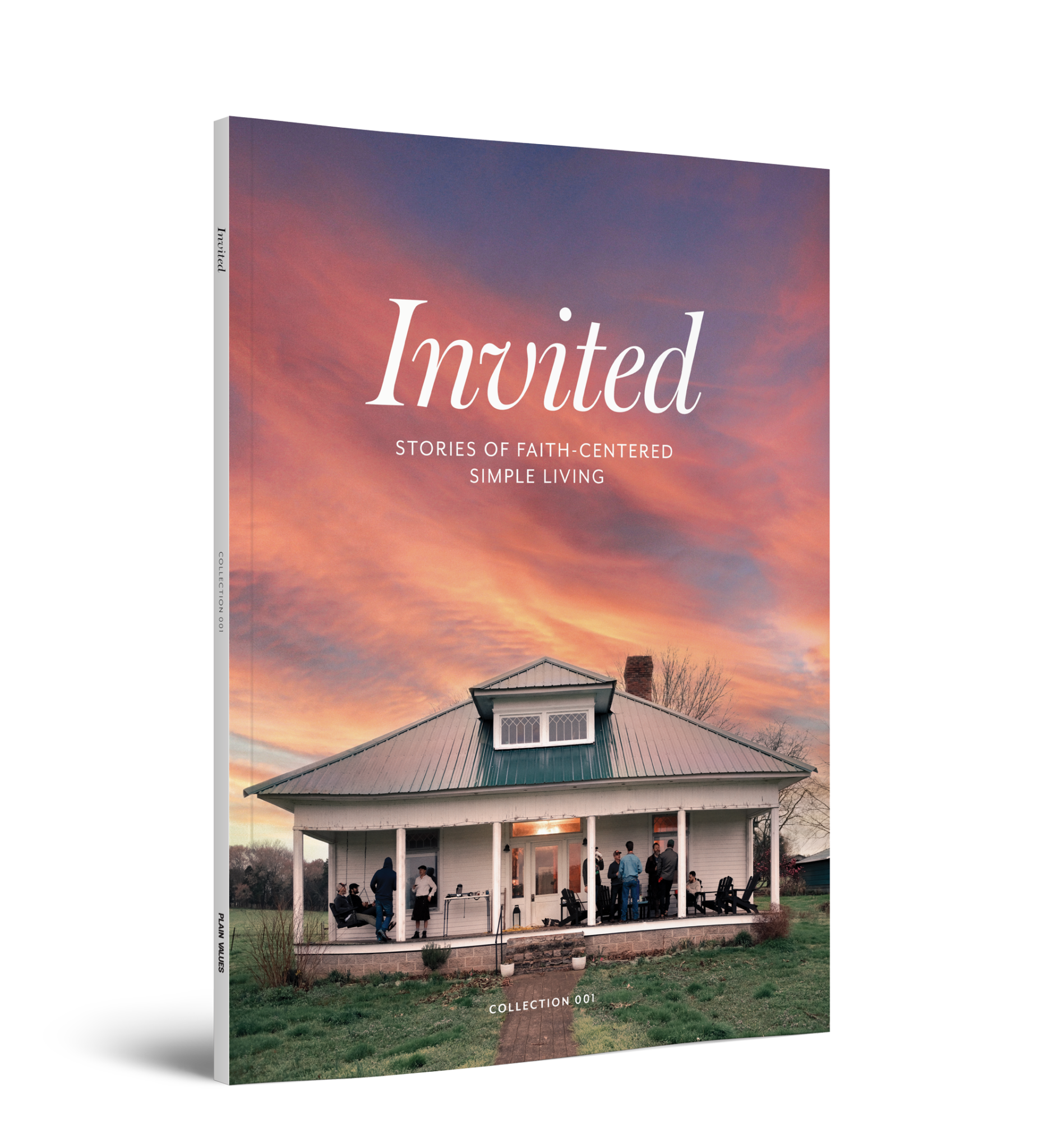
🤝THIS EPISODE’S PREMIER/FEATURED SPONSOR: Invited: Collection 001
If you’re craving stories that restore faith in hard times, Invited: Collection 001 is a handpicked “best of” from Plain Values magazine… uplifting accounts of triumph, simple joys, adoption beauty, homesteading wisdom, and gospel-centered living.
Learn more: https://homesteadliving.com/invited-collection-001/






Leave a Reply